Denver Union Station Two Trains: Urban Infrastructure as Visual Poetry

The photograph of Denver Union Station marks a shift in the photographer’s journey from natural landscapes to urban architecture. It highlights the interplay of light, color, and geometry while capturing quiet moments in public spaces. The image symbolizes Denver’s evolution in sustainable transit, merging historical preservation with contemporary design.

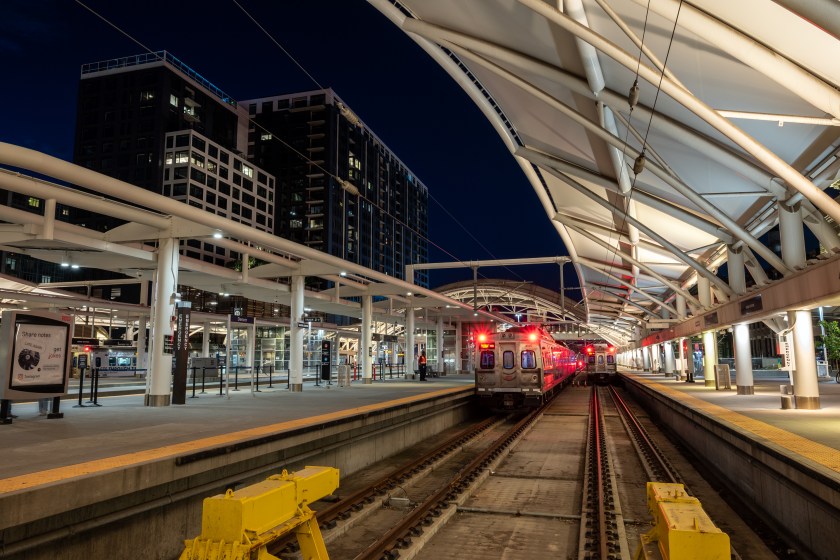
Two light rail trains sit on parallel tracks beneath the covered platforms at Denver Union Station at night.
Two RTD light rail trains are stopped on adjacent tracks at Denver Union Station in downtown Denver, Colorado.

This nocturnal study of Denver Union Station represents a compelling pivot within Chapter 3 of the photographer’s Top 100 Journey project—a shift from natural landscapes to the constructed geometries of urban infrastructure. Where previous works in this chapter have explored Colorado’s geological grandeur, this image examines the state’s architectural identity through one of its most significant transit hubs.

The composition is defined by bold linear perspective. Shot with a 14-30mm wide-angle lens, the photographer has positioned himself within the transit platform itself, allowing the parallel tracks to create strong diagonal lines that converge toward the vanishing point. This classical use of perspective transforms functional railway infrastructure into formal geometric study. The canopy overhead—a sweeping white lattice of structural supports—echoes and reinforces these diagonals, creating a rhythmic repetition that draws the eye inexorably toward the illuminated train in the distance.

Color plays a crucial role in establishing atmosphere. The deep navy blue of twilight sky provides saturated contrast against the warm artificial lighting of the station. The train’s red running lights introduce an accent of vivid color that punctuates the otherwise neutral palette of whites, grays, and concrete tones. A yellow maintenance box in the lower foreground adds an unexpected chromatic note—industrial, utilitarian, yet compositionally important as a counterweight to the red lights above.

The technical execution demonstrates careful consideration of low-light conditions. The exposure balances multiple light sources: the cool fluorescent platform lighting, the warm glow from the station building visible on the left, and the colored signals of the train itself. The photographer has managed to maintain detail throughout the frame—from the textured concrete of the platform to the lit windows of the distant residential tower—suggesting precise metering and likely the use of a tripod for stability during what was presumably a longer exposure.

What distinguishes this work is its treatment of public space during a quiet moment. The platform is nearly empty; a single figure appears as a small presence near the center, emphasizing scale and the architectural vastness of the station. This human element, though minimal, is essential—it prevents the image from becoming purely abstract geometry and reminds viewers that this is infrastructure designed for movement, for connection, for the daily transit of thousands.

Within the context of Colorado Cityscapes, this photograph documents Denver’s ongoing evolution as a metropolitan center investing in sustainable transit infrastructure. Union Station, a historic landmark renovated in recent years, represents the intersection of preservation and progress. The photographer captures this duality: the contemporary design of the platform canopy suggests forward-looking urban planning, while the fundamental elements—trains, tracks, waiting passengers—evoke the timeless ritual of rail travel.

The use of the Nikon Z5 with ultra-wide glass allows the photographer to emphasize architectural span while maintaining sharpness across the frame. The wide angle compresses multiple planes of depth into a single coherent visual statement, creating an image that functions simultaneously as documentary record and formal composition.

This photograph confirms the photographer’s ability to find visual poetry in utilitarian spaces, demonstrating that the “cityscape” portion of Chapter 3 merits equal attention to Colorado’s celebrated natural landscapes.

Contemporary Urban Narrative: The Scooter as Cultural Marker in Denver’s Historic District

The photograph captures Denver’s Union Station, highlighting urban mobility through an electric scooter, symbolizing the modern sharing economy. Blending historic architecture and contemporary transit, it embodies Denver’s revitalization. The technical execution showcases skill in low-light conditions, emphasizing the cityscape’s complexity as part of Colorado’s evolving identity.

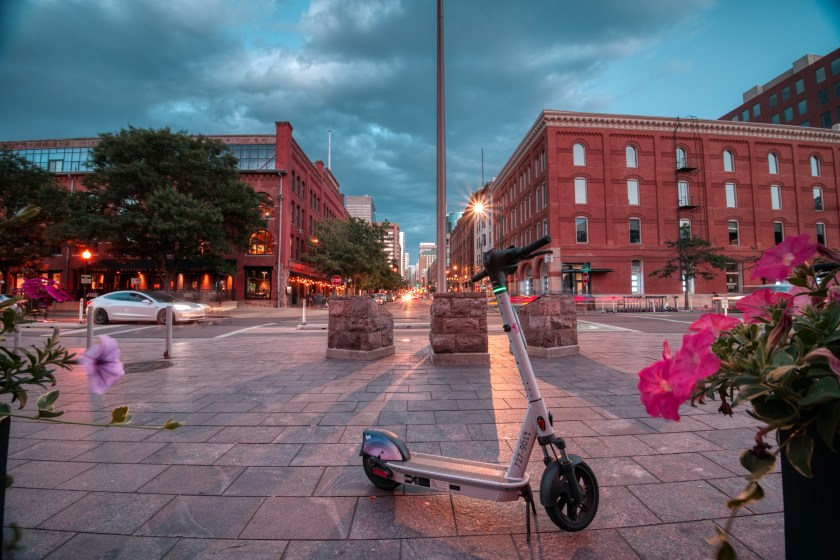
An electric scooter stands on a plaza at Denver Union Station, framed by brick buildings and evening traffic under a cloudy sky.
An electric scooter sits in the foreground near Denver Union Station as evening light and traffic move through downtown Denver.

In this street-level composition from Denver’s Union Station district, the photographer constructs a narrative about contemporary urban mobility that extends beyond mere documentation. The electric scooter, positioned prominently in the foreground, functions as both subject and symbol—a deliberate choice that anchors this image firmly in its specific cultural moment while engaging with the broader themes of his Colorado cityscapes chapter.

Shot with the Nikon Z5 and Nikkor 14-30mm wide-angle lens during the transitional blue hour, the image demonstrates technical command over challenging mixed-lighting conditions. His HDR processing through Aurora software balances the warm sodium vapor glow of street lamps with the cooler tones of approaching dusk, creating a color palette that feels authentic to the urban evening experience. The dramatic cloud formations overhead add atmospheric weight without overwhelming the architectural elements below.

The composition’s strength lies in its layered storytelling. The scooter occupies the immediate foreground, a symbol of the sharing economy and evolving transportation patterns that have reshaped American cities in recent years. Behind it, motion-blurred pedestrians and vehicle light trails suggest continuous movement—the perpetual flow of urban life. The red brick Victorian-era buildings flanking the street provide historical context, their solid permanence contrasting with the ephemeral nature of the modern transit device and the transient human figures.

This juxtaposition between historic preservation and contemporary innovation becomes the photograph’s central thesis. Denver’s Union Station neighborhood represents a successful urban revitalization, where nineteenth-century industrial architecture has been adapted for twenty-first-century use. The photographer captures this temporal complexity not through obvious before-and-after documentation, but through subtle visual relationships: old brick against new pavement, traditional street furniture against app-based transportation, architectural permanence against digital-age impermanence.

The wide-angle perspective creates dynamic leading lines through the paved plaza, drawing the viewer’s eye from the scooter through the middle ground and toward the vanishing point where downtown high-rises punctuate the skyline. Pink flowers frame the right edge, their organic forms softening the geometric rigor of the built environment while adding unexpected color that complements the warm building tones.

Within the context of Chapter 3’s exploration of Colorado landscapes and cityscapes, this image represents an important counterpoint to mountain vistas and natural panoramas. It acknowledges that Colorado’s contemporary identity includes rapidly growing urban centers navigating questions of density, mobility, and livability. The photographer treats the cityscape with the same observational care one might afford wilderness photography, suggesting that urban environments deserve equally thoughtful documentation.

The technical execution reflects growing proficiency with the Z5 system in low-light scenarios. The exposure balances bright highlights from street lamps and vehicle headlights while retaining shadow detail in the building facades and foreground elements. This dynamic range management, enhanced through HDR processing, avoids the artificial appearance that often compromises such techniques.

Ultimately, this photograph functions as cultural documentation—a moment preserved when electric scooters had become ubiquitous urban fixtures, when historic districts balanced preservation with progress, and when cities like Denver negotiated their identity between Western heritage and metropolitan aspiration. The photographer’s choice to include this image in his curated Top 100 Journey acknowledges that landscape photography can encompass the human-altered terrain of city streets, where the stories being told are equally complex and worthy of attention.

Architectural Symmetry and Urban Solitude: An HDR Study of Denver Union Station

The photographer’s nocturnal exploration of Denver Union Station highlights its architectural beauty through HDR techniques. Using a Nikon Z5, he captures the arched canopy and geometric metalwork, emphasizing both urban context and functional identity. This work redefines landscape photography, recognizing the significance of transportation infrastructure in Colorado’s cultural identity.

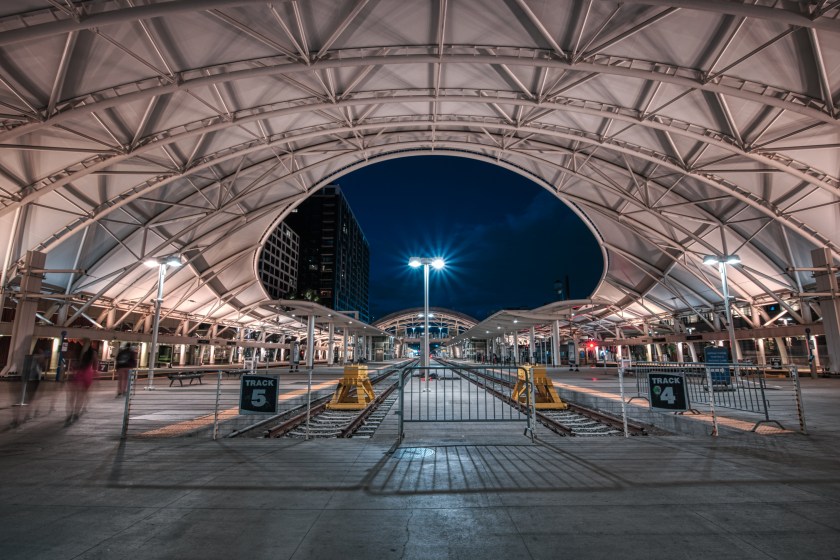
Symmetrical view of covered light rail platforms inside Denver Union Station at night, with tracks centered beneath a white arched roof.
The light rail platforms inside Denver Union Station are shown at night beneath the station’s arched canopy.

The photographer’s exploration of Colorado’s built environment finds a striking culmination in this nocturnal study of Denver Union Station’s interior architecture. Captured with a Nikon Z5 and Nikkor 14-30mm wide-angle lens, this HDR composition demonstrates a mature understanding of how contemporary digital techniques can reveal the inherent drama within civic spaces.

The image centers on the station’s distinctive arched canopy structure, a feat of engineering that dominates the frame with rhythmic precision. Metal trusses radiate outward in geometric patterns, their repetition creating a sense of ordered monumentality. The wide-angle lens choice proves deliberate rather than merely expedient—it allows the photographer to encompass both the sweeping overhead architecture and the rail infrastructure below while maintaining the spatial relationship that gives the composition its power. The central void, opening to the deep blue evening sky and a distant office tower, punctuates the manufactured enclosure with a reminder of the urban context beyond.

His HDR processing through Aurora software reveals a considered approach to tonal range. The metalwork retains textural detail without the artificial hyper-clarity that often plagues high dynamic range photography. The warm metallic tones of the canopy structure contrast effectively with the cooler blues of the twilight sky and platform lighting, establishing a color palette that feels naturalistic despite the technical manipulation required to balance such extreme luminance values.

The human element appears deliberately subdued—motion-blurred figures at the platform edges suggest activity without demanding attention, reinforcing the architectural subject while maintaining the space’s functional identity as a transportation hub. Yellow bumper stops and safety railings provide geometric counterpoints to the dominant curves above, their utilitarian forms grounding the composition in operational reality.

Within the context of Chapter 3’s focus on Colorado landscapes and cityscapes, this work represents a conceptual bridge. While the chapter presumably encompasses the state’s renowned natural vistas, the photographer recognizes that Colorado’s urban environments possess their own topography worth documenting. Denver Union Station, a historic structure serving contemporary transit needs, embodies the intersection of preservation and progress that characterizes much of the American West’s relationship with its past.

The technical execution reflects growing confidence with the Z5 system’s capabilities in challenging lighting conditions. Night photography in mixed-light environments demands both equipment competence and processing discipline, both evident here. The decision to shoot during the transitional moment between day and night—when ambient light still registers in the sky while artificial illumination dominates the platform—demonstrates an understanding of how fleeting conditions can elevate architectural documentation beyond mere record-keeping.

This image functions as more than a single photograph within his Top 100 Journey project; it suggests an expanding definition of landscape photography itself. The constructed landscape of transportation infrastructure, with its own valleys and peaks of metal and light, receives the same considered attention he might afford a mountain vista. The result is a document that honors both the anonymous designers who created this functional space and the ongoing human movement that gives it purpose.

In positioning this work within his curated collection, the photographer asserts that Colorado’s identity exists not only in its natural grandeur but in the spaces where communities gather, depart, and return—the thresholds that connect wilderness to civilization.