Burning Sands: A Meditation on Ephemeral Beginnings

The 2014 photograph from Greg Urbano’s “Burning Sands” captures a sand sculpture at Treasure Island, Florida, portraying the transient nature of creation. It juxtaposes themes of existence and decay through an overcast atmosphere, intricate details, and a solitary figure, emphasizing the cycle of beginnings and endings inherent in art and life.

Detailed sand sculpture on a beach under an overcast sky at the Sanding Ovations event in Treasure Island, Florida, photographed with a Nikon D7100 at 11.5mm.
A 2014 photograph of a sand sculpture at the Sanding Ovations event on Treasure Island Beach, Florida.

In the opening chapter of Greg Urbano’s photographic journey, “Burning Sands” stands as a profound meditation on the transient nature of creation itself. Captured in 2014 at the Sanding Ovations event in Treasure Island, Florida, this image transcends its origins as documentary photography to become something altogether more contemplative—a visual poem about the delicate threshold between existence and dissolution.

The photograph presents an intricate sand sculpture rendered in monochromatic tones, its draped forms suggesting both shelter and sorrow. A solitary figure crouches within an arched doorway, while skeletal remains sprawl at the sculpture’s base, creating a narrative that feels simultaneously ancient and immediate. What elevates this work beyond mere documentation is the atmospheric haze that envelops the scene—that distinctive quality the photographer describes as having a “Burning Man vibe.” The overcast morning has transformed the beach into an otherworldly playa, where the sun becomes a pale disk suspended in a beige firmament.

Urbano’s technical approach demonstrates a sophisticated understanding of environmental photography. Shot with a Nikon D7100 at 11.5mm, the ultra-wide angle encompasses not only the foreground sculpture but also the secondary forms receding into the atmospheric distance, creating layers of depth that pull the viewer’s eye through the composition. The aperture of f/6.3 maintains critical sharpness across the sculptural details while allowing the background to soften naturally into the haze. At 1/1600s, the shutter freezes what is essentially a meditation on impermanence—an irony not lost on the careful observer.

The positioning of this work within Chapter 1—Beginnings feels particularly apt. Sand sculptures exist in perhaps the most precarious state of any art form: they are born from the beach and inevitably return to it, whether through wind, tide, or the simple passage of time. There is something profoundly instructive about beginning a photographic journey with such ephemeral subject matter. It suggests an artist already attuned to photography’s essential purpose: to preserve the fleeting, to honor what cannot last.

The sculpture’s symbolic vocabulary—the draped archway, the protective figure, the bones suggesting mortality—reads as universal rather than specific. These are archetypal forms that resonate across cultures and epochs. Yet the photographer’s framing transforms these symbols into something fresh. The ropes cordoning the installation, visible in the foreground, serve as a subtle reminder of the boundary between art and observer, between preservation and inevitable decay.

What makes “Burning Sands” particularly compelling within Urbano’s broader body of work is its early demonstration of his eye for the liminal—those in-between spaces where conditions create unexpected beauty. The hazy atmosphere wasn’t planned or controlled; it was observed, recognized, and captured. This sensitivity to environmental gift-giving would become a hallmark of his photographic practice.

In the context of beginnings, this image offers a paradox: it documents creation while simultaneously evoking dissolution. The pale sun, the encompassing haze, the skeletal remains—all suggest endings as much as beginnings. Perhaps that’s the deeper wisdom captured here: that every beginning contains within it the seed of its own conclusion, and the artist’s task is simply to bear witness to both with equal reverence.
The Patient Observer: Greg Urbano’s “Showy Egret” and the Art of Coastal Intimacy

In Greg Urbano’s 2014 photo “Showy Egret” at Fort de Soto, the Snowy Egret’s elegance contrasts with human presence, highlighting a balance between wildlife and recreation. Urbano’s precise composition and technical skill enhance environmental storytelling, showcasing his early understanding that nature photography can embrace humor and human contexts without losing integrity.

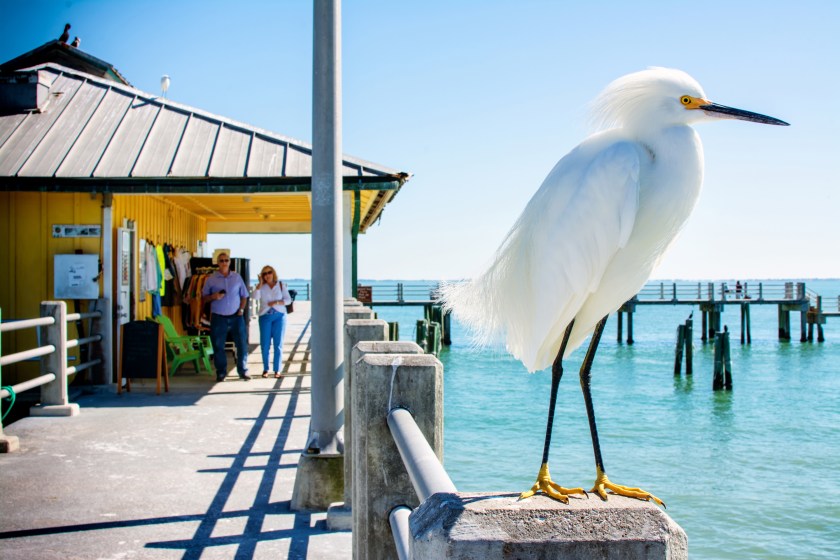
Snowy Egret standing on a concrete pier post with a yellow building, clothing racks, and tourists in the background, photographed with a Nikon D7100 and 35mm lens.
A 2014 photograph of a Snowy Egret perched on the Bay Pier at Fort De Soto Park in Florida.

In the opening chapter of Greg Urbano’s photographic journey, “Showy Egret” stands as a masterclass in compositional awareness and environmental storytelling. Captured in 2014 at Fort De Soto’s Bay Pier in Florida, this image reveals an artist already attuned to the delicate balance between wildlife photography and human context—a sensibility that would define his evolving practice.

The photograph’s immediate strength lies in its spatial intelligence. Urbano positions the Snowy Egret in the right third of the frame, allowing the bird’s pristine plumage to command attention while the weathered pier extends into the turquoise waters beyond. This compositional choice creates a natural visual flow from foreground subject to background environment, inviting viewers to experience both the bird’s individual presence and its coastal habitat simultaneously.

Technical precision underscores the image’s effectiveness. Shot with a Nikon D7100 at f/11.0, Urbano achieves crisp depth of field that renders the egret’s delicate feathers in remarkable detail—each plume distinct against the clear Florida sky. The choice of 1/200 second shutter speed at ISO 100 captures the bird in perfect stillness, transforming a fleeting moment into something approaching portraiture. The 35mm focal length, often considered a “normal” perspective, here proves ideal for environmental wildlife work, offering intimacy without the compression or distance of telephoto lenses.

What elevates this photograph beyond straightforward nature documentation is Urbano’s willingness to embrace the human element. Two tourists emerge from a yellow-trimmed pier building in the middle distance, their presence neither accidental nor intrusive. Rather than seeking the pristine wilderness imagery common in traditional wildlife photography, Urbano acknowledges the reality of modern conservation spaces—these are shared environments where human recreation and natural habitats coexist. The egret’s confident stance on the pier post, unfazed by nearby activity, speaks to this acclimatization, suggesting a more complex narrative about wildlife adapting to anthropogenic landscapes.

The photograph’s playful title—”Showy Egret” as wordplay on “Snowy Egret”—hints at Urbano’s understanding that wildlife photography need not adopt a purely reverential tone. The egret does indeed appear showy, posed almost theatrically on its concrete perch, its breeding plumage fully displayed, yellow feet gripping the weathered surface. This anthropomorphic reading, encouraged by the title, creates accessibility without diminishing the bird’s natural beauty.

Light plays a crucial supporting role. The high, clear Florida sun creates distinct shadows across the pier’s concrete surface while illuminating the egret’s white plumage to near-luminescence. The bird’s yellow lores and feet provide punctuation points of color that echo the building’s trim, creating subtle visual rhymes within the frame.

As a foundational piece in Urbano’s “Beginnings” chapter, “Showy Egret” demonstrates technical competence married to narrative intuition. The photographer shows early understanding that compelling wildlife imagery can exist within human-modified spaces, that environmental context enriches rather than dilutes subject focus, and that humor and play have legitimate places in nature photography. These insights would prove essential as his practice developed, but here, at Fort De Soto in 2014, they exist in nascent, confident form—a young artist finding his voice through patient observation and compositional thoughtfulness.

The Gateway Image: Passagrille Jetty Silhouette and the Dawn of a Photographic Vision

In a 2014 photograph taken at Passagrille Beach, Greg Urbano captures a stunning sunset over the Gulf of Mexico, which inspires his beach photography. Featuring a silhouetted fisherman against an orange sky, the image combines technical skill and emotional depth, symbolizing Urbano’s artistic journey and his evolving relationship with landscape imagery.

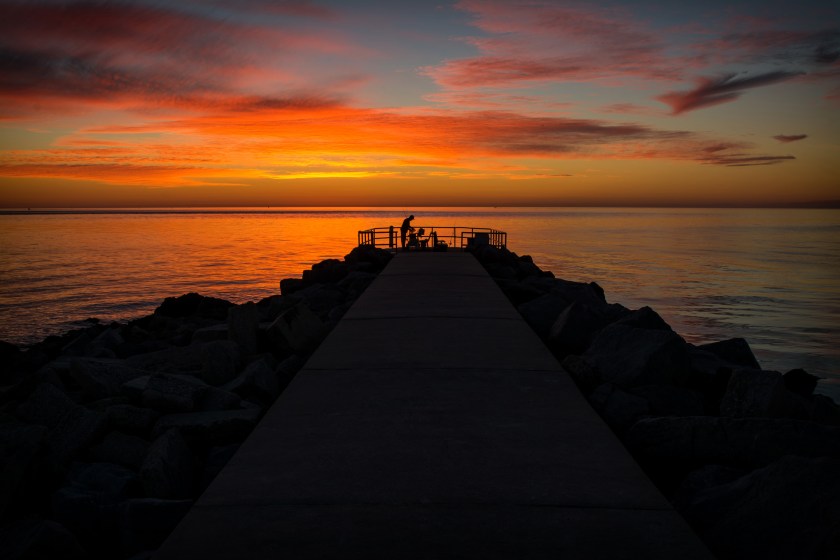
Silhouette of a lone fisherman standing on a rock jetty at Passagrille Beach during an orange Gulf of Mexico sunset, photographed with a Nikon D7100 at 24mm.
A 2014 sunset silhouette of a fisherman on the rock jetty at Passagrille Beach, Florida.

In the context of Greg Urbano’s “Beginnings” chapter, this 2014 sunset photograph from Passagrille Beach holds particular significance—not merely as a technically accomplished image, but as a foundational moment that would shape the photographer’s artistic trajectory for years to come. The image captures that precise intersection where technical competence meets emotional resonance, creating what Urbano himself identifies as his “inspiration for years of beach photography.”

The compositional structure reveals a photographer already thinking in strong geometric terms. The jetty’s dark pathway cuts through the frame with striking linearity, creating a powerful visual corridor that draws the viewer’s eye toward the observation platform at the terminus. This use of leading lines demonstrates sophisticated spatial awareness, transforming the rocky breakwater into a narrative device—a journey into the sublime moment captured in the sky above.

What distinguishes this photograph from countless other sunset images is Urbano’s commitment to silhouette as an artistic choice. Shot at ƒ/11 with a relatively slow shutter speed of 1/20 second at ISO 100, the exposure prioritizes the spectacular gradation of color in the sky while allowing the foreground elements to fall into deep shadow. The lone fisherman—barely discernible yet unmistakably present—becomes an everyman figure, a contemplative sentinel witnessing the day’s transition. This human element, reduced to pure form, prevents the image from becoming merely a spectacular sky study; instead, it grounds the natural drama in human experience.

The technical execution warrants examination. Using the Nikon D7100 with a 10-24mm lens at its maximum 24mm focal length, Urbano captures an expansive view that encompasses both the architectural elements of the jetty and the full breadth of the atmospheric display. The cropped sensor’s field of view provides enough width to establish context while maintaining focus on the central narrative. The aperture choice of ƒ/11 ensures sharpness throughout the frame, from the textured rocks in the immediate foreground to the distant horizon where sea meets sky.

The color palette—ranging from deep oranges and burning yellows to subtle purples and grays in the cloud formations—displays nature at its most theatrical. Yet Urbano’s restraint in post-processing (evident in the natural tonal transitions) allows the scene to speak with authenticity rather than hyperbole. This restraint would become a hallmark of his approach, distinguishing his work from the over-saturated aesthetic that dominates much contemporary landscape photography.

Perhaps most revealing is Urbano’s own reflection on this image as inspirational—a north star that guided subsequent explorations. One can trace forward from this moment to understand his ongoing fascination with the Gulf Coast’s theatrical sunsets, his appreciation for human elements within natural landscapes, and his sophisticated use of silhouette as a storytelling device. The photograph represents not an endpoint but a beginning, a discovery of visual vocabulary that would be refined and expanded throughout his career.

In the broader context of the “Beginnings” chapter, this Passagrille jetty image serves as both literal and metaphorical gateway—the concrete walkway leading toward beauty, the artist’s path toward photographic maturity, and the viewer’s invitation into Urbano’s evolving body of work.

Stacked Chrome Muscle: The Architecture of American Power

In a 2014 throwback photo, Greg Urbano captures a chrome muscle car engine at a car show, transforming it into a sculptural testament of American automotive culture. The monochrome composition highlights its intricate details and engineering philosophy, transcending typical automotive photography into fine art, reflecting power and craftsmanship.

Black‑and‑white close‑up photograph of a chrome muscle car engine with multiple intake stacks, polished components, and detailed mechanical parts, taken with a Nikon D7100 at 24mm.
A 2014 black‑and‑white close‑up of a stacked chrome muscle car engine captured at a car show.

In this striking image from Greg Urbano’s early photographic explorations, the viewer encounters not merely an engine, but a sculptural monument to American automotive culture. Shot at a car show in 2014, this photograph demonstrates how technical documentation can transcend its utilitarian origins to become a meditation on form, texture, and cultural identity.

The composition centers on a magnificent array of individual throttle bodies—eight polished chrome velocity stacks rising like organ pipes from the engine block below. Urbano’s decision to shoot at f/8.0 provides exceptional depth of field, rendering every fluted trumpet in sharp detail while maintaining visual coherence across the crowded mechanical landscape. The MSD Digital 6AL ignition box in the upper left corner grounds the image in specificity, reminding us this is a real machine, not an abstract study.

What elevates this work beyond conventional automotive photography is the photographer’s masterful use of monochrome. The conversion to black and white strips away distraction and reveals the essential geometry of performance engineering. Chrome becomes a study in gradation—from brilliant highlights on the velocity stack lips to the deep blacks of the engine valley below. The ribbed valve covers create rhythmic patterns that echo throughout the frame, establishing a visual cadence that draws the eye deeper into the mechanical complexity.

The lighting deserves particular attention. Working with the ambient conditions of a car show—notoriously challenging for photographers—Urbano has captured specular highlights that accentuate the three-dimensional quality of each component. The reflections dancing across polished surfaces create a sense of movement and life in what is, paradoxically, a static object. One can almost hear the anticipated roar of this engine, feel the vibration of its operation.

From a curatorial perspective, this image belongs firmly within the “Beginnings” chapter of Urbano’s journey. It reveals a photographer discovering his eye, learning to see beyond the obvious. Car shows present a particular challenge: everything is designed to be spectacular, yet the very abundance of visual stimulus can overwhelm. Here, the photographer has exercised editorial judgment, finding a perspective that isolates and celebrates a single element of automotive excess.

The stacked throttle bodies themselves represent a specific philosophy in performance engineering—individual runners for each cylinder, optimized airflow, uncompromising dedication to power over practicality. This photograph captures that ethos perfectly. There is nothing subtle about this engine, and Urbano wisely chooses not to apologize for its maximalism. Instead, he leans into the drama, using his technical choices to amplify the subject’s inherent theatricality.

The 24mm focal length on his Nikon D7100 provides just enough wide-angle perspective to encompass the scene without introducing distortion that would undermine the precision of these machined components. Shot at 1/30th of a second—relatively slow for handheld work—the image’s sharpness suggests careful technique, perhaps braced against the engine bay or shot with controlled breathing.

This photograph documents more than machinery; it captures a particular strain of American automotive culture that values power, craftsmanship, and conspicuous performance. In rendering it so beautifully, Urbano elevates the vernacular tradition of car photography into something approaching fine art—a promising beginning indeed for a photographer learning to find extraordinary subjects in ordinary places.

Night at the Dali: Architecture as Teacher

In 2013, Greg Urbano’s photography evolved, particularly with architecture and HDR techniques. His night photograph of the Dalí Museum in St. Petersburg showcases his technical growth and artistic maturity. Through careful exposure settings and HDR processing, he captures dramatic contrasts, reflecting his continuous exploration and adaptability in night photography.

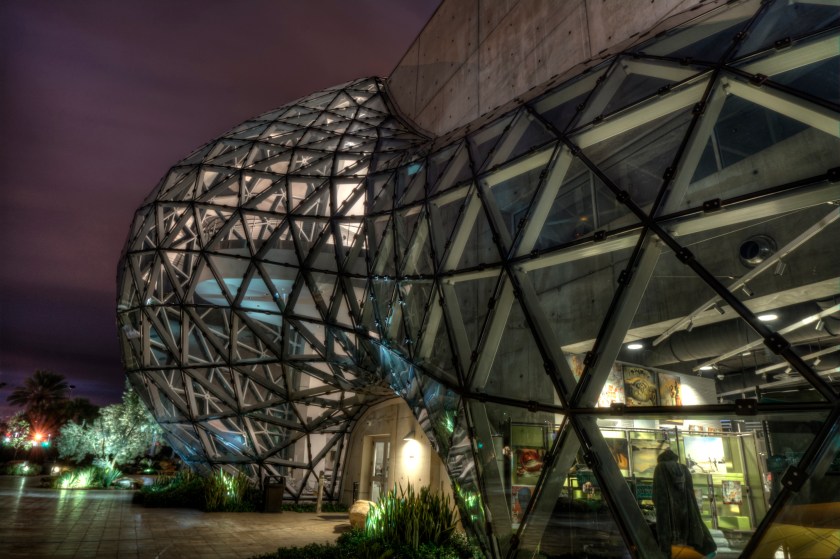
HDR nighttime photograph of the Dali Museum in St. Petersburg, Florida, showing its illuminated geodesic glass facade and surrounding landscaping, taken with a Nikon D7100 at 14mm.
A 2013 HDR nighttime photograph of the Dali Museum’s geodesic glass structure in St. Petersburg, Florida.

In this 2013 photograph of St. Petersburg’s Dalí Museum, Greg Urbano captures far more than an architectural landmark—he documents a photographer in the act of discovery, using his camera to decode the visual language of light, structure, and time. The image stands as a testament to what the Chapter 1 — Beginnings theme celebrates: the transformative power of experimentation and the artistic maturity that emerges from technical curiosity.

The composition immediately announces ambition. Shot with a 14mm ultra-wide lens, the perspective tilts upward to embrace the museum’s extraordinary geodesic glass bubble, that surrealist flourish erupting from an otherwise rectilinear concrete structure. The ultra-wide focal length creates dramatic spatial distortion—the glass sphere appears to swell toward the viewer while the building’s mass recedes at impossible angles. This is deliberate visual exaggeration, the photographer using optical characteristics as expressive tools rather than merely recording what stands before him.

Urbano’s fifteen-second exposure at ƒ/11 reveals careful consideration of night photography’s particular demands. The narrow aperture ensures front-to-back sharpness across the complex geometric planes, while the extended shutter speed gathers sufficient light to render both the illuminated interior spaces and the textured concrete exterior. At ISO 250, he maintained image quality while managing the sensor’s heat buildup during long exposures—a technical balancing act that night photography ruthlessly exposes when miscalculated.

The HDR processing, which Urbano identifies as a focus of his 2013 work, serves the subject’s inherent drama without overwhelming it. High Dynamic Range imaging compresses the vast tonal range between the glowing glass panels and the deep purple-gray twilight sky into a single viewable image. Here, the technique preserves detail in both the brightest interior lights and the shadowed architectural framework—the black steel triangles that form the geodesic pattern remain visible and textured rather than silhouetted into flat darkness.

What distinguishes this image within the Beginnings chapter is its transparency about process. The HDR treatment shows characteristic traces of learning—slight luminous halos around high-contrast edges, enhanced local contrast that gives surfaces an almost tactile presence, color saturation pushed just beyond naturalism. These are not flaws but evidence of active experimentation, a photographer testing the boundaries of technique to understand where effectiveness ends and excess begins.

The photograph’s context enriches its meaning considerably. This museum stood a brief walk from the photographer’s residence, close enough for repeated visits, for returning under different conditions, for the kind of sustained engagement that transforms casual documentation into genuine study. This proximity allowed Urbano to approach the subject with evolving sophistication, each attempt building on lessons from the previous one.

The wet pavement in the foreground adds an unexpected grace note—evidence of recent rain creating reflective surfaces that double the architectural lighting, adding visual complexity without cluttering the composition. Whether intentional or opportunistic, this detail demonstrates the photographer’s developing awareness of how environmental conditions can enhance rather than merely complicate a scene.

Viewed within the arc of artistic development, this photograph captures a crucial transition point: technical capability catching up with visual ambition, the gap between conception and execution narrowing with each frame. It is the work of a photographer actively becoming, embracing complexity as the necessary path toward mastery.

Fallen Tree: The Foundation of Seeing

The photograph from Hillsborough River State Park, taken by Greg Urbano in 2013 with a Nikon D7100, captures a pivotal moment in his artistic development. It reflects his early understanding of composition and intentionality, showcasing the dense subtropical landscape through HDR processing. This image symbolizes the importance of beginnings and learning in photography.

HDR photograph of a forest trail in Hillsborough River State Park with a large fallen tree across the path, dense vegetation, and filtered natural light, taken with a Nikon D7100 at 10mm.
A 2013 HDR landscape photograph of a fallen tree along a forest trail in Hillsborough River State Park, Florida.

In the opening chapter of Greg Urbano’s photographic journey, this image from Hillsborough River State Park stands as a testament to the essential nature of beginnings. Shot in 2013 with a Nikon D7100, the photograph captures more than a forest scene—it documents the foundational moment when a photographer learns to truly see the landscape before him.

The composition reveals an intuitive understanding of depth and perspective. Shot at 10mm, the wide-angle lens creates an immersive quality that draws viewers directly onto the trail. The fallen log in the foreground serves as both literal and metaphorical threshold, inviting passage into the deeper woods beyond. This diagonal element cuts across the frame with authority, its weathered texture rendered in sharp detail by the f/8.0 aperture, demonstrating Urbano’s early grasp of how to balance foreground interest with background context.

The HDR processing technique employed here reflects the experimental spirit characteristic of this pre-2015 period. While HDR would later fall somewhat out of favor in fine art photography circles, its application in this image serves a clear purpose: to capture the dynamic range of a Florida forest understory, where dappled sunlight creates extreme contrasts between shadow and highlight. The palmetto fronds and oak canopy are rendered with an almost hyper-real clarity that emphasizes the dense, layered nature of this subtropical ecosystem.

What makes this photograph particularly significant within the “Beginnings” chapter is its honesty about place and limitation. Urbano’s accompanying note—that this Florida park offered his “best opportunity to capture flowing water over river rocks” before relocating to Colorado—reveals something crucial about artistic development. Great photography emerges not from waiting for perfect conditions, but from working intensively with what’s available. This trail became his classroom, this fallen log his teacher.

The technical choices demonstrate a photographer thinking through his craft. The 1/50s shutter speed suggests deliberate handholding technique, while the ISO 200 setting indicates available light conditions and a preference for image quality. These aren’t the settings of someone simply pointing and shooting; they reveal consideration and intentionality, even in these early stages.

The color palette—predominantly greens with earth-toned accents—creates a cohesive, naturalistic feel despite the HDR processing. The slight motion blur in the foliage adds an organic quality, a reminder that this is a living landscape caught in a specific moment. The trail itself winds invitingly into the frame’s depth, disappearing around a bend that promises further discovery—a fitting metaphor for the artistic journey being documented.

In the context of Urbano’s larger body of work, this image represents more than just an early attempt. It embodies the crucial truth that mastery begins with showing up, with making photographs even when the circumstances aren’t ideal, even when the technique hasn’t been perfected. The photograph’s inclusion in his top 100 collection isn’t about technical perfection but about recognizing the importance of foundation.

Every artist’s journey requires a starting point, a place where curiosity meets commitment. This fallen tree, this Florida trail, this moment of learning to see—these are the essential ingredients that would eventually lead to mountain streams in Colorado and a mature photographic vision. The imperfect attempt, it turns out, isn’t just necessary. It’s everything.

The Gulf Pier: A Foundation in Light and Structure

Greg Urbano’s “Landscapes in HDR” captures the Gulf Fishing Pier at Fort de Soto Park, reflecting his artistic development in photography. Utilizing a Nikon D7100, he balances composition with HDR techniques, achieving naturalistic vibrancy without over-processing. The image embodies a pivotal moment in skill mastery, exploring the connection between environment and human creation.

HDR landscape photograph of the Gulf Fishing Pier at Fort De Soto Park in Pinellas County, Florida, extending over calm water under a bright sky, taken with a Nikon D7100 at 14mm.
A 2013 HDR landscape photograph of the Gulf Fishing Pier at Fort De Soto Park in Pinellas County, Florida.

In the early stages of any photographer’s journey, there exists a pivotal moment when technical curiosity converges with artistic vision. Greg Urbano’s “Landscapes in HDR” from 2013 captures precisely this convergence—a photograph that speaks to the fundamentals of seeing while revealing the seeds of a maturing artistic voice.

The Gulf Fishing Pier at Fort de Soto Park presents itself as an exercise in classical composition, yet the image transcends mere documentation. Shot with a Nikon D7100 at 14mm, the photographer embraced the distortion inherent in ultra-wide-angle photography, using it not as a limitation but as a tool for emphasis. The pier’s concrete pathway stretches toward the horizon with geometric insistence, its weathered surface textured with salt stains and age—details that anchor the ethereal quality of the surrounding environment.

What distinguishes this work within the context of Chapter 1—Beginnings is the deliberate exploration of HDR processing, a technique that dominated landscape photography in the early 2010s. Rather than falling into the trap of over-processing that plagued much HDR work of this era, Urbano demonstrates restraint. The luminous gradations in the sky—from deep azure to wispy white—retain a naturalistic quality while revealing detail across an impressive tonal range. The turquoise waters of the Gulf of Mexico maintain their vibrancy without crossing into hypersaturation, suggesting an eye already sensitive to the boundaries between enhancement and artifice.

The technical choices reveal a photographer building his fundamental vocabulary. The aperture of ƒ/8.0 ensures critical sharpness from the foreground concrete to the distant structures, while the fast shutter speed of 1/400s freezes the subtle motion of the scene—likely the flutter of distant flags or the movement of the few figures visible along the pier. At ISO 100, the image maintains clarity in its textures, from the horizontal railings that create rhythmic lines to the architectural shelters that punctuate the composition’s middle ground.

What makes this photograph significant in understanding Urbano’s artistic evolution is not its perfection but its purposefulness. The nearly symmetrical composition, the careful attention to the leading lines, the consideration of how architectural elements frame the natural environment—these are the building blocks upon which more complex visual narratives are constructed. The weekly visits to this location mentioned in his notes speak to something essential in photographic development: the practice of returning, of seeing the same subject under different conditions, of learning through repetition.

The landscape itself offers something eternal—the meeting point of human construction and natural expanse. The pier extends confidently into the Gulf, a gesture of connection between land and water, between the photographer’s position and the infinite horizon. In capturing this scene, Urbano was not merely documenting a favorite location but engaging with fundamental questions about how we frame our relationship to place and space.

Within the broader context of “Beginnings,” this image exemplifies the necessary stage of mastering craft before transcending it. The imperfect attempts referenced in the chapter description are not failures but essential experiments. Here, we witness a photographer learning to see in high dynamic range, to compose with geometric precision, and to capture the luminous quality of coastal light—all foundational skills that would inform the more sophisticated work to come.

This is where journeys begin: in the clarity of intention, the discipline of practice, and the recognition that every master was once a student of light.