Colorado Capital Rotunda: Vertical Aspiration and Ornamental Complexity

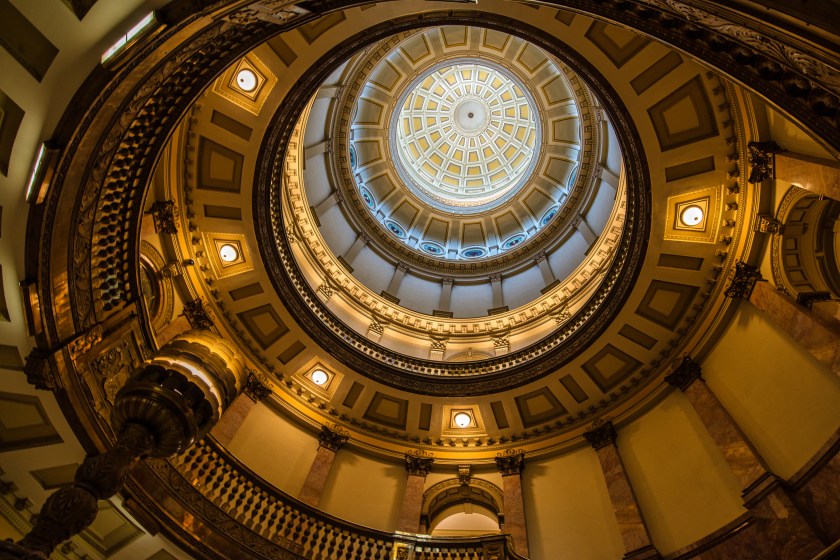
The photograph of the Colorado State Capitol rotunda represents a shift in architectural perspective, focusing on the interior’s ornate details rather than external views. Using a wide-angle lens, the image captures the dome’s grandeur and intricate design, embodying the civic experience and inviting public engagement while highlighting historical and democratic ideals.

Upward view of the ornate rotunda ceiling inside the Colorado State Capitol, showing concentric arches and a central skylight.
An interior view looking up into the rotunda of the Colorado State Capitol in Denver, Colorado.

This interior study of the Colorado State Capitol rotunda marks a significant compositional departure within Chapter 3 of the Top 100 Journey. Where previous images in this collection have examined architecture from external vantage points—emphasizing façade, silhouette, and contextual placement—this photograph inverts the perspective, directing the viewer’s gaze upward through concentric rings of ornamental detail toward a luminous oculus. The shift from exterior monumentality to interior intimacy reveals the photographer’s expanding investigation of how architectural space shapes civic experience and visual perception.

Shot with a Nikon D610 and an 18-35mm f/3.5-4.5 lens at 19mm, the wide-angle focal length proves essential to capturing the rotunda’s full vertical sweep within a single frame. The fisheye-like distortion inherent at this focal length amplifies the dome’s centripetal geometry, creating a vortex effect that draws the eye inexorably toward the coffered ceiling and its central aperture. The exposure settings—f/8.0 at 1/10s, ISO 400—balance the need for depth of field across multiple architectural tiers with the practical constraints of handheld low-light shooting. The resulting image maintains sharpness from the foreground balustrade through to the uppermost decorative elements.

The color palette divides into two distinct thermal zones. Warm golden tones dominate the lower registers, where artificial lighting illuminates gilt detailing, coffered panels, and classical ornamentation. These warm hues gradually transition to cooler whites and pale blues as the eye travels upward, culminating in the natural daylight filtering through the oculus. This chromatic shift reinforces the spiritual and hierarchical symbolism embedded in rotunda architecture—earthly richness below, celestial purity above—while simultaneously demonstrating the photographer’s attentiveness to mixed lighting conditions.

Compositional rigor anchors what could easily become visual chaos. The photographer positions himself at the precise center point beneath the dome, ensuring perfect radial symmetry. This decision transforms architectural documentation into geometric meditation, where repeating patterns of coffering, balustrades, and Corinthian capitals establish rhythmic visual cadence. The inclusion of the ornate balustrade in the lower left introduces human scale and tactile detail, preventing the image from becoming pure abstraction while emphasizing the building’s accessibility—a public space designed for citizen engagement.

Within the broader narrative of Chapter 3, this rotunda photograph functions as conceptual bridge between exterior civic monumentality and the quotidian experience of urban space. It reveals what lies beneath the gilded dome captured in his nocturnal exterior study, exposing the elaborate craftsmanship and symbolic program that nineteenth-century architects employed to manifest democratic ideals through built form. The image documents not merely architectural opulence but the spatial theater of governance—the designed environment through which political power seeks legitimacy through aesthetic grandeur.

The photographer’s note regarding access—”as simple as passing through a metal detector”—introduces subtle contemporary commentary. This threshold between public and civic space, between everyday citizen and architectural spectacle, becomes invisible in the final image yet remains conceptually present. The photograph captures a space designed for transparency and public access, its ornamental complexity serving not to exclude but to dignify the democratic project. In rendering this vertical architecture with technical precision and compositional thoughtfulness, the photographer documents both historical aspiration and ongoing civic function, making visible the constructed environments through which Colorado’s political identity continues to be performed and experienced.

Boulder Falls Long Exposure

The photograph of Boulder Falls captures the intricate interplay of water and rock in Colorado’s canyon, showcasing the photographer’s mastery of long exposure techniques. Using a Nikon D610, the image balances smooth water motion with structural clarity. This work signifies a matured artistic voice within the broader context of his evolving landscape photography.

Long-exposure view of Boulder Falls flowing over rocks into a shallow pool within a rocky canyon.
Long-exposure photograph of Boulder Falls cascading through a rocky canyon in Colorado.

The photographer’s mastery of long exposure technique reaches full maturity in this commanding portrait of Boulder Falls, where water, stone, and light converge in a composition of remarkable spatial depth and textural complexity. Captured with a Nikon D610 and an 18-35mm f/3.5-4.5 lens at its widest setting of 18mm, the image employs a half-second exposure at ƒ/4.0 and ISO 100 to render cascading water as ethereal veils against the canyon’s ancient geological architecture.

The composition operates on multiple planes, drawing the eye through a carefully orchestrated visual journey. In the immediate foreground, stream-smoothed boulders—some dry and tan, others wet and rust-colored—create a rocky platform that grounds the viewer’s perspective. Water flows around and between these stones in delicate ribbons, their motion captured as soft blur that contrasts with the sharp detail of stationary rock. The middle ground presents the falls itself, a luminous white cascade plunging through a dramatic cleft in the granite amphitheater. Finally, the background reveals towering rock walls in warm earth tones, their fractured surfaces speaking to millennia of geological upheaval, crowned by evergreen forest and a brilliant blue sky.

What distinguishes this work from countless waterfall photographs is the photographer’s sophisticated understanding of how long exposure serves composition rather than merely creating predictable aesthetic effects. The half-second shutter speed proves precisely calibrated—long enough to smooth the water into silken forms while short enough to preserve structural definition in the cascade. The falls maintain sculptural presence rather than dissolving into amorphous white masses. Similarly, the foreground stream retains enough texture and gradation to read as water in motion rather than abstract blur.

The technical choices reveal deliberate control over the medium. The wide 18mm focal length encompasses the entire scene’s grandeur while maintaining exceptional corner-to-corner sharpness, crucial when working with such complex spatial relationships. The ƒ/4.0 aperture balances depth of field considerations—keeping both foreground rocks and distant walls acceptably sharp—with the light reduction necessary for the extended exposure. At ISO 100, the image maintains optimal clarity across its tonal range, from the brightest highlights in the falling water to the shadowed crevices in the surrounding stone.

The inclusion of this photograph in Chapter 3—Colorado Landscapes & Cityscapes—marks a significant development in the photographer’s journey. Where earlier chapters saw him exploring beyond Florida’s boundaries, this chapter formalizes Colorado as a central subject within his practice. The image embodies what might be termed “high country aesthetics”: the interplay of water and granite, the vertical drama of canyon topography, the crystalline light of elevated altitude. These elements recur throughout Rocky Mountain landscape photography, yet the photographer brings fresh eyes to familiar territory through precise craft and compositional intelligence.

Within the broader context of the Top 100 Journey project, “Boulder Falls Long Exposure” represents an artist who has moved beyond technical experimentation toward mature artistic voice. The photograph demonstrates that mastery emerges not from discovering novel techniques but from wielding established ones with intention, subtlety, and unwavering attention to the specific demands of place and moment.

Passage Through Green: Corkscrew Swamp Sanctuary

The photograph from the Corkscrew Swamp Sanctuary captures the harmonious relationship between human infrastructure and Florida’s natural environment. The cypress boardwalk invites viewers into an intricate ecosystem, showcasing careful light management and depth. By depicting the balance of accessibility and preservation, it highlights Florida’s ecological significance and the need for conservation.

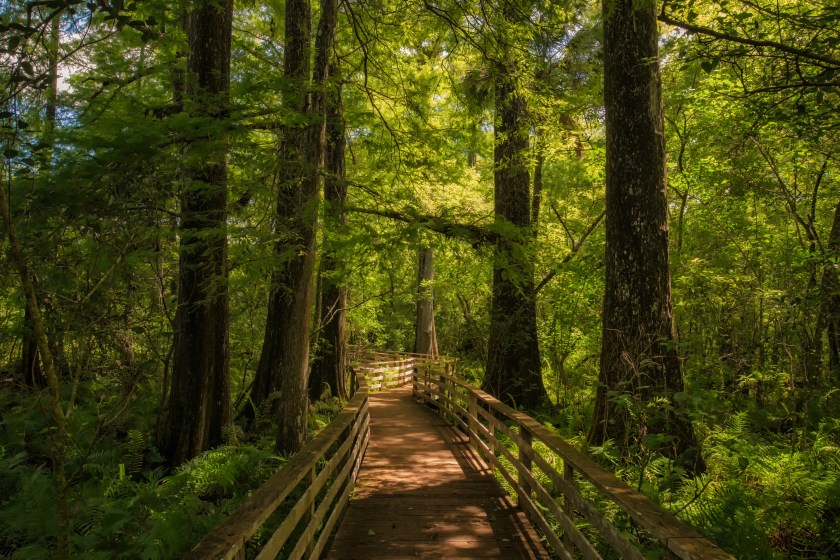
Wooden boardwalk winding through tall cypress trees and dense green foliage at Corkscrew Swamp Sanctuary, with dappled sunlight on the path.
Cypress Boardwalk at Corkscrew Swamp Sanctuary (2014)

In this luminous study from the Corkscrew Swamp Sanctuary, the photographer presents Florida’s natural landscape not as wilderness observed from a distance, but as an invitation to passage—a curated encounter between human infrastructure and primeval forest. The cypress boardwalk becomes both subject and compositional device, leading the viewer into a cathedral of green light that speaks to the delicate negotiation between preservation and access.

The technical approach reveals careful consideration of the swamp’s challenging photographic conditions. Working at ISO 100 with a half-second exposure at f/16, the photographer has maximized depth of field while maintaining exceptional image quality. This combination renders crisp detail from the weathered planks of the boardwalk through to the layered canopy above, where backlit foliage creates a luminous gradient from deep shadow to radiant yellow-green. The 24mm focal length—a moderate wide-angle perspective—provides visual breadth without the distortion that might compromise the scene’s natural proportions.

What distinguishes this image is its masterful handling of light. Shooting within the swamp’s dense canopy during what appears to be late morning or early afternoon, the photographer has captured the moment when sunlight penetrates the upper canopy, creating an almost ethereal glow. The graduated tonalities—from the shadowed foreground through the mid-tones of the boardwalk to the brilliant highlights beyond—establish a sense of progression and discovery. The exposure value suggests deliberate retention of highlight detail in what could easily have become overblown areas of white, instead preserving the textural complexity of individual leaves and branches.

The boardwalk itself serves multiple compositional functions. Its strong linear perspective creates depth and movement, drawing the eye inexorably toward the illuminated center. The railings function as framing elements, containing the viewer’s gaze while suggesting the carefully managed interaction between visitors and ecosystem. The warm tones of the aged wood provide chromatic relief from the overwhelming green, grounding the image in the tangible reality of human construction within natural space.

Within Chapter 2’s exploration of Florida landscapes, this photograph represents a significant counterpoint to the architectural documentation of the Dalí Museum. Where that image examined cultural infrastructure against an urban backdrop, this work investigates environmental infrastructure—the pathways that allow observation without destruction. The photographer recognizes that Florida’s identity is inextricably linked to its threatened ecosystems, and that contemporary experience of these spaces is mediated by such interventions.

The cypress trunks, standing as dark vertical elements throughout the frame, provide rhythmic structure while emphasizing scale. Their substantial girth and textured bark speak to age and resilience, while the dense understory of ferns visible in the lower portions of the frame suggests the biodiversity these swamp systems support. The photographer has captured not merely a scenic vista but a complex ecological narrative.

This image demonstrates the photographer’s evolving understanding of Florida’s duality—a place where nature and human presence exist in constant negotiation. The boardwalk, rather than intruding upon the swamp, becomes evidence of a conservation ethic, allowing passage while preserving the delicate substrate below. In documenting this careful balance, the photographer offers a vision of Florida that transcends tourism, revealing instead a landscape worthy of sustained attention and protection.

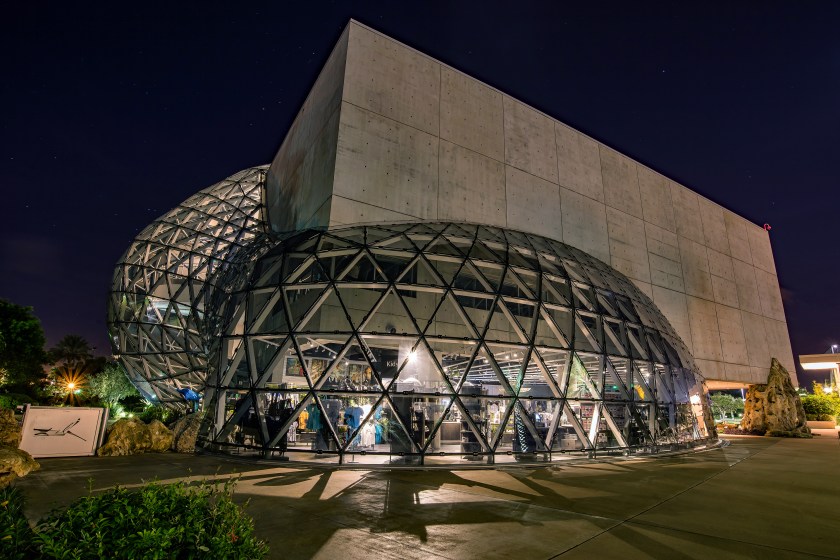
Nocturnal Geometry: The Dalí Museum, St. Petersburg

This photograph captures the illuminated Dalí Museum in St. Petersburg, Florida, showcasing the contrast between its geodesic structure and concrete form during twilight. The image highlights Florida’s cultural evolution through art, exemplifying a balanced compositional approach that emphasizes architectural integrity and the atmosphere, marking a sophisticated chapter in the photographer’s journey.

Nighttime long exposure photograph of the Dali Museum in St. Petersburg, Florida, showing its illuminated geodesic glass structure and concrete facade.
Nighttime long exposure view of the Dali Museum’s illuminated glass structure in St. Petersburg, Florida.

Within Chapter 2 of this photographic journey through Florida’s landscapes and cityscapes, this nighttime study of the Dalí Museum in St. Petersburg stands as a meditation on architectural dialogue—the convergence of structural rationality and organic form captured in the quietude of evening hours.

The photographer has positioned himself to emphasize the museum’s defining architectural gesture: the dramatic geodesic structure that emerges from the building’s otherwise austere concrete mass. Shot at 18mm, the wide-angle perspective accentuates the spherical dome’s imposing presence while maintaining the monumental quality of the adjoining concrete volume. This compositional choice creates a visual tension between geometric order and sculptural fluidity, perhaps an intentional echo of Dalí’s own artistic preoccupations with rigidity and metamorphosis.

Technical execution here demonstrates considerable deliberation. The 30-second exposure at f/11 has transformed the museum’s interior lighting into a warm, inviting glow that radiates through the triangulated framework, effectively rendering the geodesic dome as a luminous lantern against the deep blue-black sky. At ISO 250, the photographer has preserved tonal integrity in the shadows while avoiding the noise that might compromise the concrete’s textural detail—those subtle gradations and panel divisions that speak to the building’s material honesty.

The time of day proves critical to the image’s success. Shot during the transitional moment when civil twilight yields to night, enough ambient light remains in the sky to differentiate it from pure black, providing context and atmospheric depth. The surrounding landscaping, illuminated by strategic ground lighting, frames the architectural subject without competing for attention. The wet pavement in the foreground introduces specular highlights that guide the viewer’s eye toward the main structure while adding a layer of urban authenticity.

What distinguishes this photograph within the broader chapter is its representation of Florida’s cultural infrastructure rather than its natural or purely urban environment. While other images in this collection might emphasize the state’s coastal vistas or metropolitan skylines, this work acknowledges Florida’s role as a destination for arts and culture. The Dalí Museum, with its contemporary architectural interpretation housing works of surrealist mastery, becomes a symbol of Florida’s evolution beyond tourism clichés.

The photographer’s technical approach—the choice of a full-frame Nikon D610 paired with an 18-35mm lens—suggests a commitment to capturing architectural subjects with minimal distortion while maintaining portability for location work. The f/11 aperture provides sufficient depth of field to render sharp detail from the foreground plantings through to the building’s illuminated upper reaches, while the extended exposure time smooths any transient elements, creating a sense of permanence and contemplation.

In the context of the Top 100 Journey project, this image represents a maturation in the photographer’s documentation of Florida’s built environment. There is restraint here—a willingness to let the architecture speak through careful observation rather than dramatic intervention. The composition honors both the building’s geometry and its setting, creating a document that functions simultaneously as architectural photography and as a portrait of place, capturing a specific moment in Florida’s ongoing cultural narrative.

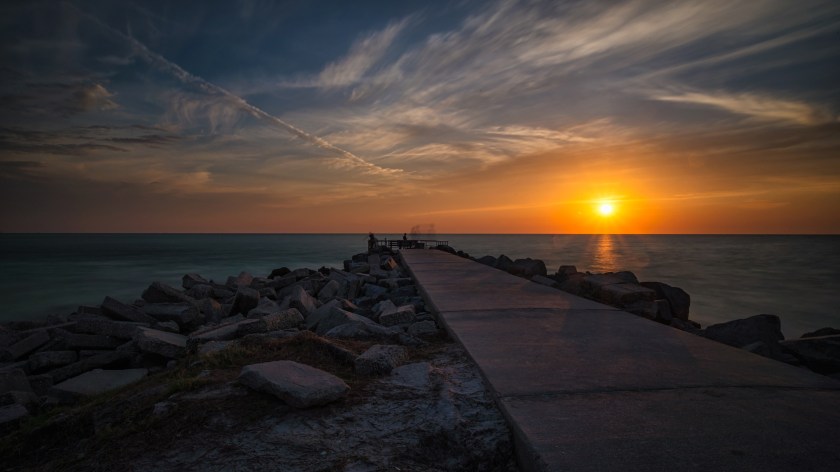
Passagrille Sunset

The photograph of a sunset over the Gulf of Mexico from the Pass-a-Grille jetty captures a sense of departure and geometric clarity. It juxtaposes the structural jetty against soft, ethereal water and sky, reflecting the photographer’s evolving approach while highlighting the tension between permanence and impermanence in landscapes.

Sunset photograph of the Pass‑a‑Grille jetty in Florida, with a concrete pier extending into the Gulf of Mexico and silhouetted figures at the horizon.
Sunset over the Gulf of Mexico from the Pass‑a‑Grille jetty.

This image from Chapter 2 of the Top 100 Journey carries with it a distinct sense of departure—a final engagement with a familiar location rendered with the careful attention of someone taking leave. Shot at Pass-a-Grille, the southern terminus of St. Pete Beach, the photograph distills the photographer’s technical vocabulary into a study of geometric clarity against atmospheric flux.

The concrete jetty commands the composition with unwavering linear authority, stretching from the immediate foreground toward the distant horizon where the sun hangs in perfect alignment. This centered positioning—often avoided in landscape photography as overly symmetrical—here becomes an asset, emphasizing the directional thrust of both structure and light. The jetty serves as more than mere subject; it functions as visual pathway, invitation, and barrier simultaneously. Flanked by massive boulder riprap on either side, the walkway creates a corridor that focuses attention while the rough-hewn stones provide textural contrast to the smooth concrete surface.

The technical approach reveals the photographer’s continued exploration of extended exposure. At fifteen seconds and f/22, the water on both sides of the jetty transforms into a milky abstraction, its individual waves collapsed into a singular luminous mass. This treatment—shorter than the sixty-second exposure employed in his Pier 60 work yet still substantially extended—suggests a refinement in his methodology. The turquoise-tinted water retains enough definition to read as liquid rather than dissolving into pure atmosphere, maintaining a crucial anchor to physical reality.

Above, the sky performs its transitional theater. Wispy cirrus formations streak diagonally across the frame from upper left, their directional movement contrasting with the horizontal stratification of color closer to the horizon. The gradient moves from deep slate blues through amber and peach tones to the incandescent disc of the sun itself. A single contrail cuts through the upper portion—a contemporary detail that situates this timeless scene firmly in the present moment, a reminder that even pristine natural settings exist within our flight-path-crossed modern reality.

The photographer has positioned himself low, allowing the foreground boulders to occupy significant visual weight in the left portion of the frame. These lichen-stained rocks, rendered in earth tones that echo the warm sunset palette, ground the image literally and figuratively. Their solidity counterbalances the ethereal qualities of water and sky, creating a dialogue between permanence and impermanence that resonates with the image’s contextual note about departure.

Within the framework of Chapter 2—Florida Landscapes & Cityscapes—this photograph demonstrates the photographer’s evolving relationship with infrastructure as subject. Where tourist piers offer human presence and activity, this utilitarian jetty provides something more austere: pure form against elemental forces. The viewing platform visible at the jetty’s terminus, occupied by silhouetted figures, offers scale and human connection without sentimentality.

The work succeeds in balancing documentary precision with interpretive mood. It captures a specific engineered structure at a specific coastal location while transcending those particulars to engage broader themes: the paths we walk toward light, the structures we build against erosion, the moments we choose to mark as endings before moving forward.

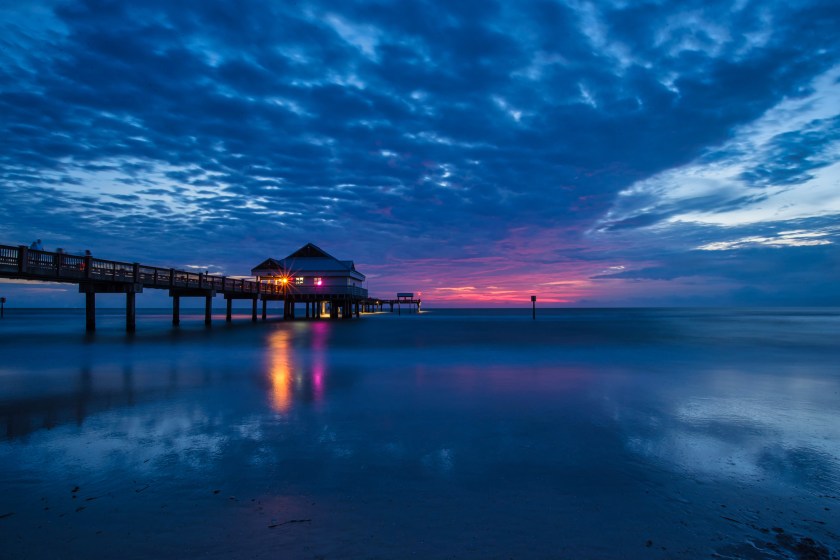
Pier 60 Pink Sunset

In this contemplative study from Chapter 2 of the Top 100 Journey, the photographer demonstrates a sophisticated command of long-exposure technique to capture the liminal hour where day surrenders to night along Florida’s Gulf Coast. Shot at Clearwater Beach, this sixty-second exposure transforms the volatile surf into a glassy, ethereal plane that mirrors the atmospheric drama unfolding above, while Pier 60 extends into the frame with geometric precision against a sky rendered in deep indigos and persistent pink tones.

Long exposure photograph of Pier 60 on Clearwater Beach at sunset, with pink and purple sky tones reflecting on calm water.
Long exposure pink sunset at Pier 60 on Clearwater Beach.

In this contemplative study from Chapter 2 of the Top 100 Journey, the photographer demonstrates a sophisticated command of long-exposure technique to capture the liminal hour where day surrenders to night along Florida’s Gulf Coast. Shot at Clearwater Beach, this sixty-second exposure transforms the volatile surf into a glassy, ethereal plane that mirrors the atmospheric drama unfolding above.

The composition centers on Pier 60, an iconic structure that extends into the frame with geometric precision. The photographer has positioned himself to capture the pier in its full dimensionality—the wooden pilings create a rhythmic vertical pattern that draws the eye toward the pavilion structure, where warm sodium lights pierce the deepening blue hour. These artificial punctuations of yellow and magenta provide crucial counterpoints to the natural color palette, preventing the image from dissolving entirely into monochromatic twilight. The long exposure has softened the lights into glowing orbs, their reflections stretching across the wet sand in elongated streaks that echo the horizontal thrust of the pier itself.

The technical execution reveals deliberate choices throughout. At f/22, the photographer has prioritized depth of field and the creation of diffraction spikes around the light sources, adding a subtle stellar quality to the illumination. The ISO 100 setting ensures maximum image quality, while the 18mm focal length—shot on a full-frame Nikon D610 with an 18-35mm lens—provides expansive coverage that encompasses both the architectural subject and the vast atmospheric canvas surrounding it. This wider perspective situates the human-made structure within the broader natural context, a recurring tension in his Florida landscapes.

The sky commands nearly two-thirds of the frame, and rightfully so. The textured cloud formations—rendered in deep indigos and cobalt blues—create a dramatic ceiling that seems to press down upon the horizon line where pink and peach tones persist from the recently set sun. This color gradient, from warm horizon to cool zenith, demonstrates the photographer’s understanding of transitional light and his patience in waiting for the precise moment when competing color temperatures achieve balance.

The wet foreground sand serves multiple compositional functions. Its reflective quality doubles the visual information, creating subtle mirror images of the pier lights, while the barely perceptible texture of the beach—preserved despite the long exposure—grounds the image in physical reality. This detail prevents the photograph from becoming overly abstract, maintaining the delicate equilibrium between documentary observation and interpretive vision.

Within the broader context of Chapter 2—Florida Landscapes & Cityscapes—this image exemplifies the photographer’s evolving relationship with his adopted coastal environment. Where earlier works might emphasize the region’s vibrant daylight character, this photograph engages with Florida’s more contemplative aspects: the quiet moments of transition, the interplay between natural beauty and recreational infrastructure, the way tourism and wilderness coexist along these developed shorelines.

The photograph ultimately succeeds as both technical achievement and aesthetic statement. It captures a specific place at a specific moment while transcending those particulars to evoke the universal experience of standing at the edge of vast water as darkness approaches—a meditation on transience rendered permanent through the camera’s patient eye.

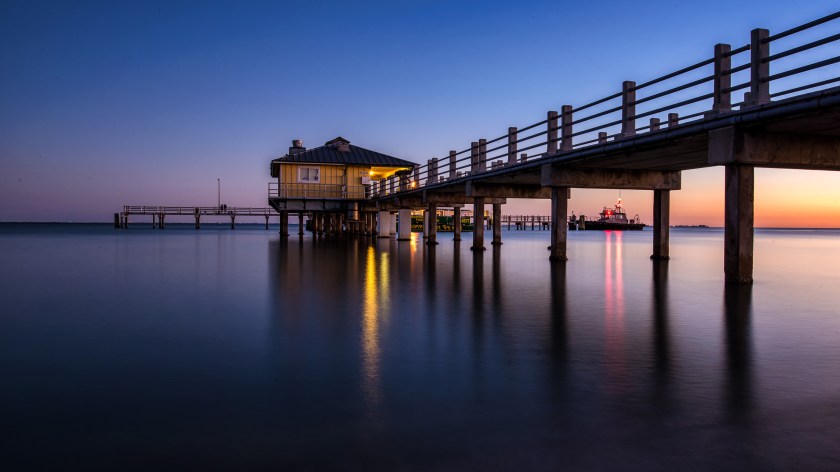
Pilot Boat Pier

This photograph of Fort De Soto Park’s pilot boat pier captures the harmony between utilitarian structures and aesthetics. Utilizing a long exposure, the image highlights light, geometry, and the duality of human activity and nature. The pier becomes more than functional; it represents Florida’s coastal identity, deserving appreciation alongside natural landscapes.

Long exposure twilight photograph of the Bay Pier at Fort De Soto Park in Florida, with a yellow pilot‑boat building illuminated over calm water.
Long exposure twilight view of the pilot boat pier at Fort De Soto Park.

In this carefully orchestrated study of maritime infrastructure at Fort De Soto Park, the photographer demonstrates his capacity to locate poetry within utilitarian structures. The pilot boat pier—a working facility that guides commercial vessels through Tampa Bay’s shipping channels—becomes here a meditation on light, geometry, and the quiet professionalism of coastal operations. Shot during the blue hour with a twenty-five-second exposure at f/16 on a Nikon D610, the image transforms functional architecture into something approaching minimalist sculpture.

The compositional intelligence reveals itself in layers. The pier’s diagonal thrust from left to right creates dynamic movement across the frame, while the elevated structure’s horizontal rails establish rhythmic intervals that lead the eye toward the distant vessel. The photographer has positioned himself to capture the pilings in perfect vertical alignment, their reflections doubling into the glassy water below—a mirror effect achieved through the extended exposure that renders Tampa Bay into polished obsidian. At ISO 100, the twenty-five-millimeter focal length provides sufficient context to establish spatial relationships without sacrificing the intimate scale of the pier house itself.

Light operates as the image’s true subject. The warm interior glow from the pier house casts golden striations across the water, creating a luminous pathway that contrasts with the cool blue-violet gradient dominating the sky. The distant pilot boat, its navigation lights punctuating the horizon in red, provides a crucial narrative element—evidence of the pier’s ongoing purpose even as twilight suspends it in apparent timelessness. This balance between ambient and artificial light, between natural phenomena and human activity, positions the work firmly within the chapter’s exploration of Florida’s developed coastlines.

What distinguishes this image from the photographer’s other coastal studies is its emphasis on infrastructure as architecture. The pier is not merely a platform for viewing nature but an elegant construction worthy of attention in its own right. The horizontal rails, repeating with mechanical precision, create a visual counterpoint to the organic curves of the shoreline visible in the distance. The photographer acknowledges that Florida’s landscape is fundamentally collaborative—nature and human intervention existing in constant dialogue rather than opposition.

The technical execution merits particular attention. The f/16 aperture ensures depth of field sufficient to hold both foreground pilings and horizon vessel in acceptable focus, while the twenty-five-second exposure smooths the water into a reflective plane that doubles the compositional impact of every vertical element. The choice to shoot at this precise moment—when daylight has drained from the western sky but hasn’t yet surrendered to complete darkness—captures that transitional state where artificial lights begin to assert themselves without overwhelming the scene’s natural tonal range.

Within the broader context of the Florida Landscapes & Cityscapes chapter, this photograph represents the photographer’s mature understanding of the state’s coastal identity. Fort De Soto’s pilot boat pier is neither wilderness nor urban environment but something uniquely Floridian—a working maritime facility embedded within a state park, where commerce and recreation, industry and leisure, coexist without apparent conflict. By rendering it with such formal rigor and aesthetic consideration, the photographer argues for expanded recognition of these hybrid spaces as legitimate subjects for contemplation, deserving the same careful attention traditionally reserved for pristine natural vistas.