Long Exposure Dillon Reservoir: A Study in Temporal Meditation

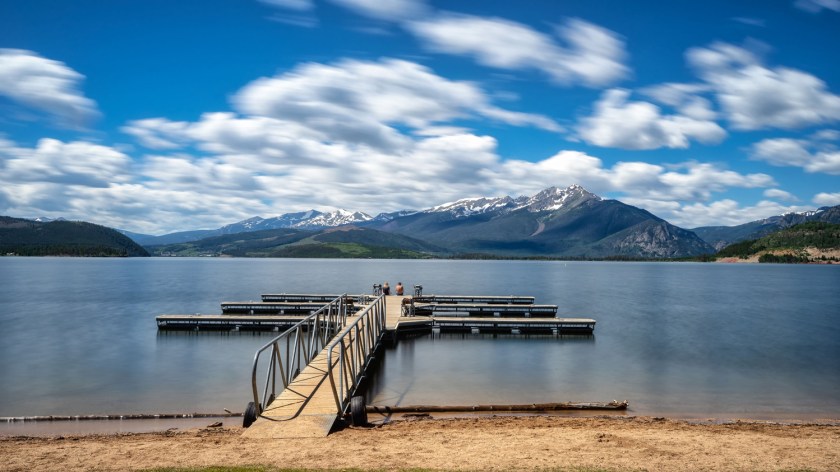
The photograph from Dillon Reservoir near Silverthorne, Colorado, features a dock leading into tranquil waters, showcasing the photographer’s technical skill and evolving artistic vision. Utilizing long exposure, the image captures a balance of nature and human infrastructure, encouraging contemplation on time, landscape, and accessibility, while inviting viewers to engage further with their surroundings.

Long exposure view of a dock extending into Dillon Reservoir with mountains and blurred clouds in the background.
A dock extends into Dillon Reservoir near Silverthorne, Colorado, with mountains rising beyond the water.

In this carefully composed study from Dillon Reservoir, the photographer employs extended exposure to transform a commonplace mountain scene into something approaching the transcendent. The image stands as a compelling entry within Chapter 3 of his Top 100 Journey, demonstrating a technical maturity and conceptual clarity that marks his evolving engagement with Colorado’s diverse landscapes.

The composition centers on a weathered dock extending into the reservoir’s calm waters, its wooden walkway and metal railings leading the viewer’s eye toward distant figures positioned at the structure’s terminus. By utilizing a 10-stop neutral density filter with his Sony A7II, the photographer has rendered the water as a glassy, almost ethereal surface—its texture smoothed into gradations of subtle color that suggest movement while paradoxically conveying absolute stillness. This temporal compression transforms fleeting moments into something more permanent, inviting contemplation of how we perceive and record the passage of time.

The technical execution reveals a photographer comfortable with his equipment’s capabilities and limitations. Working with the camera’s kit lens, he has extracted remarkable clarity across the frame, from the sandy foreground through the architectural elements of the dock to the snow-capped peaks beyond. The slight motion blur in the clouds—streaked horizontally across an impeccable blue sky—provides visual rhythm and suggests the duration of the exposure without overwhelming the image’s serene character.

What distinguishes this photograph within the Colorado landscapes chapter is its successful marriage of the state’s iconic mountain scenery with human infrastructure. Rather than presenting wilderness in isolation, the image acknowledges recreational use and accessibility, grounding the sublime natural setting in contemporary experience. The dock becomes a metaphor for our relationship with landscape—a point of interface, an invitation to venture further, a structure that both facilitates and frames our encounter with nature.

Compositionally, the photographer demonstrates sophisticated understanding of visual weight and balance. The curved railing in the immediate foreground creates dynamic entry into the frame, while the horizontal platforms and vertical posts establish geometric order against the organic forms of mountains and clouds. The small human figures at the dock’s end provide crucial scale, reminding viewers of the landscape’s monumentality while suggesting contemplative communion with place.

The color palette rewards close examination. Warm sandy tones in the foreground transition to the cool grays and blues of water and sky, punctuated by the brilliant whites of snow and cloud. This chromatic progression creates depth while maintaining overall tonal harmony. The long exposure has also produced subtle color shifts in the water, where reflected sky and submerged earth combine into something neither purely blue nor brown but somewhere beautifully between.

Within the broader context of his Top 100 Journey, this image represents a photographer increasingly confident in his technical command and artistic vision. The decision to work near Silverthorne—accessible from Interstate 70 rather than requiring backcountry expedition—suggests a mature understanding that compelling photographs need not emerge solely from remote locations. Instead, seeing becomes the essential act, recognizing potential in familiar places and applying technique to reveal what casual observation might miss.

This photograph ultimately asks viewers to pause, to consider how we move through landscape and how landscape moves through time. It is work that respects both craft and subject, offering neither mere technical display nor sentimental postcard but something more considered: a meditation on place, presence, and the strange alchemy of photography itself.
Big Thompson Long Exposure

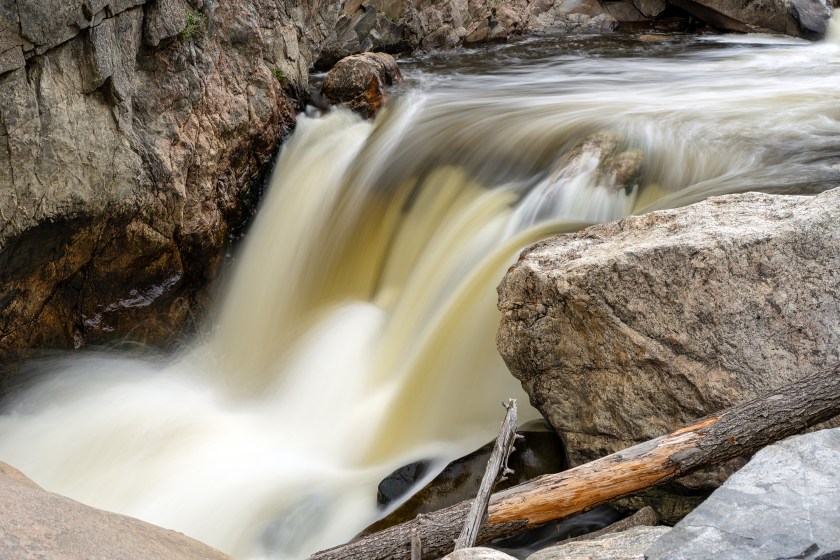
The photograph of the Big Thompson River showcases a masterful interplay of permanence and fluidity through long exposure techniques. Captured in Colorado, the image emphasizes detail in granite boulders alongside soft, flowing water. It reflects the photographer’s evolving artistic journey, expanding thematic boundaries while presenting a cohesive and naturalistic landscape composition.

Long exposure view of fast-moving water flowing over a rocky drop on the Big Thompson River between granite boulders.
Water flows over a small rocky drop along the Big Thompson River, photographed with a long exposure.

The photographer’s technical mastery converges with natural drama in this commanding study of the Big Thompson River, captured in Colorado’s rugged high country. Shot with a Sony Alpha a7 II paired with the Sony FE 28-70mm f/3.5-5.6 OSS lens at 62mm, the image employs long exposure technique enhanced by neutral density filtration to transform rushing water into ethereal ribbons of motion. At ƒ/9.0 and ISO 50, the exposure settings reveal a deliberate approach to capturing both sharpness in the surrounding geology and the silken blur of flowing water.

What immediately arrests the viewer is the dramatic interplay between permanence and fluidity. Massive granite boulders—textured, ancient, immovable—frame a cascade that appears simultaneously powerful and gossamer-soft. The long exposure technique transforms the torrent into bands of cream and amber, creating visual movement that guides the eye through the composition in sweeping arcs. The golden tint in the water suggests the presence of sediment or tannins, lending warmth to what might otherwise read as a cool mountain scene.

The compositional architecture demonstrates sophisticated understanding of visual weight and balance. A substantial boulder occupies the right foreground, its weathered surface rendered in exquisite detail, while a piece of driftwood creates a diagonal element that adds depth and natural geometry. The left side reveals stratified rock walls, their vertical presence providing counterpoint to the horizontal flow. This triangulation of elements—stone, water, wood—creates a cohesive environmental portrait rather than merely documenting a waterfall.

The inclusion of this image within Chapter 2—Florida Landscapes & Cityscapes—presents an intriguing curatorial question. Clearly captured in Colorado’s Rocky Mountain ecosystem rather than Florida, the photograph signals an expansion in the photographer’s geographical scope and thematic boundaries. This apparent departure from the chapter’s titular focus suggests an evolving artistic journey, one where the photographer moves beyond regional constraints to explore universal themes of landscape and natural process. Perhaps the chapter title reflects the photographer’s home base or primary focus, while individual works demonstrate his widening field of exploration.

The technical execution reveals growing confidence with long exposure photography as a expressive tool. The neutral density filter allows for extended exposure times in daylight conditions, creating that characteristic motion blur while maintaining proper exposure across the frame’s dynamic range. The choice of ƒ/9.0 ensures adequate depth of field to keep both foreground rocks and background elements acceptably sharp, a critical consideration in landscape work where context matters as much as subject.

What elevates this beyond technical exercise is the photographer’s eye for natural composition. The cascade’s S-curve creates inherent grace, while the careful positioning relative to the boulder forms suggests patient observation and deliberate framing. The subdued color palette—grays, tans, muted greens—speaks to naturalistic rendering rather than heightened saturation, allowing texture and form to dominate over chromatic spectacle.

Within the broader trajectory of the Top 100 Journey project, this image represents an artist testing boundaries and methodologies. It demonstrates that landscape photography, when executed with technical precision and compositional awareness, can reveal the sublime within the observable—the eternal dance between stone and water, stillness and motion, captured in a single decisive exposure.

Long Exposure Bay Pier

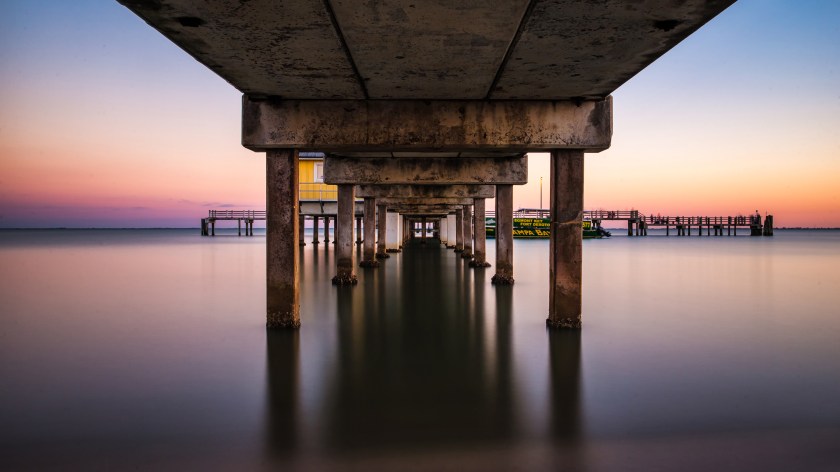
This long-exposure photograph from Fort De Soto Park captures the interplay between water and human infrastructure beneath the Bay Pier at sunset. The technical precision transforms the scene into a study of temporality, where smooth water contrasts with weathered concrete, exploring beauty in overlooked spaces. The image balances tranquility and depth, prompting contemplation.

Long exposure sunset photograph taken beneath the Bay Pier at Fort De Soto Park, showing symmetrical concrete pilings and smooth reflective water.
Long exposure sunset view beneath the Bay Pier at Fort De Soto Park.

The photographer’s technical mastery and compositional restraint converge in this striking long-exposure study from Fort De Soto Park. Captured beneath the Bay Pier at sunset, the image demonstrates a sophisticated understanding of how extended exposure transforms the ephemeral into the architectural, rendering water as smooth as polished stone and reducing the atmospheric gradient to its essential chromatic progression.

The 124-second exposure at f/16 achieves precisely what such technical specifications promise: a complete metamorphosis of the transient into the permanent. The water’s surface becomes a mirror of silk, its glassy uniformity disrupted only by the weathered pier columns that puncture the frame with rhythmic precision. These pylons, darkened by time and barnacled at their waterline, create a vanishing perspective that draws the eye inexorably toward the distant horizon where structure meets light. The photographer has positioned himself not merely under the pier but within its geometric logic, allowing the concrete deck above to function as both literal and compositional ceiling, establishing boundaries that paradoxically expand the viewer’s sense of spatial depth.

What distinguishes this work within the Florida Landscapes & Cityscapes chapter is its meditation on infrastructure as organic form. The pier’s weathered concrete surfaces—mottled with rust stains and biological growth—speak to the peninsula’s relentless humidity and salt air. Rather than presenting Florida’s more commonly depicted pristine beaches or crystalline waters, he has chosen to explore the liminal space where human construction gradually surrenders to natural forces. The corroded texture of the support beams and deck creates a counterpoint to the water’s supernatural smoothness, establishing a dialogue between industrial decay and elemental transformation.

The color palette rewards careful attention. The sky transitions from pale lavender at the zenith through bands of peach and amber toward the horizon, while the water adopts cooler tones of green and slate. This chromatic division creates temperature contrast that enhances the image’s sense of tranquility without veering into sentimentality. A yellow structure visible in the middle distance—likely a utility building or navigation marker—provides a necessary accent of saturated color, preventing the composition from becoming too subdued.

The technical execution reflects deliberate choices rather than automatic settings. The 31mm focal length on a full-frame sensor provides sufficient width to encompass the pier’s structural rhythm while maintaining proper perspective correction, avoiding the distortion that might occur at the wide end of his 18-35mm lens. The ISO 100 setting ensures maximum detail in the shadows where barnacles cling to concrete, while the extended shutter speed required neutral density filtration to prevent overexposure during the lingering twilight.

Within the photographer’s larger journey, this image represents a maturation of vision—a willingness to find beauty not in Florida’s celebrated natural wonders but in the overlooked spaces where infrastructure and environment intersect. The pier becomes a study in temporality: concrete designed to last decades, water that renews itself constantly, and light that exists only for minutes. By freezing this convergence through long exposure, he creates a document that feels both immediate and timeless, a quality that defines his most successful landscape work. The photograph succeeds because it refuses spectacle in favor of contemplation, inviting sustained viewing rather than demanding instant admiration.