Nocturnal Gateway: Union Station Illuminated

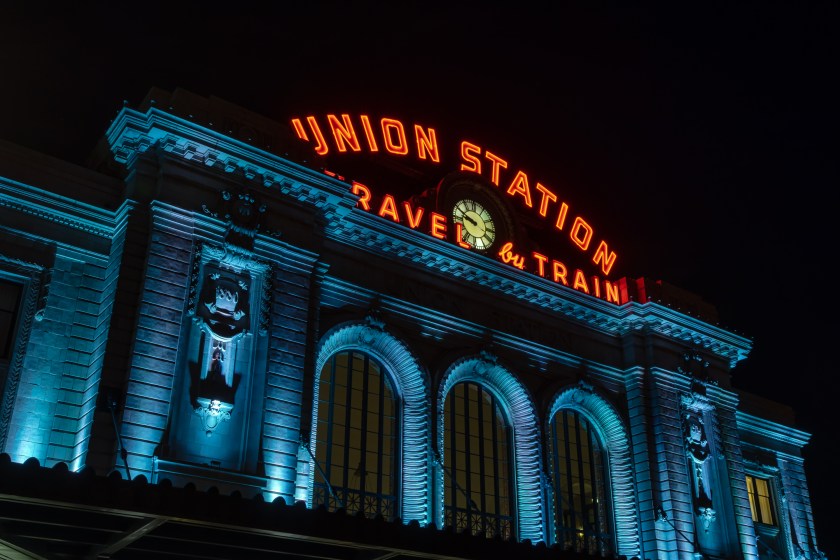
The photograph of Denver’s Union Station at night highlights its Beaux-Arts architecture through dramatic neon and electric blue lighting. Captured at ground level, it displays harmonious contrasts of light and structure, emphasizing the station’s role as a vibrant urban hub. This image underscores both preservation and the ongoing transformation of civic identity.

The illuminated front façade of Denver Union Station at night, with glowing neon signage and a clock above arched windows.
The front façade of Denver Union Station is illuminated at night, highlighted by its neon sign and historic architectural details.

In this nocturnal study of Denver’s Union Station, the photographer captures the transformation that occurs when historic architecture meets contemporary illumination. The image presents the iconic Beaux-Arts facade bathed in electric blue uplighting, while the famous neon signage glows in warm orange against the night sky—a study in complementary contrasts that speaks to both heritage and urban vitality.

The composition demonstrates restraint and classical sensibility. Shot with the Sony A7ii and kit lens, the photographer positions himself at ground level, allowing the building’s ornate cornice and horizontal bands to sweep across the upper portion of the frame. The three arched entrances anchor the lower third, their rhythmic repetition creating visual harmony while the vertical pilasters between them establish structural order. This frontal approach honors the station’s Beaux-Arts symmetry, respecting the intentions of the original 1914 design while documenting its twenty-first-century theatrical presentation.

What distinguishes this photograph is its embrace of artificial light as primary subject matter. The cool cyan wash transforms classical architectural details—the decorative moldings, the sculptural cartouches, the rusticated stonework—into relief elements that appear almost aquatic in their luminosity. This dramatic lighting choice, typically employed during special events or seasonal celebrations, removes the building from everyday documentation and positions it as urban spectacle. The warmth of the neon lettering provides essential counterpoint, its orange glow referencing mid-century Americana and the golden age of rail travel.

The working clock embedded within the signage adds temporal specificity, a reminder that this is a functioning transportation hub rather than mere architectural monument. The small silhouettes of gathered observers at the frame’s base provide crucial human scale, grounding the building’s theatrical presentation within the social realm. Their presence suggests communal gathering, the station serving its historic role as urban meeting point and threshold between destinations.

Within Chapter 3’s exploration of Colorado landscapes and cityscapes, this image represents the photographer’s engagement with Denver’s architectural heritage and its ongoing urban renewal. Union Station, revitalized in recent years as a mixed-use hub, embodies the tension between preservation and progress that defines many American cities. The photographer documents this transformation without editorial comment, allowing the dramatic lighting to speak to both celebration and commodification of historic space.

Technically, the night exposure presents challenges that the photographer navigates successfully. The deep black sky eliminates distracting context, focusing attention entirely on the illuminated facade. The exposure balances the intense neon signage against the softer architectural lighting, maintaining detail in both the brilliant highlights and the deeper blue shadows. The kit lens, often dismissed by photography purists, proves adequate to the task, capturing the scene with sufficient sharpness and minimal distortion.

This photograph pairs effectively with the earlier Denver Public Library study, together presenting divergent approaches to civic architecture. Where the library image emphasized monumental permanence through stark monochrome daylight, Union Station celebrates temporal display through saturated nocturnal color. Both reveal the photographer’s interest in how built environments express civic identity and cultural values.

The image ultimately serves as document, celebration, and subtle meditation on urban transformation—the historic gateway reimagined as luminous beacon in Denver’s evolving downtown landscape.
Boulder Theater Marquee: Neon Vernacular and Urban Memory

The Boulder Theater marquee in Colorado signifies a shift in the photographer’s focus from grand landscapes to community identity through vernacular architecture. The vibrant neon colors and design highlight cultural memory and urban vitality, capturing the theater as a living space that merges historical aesthetics with contemporary relevance, reflecting the complexity of Colorado’s identity.

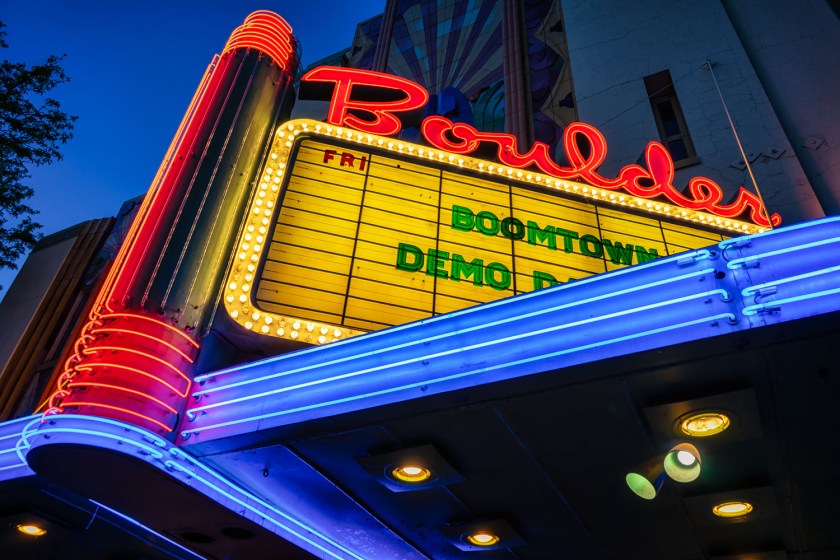
Neon-lit marquee of the Boulder Theater viewed from below against a deep blue evening sky.
The illuminated neon marquee of the Boulder Theater glows at night in Boulder, Colorado.

Within Chapter 3 of the Top 100 Journey—Colorado Landscapes & Cityscapes—this vibrant study of the Boulder Theater marquee represents a deliberate shift in the photographer’s engagement with place. Moving beyond natural terrain and monumental civic architecture, he turns his attention to vernacular structures that anchor community identity. The theater marquee, with its layered neon typography and saturated color palette, becomes a subject through which to examine cultural memory, commercial aesthetics, and the relationship between preservation and vitality in Colorado’s urban fabric.

The composition exploits the dramatic convergence of neon signage against the deepening blue hour sky. Shot at 28mm with the Sony FE 28-70mm f/3.5-5.6 OSS kit lens, the wide angle captures the marquee’s full architectural gesture—the sweeping curves of blue neon tubing that frame the illuminated message board, the iconic “Boulder” script rendered in brilliant red and orange, and the classic Art Deco detailing that situates this structure within a specific historical moment. The exposure settings—f/5.6 at 1/125s, ISO 400—balance ambient light with the intense luminosity of the neon, preventing blown highlights while maintaining detail in the surrounding architecture.

Color becomes the image’s primary narrative force. The red-to-orange gradient of the “Boulder” lettering contrasts sharply with the cool blue neon below, creating complementary tension that draws the eye across the frame. The yellow marquee board, studded with bulbs and announcing “BOOMTOWN DEMO D,” introduces a third chromatic element while grounding the image in specificity and time. This is not a sanitized historical recreation but a working theater captured mid-programming, its marquee functioning as intended—communication, invitation, spectacle.

The photographer’s decision to include surrounding context—the modern glass facade rising behind the vintage marquee, the darkening sky, the subtle presence of street elements—situates the theater within its contemporary environment rather than isolating it as nostalgic artifact. This approach speaks to his evolving methodology within the chapter, where place is understood not as static subject but as palimpsest, layered with temporal and cultural inscriptions. The Boulder Theater, a 1906 structure renovated and preserved, embodies this complexity: historic form activated by present-day use.

The low vantage point emphasizes the marquee’s projecting geometry, its thrust into public space. This compositional choice transforms signage into sculpture, highlighting the physicality of mid-century commercial architecture. The neon tubing, with its visible mounting hardware and electrical infrastructure, reveals construction and craft—elements often obscured in more polished architectural photography but celebrated here as integral to authenticity.

Within the broader trajectory of Chapter 3, the Boulder Theater image functions as cultural counterpoint to wilderness landscapes and governmental monuments. It represents Colorado’s smaller-scale urban centers, places where preservation efforts maintain continuity with architectural heritage while accommodating contemporary cultural production. The theater becomes microcosm—a site where community gathers, where entertainment and commerce intersect, where historical aesthetics remain relevant.

The photographer captures not merely a building but an experience of place, translating the visceral impact of neon light into two-dimensional form. In doing so, he documents Colorado’s layered identity: natural grandeur, civic aspiration, and the quieter vernacular spaces where daily life unfolds. The marquee, brilliant against evening sky, asserts that urban landscapes possess their own compelling beauty—electric, temporal, human-scaled, and essential to understanding the full spectrum of place.

Alioto’s on Fisherman’s Wharf: A Study in Nocturnal Americana

Greg Urbano’s 2010 black and white photograph of Alioto’s restaurant in San Francisco is a significant early work, capturing the intersection of technical skill and artistic vision. It explores familiar scenes through a developing photographic perspective, revealing how ordinary moments can become extraordinary. The image emphasizes light, structure, and context, marking a pivotal discovery in Urbano’s artistic journey.

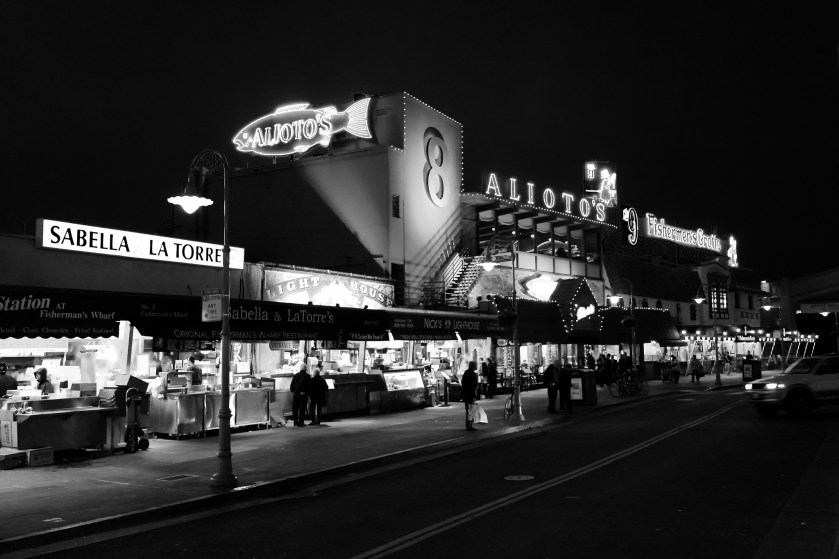
Black and white night photograph of Alioto's #8 restaurant with illuminated neon signs and marquee lights on Fisherman's Wharf in San Francisco. Food vendor stalls including Sabella LaTorre line the boardwalk in the foreground, with pedestrians visible under vintage street lamps.
Alioto’s Restaurant at Fisherman’s Wharf, San Francisco – Night Photography 2010. Iconic neon signs and vintage architecture illuminate this historic seafood destination on San Francisco’s waterfront. Black and white travel photography capturing the timeless charm of Fisherman’s Wharf restaurants and food stalls.

Alioto’s on Fisherman’s Wharf: A Study in Nocturnal Americana

Greg Urbano’s 2010 photograph of Alioto’s restaurant on Fisherman’s Wharf stands as a pivotal work from Chapter One of his Top 100 Journey—a collection dedicated to early beginnings and the formative images that taught him how to see. This photograph represents more than just a vacation snapshot; it captures the moment when technical skill and artistic vision began to converge.

This image works on multiple levels simultaneously. On the surface, it presents a straightforward night photograph of a famous San Francisco landmark. But closer examination reveals a developing understanding of tonal relationships and compositional balance. The black and white treatment isn’t merely aesthetic—it’s revelatory. By stripping away color, the photographer forces viewers to see the architecture of light itself. The neon signs become sculptural elements, the illuminated storefronts transform into glowing boxes of human activity, and the darkness above presses down with an almost palpable weight.

What makes this photograph particularly significant as an early work is its democratic vision. He doesn’t attempt to elevate Alioto’s to fine art by isolating it or abstracting it beyond recognition. Instead, he presents the entire commercial ecosystem: the neighboring Sabella LaTorre sign, the smaller vendor stalls with their utilitarian lighting, the people moving through the frame as gentle blurs. This is tourism and commerce as theater, captured without cynicism or sentimentality—a mature perspective for someone still discovering their photographic voice.

The technical execution demonstrates the learning curve inherent in Chapter One. Shot with a Samsung NX100—not a professional camera by any measure—this image proves that vision was developing faster than equipment acquisition. The exposure is carefully controlled, holding detail in both the bright signage and the darker architectural elements. The vantage point shows deliberate thought: low enough to emphasize the vertical drama of the building, yet far enough back to include context. That giant illuminated fish and the number “8” become almost sculptural forms against the night sky.

As an early capture, this photograph reveals an artist already grasping something fundamental: great photographs often lie not in exotic locations but in how we see the familiar. Fisherman’s Wharf has been photographed millions of times, yet this image feels both specific and universal. It could only be this place, yet it speaks to every similar waterfront tourist district in America. This understanding—that the ordinary can become extraordinary through careful observation—marks a crucial lesson in any photographer’s development.

The inclusion of this work in the Top 100 Journey reflects its role as a foundational piece. It’s not about perfection; it’s about the spark of discovery. The photograph represents a moment when the camera revealed something the artist was only beginning to articulate—an ability to see light as structure, to recognize the poetry in commercial spaces, to trust in straightforward documentation over manipulation.

The photograph has aged beautifully, which speaks to the instincts already present in these early days. In an era of digital saturation and Instagram filters, there’s something refreshing about this honest image. It doesn’t try too hard. It simply observes, with emerging intelligence and care.

When displayed as part of Chapter One: Beginnings, this image invites viewers to consider the photographer’s journey. It rewards examination not just for its formal qualities—the geometry, the light, the tonal range—but for what it represents: a lesson learned, a moment of clarity, a step toward understanding how to translate vision into image. This is where the journey truly began.

See larger sizes of the image on these sites:

Flickr

500px