Big Thompson Long Exposure

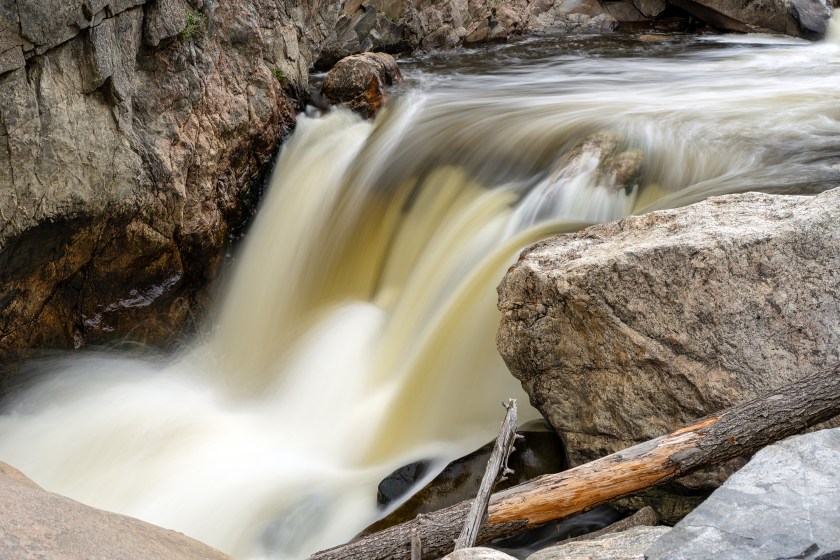
The photograph of the Big Thompson River showcases a masterful interplay of permanence and fluidity through long exposure techniques. Captured in Colorado, the image emphasizes detail in granite boulders alongside soft, flowing water. It reflects the photographer’s evolving artistic journey, expanding thematic boundaries while presenting a cohesive and naturalistic landscape composition.

Long exposure view of fast-moving water flowing over a rocky drop on the Big Thompson River between granite boulders.
Water flows over a small rocky drop along the Big Thompson River, photographed with a long exposure.

The photographer’s technical mastery converges with natural drama in this commanding study of the Big Thompson River, captured in Colorado’s rugged high country. Shot with a Sony Alpha a7 II paired with the Sony FE 28-70mm f/3.5-5.6 OSS lens at 62mm, the image employs long exposure technique enhanced by neutral density filtration to transform rushing water into ethereal ribbons of motion. At ƒ/9.0 and ISO 50, the exposure settings reveal a deliberate approach to capturing both sharpness in the surrounding geology and the silken blur of flowing water.

What immediately arrests the viewer is the dramatic interplay between permanence and fluidity. Massive granite boulders—textured, ancient, immovable—frame a cascade that appears simultaneously powerful and gossamer-soft. The long exposure technique transforms the torrent into bands of cream and amber, creating visual movement that guides the eye through the composition in sweeping arcs. The golden tint in the water suggests the presence of sediment or tannins, lending warmth to what might otherwise read as a cool mountain scene.

The compositional architecture demonstrates sophisticated understanding of visual weight and balance. A substantial boulder occupies the right foreground, its weathered surface rendered in exquisite detail, while a piece of driftwood creates a diagonal element that adds depth and natural geometry. The left side reveals stratified rock walls, their vertical presence providing counterpoint to the horizontal flow. This triangulation of elements—stone, water, wood—creates a cohesive environmental portrait rather than merely documenting a waterfall.

The inclusion of this image within Chapter 2—Florida Landscapes & Cityscapes—presents an intriguing curatorial question. Clearly captured in Colorado’s Rocky Mountain ecosystem rather than Florida, the photograph signals an expansion in the photographer’s geographical scope and thematic boundaries. This apparent departure from the chapter’s titular focus suggests an evolving artistic journey, one where the photographer moves beyond regional constraints to explore universal themes of landscape and natural process. Perhaps the chapter title reflects the photographer’s home base or primary focus, while individual works demonstrate his widening field of exploration.

The technical execution reveals growing confidence with long exposure photography as a expressive tool. The neutral density filter allows for extended exposure times in daylight conditions, creating that characteristic motion blur while maintaining proper exposure across the frame’s dynamic range. The choice of ƒ/9.0 ensures adequate depth of field to keep both foreground rocks and background elements acceptably sharp, a critical consideration in landscape work where context matters as much as subject.

What elevates this beyond technical exercise is the photographer’s eye for natural composition. The cascade’s S-curve creates inherent grace, while the careful positioning relative to the boulder forms suggests patient observation and deliberate framing. The subdued color palette—grays, tans, muted greens—speaks to naturalistic rendering rather than heightened saturation, allowing texture and form to dominate over chromatic spectacle.

Within the broader trajectory of the Top 100 Journey project, this image represents an artist testing boundaries and methodologies. It demonstrates that landscape photography, when executed with technical precision and compositional awareness, can reveal the sublime within the observable—the eternal dance between stone and water, stillness and motion, captured in a single decisive exposure.
Passage Through Green: Corkscrew Swamp Sanctuary

The photograph from the Corkscrew Swamp Sanctuary captures the harmonious relationship between human infrastructure and Florida’s natural environment. The cypress boardwalk invites viewers into an intricate ecosystem, showcasing careful light management and depth. By depicting the balance of accessibility and preservation, it highlights Florida’s ecological significance and the need for conservation.

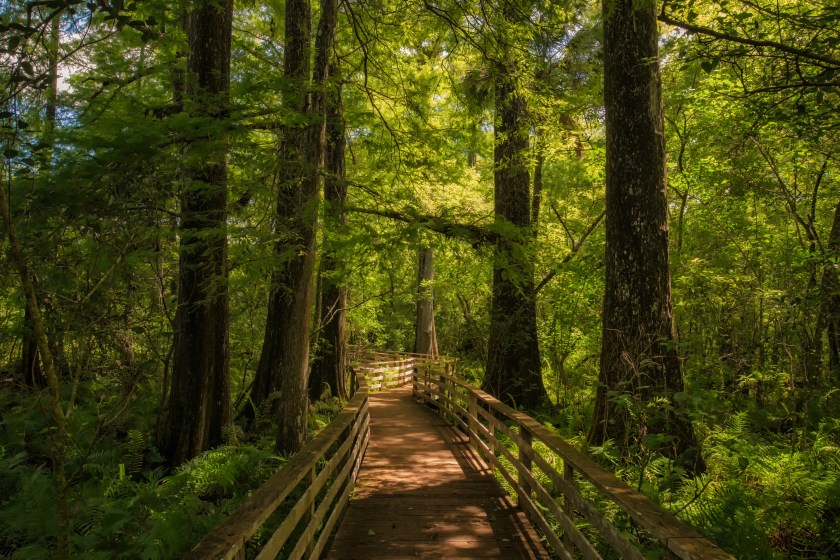
Wooden boardwalk winding through tall cypress trees and dense green foliage at Corkscrew Swamp Sanctuary, with dappled sunlight on the path.
Cypress Boardwalk at Corkscrew Swamp Sanctuary (2014)

In this luminous study from the Corkscrew Swamp Sanctuary, the photographer presents Florida’s natural landscape not as wilderness observed from a distance, but as an invitation to passage—a curated encounter between human infrastructure and primeval forest. The cypress boardwalk becomes both subject and compositional device, leading the viewer into a cathedral of green light that speaks to the delicate negotiation between preservation and access.

The technical approach reveals careful consideration of the swamp’s challenging photographic conditions. Working at ISO 100 with a half-second exposure at f/16, the photographer has maximized depth of field while maintaining exceptional image quality. This combination renders crisp detail from the weathered planks of the boardwalk through to the layered canopy above, where backlit foliage creates a luminous gradient from deep shadow to radiant yellow-green. The 24mm focal length—a moderate wide-angle perspective—provides visual breadth without the distortion that might compromise the scene’s natural proportions.

What distinguishes this image is its masterful handling of light. Shooting within the swamp’s dense canopy during what appears to be late morning or early afternoon, the photographer has captured the moment when sunlight penetrates the upper canopy, creating an almost ethereal glow. The graduated tonalities—from the shadowed foreground through the mid-tones of the boardwalk to the brilliant highlights beyond—establish a sense of progression and discovery. The exposure value suggests deliberate retention of highlight detail in what could easily have become overblown areas of white, instead preserving the textural complexity of individual leaves and branches.

The boardwalk itself serves multiple compositional functions. Its strong linear perspective creates depth and movement, drawing the eye inexorably toward the illuminated center. The railings function as framing elements, containing the viewer’s gaze while suggesting the carefully managed interaction between visitors and ecosystem. The warm tones of the aged wood provide chromatic relief from the overwhelming green, grounding the image in the tangible reality of human construction within natural space.

Within Chapter 2’s exploration of Florida landscapes, this photograph represents a significant counterpoint to the architectural documentation of the Dalí Museum. Where that image examined cultural infrastructure against an urban backdrop, this work investigates environmental infrastructure—the pathways that allow observation without destruction. The photographer recognizes that Florida’s identity is inextricably linked to its threatened ecosystems, and that contemporary experience of these spaces is mediated by such interventions.

The cypress trunks, standing as dark vertical elements throughout the frame, provide rhythmic structure while emphasizing scale. Their substantial girth and textured bark speak to age and resilience, while the dense understory of ferns visible in the lower portions of the frame suggests the biodiversity these swamp systems support. The photographer has captured not merely a scenic vista but a complex ecological narrative.

This image demonstrates the photographer’s evolving understanding of Florida’s duality—a place where nature and human presence exist in constant negotiation. The boardwalk, rather than intruding upon the swamp, becomes evidence of a conservation ethic, allowing passage while preserving the delicate substrate below. In documenting this careful balance, the photographer offers a vision of Florida that transcends tourism, revealing instead a landscape worthy of sustained attention and protection.

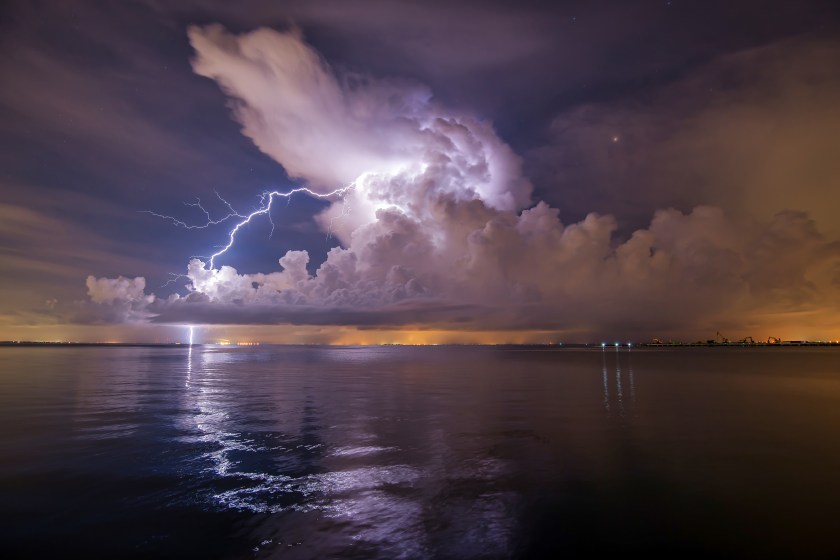
Electric Sublime: Atmospheric Drama Over Tampa Bay

The image of a lightning strike over Tampa Bay, captured from Vinoy Park, showcases the photographer’s skill in storm photography. Using a Nikon D610, the thirty-second exposure reveals a dramatic interplay of colors and natural forces. This work highlights Florida’s weather patterns, merging urban and natural landscapes in a powerful visual narrative.

Long exposure photograph of lightning illuminating clouds over Tampa Bay, viewed from Vinoy Park in St. Petersburg, Florida.
Long exposure lightning strike over Tampa Bay from Vinoy Park.

Among the most technically demanding and visually arresting images in Chapter 2 of the photographer’s Top 100 Journey, this capture of a lightning strike over Tampa Bay represents a masterful convergence of patience, preparation, and meteorological fortune. Photographed from Vinoy Park in St. Petersburg, the image transforms a transient weather event into a sustained meditation on nature’s raw power and the atmospheric spectacle that defines Florida’s subtropical climate.

The composition presents a study in horizontal stratification—water, distant shoreline, and sky arranged in classical landscape proportions, yet animated by the extraordinary electrical discharge that commands the frame’s center. A single lightning bolt descends vertically through towering cumulonimbus clouds, creating a luminous column that connects the charged atmosphere to the bay’s surface. The strike illuminates the cloud structure from within, revealing billowing formations in shades of pearl, lavender, and steel blue against a gradient sky that transitions from deep indigo to warm amber.

Technical execution reflects the specialized demands of storm photography. Working with a Nikon D610 at the wide end of an 18-35mm lens, the photographer selected an 18mm focal length to encompass both the expansive cloud system and the reflective water below. The thirty-second exposure at f/5.6 and ISO 400 represents a calculated approach to lightning capture—a long enough duration to increase the probability of recording a strike within the frame, yet controlled enough to prevent overexposure of ambient light sources visible along the distant horizon. This extended shutter speed also smooths the bay’s surface into a mirror-like plane, its subtle texture suggesting gentle motion while maintaining enough definition to anchor the composition.

The color palette distinguishes this work within the chapter’s broader collection. Where the architectural study of Signature Place employed monochrome austerity, this image embraces the full chromatic range of atmospheric phenomena. The storm cell’s cool blues and purples contrast with the warm ochre glow infiltrating from the right edge of the frame—likely light pollution from Tampa’s urban corridor or residual sunset illumination scattered through distant clouds. This interplay of cool and warm tones creates visual tension that enhances the image’s dramatic impact without resorting to artificial enhancement.

Within Chapter 2’s exploration of Florida Landscapes & Cityscapes, this photograph occupies essential territory. Florida’s identity remains inextricably linked to its volatile weather patterns—the daily thunderstorm cycles of summer, the atmospheric electricity that makes the state the lightning capital of North America. By documenting this phenomenon, the photographer engages with environmental storytelling that moves beyond picturesque representation toward a more complete portrait of place.

The work also demonstrates sophisticated understanding of the sublime in contemporary landscape photography. The tradition of depicting nature’s awesome power—from nineteenth-century Romantic painters to mid-century photographers like Ansel Adams capturing Sierra storms—finds fresh expression here. The lightning strike serves as both subject and metaphor: a literal discharge of atmospheric energy and a symbolic representation of nature’s capacity to humble human observers.

Viewed alongside the chapter’s urban architectural studies, this image provides necessary balance. Together, these photographs suggest a photographer equally attentive to built and natural environments, capable of finding visual poetry in glass towers and electrical storms alike. Such range indicates a mature artistic vision—one that recognizes Florida’s complexity as both a site of intensive human development and a landscape still subject to forces beyond human control.

Venice Fishing Pier Sunset: Mastering the Fundamentals of Light

Greg Urbano’s sunset photograph of the Venice Fishing Pier exemplifies the intersection of technical skill and artistic sensibility in landscape photography. Through meticulous use of exposure and composition, Urbano captures a moment where structured permanence meets the fluidity of nature, showcasing balanced tones and dynamic movement in a serene coastal scene.

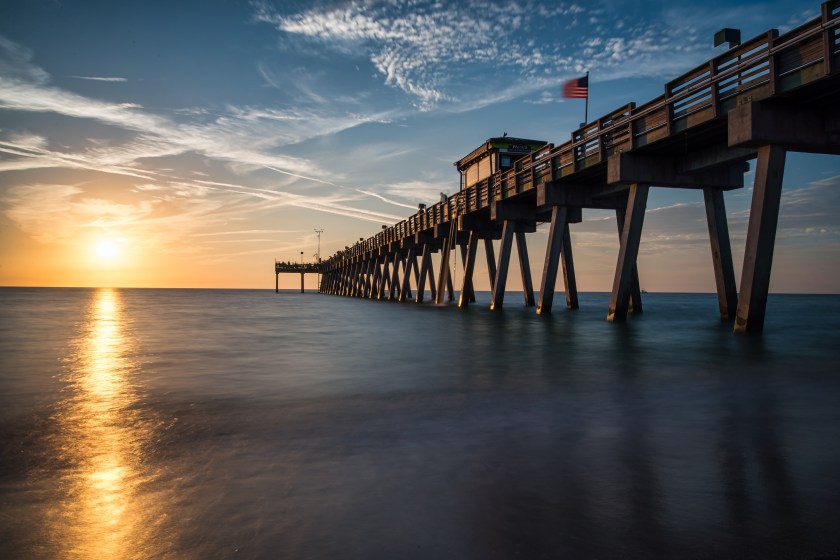
Sunset photograph of the Venice Fishing Pier in Florida, showing the pier extending into the Gulf of Mexico with golden reflections on calm water.
Sunset over the Gulf of Mexico with the Venice Fishing Pier in the background, captured in a long exposure.

Within Greg Urbano’s “Beginnings” chapter, this sunset photograph of the Venice Fishing Pier represents a photographer coming to terms with landscape photography’s essential discipline: the patient orchestration of light, water, and architecture. Shot along Florida’s Gulf Coast, the image demonstrates technical competence married to an emerging aesthetic sensibility—a combination that marks the transition from enthusiast to serious practitioner.

The technical execution reveals deliberate choices that elevate this beyond a simple sunset snapshot. Using a Nikon D610 with an 18-35mm lens set to 28mm, Urbano selected an aperture of f/18 to maximize depth of field, ensuring sharpness from the foreground water to the distant pier structure. The 13-second exposure at ISO 100 transforms the Gulf of Mexico into a silken plane, smoothing the texture of incoming waves into an ethereal blue gradient. This long exposure technique—fundamental to seascape photography—requires both technical knowledge and patience, waiting for the precise moment when light, tide, and atmospheric conditions align.

The composition demonstrates sophisticated spatial awareness. The pier’s diagonal thrust from lower right to upper left creates dynamic movement through the frame, leading the viewer’s eye from the silky foreground water toward the structure’s vanishing point. The rhythmic repetition of pier supports establishes a visual cadence, their angular geometry contrasting beautifully with the organic flow of water and clouds. An American flag atop the pier adds a vertical accent and a touch of patriotic iconography without overwhelming the scene’s natural beauty.

What distinguishes this photograph is Urbano’s treatment of light. The setting sun hovers just above the horizon line, its golden warmth reflected in a shimmering path across the water’s surface. The exposure balances multiple tonal zones expertly: the brilliant sun doesn’t blow out to featureless white, the shadowed pier structure retains detail, and the water holds both luminous highlights and cool, deep blues. This tonal control suggests a photographer who understands exposure compensation and potentially uses graduated neutral density filters or careful post-processing to manage the scene’s extreme dynamic range.

The sky deserves particular attention. Wispy cirrus clouds stretch across the frame in delicate streaks, their feathered patterns creating texture and visual interest in what might otherwise be empty blue space. The interplay between warm sunset tones near the horizon and cooler blues above establishes atmospheric depth, giving the image a sense of vast space and coastal openness.

As a “Beginnings” chapter work, this photograph represents mastery of landscape photography fundamentals. The long exposure technique, the careful attention to composition and leading lines, the patient waiting for optimal light—these are the building blocks upon which more experimental work can later be constructed. There’s confidence here, a photographer who has moved beyond technical uncertainty into intentional image-making.

The Venice Pier becomes more than a documentary subject; it transforms into a meditation on structure and impermanence. The solid, engineered permanence of the pier contrasts with the fluid, ever-changing water—a tension made visible through photographic technique. Urbano captures not just a place, but a moment of perfect equilibrium between human construction and natural forces, all bathed in the transient golden light that photographers chase endlessly along coastlines worldwide.

Fallen Tree: The Foundation of Seeing

The photograph from Hillsborough River State Park, taken by Greg Urbano in 2013 with a Nikon D7100, captures a pivotal moment in his artistic development. It reflects his early understanding of composition and intentionality, showcasing the dense subtropical landscape through HDR processing. This image symbolizes the importance of beginnings and learning in photography.

HDR photograph of a forest trail in Hillsborough River State Park with a large fallen tree across the path, dense vegetation, and filtered natural light, taken with a Nikon D7100 at 10mm.
A 2013 HDR landscape photograph of a fallen tree along a forest trail in Hillsborough River State Park, Florida.

In the opening chapter of Greg Urbano’s photographic journey, this image from Hillsborough River State Park stands as a testament to the essential nature of beginnings. Shot in 2013 with a Nikon D7100, the photograph captures more than a forest scene—it documents the foundational moment when a photographer learns to truly see the landscape before him.

The composition reveals an intuitive understanding of depth and perspective. Shot at 10mm, the wide-angle lens creates an immersive quality that draws viewers directly onto the trail. The fallen log in the foreground serves as both literal and metaphorical threshold, inviting passage into the deeper woods beyond. This diagonal element cuts across the frame with authority, its weathered texture rendered in sharp detail by the f/8.0 aperture, demonstrating Urbano’s early grasp of how to balance foreground interest with background context.

The HDR processing technique employed here reflects the experimental spirit characteristic of this pre-2015 period. While HDR would later fall somewhat out of favor in fine art photography circles, its application in this image serves a clear purpose: to capture the dynamic range of a Florida forest understory, where dappled sunlight creates extreme contrasts between shadow and highlight. The palmetto fronds and oak canopy are rendered with an almost hyper-real clarity that emphasizes the dense, layered nature of this subtropical ecosystem.

What makes this photograph particularly significant within the “Beginnings” chapter is its honesty about place and limitation. Urbano’s accompanying note—that this Florida park offered his “best opportunity to capture flowing water over river rocks” before relocating to Colorado—reveals something crucial about artistic development. Great photography emerges not from waiting for perfect conditions, but from working intensively with what’s available. This trail became his classroom, this fallen log his teacher.

The technical choices demonstrate a photographer thinking through his craft. The 1/50s shutter speed suggests deliberate handholding technique, while the ISO 200 setting indicates available light conditions and a preference for image quality. These aren’t the settings of someone simply pointing and shooting; they reveal consideration and intentionality, even in these early stages.

The color palette—predominantly greens with earth-toned accents—creates a cohesive, naturalistic feel despite the HDR processing. The slight motion blur in the foliage adds an organic quality, a reminder that this is a living landscape caught in a specific moment. The trail itself winds invitingly into the frame’s depth, disappearing around a bend that promises further discovery—a fitting metaphor for the artistic journey being documented.

In the context of Urbano’s larger body of work, this image represents more than just an early attempt. It embodies the crucial truth that mastery begins with showing up, with making photographs even when the circumstances aren’t ideal, even when the technique hasn’t been perfected. The photograph’s inclusion in his top 100 collection isn’t about technical perfection but about recognizing the importance of foundation.

Every artist’s journey requires a starting point, a place where curiosity meets commitment. This fallen tree, this Florida trail, this moment of learning to see—these are the essential ingredients that would eventually lead to mountain streams in Colorado and a mature photographic vision. The imperfect attempt, it turns out, isn’t just necessary. It’s everything.

Marie Selby Roots, 2012

In Greg Urbano’s 2012 black and white photograph of banyan tree roots at the Marie Selby Botanical Gardens, the ordinary is elevated to extraordinary. Using a Nikon D5100, he emphasizes natural architecture and texture, inviting viewers to appreciate the monumental presence of the roots and their intricate details, symbolizing persistence and growth.

Black‑and‑white close‑up photograph of large banyan tree roots spreading across the ground at Marie Selby Botanical Gardens, taken with a Nikon D5100.
A 2012 black‑and‑white photograph of banyan tree roots at Marie Selby Botanical Gardens in Sarasota, Florida.

In the Marie Selby Botanical Gardens of Sarasota, Florida, Greg Urbano discovered a subject that speaks to photography’s essential pursuit: finding extraordinary vision in the ordinary world. His 2012 image of a banyan tree’s root system transforms what many visitors might walk past into a study of natural architecture, texture, and the quiet monumentality of growth.

Shot on a Nikon D5100 at 18mm, the photograph embraces the wide-angle perspective to emphasize the sculptural sprawl of roots as they emerge from and return to the earth. The technical choices here are deliberate—an aperture of ƒ/4.5 provides sufficient depth of field to keep the intricate root structures sharp from foreground to middle ground, while the 1/80s shutter speed at ISO 100 captures clean detail in what appears to be soft, overcast light. The conversion to black and white strips away the distraction of color, allowing the image to become purely about form, line, and the interplay of light across weathered surfaces.

What makes this photograph compelling is its invitation to reconsider scale and presence. Banyan trees are known for their dramatic aerial root systems, which drop from branches to establish new anchor points in the soil. These roots, over time, become massive supporting structures that can make a single tree look like an entire forest. Urbano positions his lens low and close, giving these roots the monumentality they deserve. They undulate across the frame like organic highways, their surfaces marked by the patient work of decades—moss-covered in places, smooth and silvered in others, each groove and crack a record of growth and adaptation.

The composition draws the eye through natural pathways. The roots create flowing curves that lead deeper into the frame, while pockets of accumulated leaves and debris provide textural contrast and visual rest stops. There’s an almost sculptural quality to the way light models the cylindrical forms, revealing their three-dimensionality through subtle gradations of gray. The photograph operates on multiple levels: as documentation of a specific botanical specimen, as an abstract study of natural form, and as a meditation on time, persistence, and the hidden infrastructure that supports visible life.

Within the context of the Top 100 Journey project, this image represents the photographer’s developing eye for architectural elements in nature. The banyan’s root system is, after all, a kind of natural architecture—functional, structural, and beautiful in its purposeful design. The black and white treatment connects this work to photography’s documentary traditions while simultaneously elevating the subject into the realm of fine art.

There’s something humbling about standing before such a root system, and Urbano’s photograph captures that sense of being in the presence of something both ancient and ongoing. These roots speak to persistence, to the slow but inexorable way living things claim their space in the world. The photographer’s choice to work at ground level, to get close and look carefully, reveals a fundamental photographic truth: the world rewards sustained attention. What appears as mere roots at first glance becomes, through the lens, a landscape unto itself—complex, textured, and worthy of extended contemplation.

See this image on:

500px

Flickr

Into the Green Cathedral: Highlands Hammock State Park, 2011

Greg Urbano’s 2011 photograph from the Cypress Swamp Trail reflects the intersection of technical skill and artistic vision in photography. Using a Pentax K-x, he captures a weathered boardwalk amidst Florida’s lush swamp, illustrating the relationship between nature and human presence. The image balances light and texture, inviting viewers into a transformative experience.

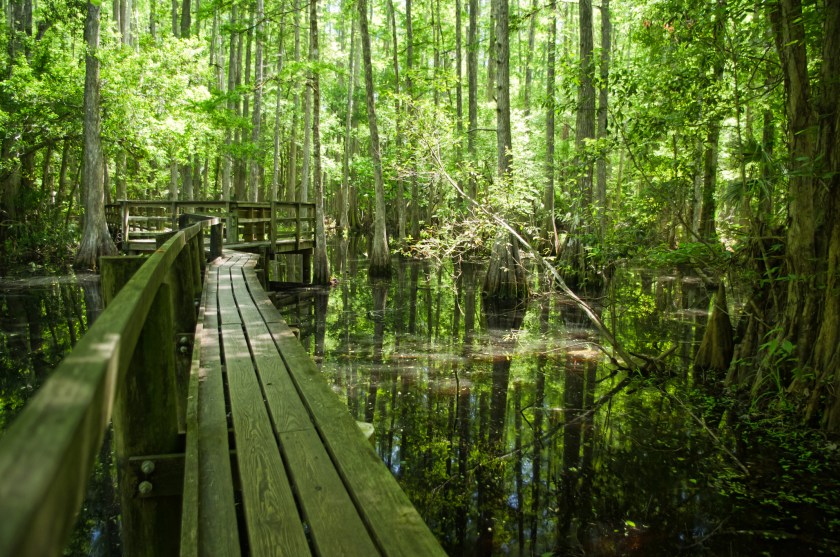
Wooden boardwalk winding through a cypress swamp with tall trees, exposed roots, and reflective dark water, photographed in 2011 with a Pentax K‑x.
A 2011 photograph of the Cypress Swamp Trail boardwalk at Highlands Hammock State Park in Florida.

In the early stages of any photographer’s journey, there exists a pivotal moment when technical capability intersects with artistic vision—when the craft begins to serve something deeper than mere documentation. Greg Urbano’s 2011 photograph from the Cypress Swamp Trail at Highlands Hammock State Park captures precisely this threshold, presenting a meditation on entrance, passage, and the liminal spaces where human intervention meets primordial nature.

The composition anchors itself on a weathered wooden boardwalk that curves through the left third of the frame, its moss-stained surface bearing witness to countless footsteps and Florida’s relentless humidity. Shot at 18mm on a Pentax K-x with the kit lens, Urbano demonstrates an understanding that wide-angle photography isn’t about capturing everything—it’s about creating context and relationship. The boardwalk serves as both literal path and visual guide, drawing the eye from the immediate foreground deep into the swamp’s verdant interior.

What distinguishes this image from typical nature photography is its masterful handling of light in a notoriously challenging environment. Shooting at f/4.0 with a 1/40s shutter speed and ISO 400, Urbano navigated the technical constraints of a modestly equipped camera to capture the dappled luminosity filtering through the canopy. The exposure balances the bright patches of sky visible through the trees with the darker water below, creating a tonal range that feels both accurate and atmospheric. The slightly elevated ISO introduces a subtle grain that, rather than detracting from the image, contributes to its organic texture.

The swamp water itself becomes a secondary canvas, reflecting the surrounding cypress trunks and creating visual echoes that blur the boundary between substance and reflection. Fallen branches break the surface tension, their pale, skeletal forms contrasting with the vibrant greens of new growth. This juxtaposition of decay and vitality speaks to the swamp’s essential nature as a place of transformation, where death continuously feeds life.

The color palette reveals a sophisticated eye for harmony—countless variations of green layer upon one another, from the luminous chartreuse of sunlit leaves to the deep olive shadows beneath the boardwalk. The aged wood introduces warmer earth tones, grounding the composition and providing respite from the overwhelming verdancy. These are the subtle decisions that separate intentional photography from happy accidents.

Within the context of a photographer’s formative work, this image represents more than technical competence. It demonstrates an emerging awareness of how to use man-made structures not as intrusions upon nature, but as framers of experience—the boardwalk doesn’t dominate the swamp; it offers a way to witness it. The slight curve of the path suggests journey and discovery, inviting viewers to imagine themselves walking deeper into this green cathedral.

Shot with entry-level equipment during a period when digital photography was becoming democratized, this photograph affirms that vision matters more than gear. The Pentax K-x and kit lens proved sufficient tools for capturing not just a place, but an atmosphere—the particular quality of light, air, and time that defines Florida’s ancient swamplands. It stands as evidence of a photographer learning to see, to compose, and to recognize moments worth preserving.

See this image on:

500px

Flickr