Aspen Stand, Poudre Canyon: A Study in Natural Geometry and Seasonal Light

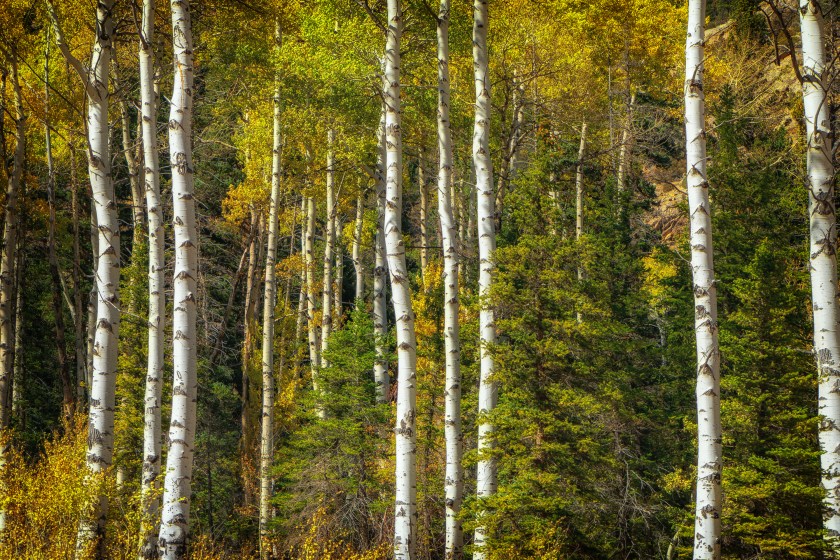
The photograph of aspen trees along Poudre Canyon Road showcases their autumn colors, balancing structural elements with individual characteristics. It features a rhythmic vertical pattern in soft light, capturing a unique moment in Colorado’s landscape photography. This singular image asserts confidence in representing the iconic aspens effectively and artistically.

Tall white-barked aspen trees with yellow autumn leaves standing among green forest vegetation.
A stand of aspen trees displays fall foliage along Poudre Canyon Road in Colorado.

Within Chapter 3 of Greg Urbano’s Top 100 Journey—dedicated to Colorado Landscapes & Cityscapes—this photograph of aspen trees along Poudre Canyon Road represents a pivotal encounter with one of the American West’s most celebrated subjects. The image captures a dense stand of aspens in their autumn transformation, their white-barked trunks creating a rhythmic vertical pattern against a backdrop of golden and green foliage. What distinguishes this work from countless other interpretations of the same subject is the photographer’s restraint and his attention to the structural elements that give the composition its quiet authority.

The vertical emphasis dominates immediately. Dozens of aspen trunks rise through the frame, their characteristic pale bark marked by dark knots and horizontal striations that break the otherwise smooth surfaces. These natural imperfections serve as visual anchors, preventing the repetition from becoming monotonous. The photographer has positioned himself to maximize this rhythm while maintaining sufficient depth to reveal the layered complexity of the forest. Evergreens punctuate the composition in the background, their darker masses providing tonal contrast to the luminous aspens and golden understory.

The treatment of light deserves particular attention. Soft, even illumination suggests either overcast conditions or the photographer’s careful timing to avoid harsh midday sun. This choice allows the full tonal range of the foliage to register—from the brilliant yellows of peak autumn color to the deeper golds and lingering greens of leaves in transition. The post-processing, executed using DXO’s Color Efex Pro 4, enhances these chromatic relationships without pushing them into artificiality. There is saturation here, certainly, but it reads as an intensification of what was present rather than an invention.

For a photographer whose body of work encompasses diverse subjects and geographies, this image represents his only definitive statement on the iconic Colorado aspen to date—a fact he acknowledges directly in his own description. This singularity is worth considering. Rather than pursuing multiple variations or returning season after season to refine his approach, he has selected this single frame as representative. The decision suggests confidence in what was captured during that Saturday excursion from Fort Collins, and indeed, the composition supports that confidence.

The photograph functions effectively within its designated chapter, contributing to a broader portrait of Colorado’s varied landscapes. Where other images in this collection might address the state’s dramatic peaks, urban environments, or expansive vistas, this work explores the intimate scale of the mid-elevation forest. The aspens become both subject and structure, their seriality creating pattern while their individuality—visible in every unique scarring and branch configuration—asserts the organic nature of the scene.

Technically, the image demonstrates solid fundamentals: adequate depth of field to maintain sharpness across the forest layers, balanced exposure that preserves detail in both the bright foliage and darker bark, and a color palette that feels cohesive despite its range. The vertical format suits the subject matter, emphasizing the trees’ upward growth and the viewer’s sense of standing within the grove rather than observing it from outside.

This photograph documents a specific moment along Poudre Canyon Road while simultaneously engaging with a broader photographic tradition of Western landscape representation. It is work that respects its subject without overstating its case—a measured, observant addition to an ongoing artistic journey.

Marie Selby Roots, 2012

In Greg Urbano’s 2012 black and white photograph of banyan tree roots at the Marie Selby Botanical Gardens, the ordinary is elevated to extraordinary. Using a Nikon D5100, he emphasizes natural architecture and texture, inviting viewers to appreciate the monumental presence of the roots and their intricate details, symbolizing persistence and growth.

Black‑and‑white close‑up photograph of large banyan tree roots spreading across the ground at Marie Selby Botanical Gardens, taken with a Nikon D5100.
A 2012 black‑and‑white photograph of banyan tree roots at Marie Selby Botanical Gardens in Sarasota, Florida.

In the Marie Selby Botanical Gardens of Sarasota, Florida, Greg Urbano discovered a subject that speaks to photography’s essential pursuit: finding extraordinary vision in the ordinary world. His 2012 image of a banyan tree’s root system transforms what many visitors might walk past into a study of natural architecture, texture, and the quiet monumentality of growth.

Shot on a Nikon D5100 at 18mm, the photograph embraces the wide-angle perspective to emphasize the sculptural sprawl of roots as they emerge from and return to the earth. The technical choices here are deliberate—an aperture of ƒ/4.5 provides sufficient depth of field to keep the intricate root structures sharp from foreground to middle ground, while the 1/80s shutter speed at ISO 100 captures clean detail in what appears to be soft, overcast light. The conversion to black and white strips away the distraction of color, allowing the image to become purely about form, line, and the interplay of light across weathered surfaces.

What makes this photograph compelling is its invitation to reconsider scale and presence. Banyan trees are known for their dramatic aerial root systems, which drop from branches to establish new anchor points in the soil. These roots, over time, become massive supporting structures that can make a single tree look like an entire forest. Urbano positions his lens low and close, giving these roots the monumentality they deserve. They undulate across the frame like organic highways, their surfaces marked by the patient work of decades—moss-covered in places, smooth and silvered in others, each groove and crack a record of growth and adaptation.

The composition draws the eye through natural pathways. The roots create flowing curves that lead deeper into the frame, while pockets of accumulated leaves and debris provide textural contrast and visual rest stops. There’s an almost sculptural quality to the way light models the cylindrical forms, revealing their three-dimensionality through subtle gradations of gray. The photograph operates on multiple levels: as documentation of a specific botanical specimen, as an abstract study of natural form, and as a meditation on time, persistence, and the hidden infrastructure that supports visible life.

Within the context of the Top 100 Journey project, this image represents the photographer’s developing eye for architectural elements in nature. The banyan’s root system is, after all, a kind of natural architecture—functional, structural, and beautiful in its purposeful design. The black and white treatment connects this work to photography’s documentary traditions while simultaneously elevating the subject into the realm of fine art.

There’s something humbling about standing before such a root system, and Urbano’s photograph captures that sense of being in the presence of something both ancient and ongoing. These roots speak to persistence, to the slow but inexorable way living things claim their space in the world. The photographer’s choice to work at ground level, to get close and look carefully, reveals a fundamental photographic truth: the world rewards sustained attention. What appears as mere roots at first glance becomes, through the lens, a landscape unto itself—complex, textured, and worthy of extended contemplation.

See this image on:

500px

Flickr