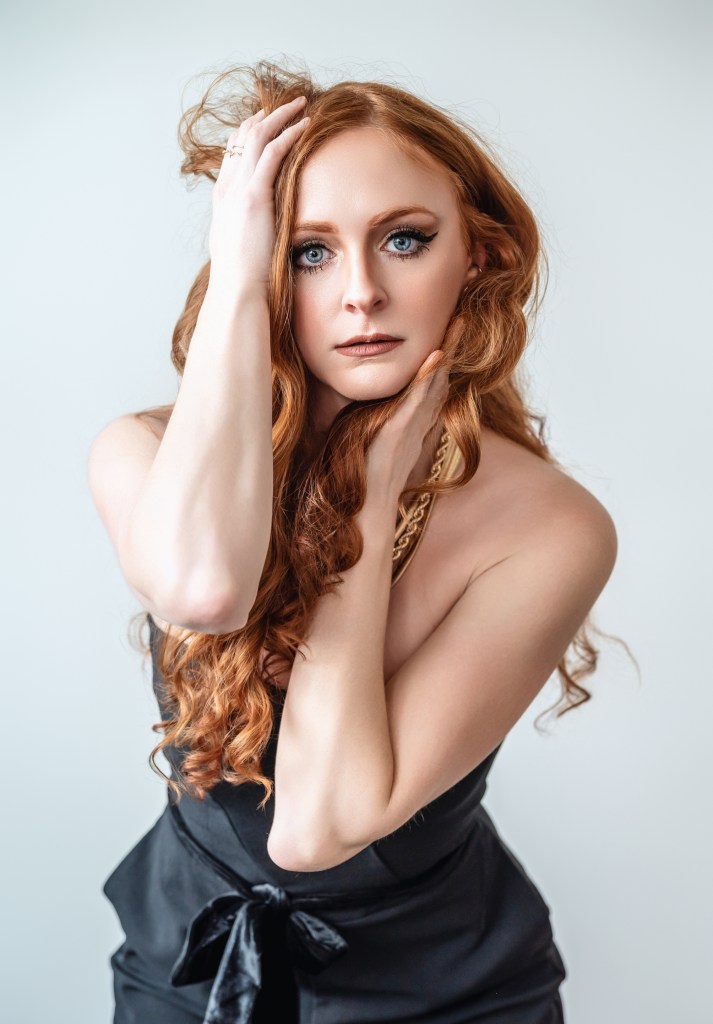
Natural Elegance: A Portrait in Copper and Light

Abigail Marchetti, known as Copper Muse, poses at a Denver Models open shoot, showcasing the photographer’s evolving studio portraiture techniques. Utilizing natural light, he captures her striking features and authentic expression, emphasizing color harmony and psychological presence. This portrait marks a significant step in his artistic development, blending classical principles with a modern sensibility.

Studio portrait of a red-haired woman in a black dress posing against a light background with her hands framing her face.
Model Abigail Marchetti, known as Copper Muse, poses during a Denver Models open shoot at Realm Studio in Denver.

This compelling portrait of model Abigail Marchetti exemplifies the photographer’s deepening engagement with studio portraiture and his refined approach to natural light as a primary sculptural tool. Captured during a Denver Models open shoot at Realm Studio, the image represents continued exploration of collaborative creative environments while demonstrating increasingly sophisticated control of the portraitist’s essential elements: light, gesture, color harmony, and psychological presence.

The composition centers on the model’s striking features—vibrant copper-red hair cascading in loose waves, piercing blue-green eyes meeting the camera with direct but unguarded confidence, and pale skin that catches and reflects the soft window light with luminous clarity. Her pose, with one hand gracefully raised to her hair and the other touching her neck, creates natural framing that draws attention to her face while suggesting unaffected spontaneity. The black strapless garment provides bold tonal contrast against both her skin and the pale backdrop, creating visual drama without competing for attention.

What distinguishes this work is the photographer’s masterful exploitation of natural window light. Rather than relying on the multiple strobes and reflectors typical of commercial studio work, he has chosen a more classical approach that recalls portrait painting traditions. The directional quality of the illumination—soft yet defined—models the subject’s features with sculptural precision while maintaining delicate gradations across skin tones. Highlights along the hair reveal its rich, multidimensional copper coloring, transforming what could be merely descriptive documentation into chromatic study.

The technical execution demonstrates growing confidence with the Nikon Z5 system and the versatile 24-120mm lens. The focal length selection—likely in the moderate telephoto range—provides flattering perspective without distortion, while the depth of field keeps the subject sharply defined against the subtly gradated background. The exposure balances the challenge of pale skin and light background without sacrificing detail in either the model’s features or the deeper tones of her garment.

Within the framework of Chapter 6—”The Road Ahead: Recent Work & Ongoing Exploration”—this portrait signals important developments in his artistic trajectory. The open shoot environment, like the previous workshop-based work, indicates willingness to engage with structured collaborative opportunities while bringing his distinct sensibility to bear. Yet where some open shoots yield generic beauty documentation, this image transcends its circumstances through careful attention to classical portraiture principles: the quality of light, the authenticity of expression, the harmony of color and form.

The model’s direct gaze introduces a quality often absent from his landscape and architectural work—reciprocal acknowledgment between photographer and subject. This mutual recognition adds psychological dimension, transforming technical exercise into genuine encounter. The slight asymmetry in her expression—contemplative rather than performative—suggests comfort and trust within the photographic exchange.

The photograph also reveals evolving aesthetic priorities. While maintaining the tonal sensitivity and compositional rigor evident throughout his portfolio, he demonstrates here that minimalism need not preclude richness. The interplay of copper hair, pale skin, black fabric, and soft grey background creates visual complexity through chromatic relationships rather than environmental detail. This represents a distillation of his practice—finding depth in apparent simplicity, discovering complexity in restraint—now applied to the human figure with increasing assurance and grace.

Portrait Slam 2024

Portrait Slam 2024 features Frank Graziano posed on a vintage railroad car, showcasing a blend of environmental portraiture and technical skill. The composition balances subject and setting, using light and shadow effectively. This portrait reflects the photographer’s evolution, integrating contemporary styling with Americana themes, and highlights a confident approach to on-location shooting.

Man wearing a hat stands on the side steps of a black railroad car, looking to the side.
Frank Graziano poses on a railroad car at the Colorado Railroad Museum in Golden, Colorado.

The photographer captures Frank Graziano in a moment of studied nonchalance, balanced on the step of a vintage railroad car against the industrial textures of riveted steel and weathered paint. This image, created during Portrait Slam 2024 at the Colorado Railroad Museum, exemplifies the photographer’s growing confidence in environmental portraiture—a technical and conceptual evolution clearly marked within Chapter 4 of his Top 100 Journey project.

What immediately distinguishes this portrait is its sophisticated balance between subject and setting. The railroad car’s dark, rivet-studded surface creates a powerful geometric frame, yet never overwhelms Graziano’s presence. The model’s positioning—one foot planted on the step, the other casually lifted, holding a vertical rail—demonstrates a dynamic use of diagonal lines that pulls the viewer’s eye through the composition. His cowboy hat and leather jacket evoke classic Americana, while the contemporary styling prevents the image from slipping into pastiche or nostalgia.

The photographer’s technical execution reveals careful consideration of light and shadow. The overcast sky provides even, diffused illumination that preserves detail across both the subject’s face and the textured metal surface behind him. This soft light wraps around Graziano’s features, creating subtle modeling without harsh shadows—a particularly important choice given the industrial setting’s potential to create competing visual elements. The muted color palette of charcoal grays, weathered browns, and faded blacks creates tonal harmony while allowing the warm leather tones of the hat to serve as a visual anchor.

Within the context of Chapter 4—Portraits Studio, Outdoor & Workshop Work—this image demonstrates the photographer’s ability to synthesize controlled studio techniques with the spontaneity of location work. Workshop environments often push photographers beyond their comfort zones, and this portrait suggests someone working confidently with both the challenges and opportunities of on-location shooting. The inclusion of the “KEEP OFF” text, partially visible in the frame, adds an element of subtle irony: the subject occupies precisely the forbidden space, transforming restriction into creative possibility.

The railroad setting serves as more than mere backdrop. It functions as visual metaphor—the convergence of journey, transit, and transitional spaces that resonates with the photographer’s larger Top 100 Journey project. The industrial heritage embedded in the railroad car’s weathered surface speaks to American mythology and masculine archetypes, themes Graziano’s styling deliberately engages while maintaining contemporary relevance.

From a curatorial perspective, this photograph marks a maturation in the photographer’s approach to environmental portraiture. Earlier works in his portfolio occasionally struggled with the balance between subject and location; here, both elements coexist in productive tension. The composition’s structured geometry—the vertical rails, horizontal platform, the rectangular frames within frames—creates order without rigidity, allowing Graziano’s natural pose to feel both choreographed and spontaneous.

The image’s inclusion in the Top 100 Journey project reflects its successful synthesis of technical skill, conceptual clarity, and visual impact. It demonstrates how workshop environments can push photographers toward their strongest work, combining the pressure of limited time with the inspiration of new locations and collaborative energy. The result is a portrait that honors both its subject and its setting, creating a narrative that extends beyond the single frozen moment into broader considerations of place, identity, and American visual mythology.