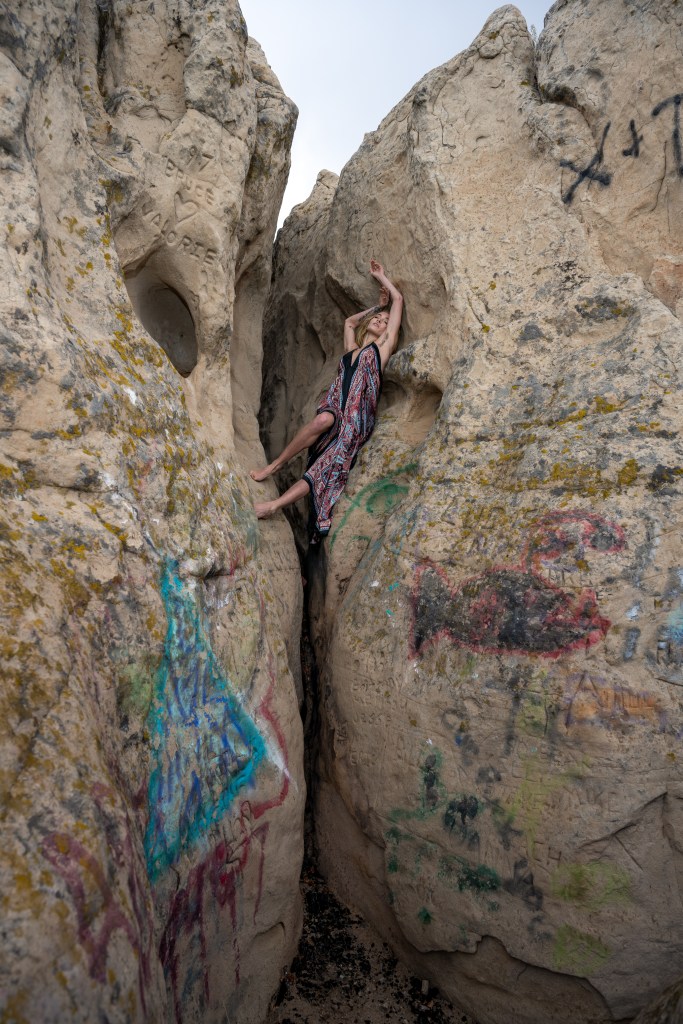
Suspended Between Earth and Sky: A Study in Geometric Embrace

The photograph of Jennie Parks in a sandstone crevice at the Colorado-Wyoming border conveys a powerful interplay between human form and rugged landscape. The composition showcases Parks as both an integral part of the environment and a symbol of human vulnerability, enriched by graffiti that connects ancient rock with contemporary existence.

Model Jennie Parks posed barefoot within a narrow sandstone rock crevice, surrounded by weathered stone walls with graffiti and lichen.
Jennie Parks positioned inside a sandstone crevice at the Natural Fort rock formation on the Colorado–Wyoming border.

In this striking composition from Chapter 6 of the photographer’s Top 100 Journey, the human figure becomes a graceful counterpoint to the harsh geometry of desert stone. Shot at the natural fort rock formation straddling the Colorado-Wyoming border, the image captures model Jennie Parks wedged within a narrow crevasse, her body forming a living bridge between two massive limestone walls that tower overhead.

The photographer demonstrates a sophisticated understanding of environmental portraiture here, positioning his subject not merely within the landscape but as an integral element of its architecture. Parks’s extended pose—one arm reaching upward, legs braced against opposing walls—transforms the human form into a line of tension that mirrors the vertical thrust of the surrounding stone. The patterned fabric of her dress introduces rhythmic visual complexity against the textured, graffiti-marked surfaces of the rock, creating a dialogue between organic movement and geological permanence.

Technically, the composition exploits the natural framing device of the rock formation with considerable skill. The converging walls create strong diagonal lines that draw the eye upward toward the narrow strip of overcast sky, while the low vantage point emphasizes the vertiginous scale of the formation. The photographer has worked with available light to maintain detail in both the shadowed crevasse and the brighter upper reaches, a challenging exposure balance that preserves the dimensional quality of the weathered stone surfaces.

What distinguishes this work within the context of “The Road Ahead: Recent Work & Ongoing Exploration” is its synthesis of earlier themes with new formal rigor. The image continues the photographer’s established interest in the relationship between human vulnerability and natural grandeur, yet demonstrates an evolving sophistication in how that relationship is articulated. Rather than placing the figure as a small element overwhelmed by landscape—a common approach in environmental portraiture—he positions Parks as an active participant in the space’s geometry, neither dominated by nor dominating the scene.

The inclusion of graffiti on the rock faces introduces an unexpected documentary element. These colorful marks of human passage—blue and turquoise abstractions, faded pink tags—situate the timeless geological formation within contemporary reality. Rather than diminishing the image’s aesthetic power, this urban palimpsest enriches the reading: the rock has witnessed countless human gestures, from ancient weathering to modern spray paint to this moment of choreographed grace.

As representative of ongoing exploration, the photograph reveals an artist continuing to refine his visual vocabulary while remaining open to chance encounters and improvisation. The natural fort formation itself suggests the kind of site-responsive work that characterizes mature landscape photography—locations discovered rather than constructed, where the photographer’s role becomes one of recognition and revelation rather than wholesale invention.

In the broader trajectory of the Top 100 Journey, this image marks a moment of confident synthesis. The technical command is assured, the conceptual framework clear, yet there remains an element of spontaneity in how Parks inhabits the narrow space. It is work that looks both backward to established concerns and forward to possibilities yet unrealized—precisely the balance one expects from a chapter titled “The Road Ahead.”

Marie Selby Roots, 2012

In Greg Urbano’s 2012 black and white photograph of banyan tree roots at the Marie Selby Botanical Gardens, the ordinary is elevated to extraordinary. Using a Nikon D5100, he emphasizes natural architecture and texture, inviting viewers to appreciate the monumental presence of the roots and their intricate details, symbolizing persistence and growth.

Black‑and‑white close‑up photograph of large banyan tree roots spreading across the ground at Marie Selby Botanical Gardens, taken with a Nikon D5100.
A 2012 black‑and‑white photograph of banyan tree roots at Marie Selby Botanical Gardens in Sarasota, Florida.

In the Marie Selby Botanical Gardens of Sarasota, Florida, Greg Urbano discovered a subject that speaks to photography’s essential pursuit: finding extraordinary vision in the ordinary world. His 2012 image of a banyan tree’s root system transforms what many visitors might walk past into a study of natural architecture, texture, and the quiet monumentality of growth.

Shot on a Nikon D5100 at 18mm, the photograph embraces the wide-angle perspective to emphasize the sculptural sprawl of roots as they emerge from and return to the earth. The technical choices here are deliberate—an aperture of ƒ/4.5 provides sufficient depth of field to keep the intricate root structures sharp from foreground to middle ground, while the 1/80s shutter speed at ISO 100 captures clean detail in what appears to be soft, overcast light. The conversion to black and white strips away the distraction of color, allowing the image to become purely about form, line, and the interplay of light across weathered surfaces.

What makes this photograph compelling is its invitation to reconsider scale and presence. Banyan trees are known for their dramatic aerial root systems, which drop from branches to establish new anchor points in the soil. These roots, over time, become massive supporting structures that can make a single tree look like an entire forest. Urbano positions his lens low and close, giving these roots the monumentality they deserve. They undulate across the frame like organic highways, their surfaces marked by the patient work of decades—moss-covered in places, smooth and silvered in others, each groove and crack a record of growth and adaptation.

The composition draws the eye through natural pathways. The roots create flowing curves that lead deeper into the frame, while pockets of accumulated leaves and debris provide textural contrast and visual rest stops. There’s an almost sculptural quality to the way light models the cylindrical forms, revealing their three-dimensionality through subtle gradations of gray. The photograph operates on multiple levels: as documentation of a specific botanical specimen, as an abstract study of natural form, and as a meditation on time, persistence, and the hidden infrastructure that supports visible life.

Within the context of the Top 100 Journey project, this image represents the photographer’s developing eye for architectural elements in nature. The banyan’s root system is, after all, a kind of natural architecture—functional, structural, and beautiful in its purposeful design. The black and white treatment connects this work to photography’s documentary traditions while simultaneously elevating the subject into the realm of fine art.

There’s something humbling about standing before such a root system, and Urbano’s photograph captures that sense of being in the presence of something both ancient and ongoing. These roots speak to persistence, to the slow but inexorable way living things claim their space in the world. The photographer’s choice to work at ground level, to get close and look carefully, reveals a fundamental photographic truth: the world rewards sustained attention. What appears as mere roots at first glance becomes, through the lens, a landscape unto itself—complex, textured, and worthy of extended contemplation.

See this image on:

500px

Flickr