Suspended Between Earth and Sky: A Study in Geometric Embrace

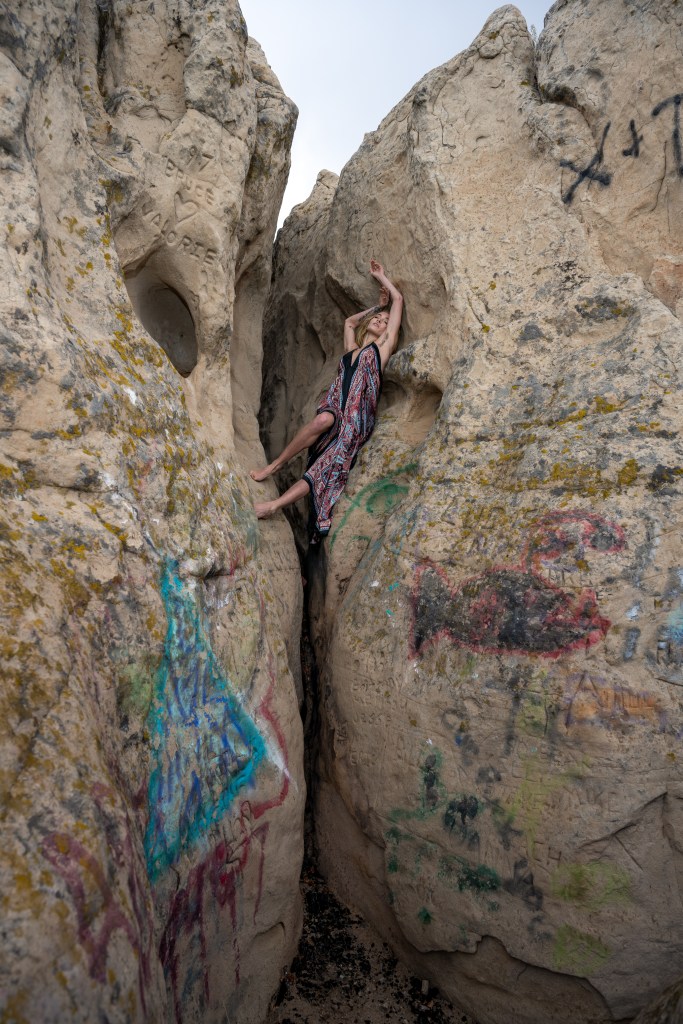
The photograph of Jennie Parks in a sandstone crevice at the Colorado-Wyoming border conveys a powerful interplay between human form and rugged landscape. The composition showcases Parks as both an integral part of the environment and a symbol of human vulnerability, enriched by graffiti that connects ancient rock with contemporary existence.

Model Jennie Parks posed barefoot within a narrow sandstone rock crevice, surrounded by weathered stone walls with graffiti and lichen.
Jennie Parks positioned inside a sandstone crevice at the Natural Fort rock formation on the Colorado–Wyoming border.

In this striking composition from Chapter 6 of the photographer’s Top 100 Journey, the human figure becomes a graceful counterpoint to the harsh geometry of desert stone. Shot at the natural fort rock formation straddling the Colorado-Wyoming border, the image captures model Jennie Parks wedged within a narrow crevasse, her body forming a living bridge between two massive limestone walls that tower overhead.

The photographer demonstrates a sophisticated understanding of environmental portraiture here, positioning his subject not merely within the landscape but as an integral element of its architecture. Parks’s extended pose—one arm reaching upward, legs braced against opposing walls—transforms the human form into a line of tension that mirrors the vertical thrust of the surrounding stone. The patterned fabric of her dress introduces rhythmic visual complexity against the textured, graffiti-marked surfaces of the rock, creating a dialogue between organic movement and geological permanence.

Technically, the composition exploits the natural framing device of the rock formation with considerable skill. The converging walls create strong diagonal lines that draw the eye upward toward the narrow strip of overcast sky, while the low vantage point emphasizes the vertiginous scale of the formation. The photographer has worked with available light to maintain detail in both the shadowed crevasse and the brighter upper reaches, a challenging exposure balance that preserves the dimensional quality of the weathered stone surfaces.

What distinguishes this work within the context of “The Road Ahead: Recent Work & Ongoing Exploration” is its synthesis of earlier themes with new formal rigor. The image continues the photographer’s established interest in the relationship between human vulnerability and natural grandeur, yet demonstrates an evolving sophistication in how that relationship is articulated. Rather than placing the figure as a small element overwhelmed by landscape—a common approach in environmental portraiture—he positions Parks as an active participant in the space’s geometry, neither dominated by nor dominating the scene.

The inclusion of graffiti on the rock faces introduces an unexpected documentary element. These colorful marks of human passage—blue and turquoise abstractions, faded pink tags—situate the timeless geological formation within contemporary reality. Rather than diminishing the image’s aesthetic power, this urban palimpsest enriches the reading: the rock has witnessed countless human gestures, from ancient weathering to modern spray paint to this moment of choreographed grace.

As representative of ongoing exploration, the photograph reveals an artist continuing to refine his visual vocabulary while remaining open to chance encounters and improvisation. The natural fort formation itself suggests the kind of site-responsive work that characterizes mature landscape photography—locations discovered rather than constructed, where the photographer’s role becomes one of recognition and revelation rather than wholesale invention.

In the broader trajectory of the Top 100 Journey, this image marks a moment of confident synthesis. The technical command is assured, the conceptual framework clear, yet there remains an element of spontaneity in how Parks inhabits the narrow space. It is work that looks both backward to established concerns and forward to possibilities yet unrealized—precisely the balance one expects from a chapter titled “The Road Ahead.”

Downtown Denver Dance in the Streets with Nina Harrington

Nina Harrington’s dance pose in downtown Denver exemplifies a sophisticated blend of environmental portraiture and spontaneous movement. The photographer skillfully uses off-camera flash and a low angle to enhance the scene, revealing dynamic interplay between light, architecture, and the dancer’s grace. This image highlights the artist’s technical evolution in outdoor portrait work.

Dancer balancing on one foot along a yellow centerline in a city street, arms extended, with buildings lining both sides.
Nina Harrington performs a dance pose in the middle of a downtown Denver street.

In this striking urban portrait, the photographer demonstrates a sophisticated command of environmental portraiture, transforming a mundane city thoroughfare into a stage for dynamic human expression. The image captures dancer Nina Harrington suspended mid-leap above yellow road markings in downtown Denver, her body forming an elegant arc against the crisp Colorado sky. The composition exemplifies the photographer’s evolving approach to outdoor portrait work, where controlled lighting meets spontaneous movement in public spaces.

The technical execution reveals deliberate choices that elevate this beyond documentary street photography. Shot at midday—traditionally challenging lighting conditions—the photographer employed a Godox AD100 pro strobe without modification to combat the harsh overhead sun. This off-camera flash technique creates a subtle but crucial fill that prevents the subject from becoming a silhouette while maintaining the natural warmth of the ambient light. The decision to forgo light modifiers preserves the hard-edged quality of the urban environment, allowing the concrete, asphalt, and brick architecture to retain their textural integrity.

Compositionally, the low vantage point proves essential to the image’s impact. By positioning the camera near street level, the photographer achieves multiple objectives: the dancer’s figure dominates the frame against the sky, creating separation from the complex urban backdrop; the road’s yellow double lines converge dramatically toward the vanishing point, providing powerful leading lines that anchor the viewer’s eye; and the surrounding buildings—including the distinctive Paramount sign—frame the action without overwhelming it. This perspective transforms the ordinary into the theatrical.

The choice of the Nikkor 24-120mm f/4 lens suggests a working distance that allowed the subject freedom of movement while maintaining compositional control. The focal length appears moderate within that range, neither compressing the perspective dramatically nor exaggerating the spatial relationships. This middle-ground approach serves the narrative well, presenting the scene as the viewer might experience it while standing in that same intersection.

Within Chapter 4’s exploration of portraits created in studios, outdoor environments, and workshop settings, this photograph represents the photographer’s confidence in synthesizing multiple disciplines. The image incorporates studio lighting principles applied to an uncontrolled environment, the collaborative relationship between photographer and subject typical of workshop environments, and the opportunistic awareness required for successful street photography. The dancer’s athletic grace becomes a vehicle for exploring light, geometry, and decisive moment—themes that recur throughout his portraiture work.

The post-processing in Luminar AI enhances rather than transforms the captured scene. The color palette—dominated by blues, warm earth tones, and the vibrant yellow road markings—feels authentic to the high-altitude western light. There’s a clarity and dimensional quality to the image that suggests thoughtful tonal adjustments without the oversaturation or artificial drama that often plague urban photography.

What distinguishes this work within the photographer’s broader journey is the seamless integration of technical skill and artistic vision. The image requires split-second timing, precise exposure calculation, spatial awareness, and the ability to direct movement—all while working in a public street with its inherent unpredictability. That such complexity appears effortless in the final result speaks to the photographer’s maturation in outdoor portrait work, where preparation meets spontaneity in equal measure.