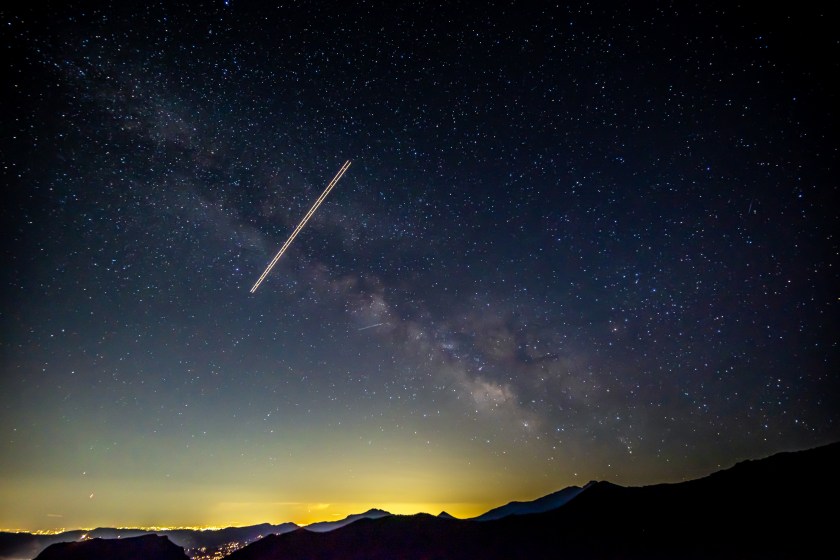
Among the selections comprising Chapter 3 of Greg Urbano’s Top 100 Journey, “Milky Way Interrupted” stands as perhaps the most conceptually layered work—a photograph that captures not one subject but three distinct temporal and spatial realities coexisting within a single frame. Captured from Rainbow Curve in Rocky Mountain National Park, the image presents the galactic core of the Milky Way, the ancient mountain silhouettes of Colorado’s high country, and a striking diagonal light trail that bisects the celestial display with unmistakable human presence.
The composition’s power lies precisely in this interruption. The aircraft’s light trail—rendered as a warm, golden-orange streak through long exposure—cuts diagonally across the frame, creating a dynamic tension between the timeless and the contemporary. While astrophotography typically seeks to eliminate such intrusions, this photographer has embraced the collision, transforming what might be considered a technical flaw into the photograph’s conceptual strength. The work becomes a document of our current moment, when even the most remote wilderness viewing points cannot escape the signatures of human movement across the planet.
Technical execution reveals careful consideration of the challenges inherent to night sky photography. Shot with a Nikon Z5, the image demonstrates the full-frame sensor’s capability to resolve stellar detail while managing the noise characteristics of extended ISO settings. The photographer has successfully balanced multiple exposure considerations: maintaining star sharpness through appropriate shutter speed selection, capturing the subtle gradations of airglow near the horizon, and rendering the mountainous foreground as legible silhouettes rather than featureless black masses.
The color palette deserves particular attention. The frame transitions from deep indigo and blue-black in the upper reaches, through the dusty rose and purple tones of the galactic core, down to the unexpected warmth of light pollution painting the horizon in amber and gold. This terrestrial glow—emanating from Front Range cities invisible beyond the mountains—creates an almost painterly quality along the lower third of the composition. The photograph thus captures three light sources simultaneously: starlight millions of years old, the reflected sunlight from a pressurized aluminum tube at 35,000 feet, and the collective illumination of human civilization diffused through atmosphere and distance.
Within the context of the Colorado Landscapes & Cityscapes chapter, this work occupies a unique position. It represents the photographer’s willingness to document Colorado not as pristine wilderness separate from human influence, but as a landscape inevitably marked by contemporary life. The image acknowledges that wilderness photography in the 21st century must contend with satellite constellations, flight paths, and light pollution—that the “natural” landscape exists now only in relationship to human infrastructure.
The title’s simple declaration—”Interrupted”—functions with appropriate restraint. It states fact without judgment, allowing viewers to bring their own interpretations to the juxtaposition. Some may read the aircraft trail as intrusion, others as a reminder of our species’ brief moment against cosmic timescales. The photographer wisely resists imposing a singular reading, instead presenting the visual evidence and trusting the inherent complexity of the image to generate meaning. This restraint marks a mature approach to landscape photography’s evolving role in documenting our changing relationship with the natural world.
 Greg Urbano