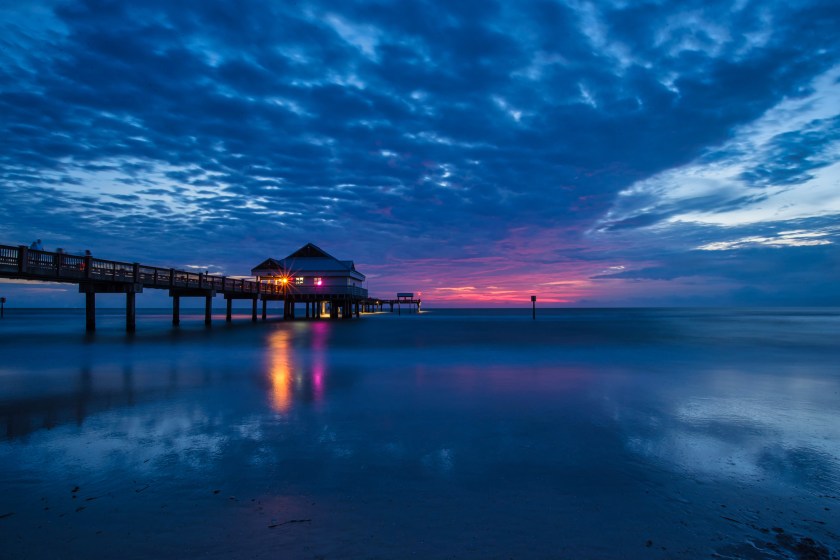
In this contemplative study from Chapter 2 of the Top 100 Journey, the photographer demonstrates a sophisticated command of long-exposure technique to capture the liminal hour where day surrenders to night along Florida’s Gulf Coast. Shot at Clearwater Beach, this sixty-second exposure transforms the volatile surf into a glassy, ethereal plane that mirrors the atmospheric drama unfolding above.
The composition centers on Pier 60, an iconic structure that extends into the frame with geometric precision. The photographer has positioned himself to capture the pier in its full dimensionality—the wooden pilings create a rhythmic vertical pattern that draws the eye toward the pavilion structure, where warm sodium lights pierce the deepening blue hour. These artificial punctuations of yellow and magenta provide crucial counterpoints to the natural color palette, preventing the image from dissolving entirely into monochromatic twilight. The long exposure has softened the lights into glowing orbs, their reflections stretching across the wet sand in elongated streaks that echo the horizontal thrust of the pier itself.
The technical execution reveals deliberate choices throughout. At f/22, the photographer has prioritized depth of field and the creation of diffraction spikes around the light sources, adding a subtle stellar quality to the illumination. The ISO 100 setting ensures maximum image quality, while the 18mm focal length—shot on a full-frame Nikon D610 with an 18-35mm lens—provides expansive coverage that encompasses both the architectural subject and the vast atmospheric canvas surrounding it. This wider perspective situates the human-made structure within the broader natural context, a recurring tension in his Florida landscapes.
The sky commands nearly two-thirds of the frame, and rightfully so. The textured cloud formations—rendered in deep indigos and cobalt blues—create a dramatic ceiling that seems to press down upon the horizon line where pink and peach tones persist from the recently set sun. This color gradient, from warm horizon to cool zenith, demonstrates the photographer’s understanding of transitional light and his patience in waiting for the precise moment when competing color temperatures achieve balance.
The wet foreground sand serves multiple compositional functions. Its reflective quality doubles the visual information, creating subtle mirror images of the pier lights, while the barely perceptible texture of the beach—preserved despite the long exposure—grounds the image in physical reality. This detail prevents the photograph from becoming overly abstract, maintaining the delicate equilibrium between documentary observation and interpretive vision.
Within the broader context of Chapter 2—Florida Landscapes & Cityscapes—this image exemplifies the photographer’s evolving relationship with his adopted coastal environment. Where earlier works might emphasize the region’s vibrant daylight character, this photograph engages with Florida’s more contemplative aspects: the quiet moments of transition, the interplay between natural beauty and recreational infrastructure, the way tourism and wilderness coexist along these developed shorelines.
The photograph ultimately succeeds as both technical achievement and aesthetic statement. It captures a specific place at a specific moment while transcending those particulars to evoke the universal experience of standing at the edge of vast water as darkness approaches—a meditation on transience rendered permanent through the camera’s patient eye.
 Greg Urbano