Jonny Edward — Portrait

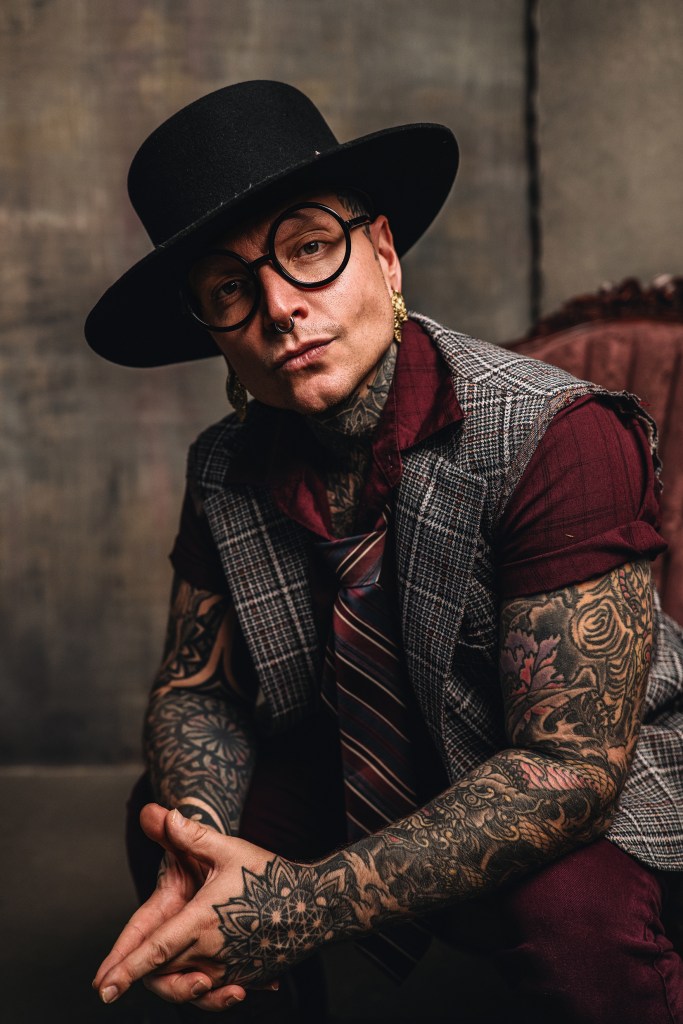
In this sixth chapter of the visual odyssey, Jonny Edward’s portrait embodies the blend of environment and identity, created in his studio, Atelier Alchimia. The image emphasizes texture and iconography, showcasing a stylistic marriage between traditional garments and modern tattoos. It marks a pivot to evocative, symbolic portraiture, exploring the philosophy of aesthetic existence.

Portrait of a person wearing a black hat and round glasses, seated indoors with tattooed arms, dressed in a vest, shirt, and tie against a textured studio backdrop.
Portrait of Jonny Edward photographed seated in his studio, wearing a hat, glasses, and layered clothing, with tattoos visible on both arms.

In the sixth chapter of this ongoing visual odyssey, the photographer explores the intersection of environment and identity, moving beyond the mere capture of a likeness to conduct a sophisticated study of texture and personal iconography. This portrait of Jonny Edward, captured within the subject’s own creative sanctuary, Atelier Alchimia, serves as a cornerstone of the “Recent Work & Ongoing Exploration” phase. It represents a pivot toward a more layered, atmospheric approach to portraiture, where the subject and the space they inhabit become indistinguishable components of a singular narrative.

The composition is a masterclass in the management of complex visual information. The subject is positioned with a calculated stillness, his gaze direct and piercing through circular frames that provide a geometric anchor for the viewer. There is a profound intentionality in the styling: the marriage of classic haberdashery—a wide-brimmed felt hat, a patterned cravat, and a structured waistcoat—against the modern, intricate cartography of extensive tattoo work. The photographer skillfully navigates these disparate elements, ensuring that the elaborate patterns of the skin and the plaid of the vest complement rather than compete with one another.

Technically, the image excels in its tonal range and tactile quality. The lighting is deliberate, casting a soft yet directional glow that carves out the contours of the subject’s face and highlights the physical relief of the ink on his forearms. There is a tangible weight to the textures presented: the coarseness of the waistcoat’s weave, the smoothness of the felt hat, and the weathered patina of the background wall. This background, reminiscent of a Renaissance fresco in its muted, distressed tones, provides a timeless quality that lifts the portrait out of a specific era and into a more permanent, artistic realm.

As a significant entry in the “Top 100 Journey,” this work illustrates the photographer’s evolving mastery of the “creative workshop” environment. By collaborating within a space designed for artistic alchemy, he has successfully distilled the essence of a fellow creator. The image functions as a dialogue between two artists—one in front of the lens and one behind it—resulting in a portrait that feels less like an observation and more like an excavation.

In the context of Chapter 6: The Road Ahead, this photograph signals a refined direction. It moves away from traditional, literal portraiture toward a more symbolic and evocative methodology. The hands, clasped in a gesture of quiet strength, draw the eye to the lower third of the frame, grounding the composition and reinforcing the sense of grounded presence. It is an exploration of the “modern alchemist,” capturing a figure who is both a product of and a contributor to the creative landscape of Colorado. This portrait does not merely record a face; it documents a philosophy of aesthetic existence, marking a high point in the photographer’s continued pursuit of visual excellence.

Portrait Slam 2024

Portrait Slam 2024 features Frank Graziano posed on a vintage railroad car, showcasing a blend of environmental portraiture and technical skill. The composition balances subject and setting, using light and shadow effectively. This portrait reflects the photographer’s evolution, integrating contemporary styling with Americana themes, and highlights a confident approach to on-location shooting.

Man wearing a hat stands on the side steps of a black railroad car, looking to the side.
Frank Graziano poses on a railroad car at the Colorado Railroad Museum in Golden, Colorado.

The photographer captures Frank Graziano in a moment of studied nonchalance, balanced on the step of a vintage railroad car against the industrial textures of riveted steel and weathered paint. This image, created during Portrait Slam 2024 at the Colorado Railroad Museum, exemplifies the photographer’s growing confidence in environmental portraiture—a technical and conceptual evolution clearly marked within Chapter 4 of his Top 100 Journey project.

What immediately distinguishes this portrait is its sophisticated balance between subject and setting. The railroad car’s dark, rivet-studded surface creates a powerful geometric frame, yet never overwhelms Graziano’s presence. The model’s positioning—one foot planted on the step, the other casually lifted, holding a vertical rail—demonstrates a dynamic use of diagonal lines that pulls the viewer’s eye through the composition. His cowboy hat and leather jacket evoke classic Americana, while the contemporary styling prevents the image from slipping into pastiche or nostalgia.

The photographer’s technical execution reveals careful consideration of light and shadow. The overcast sky provides even, diffused illumination that preserves detail across both the subject’s face and the textured metal surface behind him. This soft light wraps around Graziano’s features, creating subtle modeling without harsh shadows—a particularly important choice given the industrial setting’s potential to create competing visual elements. The muted color palette of charcoal grays, weathered browns, and faded blacks creates tonal harmony while allowing the warm leather tones of the hat to serve as a visual anchor.

Within the context of Chapter 4—Portraits Studio, Outdoor & Workshop Work—this image demonstrates the photographer’s ability to synthesize controlled studio techniques with the spontaneity of location work. Workshop environments often push photographers beyond their comfort zones, and this portrait suggests someone working confidently with both the challenges and opportunities of on-location shooting. The inclusion of the “KEEP OFF” text, partially visible in the frame, adds an element of subtle irony: the subject occupies precisely the forbidden space, transforming restriction into creative possibility.

The railroad setting serves as more than mere backdrop. It functions as visual metaphor—the convergence of journey, transit, and transitional spaces that resonates with the photographer’s larger Top 100 Journey project. The industrial heritage embedded in the railroad car’s weathered surface speaks to American mythology and masculine archetypes, themes Graziano’s styling deliberately engages while maintaining contemporary relevance.

From a curatorial perspective, this photograph marks a maturation in the photographer’s approach to environmental portraiture. Earlier works in his portfolio occasionally struggled with the balance between subject and location; here, both elements coexist in productive tension. The composition’s structured geometry—the vertical rails, horizontal platform, the rectangular frames within frames—creates order without rigidity, allowing Graziano’s natural pose to feel both choreographed and spontaneous.

The image’s inclusion in the Top 100 Journey project reflects its successful synthesis of technical skill, conceptual clarity, and visual impact. It demonstrates how workshop environments can push photographers toward their strongest work, combining the pressure of limited time with the inspiration of new locations and collaborative energy. The result is a portrait that honors both its subject and its setting, creating a narrative that extends beyond the single frozen moment into broader considerations of place, identity, and American visual mythology.

Mike Groth: Classical Studio Portraiture and the Language of Formality

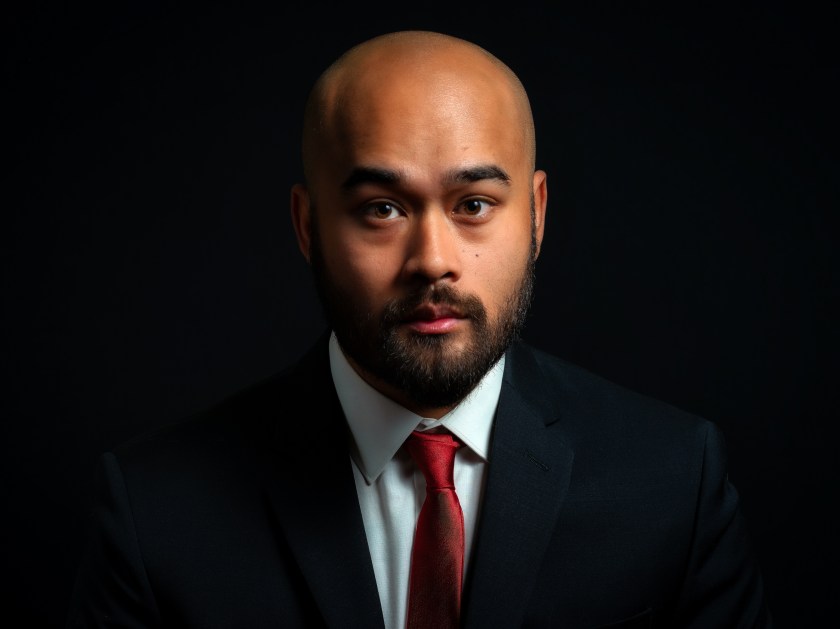
Mike Groth’s studio portrait, featured in Chapter 4 of the Top 100 Journey, exemplifies traditional portraiture through controlled lighting and composition. Shot at Old Town Yoga Studio, the image focuses on character and presence, utilizing a classic backdrop and professional techniques. Its formal simplicity highlights the subject’s confidence, making it versatile across various contexts.

Bald man with a beard wearing a suit and red tie looks directly at the camera against a black background.
Mike Groth is photographed in a studio portrait at Old Town Yoga Studio in Fort Collins, Colorado.

Within Chapter 4 of the photographer’s Top 100 Journey, this portrait of Mike Groth represents a return to the foundational principles of studio portraiture—controlled lighting, deliberate composition, and the timeless formality of traditional headshot aesthetics. Shot at the Old Town Yoga Studio in Fort Collins, Colorado, the image demonstrates the photographer’s facility with classic studio techniques while exploring the psychological dimensions of formal masculine presentation.

The technical execution adheres to established conventions of corporate and editorial portraiture. Utilizing a Sony A7ii with an 85mm f/1.8 lens, the photographer has positioned his subject against a pure black backdrop, eliminating all environmental context to focus entirely on character and presence. A Godox V1s flash paired with a shoot-through umbrella provides the primary illumination—a traditional modifier choice that produces soft, diffused light with gentle shadow gradation across the subject’s features. This approach creates dimensional modeling without the harsh contrast of direct flash, revealing the contours of the face while maintaining a polished, professional quality.

The composition centers the subject in a classical three-quarter view, shoulders angled slightly to create visual interest while the face turns toward the camera. This positioning—neither fully frontal nor profile—has been a cornerstone of portraiture since the Renaissance, offering both dimensionality and direct engagement. The subject’s formal attire—dark suit, white shirt, burgundy tie—reinforces the traditional corporate aesthetic, while his neutral expression and direct gaze suggest confidence tempered with approachability.

What distinguishes this work within the photographer’s broader practice is its embrace of restraint. Where other images in Chapter 4 explore environmental integration and spontaneous moments, this portrait strips away context to examine how lighting, posture, and expression alone can convey character. The black void backdrop functions not merely as a neutral background but as an active element, creating psychological weight and directing all attention to the subtle details: the catch lights in the eyes, the texture of facial hair, the precise fall of shadow along the jawline.

The post-processing in Luminar 4 maintains the studio’s carefully controlled atmosphere. Skin tones are rendered with natural warmth while preserving texture and detail. The lighting reveals itself as directional yet forgiving, highlighting the subject’s facial structure without creating unflattering shadows. This balance between revelation and flattery characterizes effective professional portraiture—honest without being harsh, polished without appearing artificial.

Within the context of Chapter 4’s mission to document studio, outdoor, and workshop methodologies, this image anchors the studio component with particular authority. It demonstrates that contemporary portrait photography need not abandon classical techniques in pursuit of innovation. The photographer’s choice to work within established conventions reflects an understanding that certain approaches endure precisely because they succeed in their essential task: revealing the subject’s presence and character with clarity and dignity.

The formal simplicity of this portrait allows it to function across multiple contexts—editorial, corporate, archival. This versatility speaks to the photographer’s understanding of portraiture not merely as artistic expression but as functional communication. As part of the Top 100 Journey, the image represents a technical benchmark, showcasing the fundamental competencies upon which more experimental work can build. It is portraiture in its most distilled form: light, subject, and the photographer’s ability to orchestrate their interaction with precision and purpose.