Refraction and Illumination: A Study in Controlled Light

In Greg Urbano’s entry from “The Road Ahead: Recent Work & Ongoing Exploration,” a single green LED illuminates a glass sphere, creating intricate light patterns. This photograph showcases the artist’s mastery of optical effects and light manipulation. It reflects an ongoing exploration of visual ideas, balancing technical skill with artistic homage.

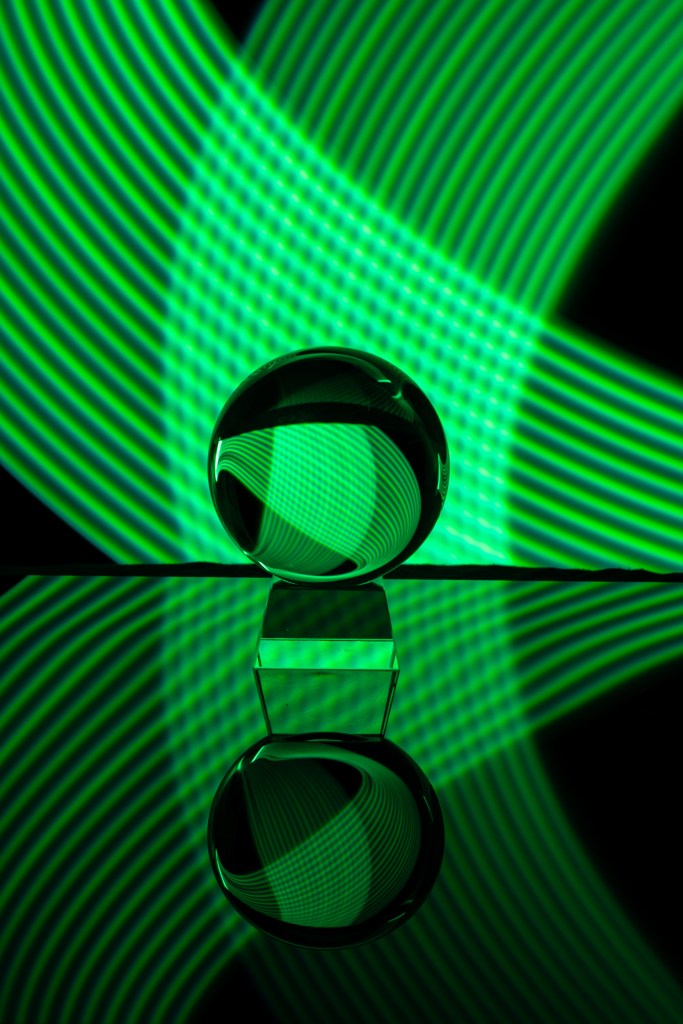
A glass sphere sits on black acrylic, bending bright green LED lines that cross diagonally, with a clear reflection below against a dark background.
A single green LED light creates intersecting line patterns that refract through a glass sphere and reflect off black acrylic.

In this striking entry from Chapter 6 of Greg Urbano’s Top 100 Journey—titled “The Road Ahead: Recent Work & Ongoing Exploration”—the photographer demonstrates a sophisticated understanding of light manipulation and optical phenomena. Created as part of the 52 Frames community’s Week 38 challenge, which called for images using a single light source, this photograph represents both technical mastery and artistic homage.

The composition centers on a glass sphere resting atop a reflective black acrylic base, positioned against a background of projected linear light patterns. What immediately captivates the viewer is the optical complexity achieved through such seemingly simple elements. The sphere acts as a lens, refracting and inverting the striped pattern behind it, while simultaneously creating a mirror image in the glossy surface below. This doubling effect—one sphere above, one reflected beneath—establishes a visual dialogue between reality and reflection that speaks to photography’s fundamental nature as a medium of light capture.

The photographer’s choice of a Godox TL30 LED wand as his single light source proves particularly astute. Rather than relying on ambient or diffused lighting, he creates a precise, linear pattern that reads as both graphic element and scientific demonstration. The vibrant green illumination pulses across the frame in parallel lines, their luminosity gradating from deep emerald to electric cyan. Where the light passes through the sphere, it bends and concentrates, revealing the optical principles at work while creating areas of intense brilliance that punctuate the geometric order.

This image explicitly acknowledges its lineage. The photographer credits Elizabeth Klepper’s 2023 work from the same community as inspiration—a refreshingly transparent gesture that positions this photograph within a continuum of artistic exchange rather than claiming isolated innovation. Yet this is no mere reproduction. Where Klepper’s original vision provided the conceptual framework, this interpretation carries distinct choices in color temperature, scale, and tonal contrast that mark it as an independent exploration.

The technical execution reveals careful consideration of multiple variables. The exposure balances the intense luminosity of the LED source with the deep blacks of the background and base, maintaining detail across a challenging dynamic range. The focus renders the sphere’s surface with crystalline clarity, allowing viewers to perceive both its transparency and its physical substance simultaneously. The alignment of the linear patterns—maintaining their parallel consistency both in direct view and through the sphere’s distortion—suggests meticulous positioning and multiple test exposures.

Within the context of Chapter 6, this photograph signals a willingness to engage with established visual ideas while pushing toward new territory. The chapter’s subtitle, “Recent Work & Ongoing Exploration,” positions the photographer at a transitional moment, actively investigating techniques and concepts that may inform future directions. This image embodies that investigative spirit—it is simultaneously a study, an exercise, and a finished work worthy of exhibition.

The minimalist aesthetic here contrasts with the more documentary or narrative approaches found in earlier chapters of the Journey. The photographer strips away contextual information, environmental cues, and representational content, focusing instead on pure optical phenomena. Light becomes subject rather than tool. The glass sphere transforms from decorative object to scientific instrument to sculptural form.

What elevates this beyond technical demonstration is its inherent beauty—the mesmerizing quality of those radiating green lines, the perfect symmetry of sphere and reflection, the luminous energy that seems to emanate from the glass itself. It exemplifies how constraint, whether self-imposed or community-mandated, can generate creative solutions that transcend their origins.
Corner House, Bosler Wyoming 2025: Architecture at the Edge of Erasure

In Chapter 6 of Greg Urbano’s Top 100 Journey, a photograph captures a deteriorating house in the ghost town of Bosler, Wyoming. The image illustrates the photographer’s exploration of abandonment, focusing on atmospheric conditions and the surrounding landscape. This work highlights the themes of decay, isolation, and the complexity of preservation amid a vanishing settlement.

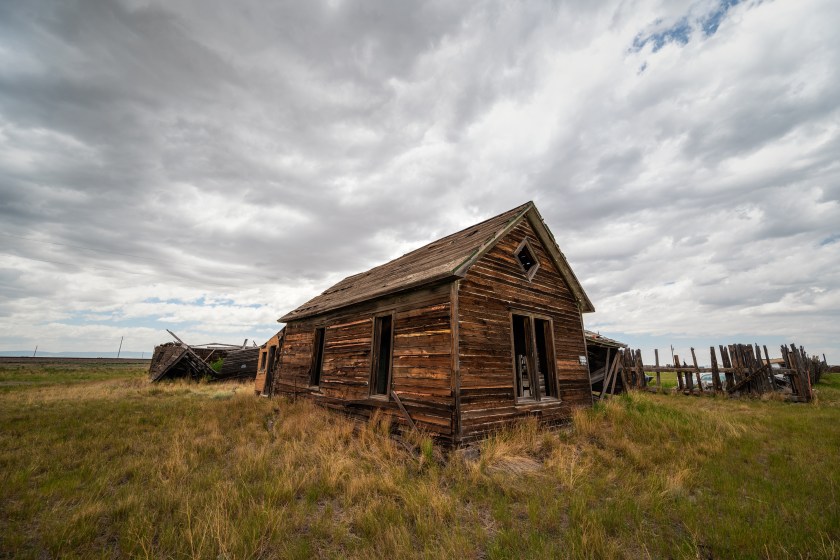
Weathered wooden house with broken windows standing alone in grassland under an overcast sky in Bosler, Wyoming.
A deteriorating wooden house stands at a corner in the ghost town of Bosler, Wyoming.

In this recently captured photograph from Chapter 6 of Greg Urbano’s Top 100 Journey, the photographer documents a collapsing structure in Bosler, Wyoming—one of the few remaining witnesses to a town that has largely disappeared from both map and memory. The image exemplifies the photographer’s continued investigation into the material traces of Western settlement, while revealing new subtleties in his approach to documenting abandonment and temporal passage.

The composition centers on a weathered wooden dwelling, its steep-pitched roofline still asserting architectural intention despite advanced structural compromise. The building’s corner placement within the frame—echoing its designation as a “corner house”—creates a dynamic diagonal energy, the structure appearing to lean into the wind-swept grassland that now reclaims the site. Dark window openings punctuate the horizontal wood siding, which has weathered to rich amber and umber tones, each plank articulated by the diffused overcast light.

What distinguishes this work within the photographer’s recent output is his expanded attention to atmospheric conditions. The turbulent cloudscape dominates nearly two-thirds of the frame, its churning gray masses punctuated by occasional breaks of blue—a meteorological drama that mirrors the building’s own precarious state between persistence and collapse. This sky is not mere backdrop but active participant, suggesting the elemental forces that have contributed to the structure’s deterioration and will eventually complete its dissolution.

The surrounding landscape provides crucial narrative context. Collapsed outbuildings and fence remnants scatter across the middle ground, fragmentary evidence of what was once a more substantial settlement. Golden prairie grasses advance toward the dwelling’s foundation, their subtle movement implied even within the photograph’s frozen moment. The extreme horizontality of the High Plains extends to a barely perceptible horizon line, emphasizing the profound isolation of this site just north of Laramie, accessible from Highway 80 yet psychologically distant from contemporary traffic patterns.

From a technical standpoint, the photographer employs what appears to be a moderate wide-angle perspective, capturing sufficient environmental context while maintaining the building’s structural integrity within the frame. The exposure handles the challenging luminosity range of overcast conditions with nuance, preserving detail in both shadowed door openings and highlighted cloud formations. This balanced approach serves the documentary imperative while allowing for aesthetic contemplation.

Within Chapter 6’s thematic framework of “The Road Ahead,” this photograph functions as meditation on endings and continuations. Bosler exists now primarily as absence—a ghost town in the most literal sense—yet the photographer’s attention validates its remaining physical evidence as worthy of sustained consideration. His choice to include this work in his curated Top 100 Journey suggests an artist grappling with questions of what deserves preservation, at least photographically, when material preservation is no longer possible.

The work also demonstrates evolution in the photographer’s relationship to his subject matter. Where earlier chapters might have emphasized formal qualities or nostalgic resonance, this image presents abandonment as process rather than state—a building actively returning to landscape, caught mid-transition. The corner house stands as both monument and warning, its dignified decay offering no easy emotional resolution. This measured, clear-eyed approach marks the maturation of an artist comfortable with ambiguity, finding profundity in the unheroic persistence of structures at civilization’s receding edge.