St. Vrain Waterfall: A Study in Motion and Permanence

The photograph of a small waterfall along St. Vrain Creek embodies the tension between geological permanence and water’s fleeting essence. Using long exposure, it transforms the scene into a contemplative study of motion and stillness. The intimate scale highlights the beauty of overlooked subjects, emphasizing the profound within Colorado’s landscapes.

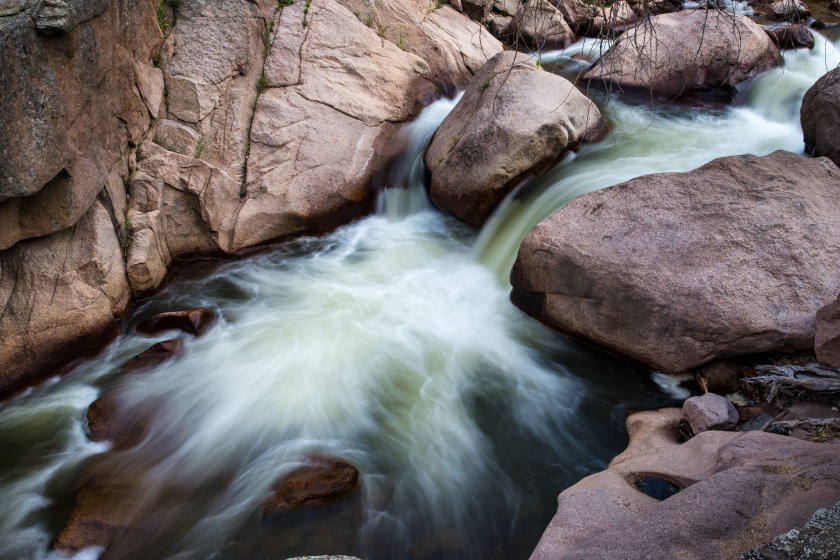
Long exposure view of a small waterfall flowing through smooth granite boulders along St. Vrain Creek.
A small waterfall flows between granite rocks along St. Vrain Creek in northern Colorado.

Within the third chapter of Greg Urbano’s Top 100 Journey—devoted to Colorado Landscapes & Cityscapes—this long exposure photograph of the St. Vrain presents a meditation on the fundamental tension between geological permanence and hydrological flux. The image captures a modest cascade in Northern Colorado, yet its technical execution elevates what might be considered a commonplace subject into something altogether more contemplative.

The photographer’s decision to employ long exposure proves essential to the work’s success. Water, rendered as gossamer curtains of white and pale green, flows through the frame with an almost supernatural quality. This technique transforms the kinetic energy of rushing water into something visually paradoxical: movement frozen into silken stillness. The effect creates a temporal ambiguity that refuses to commit to either instant or duration, existing instead in a liminal space between photographic modes.

Compositionally, the work demonstrates a sophisticated understanding of how natural forms interact within the frame. Pink-hued granite boulders, weathered and moss-touched, provide structural anchors throughout the image. These stones—products of millennia—stand in stark contrast to the ephemeral blur of water that has shaped them. The photographer positions these elements with careful attention to visual weight and balance, allowing the eye to trace pathways through the composition that mirror the water’s own journey through the rocky terrain.

The color palette reveals itself as deliberately restrained. Warm earth tones of pink and tan granite dominate, punctuated by touches of green moss and the cool, milky whites of the flowing water. This chromatic restraint prevents the image from becoming overly dramatic, instead maintaining the documentary authenticity that characterizes much of this chapter’s work. The photographer resists the temptation to over-saturate or manipulate, trusting the natural beauty of the Colorado landscape to speak for itself.

What distinguishes this photograph within the broader context of the Colorado Landscapes & Cityscapes chapter is its intimate scale. Rather than pursuing the grand vistas often associated with Rocky Mountain photography, the work turns its attention to a more modest subject—a small waterfall that countless hikers might pass without particular notice. This choice reflects a maturing sensibility within the photographer’s practice, one that finds profundity in the overlooked rather than the obvious.

The technical execution warrants recognition as well. Managing long exposure in daylight conditions requires careful control of light through neutral density filtration and precise shutter speed calculation. The photographer has balanced these elements skillfully, maintaining detail in both the highlighted water and shadowed crevices of stone. Branches visible at the top of the frame remain relatively sharp, suggesting a shutter speed calibrated to render water motion without sacrificing all structural definition in the surrounding environment.

Within the arc of the Top 100 Journey project, this image represents an important moment of focus. The work demonstrates that landscape photography need not rely on sweeping panoramas or dramatic weather to achieve visual and emotional resonance. Instead, it proposes that careful attention to the quotidian—to the small waterfalls tucked into Northern Colorado’s piedmont—can yield images of equal contemplative depth. The St. Vrain Waterfall stands as evidence of a photographer learning to see not just the spectacular, but the quietly profound.

Holiday Traffic: Urban Kinetics and the Ground-Level Perspective

Greg Urbano’s long-exposure photograph captures holiday traffic at a city intersection, blending urban dynamism with modern landscape photography. The low, ground-level perspective emphasizes movement and depth, contrasting traditional views. Utilizing experimental techniques, Urbano transforms mundane urban elements into visually engaging art, reflecting an intersection of Colorado’s natural and built environments.

Long exposure light trails streak across a city intersection at night, with a sewer grate and patches of ice in the foreground.
Long exposure light trails cross a city intersection at night, viewed from curb level during holiday traffic.

This long-exposure photograph marks a decisive departure from traditional landscape photography within Chapter 3 of Greg Urbano’s Top 100 Journey, demonstrating that the “cityscapes” component of his Colorado documentation extends beyond skyline silhouettes into the kinetic reality of urban infrastructure. Positioned at street level—literally at the curb—the photographer has created a dynamic study of nocturnal traffic patterns that transforms the mundane intersection of College Boulevard into a theater of light and motion.

The technical approach reveals deliberate experimentation with newly acquired equipment. Working with a Samyang 18mm wide-angle lens on his Sony A7ii, the photographer has exploited the optical characteristics of ultra-wide focal lengths to create exaggerated perspective and spatial depth. The low vantage point amplifies this effect dramatically: the sewer grate in the immediate foreground looms with tactile presence, its metal bars and residual ice providing textural anchor, while the light trails streak overhead in explosive radial patterns that suggest velocity and urban energy.

The compositional strategy employed here is remarkably sophisticated for what the photographer describes as “one of my early outings” with this lens. The image functions as a composite of multiple 25-30 second exposures, a technique that allows for selective accumulation of specific light sources while maintaining overall exposure balance. The resulting layering creates what might be termed a temporal palimpsest—multiple moments collapsed into a single frame, where red taillights and white headlamps trace the choreography of holiday traffic against the static geometry of traffic signals, street lamps, and seasonal decorations visible in the background.

What distinguishes this work from conventional light trail photography is its grounded perspective. Rather than adopting the elevated, observational stance typical of urban night photography, the photographer has chosen a worm’s-eye view that positions the viewer within the street infrastructure itself. This decision transforms the image from documentation into experience—we are not watching traffic from safe remove, but inhabiting the same plane as the vehicles themselves, separated only by the curb’s modest elevation.

The inclusion of the ice-rimmed drain grate serves multiple functions. Practically, it provides a foreground anchor that prevents the eye from being immediately swept into the light trails. Conceptually, it connects this urban image to the winter conditions documented elsewhere in the chapter, suggesting continuity between Colorado’s natural and built environments. The detail also introduces narrative specificity—this is not generic cityscape, but a particular moment following “last week’s big snowfall,” situating the photograph within both seasonal and meteorological context.

Within Urbano’s broader practice, this image represents important evolution. It demonstrates willingness to explore the full spectrum of Colorado’s visual character, from wilderness solitude to urban dynamism. The experimental nature of the work—testing new equipment, exploring composite techniques, embracing an unconventional viewpoint—suggests a photographer actively expanding his technical vocabulary rather than retreating to established formulas.

The photograph ultimately succeeds by finding aesthetic potential in overlooked urban moments. The holiday season’s increased traffic becomes raw material for abstract light painting, while municipal infrastructure—storm drains, asphalt, street furniture—gains unexpected visual dignity through careful framing and extended exposure. It is urbanism made kinetic, infrastructure rendered poetic.

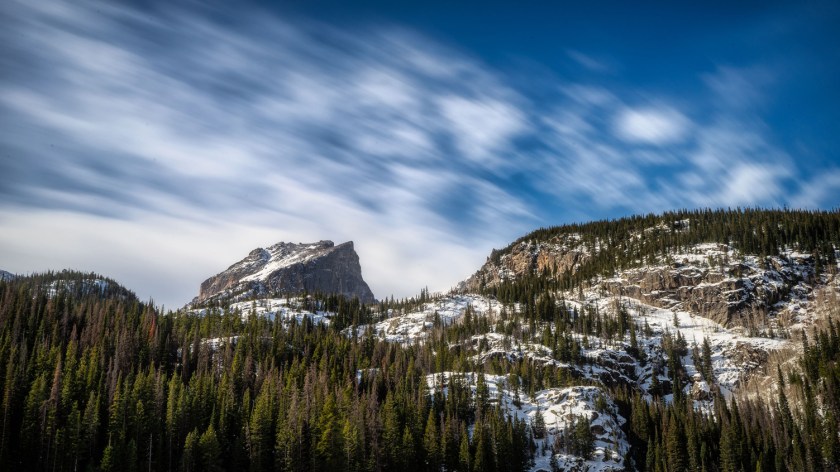
Hallett Peak: A Study in Motion and Permanence

In a captivating long-exposure photograph of Hallett Peak in Rocky Mountain National Park, the artist merges landscape photography with technical artistry. The image features dynamic cloud streaks, contrasting geological permanence, and rich tonal variations, creating an engaging interplay of time and nature. This work illustrates a mature artistic voice, enhancing familiar landscapes.

Hallett Peak rises above evergreen forest and snow-dusted slopes beneath streaked clouds in Rocky Mountain National Park.
Hallett Peak towers above forested slopes near Bear Lake in Rocky Mountain National Park, Colorado.

In this striking capture from Rocky Mountain National Park, the photographer demonstrates a sophisticated command of long-exposure technique to transform a familiar Colorado landscape into something both ethereal and architectural. The image of Hallett Peak, taken from the Bear Lake area, exemplifies the technical precision and artistic vision that defines Chapter 3 of his Top 100 Journey project.

The composition is anchored by the geological drama of Hallett Peak itself—that distinctive snow-dusted formation rising with muscular authority against the left portion of the frame. Yet it is the sky that commands immediate attention. Through extended exposure, the photographer has rendered clouds as diagonal streaks of motion, creating dynamic vectors that sweep across the upper two-thirds of the image. This technique transforms the sky from mere backdrop into active participant, suggesting the passage of time within a single frozen moment. The effect is cinematic, almost reminiscent of time-lapse sequences compressed into still photography.

The tonal range demonstrates careful exposure management in challenging high-altitude conditions. Deep blues saturate the upper atmosphere while softer, almost pearl-like whites and grays occupy the middle zones where cloud and sky intermingle. The snow-covered peaks and rock faces provide textural counterpoint—solid, immutable, sharply defined—against the fluid sky. This juxtaposition between the permanent and the transient becomes the photograph’s central artistic statement.

In the foreground, dense stands of evergreens establish both scale and context. The forest appears in rich greens and shadow-dark tones, creating a horizontal band that grounds the viewer’s eye before it ascends to the peaks and sky beyond. These trees serve multiple functions: they frame the composition, they provide Colorado’s signature ecological context, and they emphasize the vertical drama of the mountain forms rising behind them.

What distinguishes this work within the Colorado Landscapes & Cityscapes chapter is its sophisticated balance between documentary and interpretive approaches. While the location remains recognizable to anyone familiar with Rocky Mountain National Park, the artistic treatment elevates the image beyond straightforward landscape photography. The photographer has chosen to emphasize process—geological, meteorological, temporal—over simple representation.

The technical execution reveals careful planning. The long exposure required for cloud streaking demands stable tripod work, precise timing, and likely the use of neutral density filtration to manage the bright mountain light. The sharpness maintained throughout the frame, from foreground forest to distant peak, suggests a narrow aperture and careful focus technique. These are not accidental achievements but rather the results of deliberate craft.

Within the broader context of his Top 100 Journey, this photograph represents a mature artistic voice. It demonstrates that the photographer understands landscape work as more than capturing beautiful places—it involves interpreting those places through technical means that reveal aspects invisible to casual observation. The streaming clouds make visible the wind, the time, the atmospheric dynamics that define mountain environments but typically escape photographic capture.

This image invites extended viewing. Initially, one registers the dramatic sky; subsequently, the eye explores the geological complexity of the peaks, the play of snow and rock, the forest’s quiet density. It is work that rewards attention, revealing the photographer’s ability to transform a well-visited location into something that feels simultaneously familiar and newly seen—a hallmark of accomplished landscape photography.

City Pier on Anna Maria Island: A Study in Patience and Atmospheric Drama

The long exposure photograph of the City Pier on Anna Maria Island captures the unique interplay of land, water, and sky under dramatic storm clouds. Through technical mastery, the image transforms fleeting moments into timelessness, blending sharp details of the pier with ethereal human figures and smooth water, reflecting deep engagement with Florida’s coastal landscapes.

Long exposure photograph of the City Pier on Anna Maria Island, showing a wooden pier leading to a waterfront building under dark storm clouds.
Long exposure view of the City Pier on Anna Maria Island beneath dramatic storm clouds.

Within the photographer’s carefully curated Top 100 Journey, this long exposure study of the City Pier on Anna Maria Island stands as a masterful example of how technical discipline can amplify emotional resonance. Positioned within Chapter 2—Florida Landscapes & Cityscapes—the image demonstrates a sophisticated understanding of the Gulf Coast’s unique visual character, where land, water, and sky exist in constant, subtle negotiation.

The composition reveals itself through classical simplicity: a weathered wooden pier extends from foreground to middle distance, leading the viewer’s eye toward a modest building crowned with an American flag. Yet what elevates this photograph beyond documentary record is the photographer’s deliberate manipulation of time itself. Shot with a fifteen-second exposure at f/18, the image transforms fleeting atmospheric conditions into something more permanent and contemplative. The threatening cloud formations above, rather than appearing frozen in mid-motion, achieve a painterly quality—their movement compressed and softened into bands of gray and white that suggest both weight and ethereality.

This temporal expansion creates a fascinating duality throughout the frame. While the pier’s wooden planks remain sharp and detailed, bearing the textural evidence of salt air and countless footfalls, the human figures near the building dissolve into ghostly presences, their individual identities surrendered to the longer rhythm of place. The water, too, undergoes transformation; what would typically appear as distinct waves and surface texture becomes a smooth, almost metallic gradient stretching from jade green to soft gray, merging seamlessly with the horizon.

The technical execution here deserves careful consideration. Working with a Nikon D610 and an 18-35mm lens set to 35mm, the photographer has achieved remarkable sharpness across the entire frame. The f/18 aperture ensures deep depth of field while the ISO 100 setting maintains clean tonal gradations essential for the image’s subtle atmospheric rendering. These choices reflect not mere technical competence but aesthetic intention—a desire to capture both concrete detail and ephemeral mood simultaneously.

Within the broader context of Chapter 2, this photograph exemplifies the photographer’s evolving relationship with Florida’s coastal environments. Where lesser practitioners might seek the obvious drama of golden hour or storm-tossed seas, he finds complexity in overcast conditions and the patient observation they demand. The image refuses easy categorization: it is neither purely documentary nor overtly romantic, but occupies a thoughtful middle ground where observation and interpretation merge.

The architectural elements—particularly the modest pier building with its peaked roof and practical design—anchor the composition in specificity while the long exposure technique universalizes the experience. This is simultaneously a portrait of a particular place and a meditation on impermanence, on how human structures persist while human presence itself becomes fluid and uncertain.

As part of a long-term project, this photograph suggests an artist committed to deep engagement rather than superficial tourism. The willingness to wait for proper atmospheric conditions, to set up the necessary equipment for extended exposures, and to see beyond the immediate toward something more contemplative marks this as serious photographic inquiry. Within his Top 100 Journey, it stands as evidence that Florida’s landscapes, often dismissed as visually unchallenging, reward patient observation with unexpected subtlety and depth.

First Baptist Light Trails

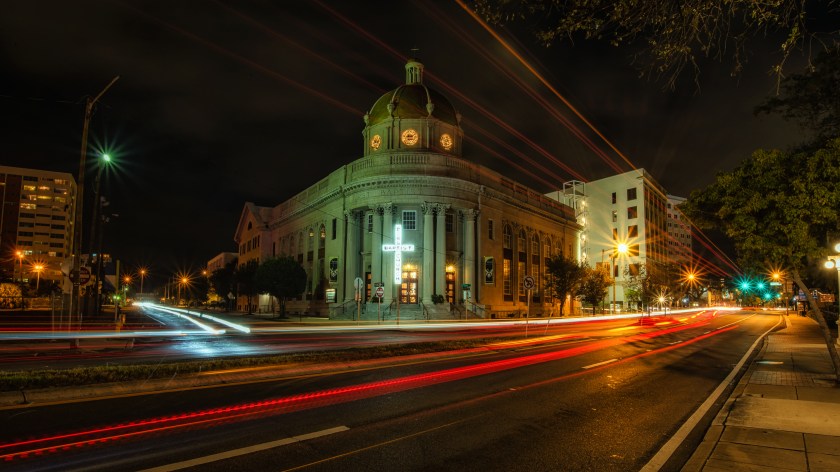
The photographer captures long exposure light trails in front of Tampa’s First Baptist Church, merging urban movement with Neoclassical architecture. This duality creates an image of modernity and tradition, showcasing the church’s historical significance against dynamic traffic patterns. The piece illustrates Tampa’s evolving identity, emphasizing beauty in its urban landscapes through innovative techniques.

Long exposure nighttime photograph of the historic First Baptist Church in Tampa, Florida, with vehicle light trails in the foreground.
Long exposure light trails in front of the historic First Baptist Church in downtown Tampa.

In this nocturnal study of Tampa’s historic First Baptist Church, the photographer transforms urban infrastructure into kinetic painting, employing a twenty-second exposure to capture the ceaseless motion of vehicular traffic as ribbons of light that both frame and animate the Neoclassical architecture. The resulting image operates simultaneously as documentary record and abstract composition, a duality that characterizes his most successful explorations of Florida’s urban environments.

The church itself commands the frame with dignified authority. Its illuminated dome, rendered in theatrical green uplighting, draws the eye upward through classical columns toward the cupola’s glowing clock faces. This architectural landmark, likely dating to the early twentieth century, represents Tampa’s ambitions during its period of rapid growth—a permanence and civic gravitas that contrasts sharply with the ephemeral streaks of red and white light that sweep through the foreground. The photographer has chosen an exposure duration that allows traffic to complete its passage through the intersection, creating continuous trails rather than fragmented segments, a decision that required both technical precision and patience in timing.

The technical execution reveals careful calibration of competing priorities. The f/20 aperture serves multiple functions: it extends the exposure time necessary to capture substantial light trails while creating pronounced starbursts from the streetlamps and building lights that punctuate the scene. This diffraction effect, often considered a technical liability, becomes here an expressive tool that enhances the image’s sense of urban energy and nocturnal luminosity. The ISO 160 setting represents a pragmatic compromise, maintaining clean shadow detail without the noise that would emerge at higher sensitivities during a twenty-second exposure.

What distinguishes this work within the Florida Landscapes & Cityscapes chapter is its engagement with the state’s urban identity—a counterpoint to the natural environments that dominate popular conceptions of Florida photography. Tampa, often overshadowed by Miami’s architectural flash or Orlando’s manufactured spectacle, possesses a layered history visible in buildings like this repurposed church structure, now apparently serving commercial functions while retaining its ecclesiastical form. The photographer documents this transformation without nostalgia or critique, allowing the juxtaposition of classical architecture and contemporary traffic patterns to speak to ongoing urban evolution.

The composition demonstrates sophisticated spatial organization. The church occupies the middle ground with centered dignity, while the light trails sweep diagonally from lower right to left, creating dynamic movement that prevents the symmetrical architecture from becoming static. Flanking buildings and street trees provide contextual depth, establishing the church within its urban fabric rather than isolating it as a monument. The streetlamp at left edge, its starburst perfectly rendered, serves as a visual anchor that balances the compositional weight of the church’s mass.

Within his broader photographic journey, this image represents an expansion of the long-exposure vocabulary established in his Bay Pier work. Where that earlier piece explored natural elements transformed by time, here he applies similar temporal techniques to the urban realm, revealing how extended duration can render the chaos of city traffic as elegant abstraction. The photograph succeeds in making visible the patterns underlying apparent disorder, suggesting that beauty in Florida’s built environments requires not different locations but altered ways of seeing—a perspective shift measured in seconds rather than miles.

Long Exposure Bay Pier

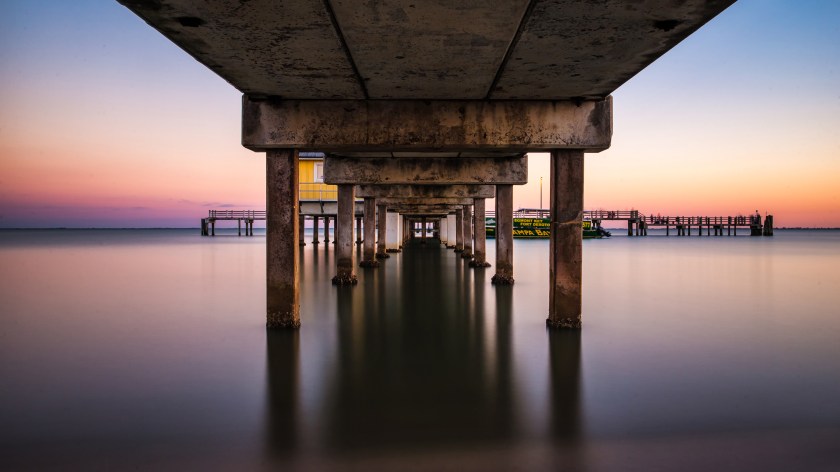
This long-exposure photograph from Fort De Soto Park captures the interplay between water and human infrastructure beneath the Bay Pier at sunset. The technical precision transforms the scene into a study of temporality, where smooth water contrasts with weathered concrete, exploring beauty in overlooked spaces. The image balances tranquility and depth, prompting contemplation.

Long exposure sunset photograph taken beneath the Bay Pier at Fort De Soto Park, showing symmetrical concrete pilings and smooth reflective water.
Long exposure sunset view beneath the Bay Pier at Fort De Soto Park.

The photographer’s technical mastery and compositional restraint converge in this striking long-exposure study from Fort De Soto Park. Captured beneath the Bay Pier at sunset, the image demonstrates a sophisticated understanding of how extended exposure transforms the ephemeral into the architectural, rendering water as smooth as polished stone and reducing the atmospheric gradient to its essential chromatic progression.

The 124-second exposure at f/16 achieves precisely what such technical specifications promise: a complete metamorphosis of the transient into the permanent. The water’s surface becomes a mirror of silk, its glassy uniformity disrupted only by the weathered pier columns that puncture the frame with rhythmic precision. These pylons, darkened by time and barnacled at their waterline, create a vanishing perspective that draws the eye inexorably toward the distant horizon where structure meets light. The photographer has positioned himself not merely under the pier but within its geometric logic, allowing the concrete deck above to function as both literal and compositional ceiling, establishing boundaries that paradoxically expand the viewer’s sense of spatial depth.

What distinguishes this work within the Florida Landscapes & Cityscapes chapter is its meditation on infrastructure as organic form. The pier’s weathered concrete surfaces—mottled with rust stains and biological growth—speak to the peninsula’s relentless humidity and salt air. Rather than presenting Florida’s more commonly depicted pristine beaches or crystalline waters, he has chosen to explore the liminal space where human construction gradually surrenders to natural forces. The corroded texture of the support beams and deck creates a counterpoint to the water’s supernatural smoothness, establishing a dialogue between industrial decay and elemental transformation.

The color palette rewards careful attention. The sky transitions from pale lavender at the zenith through bands of peach and amber toward the horizon, while the water adopts cooler tones of green and slate. This chromatic division creates temperature contrast that enhances the image’s sense of tranquility without veering into sentimentality. A yellow structure visible in the middle distance—likely a utility building or navigation marker—provides a necessary accent of saturated color, preventing the composition from becoming too subdued.

The technical execution reflects deliberate choices rather than automatic settings. The 31mm focal length on a full-frame sensor provides sufficient width to encompass the pier’s structural rhythm while maintaining proper perspective correction, avoiding the distortion that might occur at the wide end of his 18-35mm lens. The ISO 100 setting ensures maximum detail in the shadows where barnacles cling to concrete, while the extended shutter speed required neutral density filtration to prevent overexposure during the lingering twilight.

Within the photographer’s larger journey, this image represents a maturation of vision—a willingness to find beauty not in Florida’s celebrated natural wonders but in the overlooked spaces where infrastructure and environment intersect. The pier becomes a study in temporality: concrete designed to last decades, water that renews itself constantly, and light that exists only for minutes. By freezing this convergence through long exposure, he creates a document that feels both immediate and timeless, a quality that defines his most successful landscape work. The photograph succeeds because it refuses spectacle in favor of contemplation, inviting sustained viewing rather than demanding instant admiration.

Passagrille Sunset

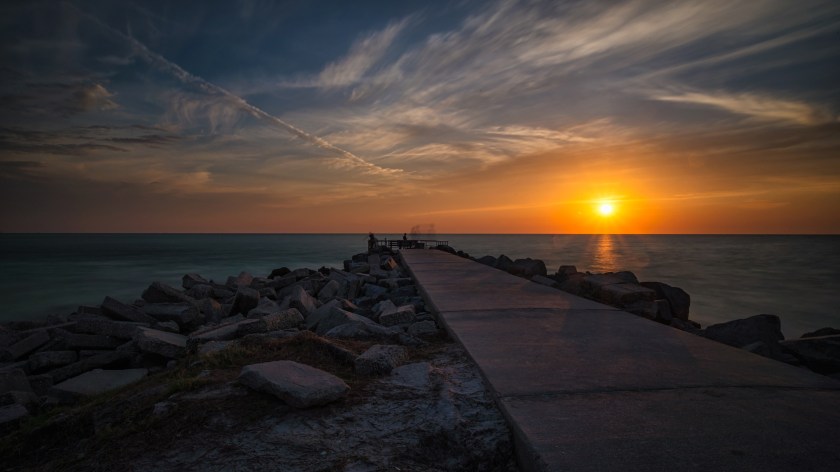
The photograph of a sunset over the Gulf of Mexico from the Pass-a-Grille jetty captures a sense of departure and geometric clarity. It juxtaposes the structural jetty against soft, ethereal water and sky, reflecting the photographer’s evolving approach while highlighting the tension between permanence and impermanence in landscapes.

Sunset photograph of the Pass‑a‑Grille jetty in Florida, with a concrete pier extending into the Gulf of Mexico and silhouetted figures at the horizon.
Sunset over the Gulf of Mexico from the Pass‑a‑Grille jetty.

This image from Chapter 2 of the Top 100 Journey carries with it a distinct sense of departure—a final engagement with a familiar location rendered with the careful attention of someone taking leave. Shot at Pass-a-Grille, the southern terminus of St. Pete Beach, the photograph distills the photographer’s technical vocabulary into a study of geometric clarity against atmospheric flux.

The concrete jetty commands the composition with unwavering linear authority, stretching from the immediate foreground toward the distant horizon where the sun hangs in perfect alignment. This centered positioning—often avoided in landscape photography as overly symmetrical—here becomes an asset, emphasizing the directional thrust of both structure and light. The jetty serves as more than mere subject; it functions as visual pathway, invitation, and barrier simultaneously. Flanked by massive boulder riprap on either side, the walkway creates a corridor that focuses attention while the rough-hewn stones provide textural contrast to the smooth concrete surface.

The technical approach reveals the photographer’s continued exploration of extended exposure. At fifteen seconds and f/22, the water on both sides of the jetty transforms into a milky abstraction, its individual waves collapsed into a singular luminous mass. This treatment—shorter than the sixty-second exposure employed in his Pier 60 work yet still substantially extended—suggests a refinement in his methodology. The turquoise-tinted water retains enough definition to read as liquid rather than dissolving into pure atmosphere, maintaining a crucial anchor to physical reality.

Above, the sky performs its transitional theater. Wispy cirrus formations streak diagonally across the frame from upper left, their directional movement contrasting with the horizontal stratification of color closer to the horizon. The gradient moves from deep slate blues through amber and peach tones to the incandescent disc of the sun itself. A single contrail cuts through the upper portion—a contemporary detail that situates this timeless scene firmly in the present moment, a reminder that even pristine natural settings exist within our flight-path-crossed modern reality.

The photographer has positioned himself low, allowing the foreground boulders to occupy significant visual weight in the left portion of the frame. These lichen-stained rocks, rendered in earth tones that echo the warm sunset palette, ground the image literally and figuratively. Their solidity counterbalances the ethereal qualities of water and sky, creating a dialogue between permanence and impermanence that resonates with the image’s contextual note about departure.

Within the framework of Chapter 2—Florida Landscapes & Cityscapes—this photograph demonstrates the photographer’s evolving relationship with infrastructure as subject. Where tourist piers offer human presence and activity, this utilitarian jetty provides something more austere: pure form against elemental forces. The viewing platform visible at the jetty’s terminus, occupied by silhouetted figures, offers scale and human connection without sentimentality.

The work succeeds in balancing documentary precision with interpretive mood. It captures a specific engineered structure at a specific coastal location while transcending those particulars to engage broader themes: the paths we walk toward light, the structures we build against erosion, the moments we choose to mark as endings before moving forward.