Tomatos

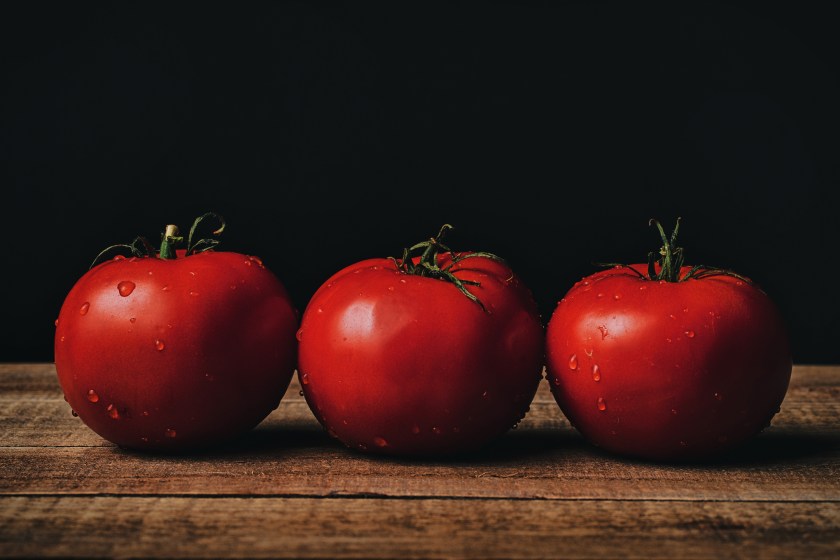
This photographic composition showcases three tomatoes on a textured wooden surface against a dark background, illustrating the themes of light and form in still life art. Using controlled lighting to create a dramatic chiaroscuro effect, the photographer emphasizes the tomatoes’ beauty, merging classical traditions with contemporary techniques.

Tabletop still life of three ripe tomatoes with water droplets on a wooden surface against a dark background.
A tabletop still life of three tomatoes arranged on a wooden surface and lit against a dark background.

In this deceptively simple composition, the photographer demonstrates how the most humble subjects—three tomatoes from a supermarket produce section—can become vehicles for exploring light, form, and the enduring traditions of still life photography. The work sits comfortably within the classical end of Chapter 5’s spectrum, channeling centuries of artistic precedent while employing decidedly contemporary tools and techniques.

The arrangement recalls Dutch Golden Age vanitas paintings, where ordinary kitchen staples were elevated to subjects of profound contemplation. Here, three ripe tomatoes rest upon a weathered wooden surface, their placement casual yet deliberate. The varying positions of their stems—pointing in different directions like botanical compasses—introduce subtle asymmetry that prevents the composition from becoming static. Water droplets cling to the glossy red skin, suggesting recent washing and adding points of light that animate the surface.

His lighting strategy proves crucial to the image’s success. Working with a single Godox V1s flash modified by a softbox and grid, he achieves remarkable control over illumination. The grid attachment narrows the light spread, creating focused illumination that emphasizes the tomatoes while allowing the background to fall into deep, theatrical darkness. This chiaroscuro effect—the dramatic interplay of light and shadow—lends gravitas to subjects that might otherwise seem merely documentary.

The wooden surface provides essential contextual grounding. Its rough texture and visible grain contrast beautifully with the smooth, taut skin of the tomatoes, creating a dialogue between refined organic form and rustic materiality. The warm tones of the aged wood complement the rich reds of the fruit, establishing a harmonious yet varied color palette that feels both earthy and sophisticated.

His post-processing approach through Skylum Luminar 4, utilizing a color LUT (Look-Up Table), demonstrates an efficient workflow that enhances rather than overwhelms the captured image. The color grading deepens the reds toward burgundy in the shadows while maintaining natural highlights, creating dimensionality that draws the eye around each form. This restrained digital intervention respects the photographic integrity of the scene while amplifying its visual impact.

Within the broader trajectory of his still life work, this image represents a return to fundamentals—a meditation on how controlled lighting and thoughtful composition can transform the everyday into the examined. Where other works in this chapter might push toward experimental territories, this photograph anchors itself in proven traditions, demonstrating that innovation need not always mean departure from established visual language.

The Sony A7ii captures these elements with clarity and subtle tonal gradation, rendering the tomatoes with sufficient detail to appreciate their imperfect spherical forms, the slight variations in color saturation, and the delicate green stems that signal recent harvest. These details matter; they prevent the image from becoming abstract or overly stylized, maintaining its connection to the tangible world.

Ultimately, this work succeeds through its quiet confidence. The photographer understands that compelling still life photography requires neither exotic subjects nor complex staging—only patient observation, technical competence, and an appreciation for how light reveals the inherent beauty in forms we too often overlook. These grocery store tomatoes, frozen in this particular moment of light and shadow, become worthy of sustained attention.
Onions and Garlic: A Study in Chiaroscuro and Culinary Stillness

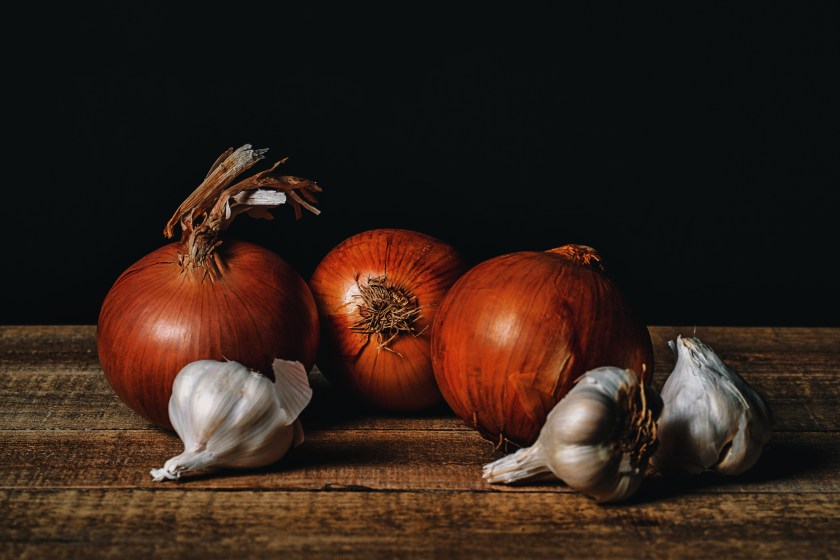
The photograph captures a still life of onions and garlic on a wooden surface, showcasing classical principles through contemporary techniques. The controlled lighting and asymmetrical balance create depth, while post-processing enhances tonal richness. This artwork engages with historical traditions, revealing how ordinary subjects can convey significant meaning through careful observation and technical precision.

Tabletop still life of whole onions and garlic bulbs arranged on a wooden surface against a dark background.
A tabletop still life of onions and garlic arranged on a wooden surface and lit against a dark background.

In this deliberate composition, the photographer demonstrates a mastery of classical still life principles while working within the constraints of contemporary digital tools. The image presents three bronze-skinned onions accompanied by two heads of garlic, arranged on weathered wood against an impenetrable black void—a setup that immediately recalls the Dutch and Spanish still life traditions of the 17th century, where humble kitchen subjects were elevated to objects of contemplation.

The technical execution reveals a sophisticated understanding of light modulation. Working with a single modified light source—a Godox V1s paired with a softbox and grid—the photographer has created a tightly controlled illumination that wraps around the subjects’ curved surfaces while maintaining crisp shadow definition. The grid attachment proves essential here, preventing light spill into the background and preserving the dramatic contrast that gives the image its gravitas. This economy of means, using just one light to achieve such dimensional modeling, speaks to both practical skill and aesthetic intentionality.

What distinguishes this work within Chapter 5’s progression from classic to experimental tabletop photography is its conscious dialogue with art historical precedent. The photographer acknowledges drawing inspiration from a tutorial source, yet the resulting image transcends mere technical exercise. The onions’ papery skins catch light with a luminosity that suggests both fragility and age, their dried stalks creating gestural elements that break the otherwise spherical regularity. The garlic bulbs, positioned in the lower quadrant, provide tonal counterpoint—their pearl-white surfaces reflecting light with greater intensity than the warmer onions above.

The compositional arrangement follows classical principles of asymmetrical balance. The three onions occupy distinct spatial planes, their positioning creating depth through overlapping forms and subtle scale variation. The leftmost onion’s dramatic upward-reaching stem introduces vertical energy, while the garlic anchors the composition’s base. This triangular organization guides the viewer’s eye through the frame in a measured, contemplative rhythm appropriate to the subject matter.

Post-processing choices, implemented through color grading in Luminar 4, enhance the image’s tonal richness without sacrificing naturalism. The warm amber-to-sienna palette suggests candlelight or late afternoon sun, though the lighting setup confirms neither. This ambiguity of light source contributes to the image’s timeless quality—it could as easily have been captured in a 17th-century Dutch kitchen as in a contemporary studio.

The weathered wooden surface provides crucial textural contrast to the subjects’ organic forms. Its rough grain and worn patina introduce narrative suggestions of use and time, transforming a simple backdrop into an active compositional element. The wood’s horizontal planking creates subtle linear structure beneath the curved biological forms above.

Within the broader context of this chapter’s exploration, this photograph occupies the “classic” end of the spectrum—demonstrating that traditional approaches retain their power when executed with technical precision and compositional intelligence. The work proves that experimentation need not always mean formal rupture; sometimes it involves mining established vocabularies with fresh attention. Here, the photographer engages in a centuries-old conversation about how light reveals form, how arrangement creates meaning, and how the ordinary, when carefully observed, achieves a quiet monumentality that rewards sustained viewing.

Architectural Authority: The Denver Public Library

The photograph of the Denver Public Library showcases the interplay of monumental architecture and urban landscape. The black and white imagery emphasizes geometric shapes and textures, transforming harsh midday light into stark contrasts. This representation transcends mere documentation, reflecting civic aspiration and how societies express values through built form within the Colorado context.

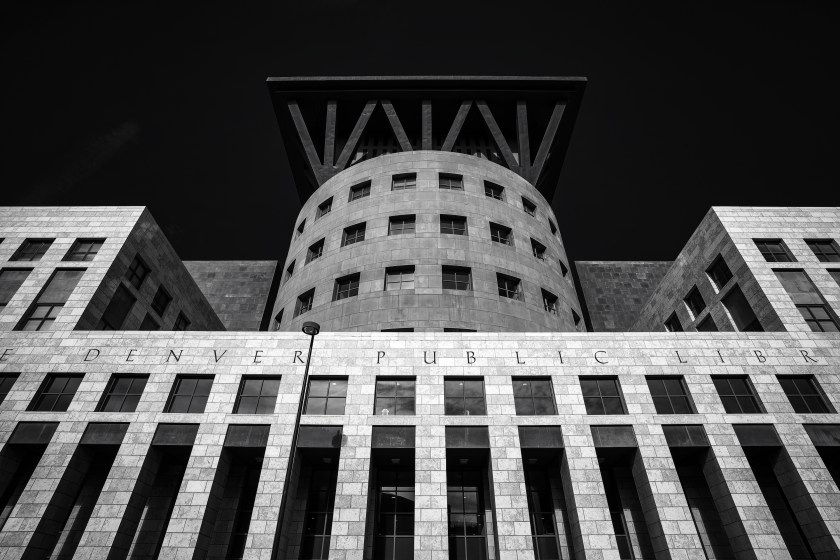
Black and white view of the Denver Public Library exterior, showing a cylindrical central structure framed by angular stone façades.
The exterior of the Denver Public Library is shown in black and white in downtown Denver, Colorado.

In this commanding study of civic architecture, the photographer demonstrates a sophisticated understanding of how monumental structures assert themselves within the urban landscape. Shot at midday when harsh overhead light typically challenges photographers, he transforms potentially difficult conditions into an asset, using deep contrast to emphasize the building’s geometric severity and sculptural mass.

The composition centers on the Denver Public Library’s distinctive cylindrical tower, which rises from the frame like a monolithic drum. The extreme upward angle, facilitated by his Samyang 18mm wide-angle lens, creates a dramatic sense of monumentality while the symmetrical flanking wings establish visual order. This architectural framework—circular form nested within angular geometry—speaks to postmodern design principles that dominated American civic architecture in the late twentieth century. The photographer’s decision to shoot in black and white strips away temporal markers and weather conditions, rendering the structure as a timeless study in form, shadow, and material.

What distinguishes this image within Chapter 3’s exploration of Colorado landscapes and cityscapes is its departure from natural grandeur toward human-made authority. Where mountain vistas offer sublime, untamed power, this photograph presents institutional permanence. The stone cladding, methodically rendered in graduated tones from light gray to near-black, becomes a study in texture and depth. The dramatic diagonal supports visible at the structure’s crown introduce dynamic tension, their angular thrust contrasting sharply with the tower’s curved facade.

The technical execution reveals maturity in the photographer’s approach to architectural documentation. Shot with the Sony A7ii, the image maintains clarity across multiple planes of depth despite the wide-angle distortion inherent to the 18mm focal length. The midday timing, often avoided by landscape photographers, proves deliberate here—the high sun creates stark shadows that carve out the building’s volumes and reveal the recessed windows as dark voids. This interplay between solid and void, light and shadow, transforms descriptive documentation into interpretive art.

The street lamp appearing at center-bottom provides crucial human scale, a reminder that this imposing structure exists within the pedestrian realm. Its modest presence underscores the building’s overwhelming verticality and mass. The text carved into the facade—”DENVER PUBLIC LIBR”—becomes both identifier and compositional element, the letterforms creating horizontal rhythm that grounds the tower’s upward thrust.

Within the photographer’s Top 100 Journey project, this image represents an important evolution. Chapter 3’s focus on Colorado landscapes and cityscapes broadens beyond wilderness to encompass how humans shape their environment. The library, as a democratic institution dedicated to public knowledge, carries symbolic weight that elevates the photograph beyond mere architectural record. It becomes a meditation on civic aspiration, on how societies express values through built form.

The conversion to monochrome proves essential to the image’s impact. Color would introduce distraction—blue sky, stone variations, surrounding urban context. Instead, the black and white treatment creates graphic clarity, emphasizing pattern, geometry, and tonal relationships. The nearly black sky becomes void, pushing the building forward as the sole subject demanding attention.

This photograph confirms the photographer’s ability to find compelling visual architecture within urban environments, applying the same compositional rigor and tonal sensitivity he brings to natural landscapes.