Lights Camera Action: Urban Pulse and Architectural Legacy

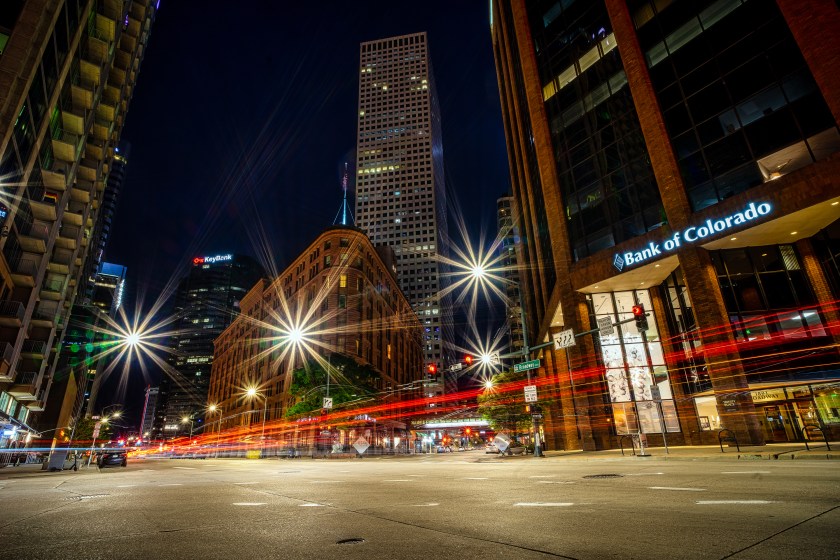
The photograph captures the Broadway and Tremont intersection in downtown Denver, highlighting the contrast between historic architecture and modern life through long exposure techniques. It features the Brown Palace Hotel amidst urban vitality, emphasizing Denver’s artistic complexity. The image challenges traditional views on Colorado’s landscape, advocating for cityscapes’ recognition in photographic surveys.

Long exposure light trails streak through a downtown Denver intersection at night, with tall buildings and streetlights surrounding the scene.
Long exposure traffic moves through the Broadway and Tremont intersection in downtown Denver, Colorado, with city buildings illuminated at night.

In this dynamic nocturnal study of downtown Denver, the photographer captures the essential duality of contemporary urban experience—the historic permanence of architecture set against the ephemeral flow of modern life. Positioned at the intersection of Broadway and Tremont, the image exemplifies his expanding vision within Chapter 3 of the Top 100 Journey, demonstrating how cityscapes demand entirely different technical and conceptual approaches than the natural landscapes that dominate much of his Colorado work.

The composition centers on the iconic triangular form of the Brown Palace Hotel, its distinctive Italianate Renaissance architecture rendered in warm amber tones against the deep blue of evening sky. This historic structure, framed between modern high-rises including the recognizable Republic Plaza tower, serves as both literal and metaphorical anchor—a touchstone of Denver’s Victorian-era prosperity surrounded by evidence of contemporary economic vitality. The photographer’s selection of this particular vantage point acknowledges the city’s layered temporal identity, where preservation and progress coexist in productive tension.

Working with an 18mm Samyang wide-angle lens mounted to his Sony A7II, he employs long exposure to transform vehicular traffic into ribbons of light—brilliant red taillights streaking horizontally across the frame’s lower third. These light trails provide kinetic energy and directional movement, leading the eye through the urban canyon while simultaneously suggesting the ceaseless motion of city life. Street lamps contribute their own starburst effects, punctuating the composition with points of crystalline brilliance that add theatrical dimension to the scene.

The technical execution reveals sophisticated understanding of night photography’s particular challenges. The exposure balances multiple light sources—artificial street lighting, illuminated building interiors, vehicle headlights, and residual ambient sky—without sacrificing detail in highlights or shadows. Corporate signage for KeyBank and Bank of Colorado glows with intentional clarity, grounding the image in specific place while contributing to the overall color harmony. The photographer’s post-processing in Luminar 4 has enhanced these chromatic relationships without pushing them into garishness, maintaining naturalistic tonality despite the inherently artificial lighting conditions.

What distinguishes this photograph within the broader chapter is its successful integration of Colorado’s urban identity alongside the state’s more frequently celebrated natural splendor. While mountain vistas and wilderness landscapes tend to dominate photographic representations of Colorado, this image argues persuasively for Denver’s visual complexity and photographic merit. The cityscape becomes landscape—vertical rather than horizontal, constructed rather than geological, but equally worthy of sustained aesthetic attention.

The wide-angle perspective introduces subtle geometric distortion that emphasizes the vertiginous quality of urban space, the way buildings frame and compress sky into channels of deep blue-black. Empty pavement in the immediate foreground provides breathing room, allowing viewers to enter the scene before being swept into the light-streaked energy of the intersection itself. This compositional breathing space demonstrates restraint and confidence, resisting the temptation to fill every pixel with information.

Within his evolving practice, this photograph represents important formal development. The controlled chaos of long-exposure urban photography requires different skills than landscape work—timing traffic flow, managing mixed lighting, balancing architectural detail against motion blur. His success here suggests a photographer expanding his technical vocabulary while maintaining consistent artistic sensibility. The image asks viewers to reconsider what constitutes Colorado landscape, proposing that cityscapes deserve equal consideration in any comprehensive photographic survey of the state’s visual identity.

Convention Center Station: Urban Infrastructure as Light Study

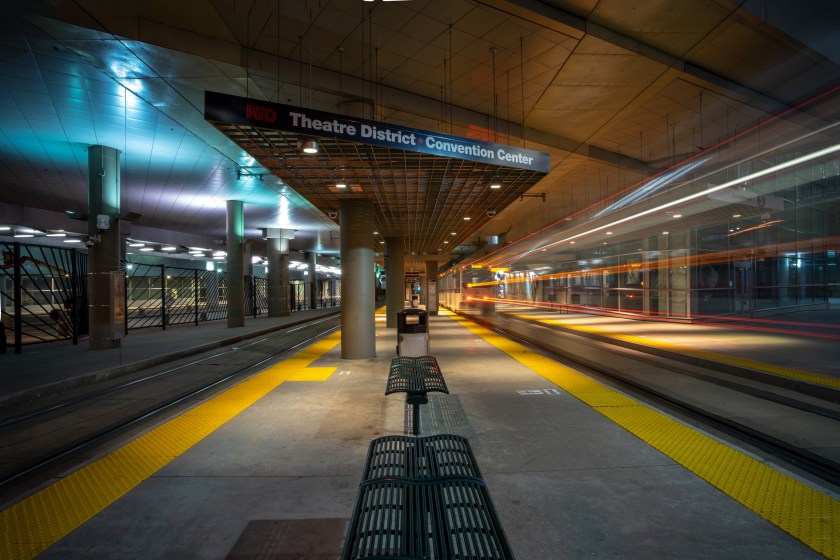
The photograph at Denver’s Convention Center RTD station captures an arriving light rail train through long exposure, emphasizing urban environments over natural landscapes. The technical choices create depth and contrast between warm light trails and cooler architectural tones. This piece illustrates Colorado’s identity, showcasing urban transit as significant as its natural vistas.

Text: Long exposure view of the RTD light rail platform at the Convention Center with blurred train lights in downtown Denver.
A long exposure captures an arriving RTD light rail train at the Convention Center station in downtown Denver, Colorado.

In the urban component of Chapter 3—Colorado Landscapes & Cityscapes—this long exposure photograph of Denver’s Convention Center RTD station marks a deliberate shift from natural subjects to the constructed environments that define contemporary Colorado life. The image captures a light rail train arriving at the platform, its motion rendered as luminous streaks of amber and red that cut through the architectural geometry of the underground station. This is urban photography that privileges process and temporal collapse over the decisive moment, transforming public transit infrastructure into an exercise in controlled abstraction.

The photographer’s technical approach is fundamental to the image’s success. Using a Sony A7ii paired with a Samyang 18mm wide-angle lens, he has embraced the distortions and expansiveness that such focal lengths provide. The wide angle compresses the station’s perspective while simultaneously stretching its architectural lines, creating a sense of depth that pulls the viewer’s eye from the central platform toward both vanishing points. The long exposure—likely several seconds given the degree of light trail elongation—allows the moving train to register as pure energy rather than solid form, a ghost of motion suspended within the static framework of concrete, steel, and tile.

Color plays a crucial structural role. The safety-yellow platform edges create strong horizontal bands that anchor the composition and provide visual weight at the bottom of the frame. These bright strips contrast sharply with the cooler tones dominating the upper portions—cyan-tinted fluorescent lighting that bathes the ceiling panels and creates atmospheric zones of cool illumination. The train’s light trails introduce warm amber tones that bridge these temperature extremes, serving as the compositional focal point despite their ethereal nature. The signage identifying the Theatre District/Convention Center stop glows in the upper third, grounding the image in specific geographic and civic context.

What distinguishes this work within the broader chapter is its commitment to representing Colorado’s urban character with the same attention previously devoted to its natural landscapes. Denver’s RTD system, as critical infrastructure connecting the metropolitan region, deserves documentation as much as any mountain vista or aspen grove. The photographer recognizes this and approaches the subject with seriousness of purpose. The empty platform—devoid of waiting passengers—allows the architecture and light to speak without human interruption, though the absence of people also raises questions about time of day, accessibility, and the photographer’s relationship to urban space during off-peak hours.

The symmetry is notable but not absolute. The central platform creates a strong vertical axis, reinforced by support columns and the overhead ceiling structure. Yet the composition retains enough asymmetry—particularly in the light trails and architectural details—to avoid static formalism. The textured platform surface, captured with clarity despite the low light conditions, provides tactile detail that prevents the image from becoming purely graphic.

Within a collection that spans Colorado’s diverse visual territories, this photograph asserts that the state’s identity includes its cities and their infrastructure. It is work that finds aesthetic potential in transit stations, that sees light trails as valid subjects alongside geological formations, and that expands the definition of landscape to include the spaces humans build for movement and connection.

Long Exposure Bay Pier

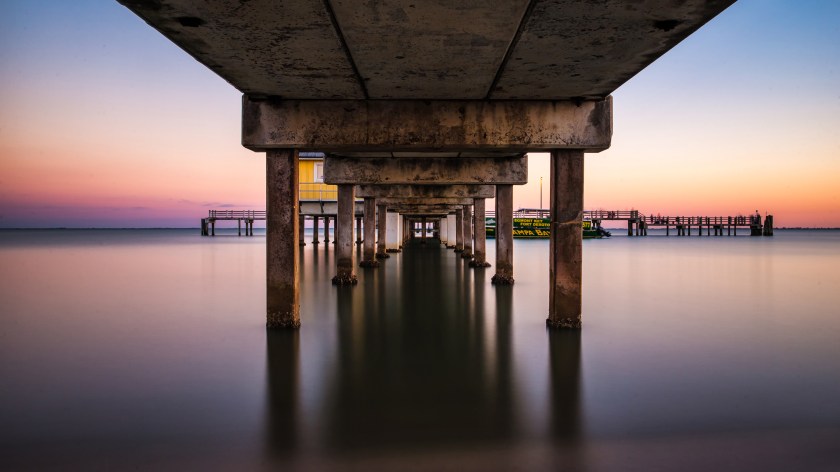
This long-exposure photograph from Fort De Soto Park captures the interplay between water and human infrastructure beneath the Bay Pier at sunset. The technical precision transforms the scene into a study of temporality, where smooth water contrasts with weathered concrete, exploring beauty in overlooked spaces. The image balances tranquility and depth, prompting contemplation.

Long exposure sunset photograph taken beneath the Bay Pier at Fort De Soto Park, showing symmetrical concrete pilings and smooth reflective water.
Long exposure sunset view beneath the Bay Pier at Fort De Soto Park.

The photographer’s technical mastery and compositional restraint converge in this striking long-exposure study from Fort De Soto Park. Captured beneath the Bay Pier at sunset, the image demonstrates a sophisticated understanding of how extended exposure transforms the ephemeral into the architectural, rendering water as smooth as polished stone and reducing the atmospheric gradient to its essential chromatic progression.

The 124-second exposure at f/16 achieves precisely what such technical specifications promise: a complete metamorphosis of the transient into the permanent. The water’s surface becomes a mirror of silk, its glassy uniformity disrupted only by the weathered pier columns that puncture the frame with rhythmic precision. These pylons, darkened by time and barnacled at their waterline, create a vanishing perspective that draws the eye inexorably toward the distant horizon where structure meets light. The photographer has positioned himself not merely under the pier but within its geometric logic, allowing the concrete deck above to function as both literal and compositional ceiling, establishing boundaries that paradoxically expand the viewer’s sense of spatial depth.

What distinguishes this work within the Florida Landscapes & Cityscapes chapter is its meditation on infrastructure as organic form. The pier’s weathered concrete surfaces—mottled with rust stains and biological growth—speak to the peninsula’s relentless humidity and salt air. Rather than presenting Florida’s more commonly depicted pristine beaches or crystalline waters, he has chosen to explore the liminal space where human construction gradually surrenders to natural forces. The corroded texture of the support beams and deck creates a counterpoint to the water’s supernatural smoothness, establishing a dialogue between industrial decay and elemental transformation.

The color palette rewards careful attention. The sky transitions from pale lavender at the zenith through bands of peach and amber toward the horizon, while the water adopts cooler tones of green and slate. This chromatic division creates temperature contrast that enhances the image’s sense of tranquility without veering into sentimentality. A yellow structure visible in the middle distance—likely a utility building or navigation marker—provides a necessary accent of saturated color, preventing the composition from becoming too subdued.

The technical execution reflects deliberate choices rather than automatic settings. The 31mm focal length on a full-frame sensor provides sufficient width to encompass the pier’s structural rhythm while maintaining proper perspective correction, avoiding the distortion that might occur at the wide end of his 18-35mm lens. The ISO 100 setting ensures maximum detail in the shadows where barnacles cling to concrete, while the extended shutter speed required neutral density filtration to prevent overexposure during the lingering twilight.

Within the photographer’s larger journey, this image represents a maturation of vision—a willingness to find beauty not in Florida’s celebrated natural wonders but in the overlooked spaces where infrastructure and environment intersect. The pier becomes a study in temporality: concrete designed to last decades, water that renews itself constantly, and light that exists only for minutes. By freezing this convergence through long exposure, he creates a document that feels both immediate and timeless, a quality that defines his most successful landscape work. The photograph succeeds because it refuses spectacle in favor of contemplation, inviting sustained viewing rather than demanding instant admiration.

Venice Fishing Pier Sunset: Mastering the Fundamentals of Light

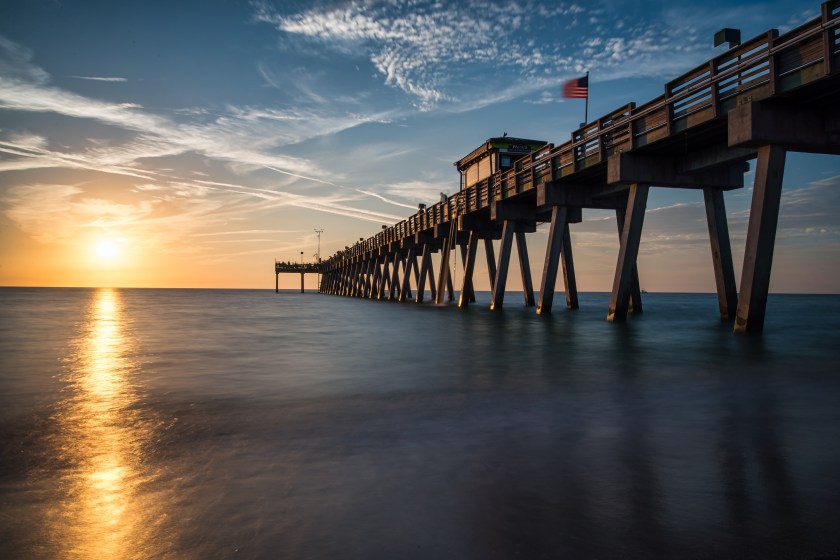
Greg Urbano’s sunset photograph of the Venice Fishing Pier exemplifies the intersection of technical skill and artistic sensibility in landscape photography. Through meticulous use of exposure and composition, Urbano captures a moment where structured permanence meets the fluidity of nature, showcasing balanced tones and dynamic movement in a serene coastal scene.

Sunset photograph of the Venice Fishing Pier in Florida, showing the pier extending into the Gulf of Mexico with golden reflections on calm water.
Sunset over the Gulf of Mexico with the Venice Fishing Pier in the background, captured in a long exposure.

Within Greg Urbano’s “Beginnings” chapter, this sunset photograph of the Venice Fishing Pier represents a photographer coming to terms with landscape photography’s essential discipline: the patient orchestration of light, water, and architecture. Shot along Florida’s Gulf Coast, the image demonstrates technical competence married to an emerging aesthetic sensibility—a combination that marks the transition from enthusiast to serious practitioner.

The technical execution reveals deliberate choices that elevate this beyond a simple sunset snapshot. Using a Nikon D610 with an 18-35mm lens set to 28mm, Urbano selected an aperture of f/18 to maximize depth of field, ensuring sharpness from the foreground water to the distant pier structure. The 13-second exposure at ISO 100 transforms the Gulf of Mexico into a silken plane, smoothing the texture of incoming waves into an ethereal blue gradient. This long exposure technique—fundamental to seascape photography—requires both technical knowledge and patience, waiting for the precise moment when light, tide, and atmospheric conditions align.

The composition demonstrates sophisticated spatial awareness. The pier’s diagonal thrust from lower right to upper left creates dynamic movement through the frame, leading the viewer’s eye from the silky foreground water toward the structure’s vanishing point. The rhythmic repetition of pier supports establishes a visual cadence, their angular geometry contrasting beautifully with the organic flow of water and clouds. An American flag atop the pier adds a vertical accent and a touch of patriotic iconography without overwhelming the scene’s natural beauty.

What distinguishes this photograph is Urbano’s treatment of light. The setting sun hovers just above the horizon line, its golden warmth reflected in a shimmering path across the water’s surface. The exposure balances multiple tonal zones expertly: the brilliant sun doesn’t blow out to featureless white, the shadowed pier structure retains detail, and the water holds both luminous highlights and cool, deep blues. This tonal control suggests a photographer who understands exposure compensation and potentially uses graduated neutral density filters or careful post-processing to manage the scene’s extreme dynamic range.

The sky deserves particular attention. Wispy cirrus clouds stretch across the frame in delicate streaks, their feathered patterns creating texture and visual interest in what might otherwise be empty blue space. The interplay between warm sunset tones near the horizon and cooler blues above establishes atmospheric depth, giving the image a sense of vast space and coastal openness.

As a “Beginnings” chapter work, this photograph represents mastery of landscape photography fundamentals. The long exposure technique, the careful attention to composition and leading lines, the patient waiting for optimal light—these are the building blocks upon which more experimental work can later be constructed. There’s confidence here, a photographer who has moved beyond technical uncertainty into intentional image-making.

The Venice Pier becomes more than a documentary subject; it transforms into a meditation on structure and impermanence. The solid, engineered permanence of the pier contrasts with the fluid, ever-changing water—a tension made visible through photographic technique. Urbano captures not just a place, but a moment of perfect equilibrium between human construction and natural forces, all bathed in the transient golden light that photographers chase endlessly along coastlines worldwide.