Northern Hotel Lobby: Architecture as Stage in the Contemporary Photographic Journey

The photograph of the Northern Hotel lobby, taken during Scott Kelby’s Worldwide Photowalk, captures the interplay of light, architecture, and human presence. Elevating the viewer’s experience, it harmonizes historical preservation with contemporary exploration, highlighting the importance of collaborative practice in photography and the evolving narrative of space and community.

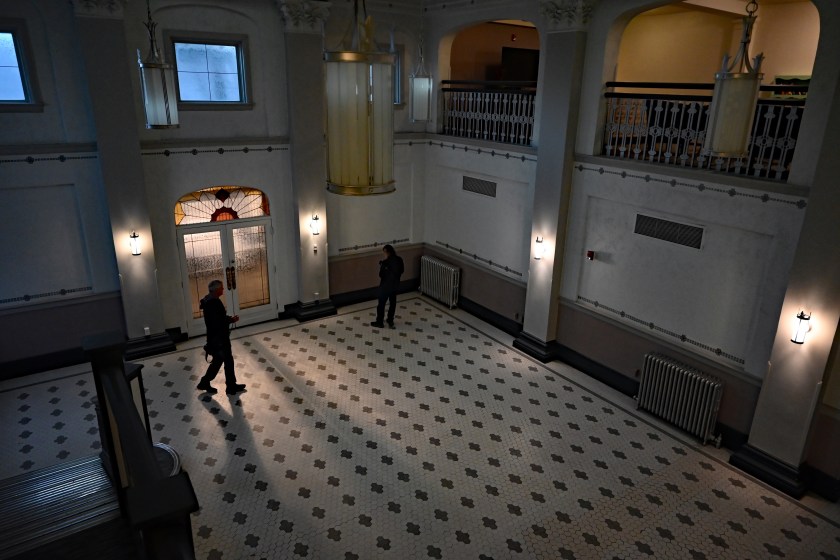
View of the Northern Hotel lobby from an upper staircase, showing patterned tile flooring, hanging lights, and two people walking across the open space below.
The Northern Hotel lobby in Fort Collins, photographed from the top of the staircase during Scott Kelby’s Worldwide Photowalk.

In this commanding architectural study, the photographer positions his lens at the apex of a staircase, transforming the Northern Hotel’s lobby into a theater of light, geometry, and human scale. Captured during Scott Kelby’s Worldwide Photowalk in Fort Collins, the image represents a significant entry in Chapter 6 of his Top 100 Journey—a section devoted to recent work and ongoing exploration. Here, the photographer’s evolving visual language finds purchase in the interplay between preserved historical space and contemporary documentary practice.

The composition demonstrates a mature understanding of spatial dynamics. Shot from an elevated vantage point, the frame encompasses the lobby’s full vertical reach, from the patterned terrazzo floor below to the arched balconies above. Two fellow photographers occupy the lower portion of the frame, their dark silhouettes providing crucial scale against the expanse of white walls and geometric flooring. This human element prevents the space from becoming merely an exercise in architectural documentation; instead, it anchors the viewer’s experience in a moment of shared discovery.

The photographer’s technical execution reveals deliberate choices regarding exposure and white balance. The warm incandescent glow from wall sconces contrasts with cooler ambient light filtering through windows, creating a subtle temperature gradient that enhances the lobby’s dimensionality. Pendant lights suspended from the ceiling echo this interplay, their cylindrical forms acting as vertical punctuation marks in the composition. The decorative tile borders running horizontally along the walls establish rhythm, while the radiators beneath provide industrial counterpoint to the space’s ornamental flourishes.

What distinguishes this work within the context of Chapter 6 is its relationship to process and community. Unlike the more introspective or solitary work that might characterize earlier chapters, this photograph emerges from collaborative exploration—a photowalk that brings practitioners together in shared discovery. The photographer’s decision to include his companions becomes a subtle commentary on the social dimensions of photographic practice, acknowledging that contemporary image-making often unfolds in dialogue with others.

The Northern Hotel itself, with its restored early twentieth-century details, offers fertile ground for examining how historical architecture persists in contemporary life. The stained glass transom above the entrance door, the ornamental ironwork of the balcony railings, and the carefully preserved floor pattern all speak to preservation efforts that transform commercial spaces into cultural touchstones. The photographer approaches this material not with nostalgia but with documentary clarity, allowing the space’s formal qualities to assert themselves.

In the broader trajectory of his Top 100 Journey, this image signals an openness to environmental portraiture and architectural narrative. The “ongoing exploration” referenced in Chapter 6 manifests here as a willingness to work within structured events and communal frameworks while maintaining individual vision. The photograph neither dominates its subject with excessive intervention nor withdraws into passive recording; rather, it strikes a balance between observation and interpretation.

The Northern Hotel lobby becomes, under his lens, both subject and metaphor—a preserved space that hosts contemporary seekers, a historical vessel filled with present-tense activity. This duality resonates throughout the photographer’s recent work, suggesting that the road ahead involves continued negotiation between tradition and innovation, solitude and community, documentation and artistic expression.

Fly Fisherman, Poudre River: Solitude and Seasonal Transition

The photograph of a fly fisherman in the Poudre River during autumn integrates human presence into Colorado’s natural landscape. Positioned mid-stream, the figure enhances the scene’s narrative and scale. This image balances aesthetics and documentary elements, showcasing a peaceful coexistence between nature and human activity amid vibrant seasonal colors.

A lone fly fisherman stands in a calm river beneath a small bridge, surrounded by autumn trees with yellow foliage.
A fly fisherman wades the Poudre River beneath a bridge during autumn in Colorado.

Among the works comprising Chapter 3—Colorado Landscapes & Cityscapes—this autumn scene along the Poudre River introduces a human presence that has been notably absent from much of the photographer’s natural landscape documentation. A lone fly fisherman stands mid-stream, his figure providing both scale and narrative focus within a composition dominated by seasonal color and the interplay of light on moving water. The image succeeds in balancing documentary observation with careful aesthetic consideration, capturing what appears to be a chance encounter during the photographer’s search for the last vestiges of fall color along this northern Colorado waterway.

The composition employs a classic landscape structure, divided roughly into thirds by the horizontal elements: the reflective water surface in the foreground, the bridge and human figure in the middle ground, and the autumn-touched forest rising beyond. The fisherman, positioned slightly off-center, serves as the crucial point of human scale that transforms what might otherwise be a standard seasonal landscape into something more contemplative. His solitary presence—the photographer notes he was likely the only other person at this remote turnoff—adds an element of quietude and shared appreciation for the conditions that drew both individuals to this location on a Saturday afternoon.

The treatment of water demonstrates technical proficiency with the Sony A7ii and kit lens combination. A moderate exposure time renders the river surface with subtle motion blur, smoothing ripples into gentle gradations of reflected light while maintaining enough definition to distinguish current patterns and submerged rocks. The right portion of the frame captures direct sunlight on the water, creating a bright zone of contrast against the darker, shadowed areas. This tonal range—from deep amber reflections to brilliant highlights—gives the water substantial visual weight and complexity.

Autumn color saturates the background, with golden aspens and cottonwoods forming luminous masses against the darker evergreens. The trees are captured at what the photographer sought—the final days of peak color—evident in the richness of the yellows and the beginning transitions toward bare branches. The small bridge, a modest steel and concrete structure, provides architectural grounding without overwhelming the natural elements. Its weathered construction suggests a rural access point rather than a major thoroughfare, reinforcing the sense of a discovered location rather than a destination.

What distinguishes this photograph within the broader chapter is its acknowledgment of human interaction with Colorado’s landscapes. Where other works present wilderness as untouched or urban environments as purely architectural, this image occupies a middle ground. The fisherman is neither intruder nor irrelevance; he belongs to this scene as much as the bridge or the turning leaves. His activity—fly fishing, with its requirements of patience, skill, and intimate knowledge of the water—suggests a relationship with place rather than mere passage through it.

The photographer’s decision to include this figure, captured during what he describes as a casual Saturday excursion, reveals an evolving understanding of how to represent place. Colorado’s identity encompasses not only its dramatic geology and seasonal transformations but also the quiet pursuits of those who seek out its rivers and forests during brief windows of perfect weather and fading color.