Mike Groth: Classical Studio Portraiture and the Language of Formality

Mike Groth’s studio portrait, featured in Chapter 4 of the Top 100 Journey, exemplifies traditional portraiture through controlled lighting and composition. Shot at Old Town Yoga Studio, the image focuses on character and presence, utilizing a classic backdrop and professional techniques. Its formal simplicity highlights the subject’s confidence, making it versatile across various contexts.

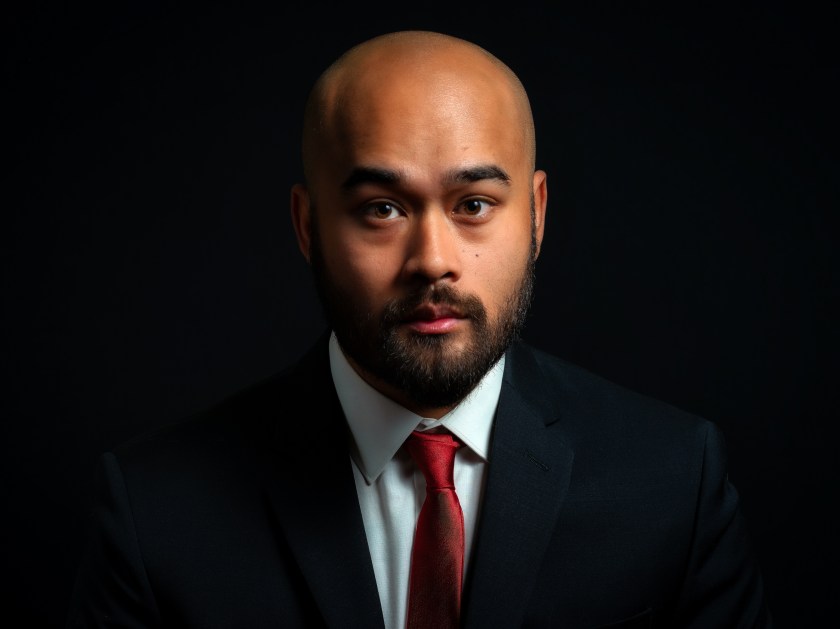
Bald man with a beard wearing a suit and red tie looks directly at the camera against a black background.
Mike Groth is photographed in a studio portrait at Old Town Yoga Studio in Fort Collins, Colorado.

Within Chapter 4 of the photographer’s Top 100 Journey, this portrait of Mike Groth represents a return to the foundational principles of studio portraiture—controlled lighting, deliberate composition, and the timeless formality of traditional headshot aesthetics. Shot at the Old Town Yoga Studio in Fort Collins, Colorado, the image demonstrates the photographer’s facility with classic studio techniques while exploring the psychological dimensions of formal masculine presentation.

The technical execution adheres to established conventions of corporate and editorial portraiture. Utilizing a Sony A7ii with an 85mm f/1.8 lens, the photographer has positioned his subject against a pure black backdrop, eliminating all environmental context to focus entirely on character and presence. A Godox V1s flash paired with a shoot-through umbrella provides the primary illumination—a traditional modifier choice that produces soft, diffused light with gentle shadow gradation across the subject’s features. This approach creates dimensional modeling without the harsh contrast of direct flash, revealing the contours of the face while maintaining a polished, professional quality.

The composition centers the subject in a classical three-quarter view, shoulders angled slightly to create visual interest while the face turns toward the camera. This positioning—neither fully frontal nor profile—has been a cornerstone of portraiture since the Renaissance, offering both dimensionality and direct engagement. The subject’s formal attire—dark suit, white shirt, burgundy tie—reinforces the traditional corporate aesthetic, while his neutral expression and direct gaze suggest confidence tempered with approachability.

What distinguishes this work within the photographer’s broader practice is its embrace of restraint. Where other images in Chapter 4 explore environmental integration and spontaneous moments, this portrait strips away context to examine how lighting, posture, and expression alone can convey character. The black void backdrop functions not merely as a neutral background but as an active element, creating psychological weight and directing all attention to the subtle details: the catch lights in the eyes, the texture of facial hair, the precise fall of shadow along the jawline.

The post-processing in Luminar 4 maintains the studio’s carefully controlled atmosphere. Skin tones are rendered with natural warmth while preserving texture and detail. The lighting reveals itself as directional yet forgiving, highlighting the subject’s facial structure without creating unflattering shadows. This balance between revelation and flattery characterizes effective professional portraiture—honest without being harsh, polished without appearing artificial.

Within the context of Chapter 4’s mission to document studio, outdoor, and workshop methodologies, this image anchors the studio component with particular authority. It demonstrates that contemporary portrait photography need not abandon classical techniques in pursuit of innovation. The photographer’s choice to work within established conventions reflects an understanding that certain approaches endure precisely because they succeed in their essential task: revealing the subject’s presence and character with clarity and dignity.

The formal simplicity of this portrait allows it to function across multiple contexts—editorial, corporate, archival. This versatility speaks to the photographer’s understanding of portraiture not merely as artistic expression but as functional communication. As part of the Top 100 Journey, the image represents a technical benchmark, showcasing the fundamental competencies upon which more experimental work can build. It is portraiture in its most distilled form: light, subject, and the photographer’s ability to orchestrate their interaction with precision and purpose.

Silhouette and Subversion: A Study in Controlled Drama

The portrait of Savage Van Sage by Greg Urbano in Chapter 4 of Top 100 Journey exemplifies refined environmental portraiture. It captures a blend of vulnerability and confidence through composition, lighting, and setting. The ivy backdrop, along with the model’s pose, invites viewers to engage with the complex narrative, reflecting Urbano’s artistic evolution and technical mastery.

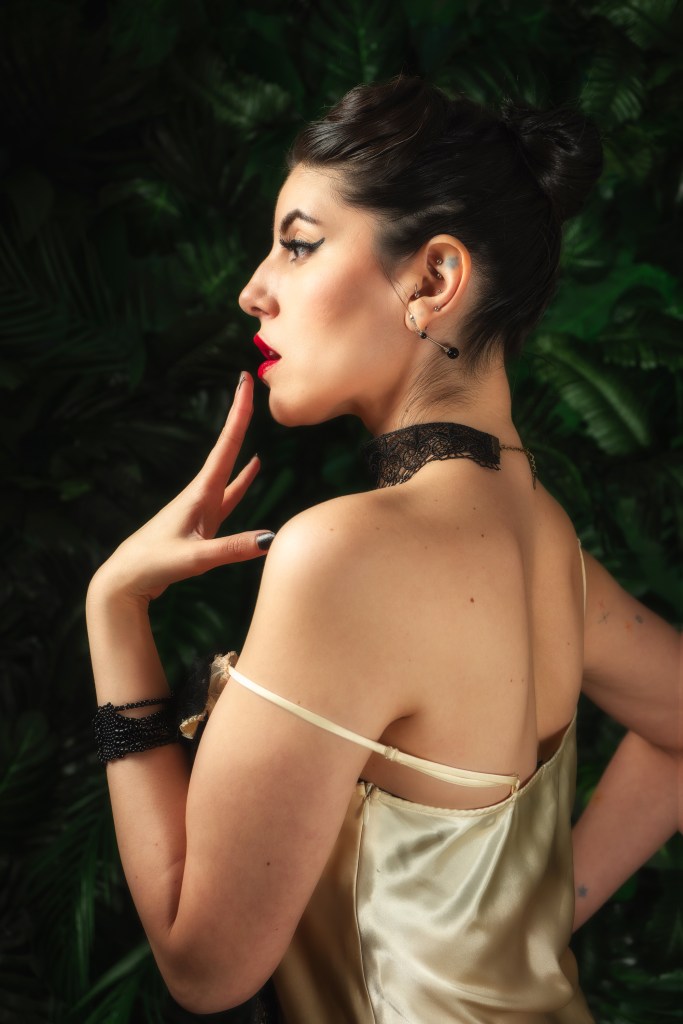
Woman in a satin dress shown in side profile against a dark leafy background, with hair in an updo and red lipstick.
Savage Van Sage poses in profile in a studio portrait with an ivy-covered wall near Denver, Colorado.

Within Chapter 4 of Greg Urbano’s Top 100 Journey—a section devoted to studio portraiture and collaborative workshop explorations—this photograph of model Savage Van Sage stands as a masterclass in theatrical restraint. Shot against an ivy-laden wall at the Headquarters studio near Denver, the image demonstrates the photographer’s evolving command of environmental portraiture, where setting and subject engage in a carefully choreographed dialogue.

The composition reveals sophisticated technical decision-making. Urbano positions his subject in profile, her face turned away from the camera yet fully engaged with the viewer through gesture and posture. The silhouette technique employed here—enhanced through post-processing in Adobe Camera Raw and Luminar 4—creates a striking interplay between illumination and shadow. Light sculpts the model’s features with precision, catching the curve of her jawline, the delicate architecture of her ear adorned with multiple piercings, and the bold contrast of crimson lips against porcelain skin.

What distinguishes this work within the chapter’s broader exploration of portrait photography is its willingness to embrace ambiguity. The model’s bare shoulder and the gossamer straps of her garment suggest vulnerability, yet her pose—hand raised to chin in a gesture of thoughtful poise—projects confidence and self-possession. The black lace choker and wrist accessory introduce elements of vintage glamour and contemporary subculture, positioning the subject at the intersection of multiple aesthetic traditions. This fusion of pin-up sensibility with darker, more enigmatic styling reflects Urbano’s interest in portraits that resist singular interpretation.

The natural ivy backdrop functions as more than mere decoration. Its organic chaos provides textural depth and creates a liminal space—neither entirely studio nor wholly natural environment. This choice aligns with the chapter’s documentation of the photographer’s studio and workshop methodologies, demonstrating how controlled environments can be manipulated to suggest narrative possibilities beyond their physical constraints. The deep greens recede into darkness, focusing attention on the figure while maintaining atmospheric richness.

Technically, the photograph showcases the photographer’s proficiency with studio lighting configurations. The illumination appears to originate from a single, directional source, creating the dramatic side-lighting characteristic of classic portraiture while maintaining sufficient fill to preserve detail in shadow areas. This approach—refined through workshop collaborations and repeated studio sessions—demonstrates a maturation from documentary impulses toward more deliberately constructed imagery.

The inclusion of this photograph in the Top 100 Journey marks a significant moment in Urbano’s artistic development. Where earlier chapters might emphasize spontaneity or environmental documentation, this studio work reveals an artist increasingly comfortable with artifice and construction. The model becomes collaborator rather than subject, her professional experience evident in the precision of her pose and the deliberate theatricality of her presentation.

Ultimately, this portrait succeeds because it understands the power of suggestion over declaration. The viewer receives fragments—a profile, a gesture, a carefully composed environment—and must construct meaning from these elements. It is portrait photography that honors both the technical traditions of studio work and the contemporary expectation that images should provoke rather than simply document. Within Urbano’s evolving practice, it represents a confident synthesis of technical skill and artistic vision.

Colorado Capital Rotunda: Vertical Aspiration and Ornamental Complexity

The photograph of the Colorado State Capitol rotunda represents a shift in architectural perspective, focusing on the interior’s ornate details rather than external views. Using a wide-angle lens, the image captures the dome’s grandeur and intricate design, embodying the civic experience and inviting public engagement while highlighting historical and democratic ideals.

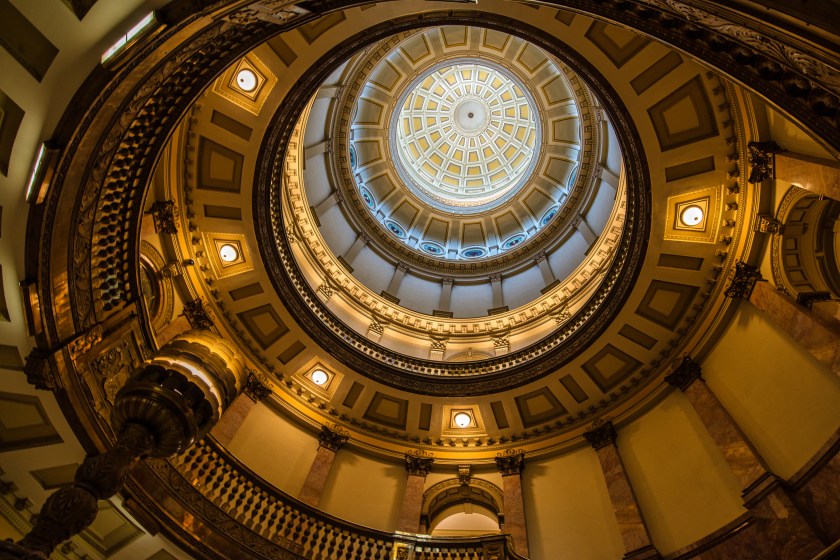
Upward view of the ornate rotunda ceiling inside the Colorado State Capitol, showing concentric arches and a central skylight.
An interior view looking up into the rotunda of the Colorado State Capitol in Denver, Colorado.

This interior study of the Colorado State Capitol rotunda marks a significant compositional departure within Chapter 3 of the Top 100 Journey. Where previous images in this collection have examined architecture from external vantage points—emphasizing façade, silhouette, and contextual placement—this photograph inverts the perspective, directing the viewer’s gaze upward through concentric rings of ornamental detail toward a luminous oculus. The shift from exterior monumentality to interior intimacy reveals the photographer’s expanding investigation of how architectural space shapes civic experience and visual perception.

Shot with a Nikon D610 and an 18-35mm f/3.5-4.5 lens at 19mm, the wide-angle focal length proves essential to capturing the rotunda’s full vertical sweep within a single frame. The fisheye-like distortion inherent at this focal length amplifies the dome’s centripetal geometry, creating a vortex effect that draws the eye inexorably toward the coffered ceiling and its central aperture. The exposure settings—f/8.0 at 1/10s, ISO 400—balance the need for depth of field across multiple architectural tiers with the practical constraints of handheld low-light shooting. The resulting image maintains sharpness from the foreground balustrade through to the uppermost decorative elements.

The color palette divides into two distinct thermal zones. Warm golden tones dominate the lower registers, where artificial lighting illuminates gilt detailing, coffered panels, and classical ornamentation. These warm hues gradually transition to cooler whites and pale blues as the eye travels upward, culminating in the natural daylight filtering through the oculus. This chromatic shift reinforces the spiritual and hierarchical symbolism embedded in rotunda architecture—earthly richness below, celestial purity above—while simultaneously demonstrating the photographer’s attentiveness to mixed lighting conditions.

Compositional rigor anchors what could easily become visual chaos. The photographer positions himself at the precise center point beneath the dome, ensuring perfect radial symmetry. This decision transforms architectural documentation into geometric meditation, where repeating patterns of coffering, balustrades, and Corinthian capitals establish rhythmic visual cadence. The inclusion of the ornate balustrade in the lower left introduces human scale and tactile detail, preventing the image from becoming pure abstraction while emphasizing the building’s accessibility—a public space designed for citizen engagement.

Within the broader narrative of Chapter 3, this rotunda photograph functions as conceptual bridge between exterior civic monumentality and the quotidian experience of urban space. It reveals what lies beneath the gilded dome captured in his nocturnal exterior study, exposing the elaborate craftsmanship and symbolic program that nineteenth-century architects employed to manifest democratic ideals through built form. The image documents not merely architectural opulence but the spatial theater of governance—the designed environment through which political power seeks legitimacy through aesthetic grandeur.

The photographer’s note regarding access—”as simple as passing through a metal detector”—introduces subtle contemporary commentary. This threshold between public and civic space, between everyday citizen and architectural spectacle, becomes invisible in the final image yet remains conceptually present. The photograph captures a space designed for transparency and public access, its ornamental complexity serving not to exclude but to dignify the democratic project. In rendering this vertical architecture with technical precision and compositional thoughtfulness, the photographer documents both historical aspiration and ongoing civic function, making visible the constructed environments through which Colorado’s political identity continues to be performed and experienced.

Vertical Ascension: Modernist Form in Downtown St. Petersburg

The black and white photograph of the Signature Place high-rise in St. Petersburg captures its architectural monumentality through a minimalist lens. Stripping color emphasizes form and texture, while a dynamic composition highlights urban development. The work reflects the photographer’s evolving vision, merging documentary and artistic interpretation within contemporary architectural photography.

Black and white low‑angle photograph of the Signature Place condominium tower in downtown St. Petersburg, Florida, showing strong geometric lines and modern architecture.
Black and white architectural study of the Signature Place high‑rise in downtown St. Petersburg.

In this striking image from Chapter 2 of the photographer’s Top 100 Journey, the Signature Place Condominium tower emerges as a study in architectural monumentality and photographic restraint. Shot in downtown St. Petersburg, Florida, the photograph transforms a contemporary residential structure into something both documentary and abstract—a meditation on verticality, light, and the geometric language of modern urban development.

The decision to render this scene in black and white proves essential to the image’s success. By stripping away color, the photographer directs attention to the fundamental elements of architectural photography: form, texture, and tonal gradation. The building’s repetitive window pattern creates a rhythmic grid that draws the eye upward, while the dramatic contrast between the illuminated facade and the darkening sky suggests a specific moment of transition—likely the golden hour, when natural light rakes across surfaces to reveal dimension and depth.

Technical execution demonstrates thoughtful consideration of both optics and exposure. Working at 35mm on an 18-35mm lens mounted to a full-frame Nikon D610, he selected a narrow aperture of f/18 to maximize depth of field and ensure crisp detail throughout the frame. The resulting sharpness allows the viewer to appreciate the building’s material qualities—the interplay of glass, concrete, and steel that defines contemporary high-rise construction. A shutter speed of 1/8 second at ISO 100 suggests the use of a tripod, essential for maintaining clarity at this exposure length while preserving clean shadow detail.

The composition employs a low vantage point that accentuates the tower’s dramatic thrust skyward. This perspective, common in architectural photography but executed here with particular effectiveness, creates a sense of imposing scale while maintaining architectural integrity. The building’s angular crown punctures the upper portion of the frame, while a lower podium structure grounds the composition and provides contextual anchoring in the urban landscape.

Within the broader framework of Chapter 2—Florida Landscapes & Cityscapes—this photograph represents an important counterpoint to the state’s more commonly photographed natural environments. Rather than beaches, wetlands, or subtropical flora, the photographer turns his lens toward Florida’s built environment, acknowledging the contemporary reality of rapid urban development along the Gulf Coast. St. Petersburg’s downtown skyline, transformed dramatically over recent decades, serves as a compelling subject for examining how modern architecture reshapes regional identity.

The image also speaks to the photographer’s evolving vision throughout the Top 100 Journey. Where other selections might emphasize natural wonder or environmental preservation, this work demonstrates equal comfort with urban subject matter. The modernist aesthetic—clean lines, geometric precision, monochromatic palette—suggests an appreciation for architectural form as a legitimate subject for serious photographic inquiry.

What elevates this photograph beyond mere documentation is its atmospheric quality. The graduated sky, rendered in smooth tones from deep black to luminous gray, provides a canvas against which the building performs. The partially visible vegetation at the frame’s base hints at the subtropical context without overwhelming the primary subject. This careful balance between architectural documentation and artistic interpretation positions the work within a tradition extending from early twentieth-century modernist photography through contemporary fine art practice—a lineage that recognizes buildings not merely as structures to be recorded, but as forms to be interpreted.