Northern Hotel Lobby: Architecture as Stage in the Contemporary Photographic Journey

The photograph of the Northern Hotel lobby, taken during Scott Kelby’s Worldwide Photowalk, captures the interplay of light, architecture, and human presence. Elevating the viewer’s experience, it harmonizes historical preservation with contemporary exploration, highlighting the importance of collaborative practice in photography and the evolving narrative of space and community.

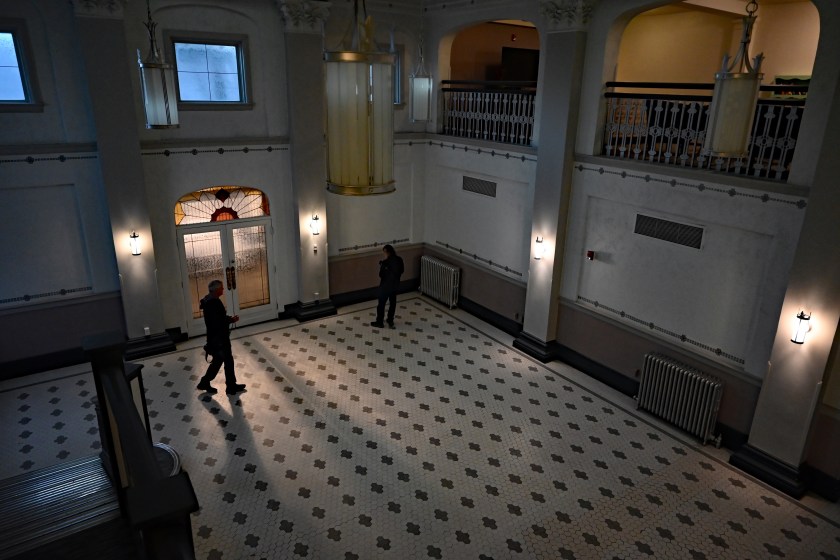
View of the Northern Hotel lobby from an upper staircase, showing patterned tile flooring, hanging lights, and two people walking across the open space below.
The Northern Hotel lobby in Fort Collins, photographed from the top of the staircase during Scott Kelby’s Worldwide Photowalk.

In this commanding architectural study, the photographer positions his lens at the apex of a staircase, transforming the Northern Hotel’s lobby into a theater of light, geometry, and human scale. Captured during Scott Kelby’s Worldwide Photowalk in Fort Collins, the image represents a significant entry in Chapter 6 of his Top 100 Journey—a section devoted to recent work and ongoing exploration. Here, the photographer’s evolving visual language finds purchase in the interplay between preserved historical space and contemporary documentary practice.

The composition demonstrates a mature understanding of spatial dynamics. Shot from an elevated vantage point, the frame encompasses the lobby’s full vertical reach, from the patterned terrazzo floor below to the arched balconies above. Two fellow photographers occupy the lower portion of the frame, their dark silhouettes providing crucial scale against the expanse of white walls and geometric flooring. This human element prevents the space from becoming merely an exercise in architectural documentation; instead, it anchors the viewer’s experience in a moment of shared discovery.

The photographer’s technical execution reveals deliberate choices regarding exposure and white balance. The warm incandescent glow from wall sconces contrasts with cooler ambient light filtering through windows, creating a subtle temperature gradient that enhances the lobby’s dimensionality. Pendant lights suspended from the ceiling echo this interplay, their cylindrical forms acting as vertical punctuation marks in the composition. The decorative tile borders running horizontally along the walls establish rhythm, while the radiators beneath provide industrial counterpoint to the space’s ornamental flourishes.

What distinguishes this work within the context of Chapter 6 is its relationship to process and community. Unlike the more introspective or solitary work that might characterize earlier chapters, this photograph emerges from collaborative exploration—a photowalk that brings practitioners together in shared discovery. The photographer’s decision to include his companions becomes a subtle commentary on the social dimensions of photographic practice, acknowledging that contemporary image-making often unfolds in dialogue with others.

The Northern Hotel itself, with its restored early twentieth-century details, offers fertile ground for examining how historical architecture persists in contemporary life. The stained glass transom above the entrance door, the ornamental ironwork of the balcony railings, and the carefully preserved floor pattern all speak to preservation efforts that transform commercial spaces into cultural touchstones. The photographer approaches this material not with nostalgia but with documentary clarity, allowing the space’s formal qualities to assert themselves.

In the broader trajectory of his Top 100 Journey, this image signals an openness to environmental portraiture and architectural narrative. The “ongoing exploration” referenced in Chapter 6 manifests here as a willingness to work within structured events and communal frameworks while maintaining individual vision. The photograph neither dominates its subject with excessive intervention nor withdraws into passive recording; rather, it strikes a balance between observation and interpretation.

The Northern Hotel lobby becomes, under his lens, both subject and metaphor—a preserved space that hosts contemporary seekers, a historical vessel filled with present-tense activity. This duality resonates throughout the photographer’s recent work, suggesting that the road ahead involves continued negotiation between tradition and innovation, solitude and community, documentation and artistic expression.
Ancient Greek Coin, Head of Alexander II Zebina

A macro photograph of a 123 BC Greek coin by Alexander II Zebina captures its historical significance and texture. The artist avoids over-sharpening, choosing selective focus to highlight the coin’s surface. This work raises questions about ownership, memory, and our connection to time, ultimately transforming the coin into a philosophical exploration of history.

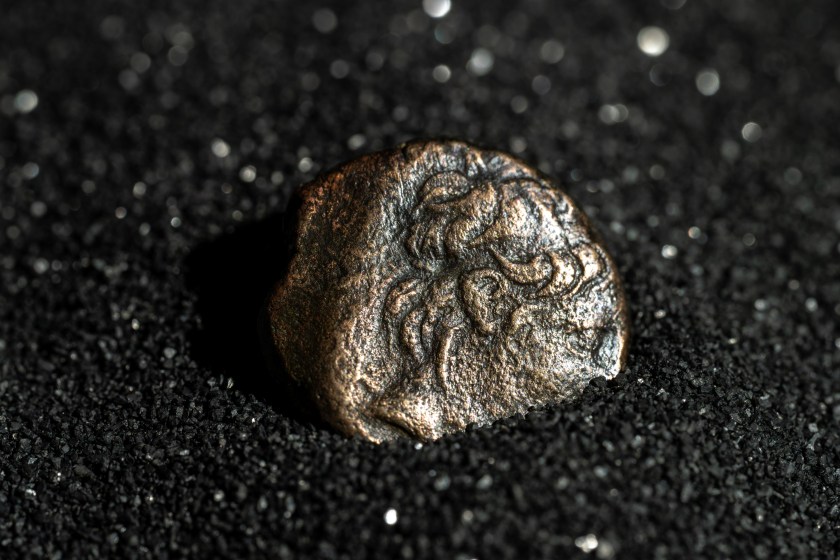
Close-up of a worn ancient Greek coin showing a raised portrait, resting on coarse black granular material.
A macro photograph of an ancient Greek coin with a portrait relief placed on a dark textured surface.

In this macro study from Chapter 6 of his Top 100 Journey, the photographer confronts an artifact that predates the medium of photography by over two millennia. The coin—a bronze piece from 123 BC bearing the portrait of Alexander II Zebina—becomes both subject and collaborator, its weathered surface telling stories that extend far beyond the frame. This single exposure, created for the 52 Frames challenge, demonstrates a mature understanding of how light and composition can resurrect history from oxidized metal.

The technical execution reveals deliberate restraint. Rather than employ focus stacking to render every millimeter sharp, he opts for a single capture that honors the coin’s irregular topography through selective focus. The shallow depth of field becomes a curatorial choice: not everything from antiquity needs to be preserved with clinical precision. Some details fade into soft ambiguity, much as memory itself blurs across centuries. The side lighting—achieved through what appears to be a carefully positioned single source—rakes across the relief, transforming corrosion patterns into a luminous bronze landscape. Highlights catch on the highest points of wear, creating a constellation of golden moments against near-black valleys of shadow.

The substrate selection proves equally thoughtful. Black granular material, possibly sand or volcanic rock, provides textural contrast while introducing delicate bokeh spheres that float in the background like suspended time. This environmental choice feels archaeological, suggesting the coin might have just emerged from excavation rather than from a flea market display case. The photographer resists any impulse toward nostalgic sepia or artificial aging effects; instead, he allows the genuine patina—two thousand years in the making—to provide all the historical gravitas the image requires.

What distinguishes this work within Chapter 6’s framework of ongoing exploration is its meditation on ownership and stewardship. The accompanying note reveals this coin represents “the oldest man-made thing I have ever owned,” yet the photograph itself seems to question that possessive relationship. Can anyone truly own such an object, or are we merely temporary custodians in an impossibly long chain of hands? The macro perspective literalizes this contemplation, bringing the viewer so close that individual crystals of corrosion become visible, each one a marker of time the photographer will never witness.

The portrait of Alexander II Zebina—barely discernible beneath centuries of oxidation—emerges as a ghost in metal, features obscured yet undeniably present. This parallel between photographic and numismatic portraiture feels intentional. Both mediums attempt to freeze time, to preserve likeness against entropy’s relentless work. The photograph succeeds where the coin has partially failed, capturing not just the object but the precise quality of light falling upon it on a specific day in 2025, creating a new historical layer atop the ancient one.

Within the photographer’s evolving practice, this image represents a turn toward material intimacy and temporal reflection. The macro lens becomes a tool for philosophical inquiry rather than mere magnification. By isolating this small artifact against darkness and bringing such focused attention to its corrupted beauty, he creates space for viewers to contemplate their own relationship with history, permanence, and the objects that outlive their makers by millennia.