Nocturnal Gateway: Union Station Illuminated

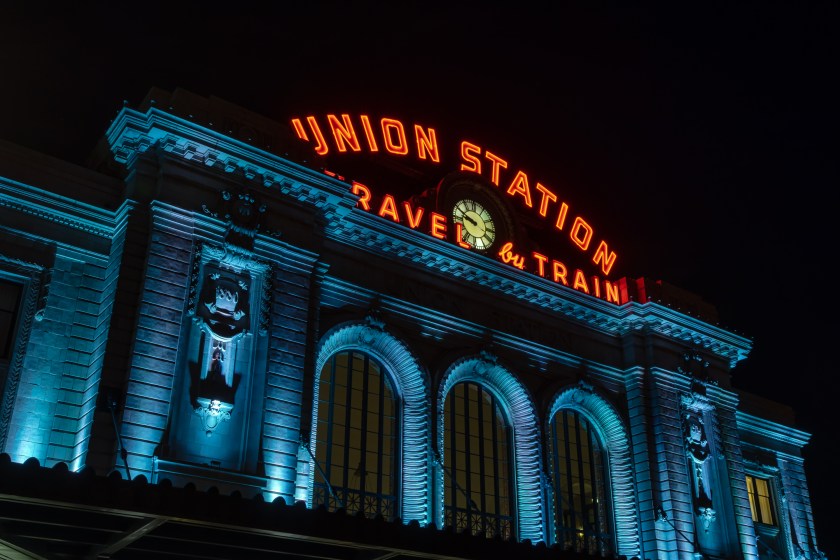
The photograph of Denver’s Union Station at night highlights its Beaux-Arts architecture through dramatic neon and electric blue lighting. Captured at ground level, it displays harmonious contrasts of light and structure, emphasizing the station’s role as a vibrant urban hub. This image underscores both preservation and the ongoing transformation of civic identity.

The illuminated front façade of Denver Union Station at night, with glowing neon signage and a clock above arched windows.
The front façade of Denver Union Station is illuminated at night, highlighted by its neon sign and historic architectural details.

In this nocturnal study of Denver’s Union Station, the photographer captures the transformation that occurs when historic architecture meets contemporary illumination. The image presents the iconic Beaux-Arts facade bathed in electric blue uplighting, while the famous neon signage glows in warm orange against the night sky—a study in complementary contrasts that speaks to both heritage and urban vitality.

The composition demonstrates restraint and classical sensibility. Shot with the Sony A7ii and kit lens, the photographer positions himself at ground level, allowing the building’s ornate cornice and horizontal bands to sweep across the upper portion of the frame. The three arched entrances anchor the lower third, their rhythmic repetition creating visual harmony while the vertical pilasters between them establish structural order. This frontal approach honors the station’s Beaux-Arts symmetry, respecting the intentions of the original 1914 design while documenting its twenty-first-century theatrical presentation.

What distinguishes this photograph is its embrace of artificial light as primary subject matter. The cool cyan wash transforms classical architectural details—the decorative moldings, the sculptural cartouches, the rusticated stonework—into relief elements that appear almost aquatic in their luminosity. This dramatic lighting choice, typically employed during special events or seasonal celebrations, removes the building from everyday documentation and positions it as urban spectacle. The warmth of the neon lettering provides essential counterpoint, its orange glow referencing mid-century Americana and the golden age of rail travel.

The working clock embedded within the signage adds temporal specificity, a reminder that this is a functioning transportation hub rather than mere architectural monument. The small silhouettes of gathered observers at the frame’s base provide crucial human scale, grounding the building’s theatrical presentation within the social realm. Their presence suggests communal gathering, the station serving its historic role as urban meeting point and threshold between destinations.

Within Chapter 3’s exploration of Colorado landscapes and cityscapes, this image represents the photographer’s engagement with Denver’s architectural heritage and its ongoing urban renewal. Union Station, revitalized in recent years as a mixed-use hub, embodies the tension between preservation and progress that defines many American cities. The photographer documents this transformation without editorial comment, allowing the dramatic lighting to speak to both celebration and commodification of historic space.

Technically, the night exposure presents challenges that the photographer navigates successfully. The deep black sky eliminates distracting context, focusing attention entirely on the illuminated facade. The exposure balances the intense neon signage against the softer architectural lighting, maintaining detail in both the brilliant highlights and the deeper blue shadows. The kit lens, often dismissed by photography purists, proves adequate to the task, capturing the scene with sufficient sharpness and minimal distortion.

This photograph pairs effectively with the earlier Denver Public Library study, together presenting divergent approaches to civic architecture. Where the library image emphasized monumental permanence through stark monochrome daylight, Union Station celebrates temporal display through saturated nocturnal color. Both reveal the photographer’s interest in how built environments express civic identity and cultural values.

The image ultimately serves as document, celebration, and subtle meditation on urban transformation—the historic gateway reimagined as luminous beacon in Denver’s evolving downtown landscape.
Lights Camera Action: Urban Pulse and Architectural Legacy

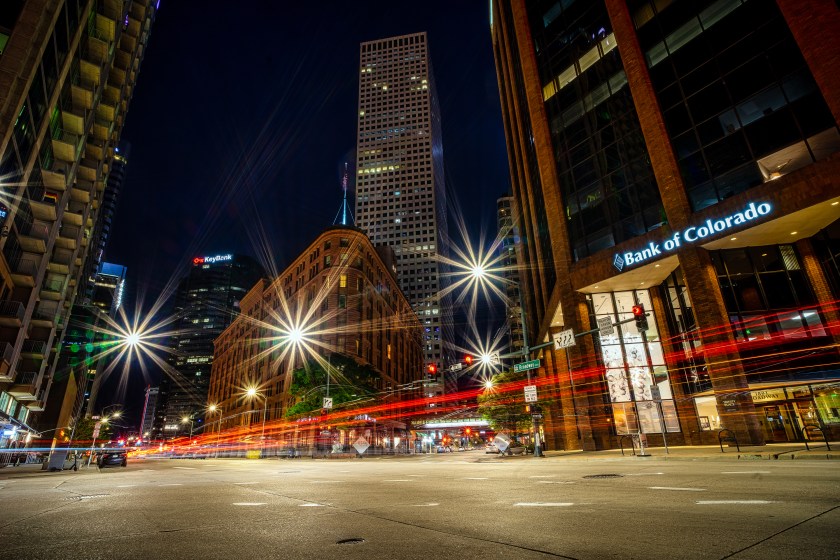
The photograph captures the Broadway and Tremont intersection in downtown Denver, highlighting the contrast between historic architecture and modern life through long exposure techniques. It features the Brown Palace Hotel amidst urban vitality, emphasizing Denver’s artistic complexity. The image challenges traditional views on Colorado’s landscape, advocating for cityscapes’ recognition in photographic surveys.

Long exposure light trails streak through a downtown Denver intersection at night, with tall buildings and streetlights surrounding the scene.
Long exposure traffic moves through the Broadway and Tremont intersection in downtown Denver, Colorado, with city buildings illuminated at night.

In this dynamic nocturnal study of downtown Denver, the photographer captures the essential duality of contemporary urban experience—the historic permanence of architecture set against the ephemeral flow of modern life. Positioned at the intersection of Broadway and Tremont, the image exemplifies his expanding vision within Chapter 3 of the Top 100 Journey, demonstrating how cityscapes demand entirely different technical and conceptual approaches than the natural landscapes that dominate much of his Colorado work.

The composition centers on the iconic triangular form of the Brown Palace Hotel, its distinctive Italianate Renaissance architecture rendered in warm amber tones against the deep blue of evening sky. This historic structure, framed between modern high-rises including the recognizable Republic Plaza tower, serves as both literal and metaphorical anchor—a touchstone of Denver’s Victorian-era prosperity surrounded by evidence of contemporary economic vitality. The photographer’s selection of this particular vantage point acknowledges the city’s layered temporal identity, where preservation and progress coexist in productive tension.

Working with an 18mm Samyang wide-angle lens mounted to his Sony A7II, he employs long exposure to transform vehicular traffic into ribbons of light—brilliant red taillights streaking horizontally across the frame’s lower third. These light trails provide kinetic energy and directional movement, leading the eye through the urban canyon while simultaneously suggesting the ceaseless motion of city life. Street lamps contribute their own starburst effects, punctuating the composition with points of crystalline brilliance that add theatrical dimension to the scene.

The technical execution reveals sophisticated understanding of night photography’s particular challenges. The exposure balances multiple light sources—artificial street lighting, illuminated building interiors, vehicle headlights, and residual ambient sky—without sacrificing detail in highlights or shadows. Corporate signage for KeyBank and Bank of Colorado glows with intentional clarity, grounding the image in specific place while contributing to the overall color harmony. The photographer’s post-processing in Luminar 4 has enhanced these chromatic relationships without pushing them into garishness, maintaining naturalistic tonality despite the inherently artificial lighting conditions.

What distinguishes this photograph within the broader chapter is its successful integration of Colorado’s urban identity alongside the state’s more frequently celebrated natural splendor. While mountain vistas and wilderness landscapes tend to dominate photographic representations of Colorado, this image argues persuasively for Denver’s visual complexity and photographic merit. The cityscape becomes landscape—vertical rather than horizontal, constructed rather than geological, but equally worthy of sustained aesthetic attention.

The wide-angle perspective introduces subtle geometric distortion that emphasizes the vertiginous quality of urban space, the way buildings frame and compress sky into channels of deep blue-black. Empty pavement in the immediate foreground provides breathing room, allowing viewers to enter the scene before being swept into the light-streaked energy of the intersection itself. This compositional breathing space demonstrates restraint and confidence, resisting the temptation to fill every pixel with information.

Within his evolving practice, this photograph represents important formal development. The controlled chaos of long-exposure urban photography requires different skills than landscape work—timing traffic flow, managing mixed lighting, balancing architectural detail against motion blur. His success here suggests a photographer expanding his technical vocabulary while maintaining consistent artistic sensibility. The image asks viewers to reconsider what constitutes Colorado landscape, proposing that cityscapes deserve equal consideration in any comprehensive photographic survey of the state’s visual identity.

First Baptist Light Trails

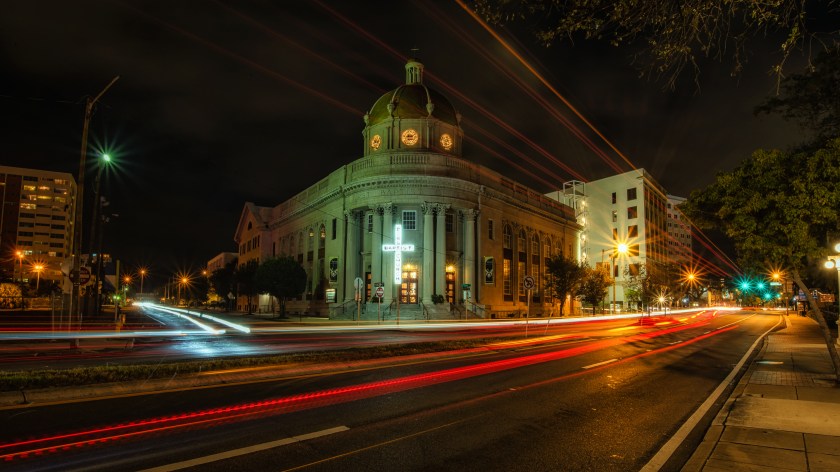
The photographer captures long exposure light trails in front of Tampa’s First Baptist Church, merging urban movement with Neoclassical architecture. This duality creates an image of modernity and tradition, showcasing the church’s historical significance against dynamic traffic patterns. The piece illustrates Tampa’s evolving identity, emphasizing beauty in its urban landscapes through innovative techniques.

Long exposure nighttime photograph of the historic First Baptist Church in Tampa, Florida, with vehicle light trails in the foreground.
Long exposure light trails in front of the historic First Baptist Church in downtown Tampa.

In this nocturnal study of Tampa’s historic First Baptist Church, the photographer transforms urban infrastructure into kinetic painting, employing a twenty-second exposure to capture the ceaseless motion of vehicular traffic as ribbons of light that both frame and animate the Neoclassical architecture. The resulting image operates simultaneously as documentary record and abstract composition, a duality that characterizes his most successful explorations of Florida’s urban environments.

The church itself commands the frame with dignified authority. Its illuminated dome, rendered in theatrical green uplighting, draws the eye upward through classical columns toward the cupola’s glowing clock faces. This architectural landmark, likely dating to the early twentieth century, represents Tampa’s ambitions during its period of rapid growth—a permanence and civic gravitas that contrasts sharply with the ephemeral streaks of red and white light that sweep through the foreground. The photographer has chosen an exposure duration that allows traffic to complete its passage through the intersection, creating continuous trails rather than fragmented segments, a decision that required both technical precision and patience in timing.

The technical execution reveals careful calibration of competing priorities. The f/20 aperture serves multiple functions: it extends the exposure time necessary to capture substantial light trails while creating pronounced starbursts from the streetlamps and building lights that punctuate the scene. This diffraction effect, often considered a technical liability, becomes here an expressive tool that enhances the image’s sense of urban energy and nocturnal luminosity. The ISO 160 setting represents a pragmatic compromise, maintaining clean shadow detail without the noise that would emerge at higher sensitivities during a twenty-second exposure.

What distinguishes this work within the Florida Landscapes & Cityscapes chapter is its engagement with the state’s urban identity—a counterpoint to the natural environments that dominate popular conceptions of Florida photography. Tampa, often overshadowed by Miami’s architectural flash or Orlando’s manufactured spectacle, possesses a layered history visible in buildings like this repurposed church structure, now apparently serving commercial functions while retaining its ecclesiastical form. The photographer documents this transformation without nostalgia or critique, allowing the juxtaposition of classical architecture and contemporary traffic patterns to speak to ongoing urban evolution.

The composition demonstrates sophisticated spatial organization. The church occupies the middle ground with centered dignity, while the light trails sweep diagonally from lower right to left, creating dynamic movement that prevents the symmetrical architecture from becoming static. Flanking buildings and street trees provide contextual depth, establishing the church within its urban fabric rather than isolating it as a monument. The streetlamp at left edge, its starburst perfectly rendered, serves as a visual anchor that balances the compositional weight of the church’s mass.

Within his broader photographic journey, this image represents an expansion of the long-exposure vocabulary established in his Bay Pier work. Where that earlier piece explored natural elements transformed by time, here he applies similar temporal techniques to the urban realm, revealing how extended duration can render the chaos of city traffic as elegant abstraction. The photograph succeeds in making visible the patterns underlying apparent disorder, suggesting that beauty in Florida’s built environments requires not different locations but altered ways of seeing—a perspective shift measured in seconds rather than miles.