Contemporary Urban Narrative: The Scooter as Cultural Marker in Denver’s Historic District

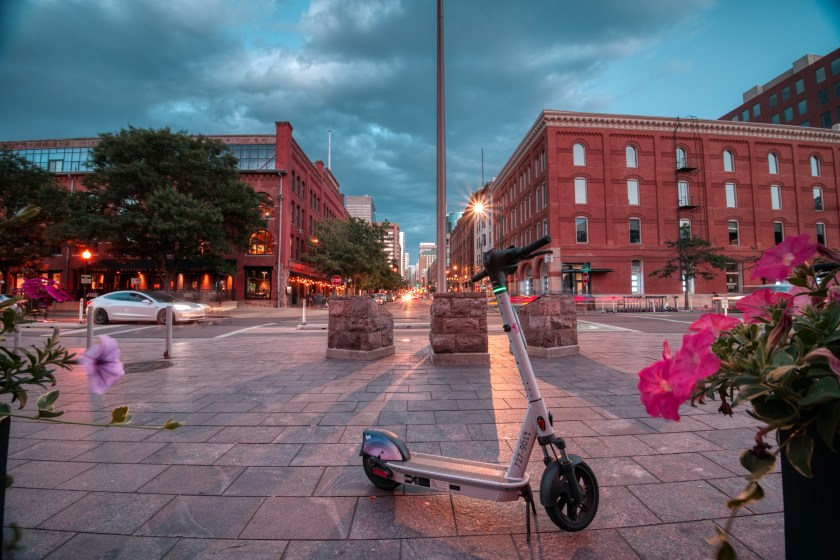
The photograph captures Denver’s Union Station, highlighting urban mobility through an electric scooter, symbolizing the modern sharing economy. Blending historic architecture and contemporary transit, it embodies Denver’s revitalization. The technical execution showcases skill in low-light conditions, emphasizing the cityscape’s complexity as part of Colorado’s evolving identity.

An electric scooter stands on a plaza at Denver Union Station, framed by brick buildings and evening traffic under a cloudy sky.
An electric scooter sits in the foreground near Denver Union Station as evening light and traffic move through downtown Denver.

In this street-level composition from Denver’s Union Station district, the photographer constructs a narrative about contemporary urban mobility that extends beyond mere documentation. The electric scooter, positioned prominently in the foreground, functions as both subject and symbol—a deliberate choice that anchors this image firmly in its specific cultural moment while engaging with the broader themes of his Colorado cityscapes chapter.

Shot with the Nikon Z5 and Nikkor 14-30mm wide-angle lens during the transitional blue hour, the image demonstrates technical command over challenging mixed-lighting conditions. His HDR processing through Aurora software balances the warm sodium vapor glow of street lamps with the cooler tones of approaching dusk, creating a color palette that feels authentic to the urban evening experience. The dramatic cloud formations overhead add atmospheric weight without overwhelming the architectural elements below.

The composition’s strength lies in its layered storytelling. The scooter occupies the immediate foreground, a symbol of the sharing economy and evolving transportation patterns that have reshaped American cities in recent years. Behind it, motion-blurred pedestrians and vehicle light trails suggest continuous movement—the perpetual flow of urban life. The red brick Victorian-era buildings flanking the street provide historical context, their solid permanence contrasting with the ephemeral nature of the modern transit device and the transient human figures.

This juxtaposition between historic preservation and contemporary innovation becomes the photograph’s central thesis. Denver’s Union Station neighborhood represents a successful urban revitalization, where nineteenth-century industrial architecture has been adapted for twenty-first-century use. The photographer captures this temporal complexity not through obvious before-and-after documentation, but through subtle visual relationships: old brick against new pavement, traditional street furniture against app-based transportation, architectural permanence against digital-age impermanence.

The wide-angle perspective creates dynamic leading lines through the paved plaza, drawing the viewer’s eye from the scooter through the middle ground and toward the vanishing point where downtown high-rises punctuate the skyline. Pink flowers frame the right edge, their organic forms softening the geometric rigor of the built environment while adding unexpected color that complements the warm building tones.

Within the context of Chapter 3’s exploration of Colorado landscapes and cityscapes, this image represents an important counterpoint to mountain vistas and natural panoramas. It acknowledges that Colorado’s contemporary identity includes rapidly growing urban centers navigating questions of density, mobility, and livability. The photographer treats the cityscape with the same observational care one might afford wilderness photography, suggesting that urban environments deserve equally thoughtful documentation.

The technical execution reflects growing proficiency with the Z5 system in low-light scenarios. The exposure balances bright highlights from street lamps and vehicle headlights while retaining shadow detail in the building facades and foreground elements. This dynamic range management, enhanced through HDR processing, avoids the artificial appearance that often compromises such techniques.

Ultimately, this photograph functions as cultural documentation—a moment preserved when electric scooters had become ubiquitous urban fixtures, when historic districts balanced preservation with progress, and when cities like Denver negotiated their identity between Western heritage and metropolitan aspiration. The photographer’s choice to include this image in his curated Top 100 Journey acknowledges that landscape photography can encompass the human-altered terrain of city streets, where the stories being told are equally complex and worthy of attention.
Architectural Symmetry and Urban Solitude: An HDR Study of Denver Union Station

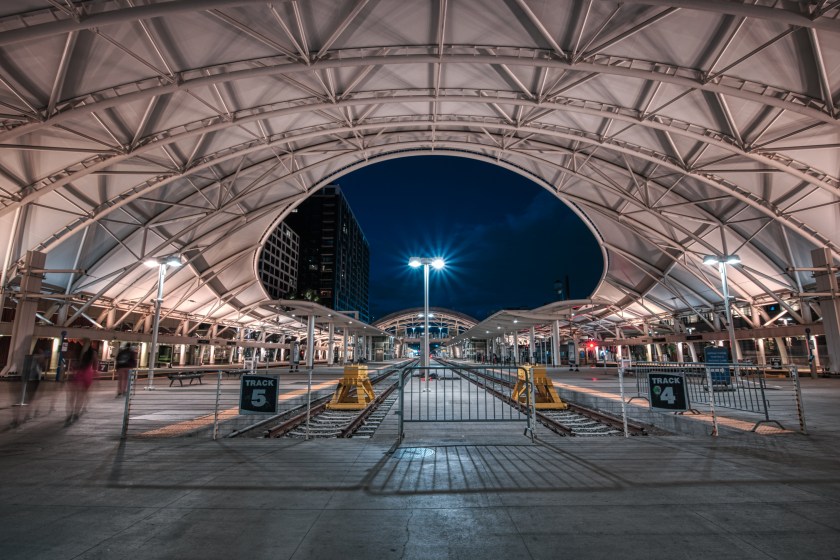
The photographer’s nocturnal exploration of Denver Union Station highlights its architectural beauty through HDR techniques. Using a Nikon Z5, he captures the arched canopy and geometric metalwork, emphasizing both urban context and functional identity. This work redefines landscape photography, recognizing the significance of transportation infrastructure in Colorado’s cultural identity.

Symmetrical view of covered light rail platforms inside Denver Union Station at night, with tracks centered beneath a white arched roof.
The light rail platforms inside Denver Union Station are shown at night beneath the station’s arched canopy.

The photographer’s exploration of Colorado’s built environment finds a striking culmination in this nocturnal study of Denver Union Station’s interior architecture. Captured with a Nikon Z5 and Nikkor 14-30mm wide-angle lens, this HDR composition demonstrates a mature understanding of how contemporary digital techniques can reveal the inherent drama within civic spaces.

The image centers on the station’s distinctive arched canopy structure, a feat of engineering that dominates the frame with rhythmic precision. Metal trusses radiate outward in geometric patterns, their repetition creating a sense of ordered monumentality. The wide-angle lens choice proves deliberate rather than merely expedient—it allows the photographer to encompass both the sweeping overhead architecture and the rail infrastructure below while maintaining the spatial relationship that gives the composition its power. The central void, opening to the deep blue evening sky and a distant office tower, punctuates the manufactured enclosure with a reminder of the urban context beyond.

His HDR processing through Aurora software reveals a considered approach to tonal range. The metalwork retains textural detail without the artificial hyper-clarity that often plagues high dynamic range photography. The warm metallic tones of the canopy structure contrast effectively with the cooler blues of the twilight sky and platform lighting, establishing a color palette that feels naturalistic despite the technical manipulation required to balance such extreme luminance values.

The human element appears deliberately subdued—motion-blurred figures at the platform edges suggest activity without demanding attention, reinforcing the architectural subject while maintaining the space’s functional identity as a transportation hub. Yellow bumper stops and safety railings provide geometric counterpoints to the dominant curves above, their utilitarian forms grounding the composition in operational reality.

Within the context of Chapter 3’s focus on Colorado landscapes and cityscapes, this work represents a conceptual bridge. While the chapter presumably encompasses the state’s renowned natural vistas, the photographer recognizes that Colorado’s urban environments possess their own topography worth documenting. Denver Union Station, a historic structure serving contemporary transit needs, embodies the intersection of preservation and progress that characterizes much of the American West’s relationship with its past.

The technical execution reflects growing confidence with the Z5 system’s capabilities in challenging lighting conditions. Night photography in mixed-light environments demands both equipment competence and processing discipline, both evident here. The decision to shoot during the transitional moment between day and night—when ambient light still registers in the sky while artificial illumination dominates the platform—demonstrates an understanding of how fleeting conditions can elevate architectural documentation beyond mere record-keeping.

This image functions as more than a single photograph within his Top 100 Journey project; it suggests an expanding definition of landscape photography itself. The constructed landscape of transportation infrastructure, with its own valleys and peaks of metal and light, receives the same considered attention he might afford a mountain vista. The result is a document that honors both the anonymous designers who created this functional space and the ongoing human movement that gives it purpose.

In positioning this work within his curated collection, the photographer asserts that Colorado’s identity exists not only in its natural grandeur but in the spaces where communities gather, depart, and return—the thresholds that connect wilderness to civilization.

Fallen Tree: The Foundation of Seeing

The photograph from Hillsborough River State Park, taken by Greg Urbano in 2013 with a Nikon D7100, captures a pivotal moment in his artistic development. It reflects his early understanding of composition and intentionality, showcasing the dense subtropical landscape through HDR processing. This image symbolizes the importance of beginnings and learning in photography.

HDR photograph of a forest trail in Hillsborough River State Park with a large fallen tree across the path, dense vegetation, and filtered natural light, taken with a Nikon D7100 at 10mm.
A 2013 HDR landscape photograph of a fallen tree along a forest trail in Hillsborough River State Park, Florida.

In the opening chapter of Greg Urbano’s photographic journey, this image from Hillsborough River State Park stands as a testament to the essential nature of beginnings. Shot in 2013 with a Nikon D7100, the photograph captures more than a forest scene—it documents the foundational moment when a photographer learns to truly see the landscape before him.

The composition reveals an intuitive understanding of depth and perspective. Shot at 10mm, the wide-angle lens creates an immersive quality that draws viewers directly onto the trail. The fallen log in the foreground serves as both literal and metaphorical threshold, inviting passage into the deeper woods beyond. This diagonal element cuts across the frame with authority, its weathered texture rendered in sharp detail by the f/8.0 aperture, demonstrating Urbano’s early grasp of how to balance foreground interest with background context.

The HDR processing technique employed here reflects the experimental spirit characteristic of this pre-2015 period. While HDR would later fall somewhat out of favor in fine art photography circles, its application in this image serves a clear purpose: to capture the dynamic range of a Florida forest understory, where dappled sunlight creates extreme contrasts between shadow and highlight. The palmetto fronds and oak canopy are rendered with an almost hyper-real clarity that emphasizes the dense, layered nature of this subtropical ecosystem.

What makes this photograph particularly significant within the “Beginnings” chapter is its honesty about place and limitation. Urbano’s accompanying note—that this Florida park offered his “best opportunity to capture flowing water over river rocks” before relocating to Colorado—reveals something crucial about artistic development. Great photography emerges not from waiting for perfect conditions, but from working intensively with what’s available. This trail became his classroom, this fallen log his teacher.

The technical choices demonstrate a photographer thinking through his craft. The 1/50s shutter speed suggests deliberate handholding technique, while the ISO 200 setting indicates available light conditions and a preference for image quality. These aren’t the settings of someone simply pointing and shooting; they reveal consideration and intentionality, even in these early stages.

The color palette—predominantly greens with earth-toned accents—creates a cohesive, naturalistic feel despite the HDR processing. The slight motion blur in the foliage adds an organic quality, a reminder that this is a living landscape caught in a specific moment. The trail itself winds invitingly into the frame’s depth, disappearing around a bend that promises further discovery—a fitting metaphor for the artistic journey being documented.

In the context of Urbano’s larger body of work, this image represents more than just an early attempt. It embodies the crucial truth that mastery begins with showing up, with making photographs even when the circumstances aren’t ideal, even when the technique hasn’t been perfected. The photograph’s inclusion in his top 100 collection isn’t about technical perfection but about recognizing the importance of foundation.

Every artist’s journey requires a starting point, a place where curiosity meets commitment. This fallen tree, this Florida trail, this moment of learning to see—these are the essential ingredients that would eventually lead to mountain streams in Colorado and a mature photographic vision. The imperfect attempt, it turns out, isn’t just necessary. It’s everything.

The Gulf Pier: A Foundation in Light and Structure

Greg Urbano’s “Landscapes in HDR” captures the Gulf Fishing Pier at Fort de Soto Park, reflecting his artistic development in photography. Utilizing a Nikon D7100, he balances composition with HDR techniques, achieving naturalistic vibrancy without over-processing. The image embodies a pivotal moment in skill mastery, exploring the connection between environment and human creation.

HDR landscape photograph of the Gulf Fishing Pier at Fort De Soto Park in Pinellas County, Florida, extending over calm water under a bright sky, taken with a Nikon D7100 at 14mm.
A 2013 HDR landscape photograph of the Gulf Fishing Pier at Fort De Soto Park in Pinellas County, Florida.

In the early stages of any photographer’s journey, there exists a pivotal moment when technical curiosity converges with artistic vision. Greg Urbano’s “Landscapes in HDR” from 2013 captures precisely this convergence—a photograph that speaks to the fundamentals of seeing while revealing the seeds of a maturing artistic voice.

The Gulf Fishing Pier at Fort de Soto Park presents itself as an exercise in classical composition, yet the image transcends mere documentation. Shot with a Nikon D7100 at 14mm, the photographer embraced the distortion inherent in ultra-wide-angle photography, using it not as a limitation but as a tool for emphasis. The pier’s concrete pathway stretches toward the horizon with geometric insistence, its weathered surface textured with salt stains and age—details that anchor the ethereal quality of the surrounding environment.

What distinguishes this work within the context of Chapter 1—Beginnings is the deliberate exploration of HDR processing, a technique that dominated landscape photography in the early 2010s. Rather than falling into the trap of over-processing that plagued much HDR work of this era, Urbano demonstrates restraint. The luminous gradations in the sky—from deep azure to wispy white—retain a naturalistic quality while revealing detail across an impressive tonal range. The turquoise waters of the Gulf of Mexico maintain their vibrancy without crossing into hypersaturation, suggesting an eye already sensitive to the boundaries between enhancement and artifice.

The technical choices reveal a photographer building his fundamental vocabulary. The aperture of ƒ/8.0 ensures critical sharpness from the foreground concrete to the distant structures, while the fast shutter speed of 1/400s freezes the subtle motion of the scene—likely the flutter of distant flags or the movement of the few figures visible along the pier. At ISO 100, the image maintains clarity in its textures, from the horizontal railings that create rhythmic lines to the architectural shelters that punctuate the composition’s middle ground.

What makes this photograph significant in understanding Urbano’s artistic evolution is not its perfection but its purposefulness. The nearly symmetrical composition, the careful attention to the leading lines, the consideration of how architectural elements frame the natural environment—these are the building blocks upon which more complex visual narratives are constructed. The weekly visits to this location mentioned in his notes speak to something essential in photographic development: the practice of returning, of seeing the same subject under different conditions, of learning through repetition.

The landscape itself offers something eternal—the meeting point of human construction and natural expanse. The pier extends confidently into the Gulf, a gesture of connection between land and water, between the photographer’s position and the infinite horizon. In capturing this scene, Urbano was not merely documenting a favorite location but engaging with fundamental questions about how we frame our relationship to place and space.

Within the broader context of “Beginnings,” this image exemplifies the necessary stage of mastering craft before transcending it. The imperfect attempts referenced in the chapter description are not failures but essential experiments. Here, we witness a photographer learning to see in high dynamic range, to compose with geometric precision, and to capture the luminous quality of coastal light—all foundational skills that would inform the more sophisticated work to come.

This is where journeys begin: in the clarity of intention, the discipline of practice, and the recognition that every master was once a student of light.

Lady in a Hat: A Study in Perspective and Presence

In 2013, Greg Urbano’s photograph “Lady in a Hat” encapsulated his experimental spirit in photography. Taken at a Veterans benefit car show in Florida, it features a classic car and a woman in a hat, illustrating the dynamic between subject and observer. This image showcases the evolution of Urbano’s artistry and HDR techniques, emphasizing compositional storytelling.

HDR photograph from a 2013 car show featuring a woman wearing a hat standing near classic vehicles, taken with a Nikon D5100 at 10mm.
A 2013 HDR photograph from a Veterans benefit car show at Bay Pines VA in Pinellas County, Florida.
Shot with a Nikon D5100.

In the early years of Greg Urbano’s photographic journey, there existed a willingness to experiment boldly with emerging digital techniques—a quality that would become foundational to his artistic identity. “Lady in a Hat,” captured in 2013 at a Veterans benefit car show in Bay Pines, Florida, exemplifies this experimental spirit while revealing an intuitive understanding of compositional storytelling that would define his later work.

The photograph presents a gleaming black classic car, its hood raised to display immaculate chrome and engineering, positioned at a dramatic low angle that transforms the vehicle into something monumental. But what elevates this image beyond typical automotive photography is the deliberate inclusion of a figure in the background—a woman in a distinctive hat, observing the scene. This compositional choice transforms what could have been a straightforward documentation of mechanical beauty into a meditation on observation itself, on the relationship between spectator and spectacle.

Urbano shot this image with a Nikon D5100 at 10mm, an ultra-wide focal length that creates pronounced perspective distortion. The technical settings—f/10 at 1/320s, ISO 160—suggest bright midday conditions, yet the photographer’s use of HDR processing pushes the tonal range far beyond what the camera captured in a single exposure. This was 2013, when HDR photography was experiencing widespread popularity in automotive and architectural work, and Urbano was actively exploring its possibilities. The processing intensifies the reflections on the car’s black paint, brings out texture in the engine bay, and maintains detail in both the bright Florida sky and the shadowed undercarriage.

What makes this image significant within the context of Chapter 1—Beginnings is not its technical perfection, but rather what it reveals about the photographer’s developing eye. The ultra-wide perspective could easily overwhelm the frame, yet Urbano maintains balance through careful positioning. The car dominates the foreground, grounded by fallen leaves and grass texture, while the human element remains present but unobtrusive in the middle distance. This suggests an emerging awareness of layered storytelling, of creating images that reward sustained viewing.

The title itself demonstrates artistic intentionality. “Lady in a Hat” redirects our attention from the obvious subject—the pristine classic car—to the peripheral human presence, suggesting that the photographer understood even then that compelling photographs often exist in the tension between primary and secondary subjects, between what commands attention and what quietly observes.

This photograph also documents a specific moment in Urbano’s technical education. HDR processing, with its characteristic emphasis on local contrast and detail recovery, taught photographers of this era to see scenes in terms of tonal relationships rather than single exposures. This training in visualizing extended dynamic range would later inform his approach to lighting and exposure, even when shooting single frames.

Within the broader narrative of the Top 100 Journey project, “Lady in a Hat” represents the necessary phase of bold experimentation that precedes refinement. It captures a photographer unafraid to push processing techniques to their limits, to shoot from unconventional angles, and to include elements that complicate rather than simplify the frame. These imperfect attempts, as Urbano himself acknowledges, formed the foundation for everything that followed—a reminder that artistic growth requires the courage to create before one fully understands how.