City Pier on Anna Maria Island: A Study in Patience and Atmospheric Drama

The long exposure photograph of the City Pier on Anna Maria Island captures the unique interplay of land, water, and sky under dramatic storm clouds. Through technical mastery, the image transforms fleeting moments into timelessness, blending sharp details of the pier with ethereal human figures and smooth water, reflecting deep engagement with Florida’s coastal landscapes.

Long exposure photograph of the City Pier on Anna Maria Island, showing a wooden pier leading to a waterfront building under dark storm clouds.
Long exposure view of the City Pier on Anna Maria Island beneath dramatic storm clouds.

Within the photographer’s carefully curated Top 100 Journey, this long exposure study of the City Pier on Anna Maria Island stands as a masterful example of how technical discipline can amplify emotional resonance. Positioned within Chapter 2—Florida Landscapes & Cityscapes—the image demonstrates a sophisticated understanding of the Gulf Coast’s unique visual character, where land, water, and sky exist in constant, subtle negotiation.

The composition reveals itself through classical simplicity: a weathered wooden pier extends from foreground to middle distance, leading the viewer’s eye toward a modest building crowned with an American flag. Yet what elevates this photograph beyond documentary record is the photographer’s deliberate manipulation of time itself. Shot with a fifteen-second exposure at f/18, the image transforms fleeting atmospheric conditions into something more permanent and contemplative. The threatening cloud formations above, rather than appearing frozen in mid-motion, achieve a painterly quality—their movement compressed and softened into bands of gray and white that suggest both weight and ethereality.

This temporal expansion creates a fascinating duality throughout the frame. While the pier’s wooden planks remain sharp and detailed, bearing the textural evidence of salt air and countless footfalls, the human figures near the building dissolve into ghostly presences, their individual identities surrendered to the longer rhythm of place. The water, too, undergoes transformation; what would typically appear as distinct waves and surface texture becomes a smooth, almost metallic gradient stretching from jade green to soft gray, merging seamlessly with the horizon.

The technical execution here deserves careful consideration. Working with a Nikon D610 and an 18-35mm lens set to 35mm, the photographer has achieved remarkable sharpness across the entire frame. The f/18 aperture ensures deep depth of field while the ISO 100 setting maintains clean tonal gradations essential for the image’s subtle atmospheric rendering. These choices reflect not mere technical competence but aesthetic intention—a desire to capture both concrete detail and ephemeral mood simultaneously.

Within the broader context of Chapter 2, this photograph exemplifies the photographer’s evolving relationship with Florida’s coastal environments. Where lesser practitioners might seek the obvious drama of golden hour or storm-tossed seas, he finds complexity in overcast conditions and the patient observation they demand. The image refuses easy categorization: it is neither purely documentary nor overtly romantic, but occupies a thoughtful middle ground where observation and interpretation merge.

The architectural elements—particularly the modest pier building with its peaked roof and practical design—anchor the composition in specificity while the long exposure technique universalizes the experience. This is simultaneously a portrait of a particular place and a meditation on impermanence, on how human structures persist while human presence itself becomes fluid and uncertain.

As part of a long-term project, this photograph suggests an artist committed to deep engagement rather than superficial tourism. The willingness to wait for proper atmospheric conditions, to set up the necessary equipment for extended exposures, and to see beyond the immediate toward something more contemplative marks this as serious photographic inquiry. Within his Top 100 Journey, it stands as evidence that Florida’s landscapes, often dismissed as visually unchallenging, reward patient observation with unexpected subtlety and depth.
Night at the Marina: A Study in Urban Reflection

The photograph from Greg Urbano’s Top 100 Journey captures St. Petersburg’s Municipal Marina at night, showcasing a dialogue of architecture, water, and light. Through a long exposure, the image blends city and reflection, revealing duality in urban nature. Urbano’s technical choices highlight Florida’s beauty within its metropolitan context.

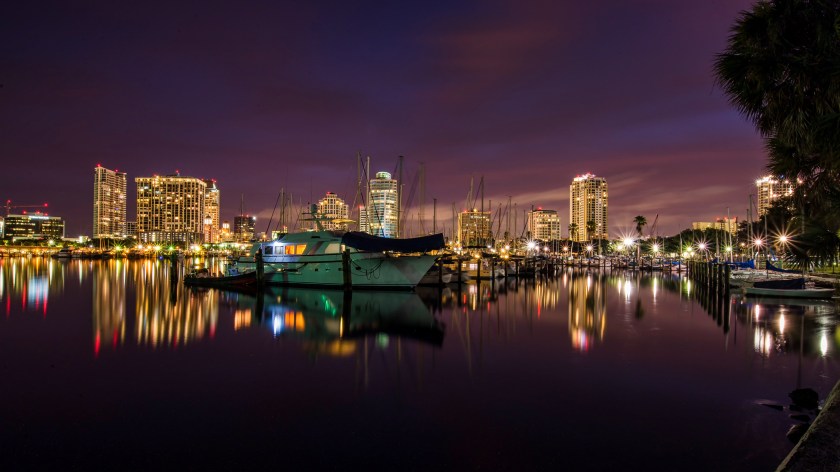
Nighttime long exposure photograph of the St. Petersburg, Florida skyline viewed from the Municipal Marina, with boats and colorful reflections on calm water.
Long exposure nighttime view of the St. Petersburg skyline from the Municipal Marina.

In this striking nocturnal composition from Chapter 2 of Greg Urbano’s Top 100 Journey, the photographer transforms St. Petersburg’s Municipal Marina into a stage where architecture, water, and light perform an intricate dialogue. Shot with a Nikon D610 at the wide end of an 18-35mm lens, the image demonstrates his evolving command of the Florida landscape—this time rendered not through the state’s iconic natural vistas, but through the geometry and luminescence of its urban waterfront.

The technical approach reveals deliberate choices that serve the image’s contemplative mood. A 150-second exposure at f/20 has allowed the photographer to capture not merely a moment but an accumulation of light and stillness. The water becomes a flawless mirror, its surface so calm that the distinction between city and reflection dissolves into symmetry. This extended duration smooths away any transient ripples, creating an almost surreal doubling effect where the marina’s vessels and the downtown skyline exist in perfect vertical equilibrium.

The color palette is equally considered. The twilight sky transitions from deep violet to warm amber along the horizon, providing a graduated backdrop that never competes with the main subject. The buildings’ golden illumination—ranging from honey tones to brilliant white—creates rhythmic vertical accents across the frame, while the marina lights introduce unexpected splashes of emerald and ruby that punctuate the composition with chromatic variety. These colored reflections stretch and shimmer in the foreground water, adding texture to what might otherwise be an overly static scene.

Compositionally, the photographer has positioned himself to maximize the reflection’s impact while maintaining architectural legibility. The yacht in the immediate foreground serves as an anchor point, its substantial form providing scale and depth to the scene. The vessel’s subtle green illumination connects it visually to the reflected lights while distinguishing it from the darker water surrounding it. Behind, the forest of masts creates a delicate counterpoint to the solid mass of the high-rises, introducing organic irregularity into an otherwise geometric composition.

What distinguishes this work within the Florida Landscapes & Cityscapes chapter is its meditation on duality—the way human development interacts with the natural world, specifically water’s capacity to both accept and transform urban light. The photographer has found in St. Petersburg’s marina a location where Florida’s maritime character persists even within its metropolitan context. The palm fronds visible at the frame’s edge remind viewers of the subtropical environment, preventing the scene from becoming generically urban.

The technical execution supports this conceptual balance. The ISO 160 setting has preserved clean shadows and prevented noise in the darker areas, while the narrow aperture has rendered sharpness from the foreground yacht to the distant towers. The starburst effects visible on some light sources—a result of the f/20 aperture—add a subtle decorative element without overwhelming the image’s naturalistic foundation.

Within his broader body of work exploring Florida’s diverse landscapes, this photograph represents an important expansion of scope. Here, the photographer demonstrates that the state’s visual poetry exists not only in its Everglades, beaches, and wetlands, but also in the moments when its cities pause and reflect—literally and figuratively—upon themselves. The result is an image that honors both the constructed and the elemental, capturing a Florida that is simultaneously modern and timeless.

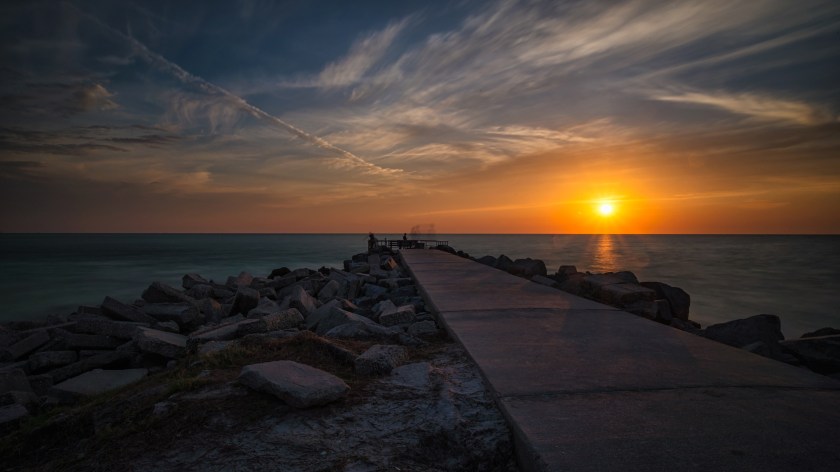
Passagrille Sunset

The photograph of a sunset over the Gulf of Mexico from the Pass-a-Grille jetty captures a sense of departure and geometric clarity. It juxtaposes the structural jetty against soft, ethereal water and sky, reflecting the photographer’s evolving approach while highlighting the tension between permanence and impermanence in landscapes.

Sunset photograph of the Pass‑a‑Grille jetty in Florida, with a concrete pier extending into the Gulf of Mexico and silhouetted figures at the horizon.
Sunset over the Gulf of Mexico from the Pass‑a‑Grille jetty.

This image from Chapter 2 of the Top 100 Journey carries with it a distinct sense of departure—a final engagement with a familiar location rendered with the careful attention of someone taking leave. Shot at Pass-a-Grille, the southern terminus of St. Pete Beach, the photograph distills the photographer’s technical vocabulary into a study of geometric clarity against atmospheric flux.

The concrete jetty commands the composition with unwavering linear authority, stretching from the immediate foreground toward the distant horizon where the sun hangs in perfect alignment. This centered positioning—often avoided in landscape photography as overly symmetrical—here becomes an asset, emphasizing the directional thrust of both structure and light. The jetty serves as more than mere subject; it functions as visual pathway, invitation, and barrier simultaneously. Flanked by massive boulder riprap on either side, the walkway creates a corridor that focuses attention while the rough-hewn stones provide textural contrast to the smooth concrete surface.

The technical approach reveals the photographer’s continued exploration of extended exposure. At fifteen seconds and f/22, the water on both sides of the jetty transforms into a milky abstraction, its individual waves collapsed into a singular luminous mass. This treatment—shorter than the sixty-second exposure employed in his Pier 60 work yet still substantially extended—suggests a refinement in his methodology. The turquoise-tinted water retains enough definition to read as liquid rather than dissolving into pure atmosphere, maintaining a crucial anchor to physical reality.

Above, the sky performs its transitional theater. Wispy cirrus formations streak diagonally across the frame from upper left, their directional movement contrasting with the horizontal stratification of color closer to the horizon. The gradient moves from deep slate blues through amber and peach tones to the incandescent disc of the sun itself. A single contrail cuts through the upper portion—a contemporary detail that situates this timeless scene firmly in the present moment, a reminder that even pristine natural settings exist within our flight-path-crossed modern reality.

The photographer has positioned himself low, allowing the foreground boulders to occupy significant visual weight in the left portion of the frame. These lichen-stained rocks, rendered in earth tones that echo the warm sunset palette, ground the image literally and figuratively. Their solidity counterbalances the ethereal qualities of water and sky, creating a dialogue between permanence and impermanence that resonates with the image’s contextual note about departure.

Within the framework of Chapter 2—Florida Landscapes & Cityscapes—this photograph demonstrates the photographer’s evolving relationship with infrastructure as subject. Where tourist piers offer human presence and activity, this utilitarian jetty provides something more austere: pure form against elemental forces. The viewing platform visible at the jetty’s terminus, occupied by silhouetted figures, offers scale and human connection without sentimentality.

The work succeeds in balancing documentary precision with interpretive mood. It captures a specific engineered structure at a specific coastal location while transcending those particulars to engage broader themes: the paths we walk toward light, the structures we build against erosion, the moments we choose to mark as endings before moving forward.

Redington Long Pier Sunset

The photograph of Redington Long Pier at sunset highlights the interplay between Florida’s coastal architecture and natural beauty. Captured with a long exposure technique, it merges structure and color, showcasing the significance of humble elements like a bait shop sign. This image advocates for a broader definition of landscape photography, embracing authenticity over idealization.

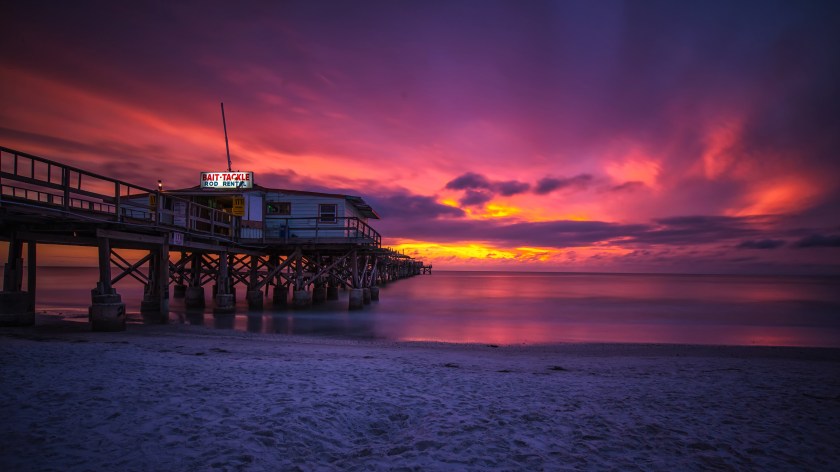
Long exposure photograph of the Redington Long Pier on Redington Beach, Florida, taken after sunset with vivid sky colors and calm reflective water.
Long exposure sunset view of the Redington Long Pier on Redington Beach.

The photographer’s approach to Florida’s coastal architecture reveals itself most compellingly in this extended exposure from Redington Beach, where a humble fishing pier becomes a study in structural grace against an incandescent sky. Captured on a Nikon D610 with an 18-35mm lens set to its widest focal length, the thirty-second exposure at f/8.0 transforms the Gulf of Mexico into liquid silk, while the pier’s weathered geometry provides essential counterpoint to the sky’s theatrical display.

What distinguishes this image within the Florida Landscapes & Cityscapes chapter is its subtle negotiation between the vernacular and the sublime. The “Bait·Tackle Rod Rental” sign—a modest beacon of commercial utility—anchors the composition with an authenticity that elevates rather than diminishes the scene’s natural grandeur. This juxtaposition speaks to the photographer’s evolving understanding of Florida’s coastal identity, where working piers and rental shacks exist not as intrusions upon beauty but as integral components of it.

The technical execution demonstrates considerable restraint. The eighteen-millimeter perspective captures the pier’s diagonal recession into the frame while maintaining clarity in the structural cross-bracing beneath the deck. The thirty-second exposure, calibrated to ISO 200, achieves that liminal smoothness in the water without sacrificing detail in the sky’s stratified clouds. The photographer has timed his capture for that brief window after sunset when the western horizon blazes with residual light while the zenith deepens toward purple—a moment lasting perhaps ten minutes when the dynamic range compresses just enough for a single exposure to hold both fire and shadow.

Color becomes the image’s primary language. The gradient from molten gold through crimson to violet speaks to the atmospheric conditions particular to Gulf Coast evenings, where humidity and marine air create these saturated transitions. The pier itself, rendered in silhouette, serves as a tonal anchor that prevents the composition from dissolving into pure chromaticism. The photographer’s choice to shoot into this gradient, rather than capturing the pier against a uniformly lit sky, reveals an understanding of how structure and color can modulate one another.

Within the broader trajectory of this chapter, the image represents a maturation of approach. Where earlier Florida work might have privileged either the natural landscape or the built environment, this photograph insists they cannot be separated. The pier extends from beach to horizon as a human gesture toward the infinite, its pilings disappearing into softened water that suggests both permanence and impermanence. The long exposure technique—a methodology that appears repeatedly throughout his landscape work—here serves not merely as technical flourish but as philosophical statement about time’s accumulation within a single frame.

The composition’s formal elegance belies its democratic subject matter. This is not a pristine wilderness or an architectural landmark, but a working-class fishing pier on a stretch of developed coastline. By rendering it with such visual authority, the photographer argues for an expanded definition of landscape photography—one that acknowledges Florida’s actual character rather than retreating to fantasies of unspoiled nature. The sunset may be spectacular, but it is the bait shop sign, glowing like a minor constellation above the water, that makes this image distinctly Floridian, distinctly true

See this image on:

Flickr

500px

The Patient Observer: Greg Urbano’s “Showy Egret” and the Art of Coastal Intimacy

In Greg Urbano’s 2014 photo “Showy Egret” at Fort de Soto, the Snowy Egret’s elegance contrasts with human presence, highlighting a balance between wildlife and recreation. Urbano’s precise composition and technical skill enhance environmental storytelling, showcasing his early understanding that nature photography can embrace humor and human contexts without losing integrity.

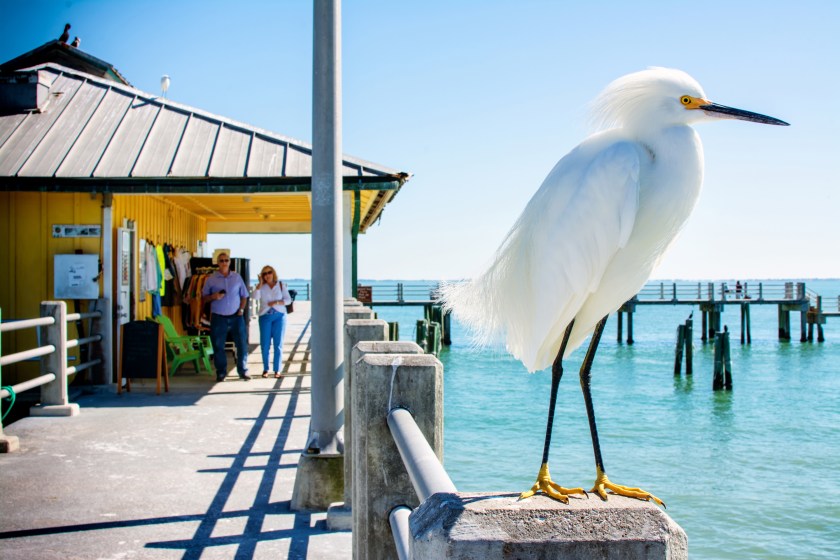
Snowy Egret standing on a concrete pier post with a yellow building, clothing racks, and tourists in the background, photographed with a Nikon D7100 and 35mm lens.
A 2014 photograph of a Snowy Egret perched on the Bay Pier at Fort De Soto Park in Florida.

In the opening chapter of Greg Urbano’s photographic journey, “Showy Egret” stands as a masterclass in compositional awareness and environmental storytelling. Captured in 2014 at Fort De Soto’s Bay Pier in Florida, this image reveals an artist already attuned to the delicate balance between wildlife photography and human context—a sensibility that would define his evolving practice.

The photograph’s immediate strength lies in its spatial intelligence. Urbano positions the Snowy Egret in the right third of the frame, allowing the bird’s pristine plumage to command attention while the weathered pier extends into the turquoise waters beyond. This compositional choice creates a natural visual flow from foreground subject to background environment, inviting viewers to experience both the bird’s individual presence and its coastal habitat simultaneously.

Technical precision underscores the image’s effectiveness. Shot with a Nikon D7100 at f/11.0, Urbano achieves crisp depth of field that renders the egret’s delicate feathers in remarkable detail—each plume distinct against the clear Florida sky. The choice of 1/200 second shutter speed at ISO 100 captures the bird in perfect stillness, transforming a fleeting moment into something approaching portraiture. The 35mm focal length, often considered a “normal” perspective, here proves ideal for environmental wildlife work, offering intimacy without the compression or distance of telephoto lenses.

What elevates this photograph beyond straightforward nature documentation is Urbano’s willingness to embrace the human element. Two tourists emerge from a yellow-trimmed pier building in the middle distance, their presence neither accidental nor intrusive. Rather than seeking the pristine wilderness imagery common in traditional wildlife photography, Urbano acknowledges the reality of modern conservation spaces—these are shared environments where human recreation and natural habitats coexist. The egret’s confident stance on the pier post, unfazed by nearby activity, speaks to this acclimatization, suggesting a more complex narrative about wildlife adapting to anthropogenic landscapes.

The photograph’s playful title—”Showy Egret” as wordplay on “Snowy Egret”—hints at Urbano’s understanding that wildlife photography need not adopt a purely reverential tone. The egret does indeed appear showy, posed almost theatrically on its concrete perch, its breeding plumage fully displayed, yellow feet gripping the weathered surface. This anthropomorphic reading, encouraged by the title, creates accessibility without diminishing the bird’s natural beauty.

Light plays a crucial supporting role. The high, clear Florida sun creates distinct shadows across the pier’s concrete surface while illuminating the egret’s white plumage to near-luminescence. The bird’s yellow lores and feet provide punctuation points of color that echo the building’s trim, creating subtle visual rhymes within the frame.

As a foundational piece in Urbano’s “Beginnings” chapter, “Showy Egret” demonstrates technical competence married to narrative intuition. The photographer shows early understanding that compelling wildlife imagery can exist within human-modified spaces, that environmental context enriches rather than dilutes subject focus, and that humor and play have legitimate places in nature photography. These insights would prove essential as his practice developed, but here, at Fort De Soto in 2014, they exist in nascent, confident form—a young artist finding his voice through patient observation and compositional thoughtfulness.

The Gateway Image: Passagrille Jetty Silhouette and the Dawn of a Photographic Vision

In a 2014 photograph taken at Passagrille Beach, Greg Urbano captures a stunning sunset over the Gulf of Mexico, which inspires his beach photography. Featuring a silhouetted fisherman against an orange sky, the image combines technical skill and emotional depth, symbolizing Urbano’s artistic journey and his evolving relationship with landscape imagery.

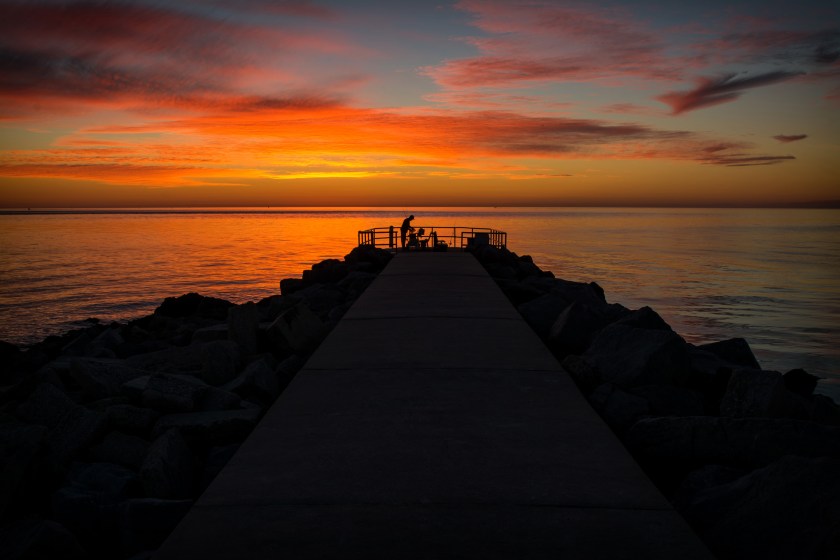
Silhouette of a lone fisherman standing on a rock jetty at Passagrille Beach during an orange Gulf of Mexico sunset, photographed with a Nikon D7100 at 24mm.
A 2014 sunset silhouette of a fisherman on the rock jetty at Passagrille Beach, Florida.

In the context of Greg Urbano’s “Beginnings” chapter, this 2014 sunset photograph from Passagrille Beach holds particular significance—not merely as a technically accomplished image, but as a foundational moment that would shape the photographer’s artistic trajectory for years to come. The image captures that precise intersection where technical competence meets emotional resonance, creating what Urbano himself identifies as his “inspiration for years of beach photography.”

The compositional structure reveals a photographer already thinking in strong geometric terms. The jetty’s dark pathway cuts through the frame with striking linearity, creating a powerful visual corridor that draws the viewer’s eye toward the observation platform at the terminus. This use of leading lines demonstrates sophisticated spatial awareness, transforming the rocky breakwater into a narrative device—a journey into the sublime moment captured in the sky above.

What distinguishes this photograph from countless other sunset images is Urbano’s commitment to silhouette as an artistic choice. Shot at ƒ/11 with a relatively slow shutter speed of 1/20 second at ISO 100, the exposure prioritizes the spectacular gradation of color in the sky while allowing the foreground elements to fall into deep shadow. The lone fisherman—barely discernible yet unmistakably present—becomes an everyman figure, a contemplative sentinel witnessing the day’s transition. This human element, reduced to pure form, prevents the image from becoming merely a spectacular sky study; instead, it grounds the natural drama in human experience.

The technical execution warrants examination. Using the Nikon D7100 with a 10-24mm lens at its maximum 24mm focal length, Urbano captures an expansive view that encompasses both the architectural elements of the jetty and the full breadth of the atmospheric display. The cropped sensor’s field of view provides enough width to establish context while maintaining focus on the central narrative. The aperture choice of ƒ/11 ensures sharpness throughout the frame, from the textured rocks in the immediate foreground to the distant horizon where sea meets sky.

The color palette—ranging from deep oranges and burning yellows to subtle purples and grays in the cloud formations—displays nature at its most theatrical. Yet Urbano’s restraint in post-processing (evident in the natural tonal transitions) allows the scene to speak with authenticity rather than hyperbole. This restraint would become a hallmark of his approach, distinguishing his work from the over-saturated aesthetic that dominates much contemporary landscape photography.

Perhaps most revealing is Urbano’s own reflection on this image as inspirational—a north star that guided subsequent explorations. One can trace forward from this moment to understand his ongoing fascination with the Gulf Coast’s theatrical sunsets, his appreciation for human elements within natural landscapes, and his sophisticated use of silhouette as a storytelling device. The photograph represents not an endpoint but a beginning, a discovery of visual vocabulary that would be refined and expanded throughout his career.

In the broader context of the “Beginnings” chapter, this Passagrille jetty image serves as both literal and metaphorical gateway—the concrete walkway leading toward beauty, the artist’s path toward photographic maturity, and the viewer’s invitation into Urbano’s evolving body of work.

The Gulf Pier: A Foundation in Light and Structure

Greg Urbano’s “Landscapes in HDR” captures the Gulf Fishing Pier at Fort de Soto Park, reflecting his artistic development in photography. Utilizing a Nikon D7100, he balances composition with HDR techniques, achieving naturalistic vibrancy without over-processing. The image embodies a pivotal moment in skill mastery, exploring the connection between environment and human creation.

HDR landscape photograph of the Gulf Fishing Pier at Fort De Soto Park in Pinellas County, Florida, extending over calm water under a bright sky, taken with a Nikon D7100 at 14mm.
A 2013 HDR landscape photograph of the Gulf Fishing Pier at Fort De Soto Park in Pinellas County, Florida.

In the early stages of any photographer’s journey, there exists a pivotal moment when technical curiosity converges with artistic vision. Greg Urbano’s “Landscapes in HDR” from 2013 captures precisely this convergence—a photograph that speaks to the fundamentals of seeing while revealing the seeds of a maturing artistic voice.

The Gulf Fishing Pier at Fort de Soto Park presents itself as an exercise in classical composition, yet the image transcends mere documentation. Shot with a Nikon D7100 at 14mm, the photographer embraced the distortion inherent in ultra-wide-angle photography, using it not as a limitation but as a tool for emphasis. The pier’s concrete pathway stretches toward the horizon with geometric insistence, its weathered surface textured with salt stains and age—details that anchor the ethereal quality of the surrounding environment.

What distinguishes this work within the context of Chapter 1—Beginnings is the deliberate exploration of HDR processing, a technique that dominated landscape photography in the early 2010s. Rather than falling into the trap of over-processing that plagued much HDR work of this era, Urbano demonstrates restraint. The luminous gradations in the sky—from deep azure to wispy white—retain a naturalistic quality while revealing detail across an impressive tonal range. The turquoise waters of the Gulf of Mexico maintain their vibrancy without crossing into hypersaturation, suggesting an eye already sensitive to the boundaries between enhancement and artifice.

The technical choices reveal a photographer building his fundamental vocabulary. The aperture of ƒ/8.0 ensures critical sharpness from the foreground concrete to the distant structures, while the fast shutter speed of 1/400s freezes the subtle motion of the scene—likely the flutter of distant flags or the movement of the few figures visible along the pier. At ISO 100, the image maintains clarity in its textures, from the horizontal railings that create rhythmic lines to the architectural shelters that punctuate the composition’s middle ground.

What makes this photograph significant in understanding Urbano’s artistic evolution is not its perfection but its purposefulness. The nearly symmetrical composition, the careful attention to the leading lines, the consideration of how architectural elements frame the natural environment—these are the building blocks upon which more complex visual narratives are constructed. The weekly visits to this location mentioned in his notes speak to something essential in photographic development: the practice of returning, of seeing the same subject under different conditions, of learning through repetition.

The landscape itself offers something eternal—the meeting point of human construction and natural expanse. The pier extends confidently into the Gulf, a gesture of connection between land and water, between the photographer’s position and the infinite horizon. In capturing this scene, Urbano was not merely documenting a favorite location but engaging with fundamental questions about how we frame our relationship to place and space.

Within the broader context of “Beginnings,” this image exemplifies the necessary stage of mastering craft before transcending it. The imperfect attempts referenced in the chapter description are not failures but essential experiments. Here, we witness a photographer learning to see in high dynamic range, to compose with geometric precision, and to capture the luminous quality of coastal light—all foundational skills that would inform the more sophisticated work to come.

This is where journeys begin: in the clarity of intention, the discipline of practice, and the recognition that every master was once a student of light.