Corner House, Bosler Wyoming 2025: Architecture at the Edge of Erasure

In Chapter 6 of Greg Urbano’s Top 100 Journey, a photograph captures a deteriorating house in the ghost town of Bosler, Wyoming. The image illustrates the photographer’s exploration of abandonment, focusing on atmospheric conditions and the surrounding landscape. This work highlights the themes of decay, isolation, and the complexity of preservation amid a vanishing settlement.

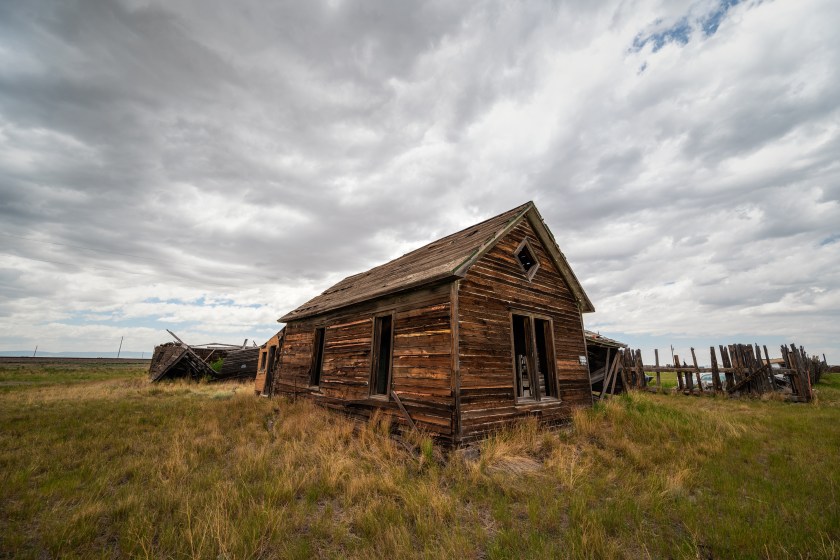
Weathered wooden house with broken windows standing alone in grassland under an overcast sky in Bosler, Wyoming.
A deteriorating wooden house stands at a corner in the ghost town of Bosler, Wyoming.

In this recently captured photograph from Chapter 6 of Greg Urbano’s Top 100 Journey, the photographer documents a collapsing structure in Bosler, Wyoming—one of the few remaining witnesses to a town that has largely disappeared from both map and memory. The image exemplifies the photographer’s continued investigation into the material traces of Western settlement, while revealing new subtleties in his approach to documenting abandonment and temporal passage.

The composition centers on a weathered wooden dwelling, its steep-pitched roofline still asserting architectural intention despite advanced structural compromise. The building’s corner placement within the frame—echoing its designation as a “corner house”—creates a dynamic diagonal energy, the structure appearing to lean into the wind-swept grassland that now reclaims the site. Dark window openings punctuate the horizontal wood siding, which has weathered to rich amber and umber tones, each plank articulated by the diffused overcast light.

What distinguishes this work within the photographer’s recent output is his expanded attention to atmospheric conditions. The turbulent cloudscape dominates nearly two-thirds of the frame, its churning gray masses punctuated by occasional breaks of blue—a meteorological drama that mirrors the building’s own precarious state between persistence and collapse. This sky is not mere backdrop but active participant, suggesting the elemental forces that have contributed to the structure’s deterioration and will eventually complete its dissolution.

The surrounding landscape provides crucial narrative context. Collapsed outbuildings and fence remnants scatter across the middle ground, fragmentary evidence of what was once a more substantial settlement. Golden prairie grasses advance toward the dwelling’s foundation, their subtle movement implied even within the photograph’s frozen moment. The extreme horizontality of the High Plains extends to a barely perceptible horizon line, emphasizing the profound isolation of this site just north of Laramie, accessible from Highway 80 yet psychologically distant from contemporary traffic patterns.

From a technical standpoint, the photographer employs what appears to be a moderate wide-angle perspective, capturing sufficient environmental context while maintaining the building’s structural integrity within the frame. The exposure handles the challenging luminosity range of overcast conditions with nuance, preserving detail in both shadowed door openings and highlighted cloud formations. This balanced approach serves the documentary imperative while allowing for aesthetic contemplation.

Within Chapter 6’s thematic framework of “The Road Ahead,” this photograph functions as meditation on endings and continuations. Bosler exists now primarily as absence—a ghost town in the most literal sense—yet the photographer’s attention validates its remaining physical evidence as worthy of sustained consideration. His choice to include this work in his curated Top 100 Journey suggests an artist grappling with questions of what deserves preservation, at least photographically, when material preservation is no longer possible.

The work also demonstrates evolution in the photographer’s relationship to his subject matter. Where earlier chapters might have emphasized formal qualities or nostalgic resonance, this image presents abandonment as process rather than state—a building actively returning to landscape, caught mid-transition. The corner house stands as both monument and warning, its dignified decay offering no easy emotional resolution. This measured, clear-eyed approach marks the maturation of an artist comfortable with ambiguity, finding profundity in the unheroic persistence of structures at civilization’s receding edge.
Briggsdale Scale and Silos: Monuments of Rural Persistence

The photograph of the Briggsdale Scale and Silos in eastern Colorado captures the beauty of agricultural remnants under a vast prairie sky. The artist portrays abandonment as transformation rather than decay, highlighting layered complexities and themes of economic change. This work reflects both personal exploration and broader cultural narratives in rural America.

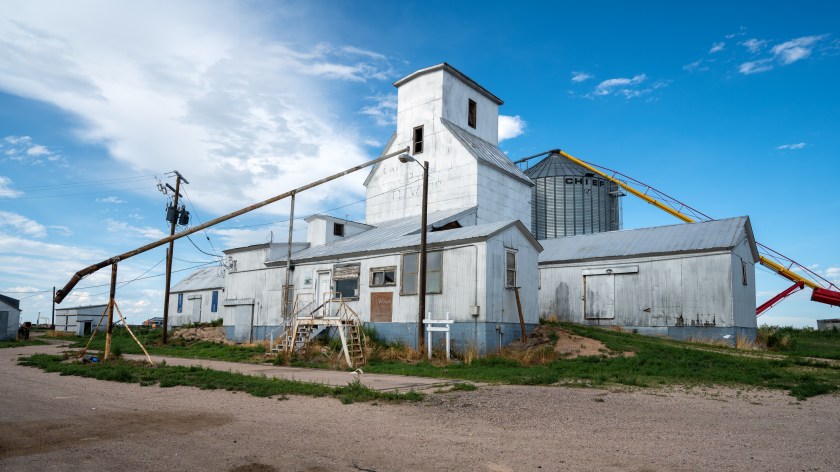
Rural grain elevator complex with white scale house buildings and metal silos under a blue sky in eastern Colorado.
The Briggsdale scale and silos stand along a roadside in rural eastern Colorado.

In this commanding photograph from Chapter 6 of Greg Urbano’s Top 100 Journey, the photographer turns his lens toward the structural remnants of agricultural infrastructure in eastern Colorado. The Briggsdale Scale and Silos stand as weathered sentinels against an expansive prairie sky, their utilitarian forms elevated to subjects of aesthetic contemplation through careful compositional framing and an acute sensitivity to light.

The image presents a study in contrasts—temporal, textural, and tonal. The white-painted grain elevator rises prominently in the frame’s left third, its verticality punctuated by narrow window openings that read as dark voids against the painted surface. Adjacent structures spread horizontally across the composition, their corrugated metal siding bearing the patina of decades exposed to the elements. A modern Chief grain bin introduces a cylindrical geometry, while the skeletal remains of what appears to be an auger system arc across the upper right quadrant, its yellow and red paint providing the only vivid chromatic notes in an otherwise muted palette.

What distinguishes this work within the photographer’s ongoing exploration is its treatment of abandonment not as decay but as transformation. The structures retain their monumental presence even as nature begins its slow reclamation—weeds push through concrete, grass encroaches on gravel pathways, and rust blooms across metal surfaces. The dramatic cloud formation sweeping across the cobalt sky suggests movement and change, while the buildings themselves remain rooted, immovable despite their gradual obsolescence.

The photographer’s technical execution reveals a sophisticated understanding of documentary traditions. Shot in brilliant midday light that might challenge less experienced practitioners, he harnesses the harsh illumination to articulate every surface detail—the vertical seams of the elevator, the weathering patterns on wood siding, the dimensional quality of the corrugated metal. The deep blue sky provides crucial tonal separation, preventing the white structures from dissolving into atmospheric haze while simultaneously emphasizing the vastness of the landscape context.

Within Chapter 6’s framework of “The Road Ahead,” this photograph functions as both retrospective and prospective statement. It acknowledges the photographer’s established interest in vernacular architecture and rural landscapes while suggesting new territories of investigation. The composition’s layered complexity—multiple structures occupying different spatial planes, the interplay of geometric forms, the dialogue between human-made and natural elements—indicates an artist pushing beyond straightforward documentation toward more nuanced visual poetry.

The work also engages broader themes of economic transition and cultural memory embedded in the American rural landscape. These agricultural structures, once vital nodes in the grain production and distribution network, now stand largely dormant, their continued presence a testament to both past prosperity and present uncertainty. The photographer neither romanticizes nor condemns this state of affairs; instead, he presents the scene with clear-eyed attention, allowing viewers to project their own narratives onto these architectural forms.

As part of his long-term Top 100 Journey project, this image demonstrates the photographer’s commitment to sustained engagement with place and subject matter. His repeated travels through eastern Colorado have yielded not mere repetition but deepening insight, as evidenced by this photograph’s confident handling of complex visual elements. It represents the work of an artist whose ongoing exploration continues to reveal new dimensions within familiar territory, finding monumentality in structures others might overlook and poetry in the persistent presence of the seemingly obsolete.