St. Vrain Waterfall: A Study in Motion and Permanence

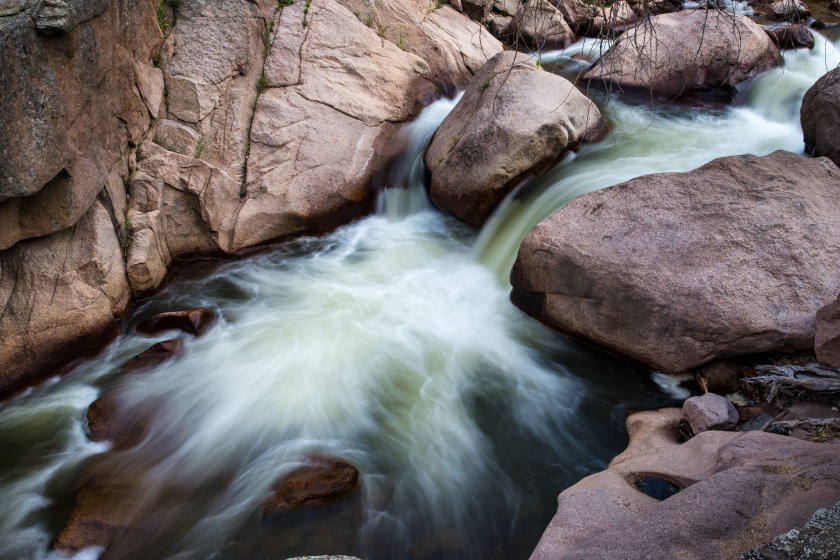
The photograph of a small waterfall along St. Vrain Creek embodies the tension between geological permanence and water’s fleeting essence. Using long exposure, it transforms the scene into a contemplative study of motion and stillness. The intimate scale highlights the beauty of overlooked subjects, emphasizing the profound within Colorado’s landscapes.

Long exposure view of a small waterfall flowing through smooth granite boulders along St. Vrain Creek.
A small waterfall flows between granite rocks along St. Vrain Creek in northern Colorado.

Within the third chapter of Greg Urbano’s Top 100 Journey—devoted to Colorado Landscapes & Cityscapes—this long exposure photograph of the St. Vrain presents a meditation on the fundamental tension between geological permanence and hydrological flux. The image captures a modest cascade in Northern Colorado, yet its technical execution elevates what might be considered a commonplace subject into something altogether more contemplative.

The photographer’s decision to employ long exposure proves essential to the work’s success. Water, rendered as gossamer curtains of white and pale green, flows through the frame with an almost supernatural quality. This technique transforms the kinetic energy of rushing water into something visually paradoxical: movement frozen into silken stillness. The effect creates a temporal ambiguity that refuses to commit to either instant or duration, existing instead in a liminal space between photographic modes.

Compositionally, the work demonstrates a sophisticated understanding of how natural forms interact within the frame. Pink-hued granite boulders, weathered and moss-touched, provide structural anchors throughout the image. These stones—products of millennia—stand in stark contrast to the ephemeral blur of water that has shaped them. The photographer positions these elements with careful attention to visual weight and balance, allowing the eye to trace pathways through the composition that mirror the water’s own journey through the rocky terrain.

The color palette reveals itself as deliberately restrained. Warm earth tones of pink and tan granite dominate, punctuated by touches of green moss and the cool, milky whites of the flowing water. This chromatic restraint prevents the image from becoming overly dramatic, instead maintaining the documentary authenticity that characterizes much of this chapter’s work. The photographer resists the temptation to over-saturate or manipulate, trusting the natural beauty of the Colorado landscape to speak for itself.

What distinguishes this photograph within the broader context of the Colorado Landscapes & Cityscapes chapter is its intimate scale. Rather than pursuing the grand vistas often associated with Rocky Mountain photography, the work turns its attention to a more modest subject—a small waterfall that countless hikers might pass without particular notice. This choice reflects a maturing sensibility within the photographer’s practice, one that finds profundity in the overlooked rather than the obvious.

The technical execution warrants recognition as well. Managing long exposure in daylight conditions requires careful control of light through neutral density filtration and precise shutter speed calculation. The photographer has balanced these elements skillfully, maintaining detail in both the highlighted water and shadowed crevices of stone. Branches visible at the top of the frame remain relatively sharp, suggesting a shutter speed calibrated to render water motion without sacrificing all structural definition in the surrounding environment.

Within the arc of the Top 100 Journey project, this image represents an important moment of focus. The work demonstrates that landscape photography need not rely on sweeping panoramas or dramatic weather to achieve visual and emotional resonance. Instead, it proposes that careful attention to the quotidian—to the small waterfalls tucked into Northern Colorado’s piedmont—can yield images of equal contemplative depth. The St. Vrain Waterfall stands as evidence of a photographer learning to see not just the spectacular, but the quietly profound.
Boulder Creek Long Exposure

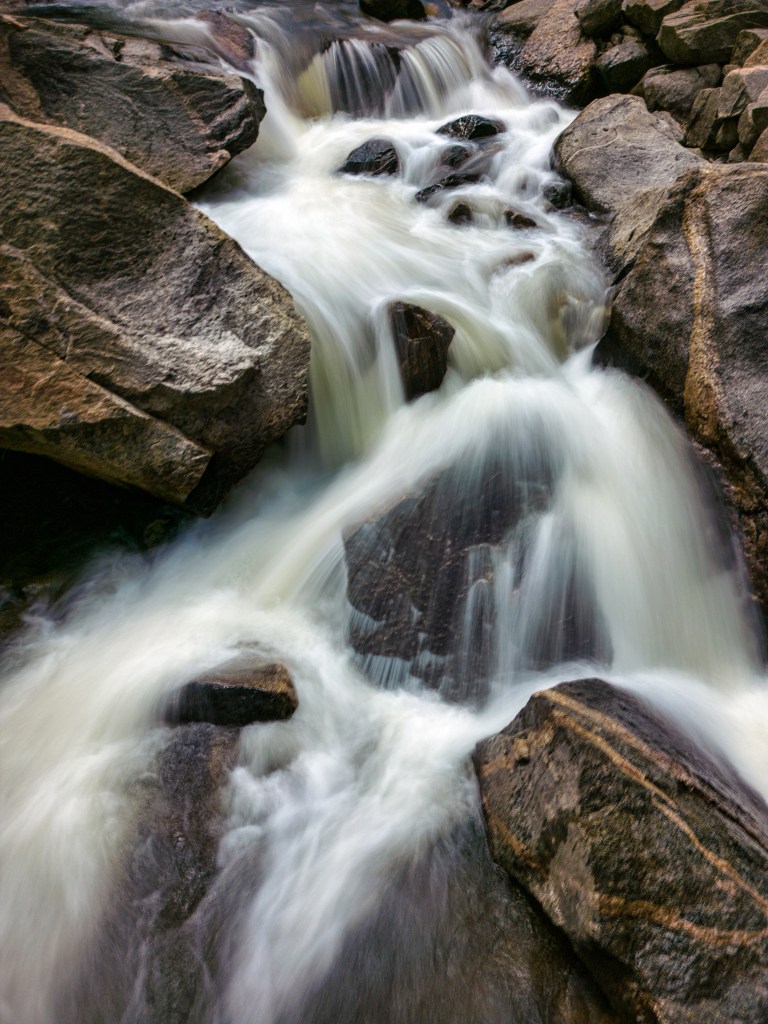
The aerial photograph of Boulder Creek, captured with a DJI Mini 3 Pro drone, showcases a harmonious blend of long exposure techniques and modern technology. The composition balances flowing water and angular granite boulders, creating an abstract visual narrative that highlights the juxtaposition of motion and permanence in landscape photography.

Long-exposure view of flowing creek water cascading over large rocks in a narrow channel.
Long-exposure water flows over boulders in Boulder Creek along Boulder Canyon Drive, Colorado.

This aerial perspective of Boulder Creek represents a striking departure in both technical approach and creative vision, captured not with traditional camera equipment but with a DJI Mini 3 Pro drone equipped with a Freewell ND2000 filter. The photographer’s willingness to embrace emerging technologies while maintaining classical long exposure techniques demonstrates an adaptive practice that refuses to be constrained by conventional methodologies. Shot at 6.7mm with ƒ/1.7 aperture, 1/2 second exposure, and ISO 100, the image transforms cascading water and weathered granite into an abstract study of motion and permanence.

The aerial vantage point offers what might be termed a “god’s eye” perspective—looking directly down upon the creek as it navigates through massive boulders along Boulder Canyon Drive. This top-down orientation fundamentally alters the traditional landscape viewing experience. Rather than observing the scene from a human standpoint at creek level, the viewer hovers above, granted access to compositional relationships and water patterns typically invisible from ground perspective. The half-second exposure blurs the rushing water into silken ribbons that weave between dark stones, creating organic shapes that appear almost calligraphic against the textured rock surfaces.

The geological elements provide crucial counterpoint to the flowing water. Angular granite boulders, their surfaces marked by striations and mineral deposits, display warm ochre and gray tones that anchor the composition’s cooler water tones. These stones reveal billions of years of geological history—compression, uplift, erosion—rendered in layers and fractures visible even from the drone’s elevation. The photographer frames the scene to balance solid mass with liquid movement, allowing neither element to dominate but instead creating a dynamic equilibrium between opposing forces.

The technical execution demonstrates sophisticated problem-solving. Achieving long exposure effects from an airborne platform presents unique challenges—the drone itself must remain perfectly stable while the camera shutter stays open. The ND2000 filter proves essential, reducing light transmission sufficiently to permit a half-second exposure in daylight conditions without overexposure. At ƒ/1.7, the lens operates wide open, yet the minimal depth of field concerns inherent in macro or portrait photography become irrelevant when shooting from such elevation; everything within the frame exists at roughly equivalent focus distance.

Within Chapter 2—Florida Landscapes & Cityscapes—this Colorado waterway continues the photographer’s geographic expansion evident throughout this section of the Top 100 Journey. The consistent choice to photograph Rocky Mountain landscapes suggests deliberate exploration of environments radically different from Florida’s flat, subtropical character. Perhaps this juxtaposition serves the project’s broader narrative: an artist defining his vision through contrast, discovering what landscape means by experiencing its various manifestations across diverse topographies.

“Boulder Creek Long Exposure ” ultimately represents the democratization of aerial perspective through consumer drone technology, married to time-honored long exposure aesthetics. The photographer recognizes that tools matter less than vision—that a small drone can produce work as artistically valid as traditional large-format equipment when wielded with intention and compositional awareness. The image stands as testament to adaptive practice in contemporary landscape photography, where technical innovation serves timeless artistic goals.