Portrait Slam 2024

Portrait Slam 2024 features Frank Graziano posed on a vintage railroad car, showcasing a blend of environmental portraiture and technical skill. The composition balances subject and setting, using light and shadow effectively. This portrait reflects the photographer’s evolution, integrating contemporary styling with Americana themes, and highlights a confident approach to on-location shooting.

Man wearing a hat stands on the side steps of a black railroad car, looking to the side.
Frank Graziano poses on a railroad car at the Colorado Railroad Museum in Golden, Colorado.

The photographer captures Frank Graziano in a moment of studied nonchalance, balanced on the step of a vintage railroad car against the industrial textures of riveted steel and weathered paint. This image, created during Portrait Slam 2024 at the Colorado Railroad Museum, exemplifies the photographer’s growing confidence in environmental portraiture—a technical and conceptual evolution clearly marked within Chapter 4 of his Top 100 Journey project.

What immediately distinguishes this portrait is its sophisticated balance between subject and setting. The railroad car’s dark, rivet-studded surface creates a powerful geometric frame, yet never overwhelms Graziano’s presence. The model’s positioning—one foot planted on the step, the other casually lifted, holding a vertical rail—demonstrates a dynamic use of diagonal lines that pulls the viewer’s eye through the composition. His cowboy hat and leather jacket evoke classic Americana, while the contemporary styling prevents the image from slipping into pastiche or nostalgia.

The photographer’s technical execution reveals careful consideration of light and shadow. The overcast sky provides even, diffused illumination that preserves detail across both the subject’s face and the textured metal surface behind him. This soft light wraps around Graziano’s features, creating subtle modeling without harsh shadows—a particularly important choice given the industrial setting’s potential to create competing visual elements. The muted color palette of charcoal grays, weathered browns, and faded blacks creates tonal harmony while allowing the warm leather tones of the hat to serve as a visual anchor.

Within the context of Chapter 4—Portraits Studio, Outdoor & Workshop Work—this image demonstrates the photographer’s ability to synthesize controlled studio techniques with the spontaneity of location work. Workshop environments often push photographers beyond their comfort zones, and this portrait suggests someone working confidently with both the challenges and opportunities of on-location shooting. The inclusion of the “KEEP OFF” text, partially visible in the frame, adds an element of subtle irony: the subject occupies precisely the forbidden space, transforming restriction into creative possibility.

The railroad setting serves as more than mere backdrop. It functions as visual metaphor—the convergence of journey, transit, and transitional spaces that resonates with the photographer’s larger Top 100 Journey project. The industrial heritage embedded in the railroad car’s weathered surface speaks to American mythology and masculine archetypes, themes Graziano’s styling deliberately engages while maintaining contemporary relevance.

From a curatorial perspective, this photograph marks a maturation in the photographer’s approach to environmental portraiture. Earlier works in his portfolio occasionally struggled with the balance between subject and location; here, both elements coexist in productive tension. The composition’s structured geometry—the vertical rails, horizontal platform, the rectangular frames within frames—creates order without rigidity, allowing Graziano’s natural pose to feel both choreographed and spontaneous.

The image’s inclusion in the Top 100 Journey project reflects its successful synthesis of technical skill, conceptual clarity, and visual impact. It demonstrates how workshop environments can push photographers toward their strongest work, combining the pressure of limited time with the inspiration of new locations and collaborative energy. The result is a portrait that honors both its subject and its setting, creating a narrative that extends beyond the single frozen moment into broader considerations of place, identity, and American visual mythology.
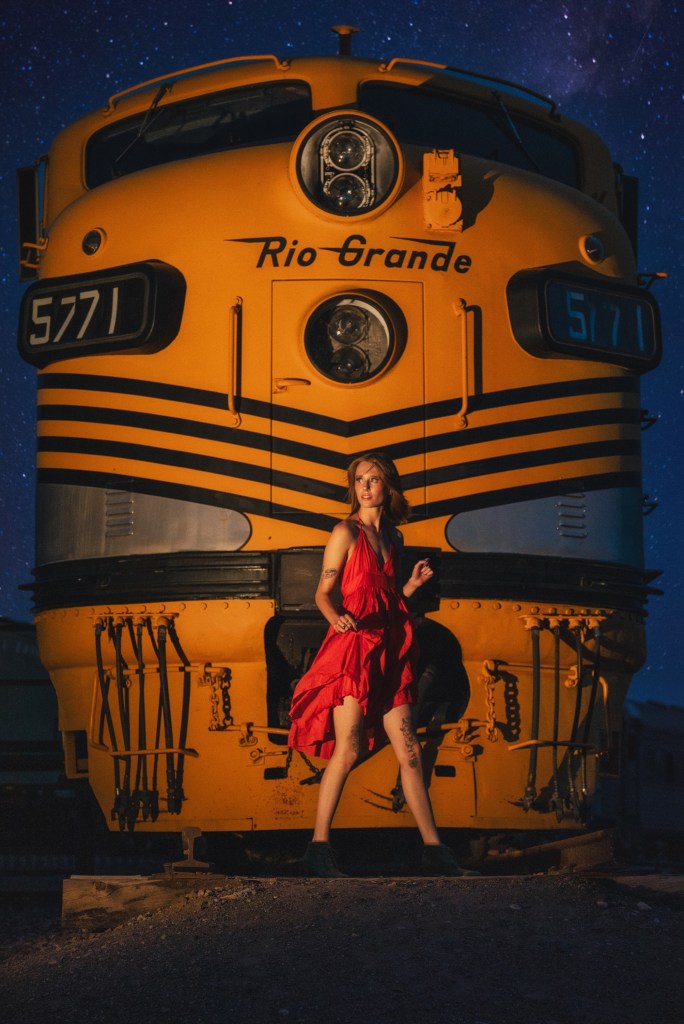
Scale and Spectacle: Industrial Heritage as Portrait Stage

Savana Steinhoff’s portrait in front of the Rio Grande 5771 locomotive at the Colorado Railroad Museum showcases Greg Urbano’s artistic vision in environmental portraiture. The photo employs effective lighting, wardrobe choice, and spatial awareness to highlight both model and industrial backdrop, reflecting broader themes of coexistence and cultural significance in contemporary photography.

Woman in a red dress stands in front of a yellow Rio Grande locomotive at night, lit against a dark sky.
Savana Steinhoff poses in front of the Rio Grande 5771 locomotive at the Colorado Railroad Museum in Golden, Colorado.

Among the most ambitious entries in Chapter 4 of Greg Urbano’s Top 100 Journey, this photograph from Portrait Slam 2024 represents the photographer’s engagement with large-scale environmental portraiture under challenging technical conditions. Created at the Colorado Railroad Museum in Golden, the image positions model Savana Steinhoff against the imposing facade of Rio Grande locomotive 5771, transforming industrial artifact into dramatic backdrop and exploring the relationship between human scale and mechanical monumentality.

The composition immediately announces its ambitions. The locomotive dominates the frame, its iconic orange and black striping creating bold graphic elements that could easily overwhelm a human subject. Yet Urbano’s placement of the model—centered beneath the Rio Grande nameplate, her crimson dress echoing the warm tones of the engine—establishes a visual hierarchy that honors both subject and setting. The photographer has chosen a low angle that emphasizes the locomotive’s imposing height while maintaining the model’s presence as the compositional anchor. This decision reflects sophisticated spatial awareness, particularly valuable in workshop environments where multiple photographers compete for optimal vantage points.

The lighting strategy reveals careful planning and execution. Shot during the blue hour, the image captures that transitional moment when artificial illumination and residual daylight achieve balance. The locomotive’s exterior lighting creates warm pools of color against the deepening twilight sky, while additional lighting—likely strobes positioned to camera left—illuminates the model without destroying the ambient atmosphere. Stars visible in the darkening sky suggest either long exposure techniques or composite work in post-processing, adding a dreamlike quality to what might otherwise be straightforward location portraiture.

The choice of wardrobe proves integral to the photograph’s success. The flowing red dress provides both color contrast and movement, its flowing fabric creating visual interest against the rigid geometry of the industrial subject. The model’s pose—casual yet purposeful, one leg slightly forward—suggests confidence rather than confrontation with the massive machine behind her. This approach differs markedly from more aggressive “beauty and the beast” tropes often employed in automotive and industrial photography, opting instead for coexistence rather than contrast.

Within the context of Chapter 4’s documentation of workshop and collaborative shooting experiences, this photograph demonstrates the photographer’s ability to execute complex concepts under time constraints typical of group shooting events. Portrait Slam workshops challenge participants to work efficiently in unfamiliar locations with coordinated models and lighting setups, requiring both technical proficiency and decisive artistic vision. The inclusion of this image in the Top 100 Journey suggests Urbano views such collaborative environments not as limitations but as catalysts for ambitious work.

The photograph also reflects broader themes in contemporary portrait photography, where environmental context carries equal weight to subject representation. The locomotive serves as cultural artifact—a symbol of westward expansion, industrial heritage, and American rail history—while simultaneously functioning as pure visual element. This duality enriches the image beyond simple fashion or glamour photography, situating it within traditions of documentary-informed portraiture.

Ultimately, this work from Portrait Slam 2024 exemplifies the photographer’s mature approach to environmental portraiture: technically sophisticated, conceptually layered, and visually arresting without sacrificing authenticity or becoming mere spectacle.