Shan Light: Choreographing Time and Illumination

Shannon Quinn’s photograph, taken at Void Studios, symbolizes the photographer’s exploration of long-exposure light painting in collaboration with a dancer. The composition highlights a figure in black, illuminated by vibrant light trails, merging technical skill with performance. This work exemplifies an ongoing artistic journey, emphasizing collaboration and the evolution of creative expression.

Studio portrait of go-go dancer Shannon Quinn wearing a blue wig and dark outfit, surrounded by curved orange light trails created through long-exposure light painting.
Shannon Quinn (ShanOSteel) photographed at Void Studios Denver during a collaborative light painting and long-exposure studio session.

In this striking image from Chapter 6 of Greg Urbano’s Top 100 Journey—titled “The Road Ahead: Recent Work & Ongoing Exploration”—the photographer ventures into territory that merges technical experimentation with performative energy. Shot at Void Studios in Denver during a collaborative session with dancer Shannon Quinn, the photograph represents a deliberate pivot toward long-exposure light painting, a technique the photographer had not previously explored in a controlled studio environment.

The composition centers on a figure clad in black with a blue-toned wig, positioned against a muted backdrop while wielding LED wands that trace vivid arcs of orange and yellow light through space. The long exposure—achieved through rear curtain sync flash combined with continuous LED sources—captures both the frozen stillness of the subject and the kinetic energy of movement, creating a visual paradox that challenges our perception of time. The metallic sheen of the vest catches ambient light, adding textural contrast to the otherwise shadow-heavy figure, while knee-high boots ground the composition in the physical realm even as the light trails suggest something ethereal.

What distinguishes this work within the photographer’s evolving practice is its collaborative foundation. Unlike many studio portraits that position the photographer as sole author, this image emerges from a dialogue between creator and performer. Quinn’s background as a go-go dancer informs the dynamic posture and confident spatial awareness visible in the frame. The choreography of light becomes inseparable from the choreography of the body, suggesting that technical mastery alone cannot produce such results—it requires a willing, skilled collaborator who understands how to perform for extended exposures.

The technical apparatus employed here—a Nikon Z7ii paired with Godox TL30 LED wands and an AD100 strobe—speaks to a hybrid approach that balances ambient light sculpting with decisive flash illumination. Rear curtain sync ensures that the sharpest rendering of the subject occurs at the end of the exposure, allowing motion blur and light trails to accumulate before the final moment of clarity. This reversal of typical flash timing creates a sense of forward momentum, as though the figure is moving into her frozen state rather than away from it.

Within the context of Chapter 6, this photograph embodies the spirit of its subtitle: ongoing exploration. The photographer’s willingness to attempt unfamiliar techniques in a new setting demonstrates an artistic practice that refuses stagnation. Rather than retreating to established strengths, the work here shows someone leaning into uncertainty, using collaboration as a catalyst for discovery.

The color palette—dominated by warm oranges against cool blues and deep blacks—creates a retro-futuristic aesthetic that recalls both 1980s cyberpunk imagery and contemporary LED performance art. Yet the image avoids pastiche. Instead, it synthesizes influences into something distinctly contemporary, a visual language appropriate for documenting this moment in the photographer’s trajectory.

As part of a curated selection representing his strongest work, this image signals not arrival but continuation. It captures the photographer mid-journey, experimenting with new tools and partnerships, documenting not just a subject but a process of becoming. The road ahead, as the chapter title suggests, remains open—and this photograph marks one compelling point along that route.

Pears: A Chromatic Triptych in Measured Light

A still life photograph features three pears, highlighting the photographer’s evolving technique in transforming everyday produce into subjects for aesthetic contemplation. Using controlled lighting and a focused composition, the work emphasizes color variation and organic authenticity. This piece bridges classic and contemporary styles, encouraging viewers to appreciate the beauty in simplicity.

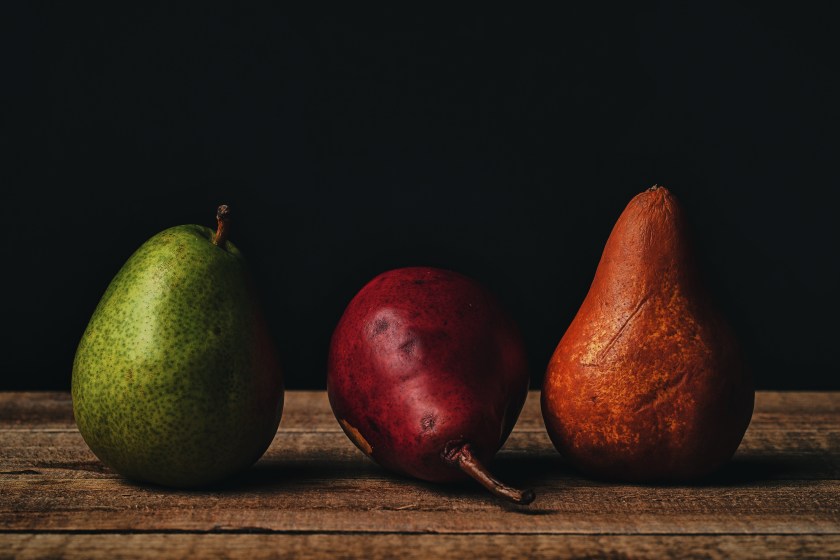
Tabletop still life of three pears arranged side by side on a wooden surface against a dark background.
A tabletop still life of three pears arranged on a wooden surface and lit against a dark background.

This composition of three pears exemplifies the photographer’s evolving approach to still life, transforming quotidian supermarket produce into subjects worthy of sustained aesthetic contemplation. Arranged in strict linear progression across weathered wood, the trio presents a study in chromatic variation and volumetric form that speaks to both classical still life traditions and contemporary minimalist sensibilities.

The technical framework mirrors the controlled approach evident throughout this body of work: a single Godox V1s strobe modified by softbox and grid, captured with a Sony A7ii paired with an 85mm f/1.8 lens. This choice of focal length proves particularly significant. Unlike the wider perspectives often employed in tabletop work, the 85mm compression subtly flattens spatial relationships while maintaining separation between subjects, creating a stage-like presentation where each pear occupies its designated position with theatrical clarity.

What distinguishes this image within the chapter’s trajectory is its bold embrace of color as primary subject matter. Where the earlier onion and garlic study operated within a narrow tonal range of earth and amber, here the photographer orchestrates a chromatic progression—verdant green, deep crimson, oxidized copper—that reads almost as a color theory exercise. Yet the natural imperfections of each fruit prevent the composition from becoming merely schematic. Surface blemishes, stem variations, and subtle textural differences assert the subjects’ organic authenticity.

The lighting strategy reveals sophisticated control over shadow placement and tonal gradation. The grid attachment concentrates illumination on the subjects while allowing the background to fall into near-absolute blackness, a technique borrowed from Old Master painting that isolates forms in dramatic relief. Light wraps around each pear’s curved surface with mathematical precision, creating highlight-to-shadow transitions that define volume without resorting to harsh contrast. The wooden platform receives just enough illumination to establish spatial grounding, its grain and weathering providing textural counterpoint to the fruits’ smooth skins.

Compositional decisions demonstrate a rigorous formal intelligence. The three pears, though similar in scale, exhibit distinct silhouettes—the green pear’s upright verticality, the red pear’s compressed roundness, the copper pear’s elongated diagonal lean. This variation within repetition creates visual rhythm while avoiding monotony. The spacing between subjects appears carefully calibrated, neither crowding nor isolating, allowing each fruit to maintain individual presence while contributing to the unified whole.

Post-processing through color grading has intensified chromatic saturation while preserving naturalistic tonality. The resulting palette suggests both heightened reality and painterly intention—colors feel amplified yet believable, enhanced rather than fabricated. This balance between documentation and interpretation positions the work at a productive intersection of photographic traditions.

Within the chapter’s arc from classic to experimental approaches, this image occupies transitional territory. Its formal rigor and single-light methodology align with classical practice, yet the chromatic boldness and almost Pop Art sensibility of three isolated, colored forms hint at more conceptual concerns. The photograph demonstrates that experimentation can emerge from treating simple subjects with exacting attention rather than through technical complexity alone.

The work ultimately asks viewers to reconsider the aesthetic potential residing in everyday objects, a question central to still life practice across centuries. By isolating these supermarket pears in dramatic light and formal precision, the photographer transforms the ordinary into an opportunity for visual meditation on color, form, and the enduring power of careful observation.

Onions and Garlic: A Study in Chiaroscuro and Culinary Stillness

The photograph captures a still life of onions and garlic on a wooden surface, showcasing classical principles through contemporary techniques. The controlled lighting and asymmetrical balance create depth, while post-processing enhances tonal richness. This artwork engages with historical traditions, revealing how ordinary subjects can convey significant meaning through careful observation and technical precision.

Tabletop still life of whole onions and garlic bulbs arranged on a wooden surface against a dark background.
A tabletop still life of onions and garlic arranged on a wooden surface and lit against a dark background.

In this deliberate composition, the photographer demonstrates a mastery of classical still life principles while working within the constraints of contemporary digital tools. The image presents three bronze-skinned onions accompanied by two heads of garlic, arranged on weathered wood against an impenetrable black void—a setup that immediately recalls the Dutch and Spanish still life traditions of the 17th century, where humble kitchen subjects were elevated to objects of contemplation.

The technical execution reveals a sophisticated understanding of light modulation. Working with a single modified light source—a Godox V1s paired with a softbox and grid—the photographer has created a tightly controlled illumination that wraps around the subjects’ curved surfaces while maintaining crisp shadow definition. The grid attachment proves essential here, preventing light spill into the background and preserving the dramatic contrast that gives the image its gravitas. This economy of means, using just one light to achieve such dimensional modeling, speaks to both practical skill and aesthetic intentionality.

What distinguishes this work within Chapter 5’s progression from classic to experimental tabletop photography is its conscious dialogue with art historical precedent. The photographer acknowledges drawing inspiration from a tutorial source, yet the resulting image transcends mere technical exercise. The onions’ papery skins catch light with a luminosity that suggests both fragility and age, their dried stalks creating gestural elements that break the otherwise spherical regularity. The garlic bulbs, positioned in the lower quadrant, provide tonal counterpoint—their pearl-white surfaces reflecting light with greater intensity than the warmer onions above.

The compositional arrangement follows classical principles of asymmetrical balance. The three onions occupy distinct spatial planes, their positioning creating depth through overlapping forms and subtle scale variation. The leftmost onion’s dramatic upward-reaching stem introduces vertical energy, while the garlic anchors the composition’s base. This triangular organization guides the viewer’s eye through the frame in a measured, contemplative rhythm appropriate to the subject matter.

Post-processing choices, implemented through color grading in Luminar 4, enhance the image’s tonal richness without sacrificing naturalism. The warm amber-to-sienna palette suggests candlelight or late afternoon sun, though the lighting setup confirms neither. This ambiguity of light source contributes to the image’s timeless quality—it could as easily have been captured in a 17th-century Dutch kitchen as in a contemporary studio.

The weathered wooden surface provides crucial textural contrast to the subjects’ organic forms. Its rough grain and worn patina introduce narrative suggestions of use and time, transforming a simple backdrop into an active compositional element. The wood’s horizontal planking creates subtle linear structure beneath the curved biological forms above.

Within the broader context of this chapter’s exploration, this photograph occupies the “classic” end of the spectrum—demonstrating that traditional approaches retain their power when executed with technical precision and compositional intelligence. The work proves that experimentation need not always mean formal rupture; sometimes it involves mining established vocabularies with fresh attention. Here, the photographer engages in a centuries-old conversation about how light reveals form, how arrangement creates meaning, and how the ordinary, when carefully observed, achieves a quiet monumentality that rewards sustained viewing.

Anne-Elise

The portrait of Anne-Elise Chapman in City Park, Fort Collins, highlights the photographer’s skill in blending environmental portraiture with studio techniques. Utilizing careful lighting and composition, the image captures contrasts between natural and contemporary elements. The strategic use of color and texture enriches the narrative, showcasing technical excellence and artistic vision.

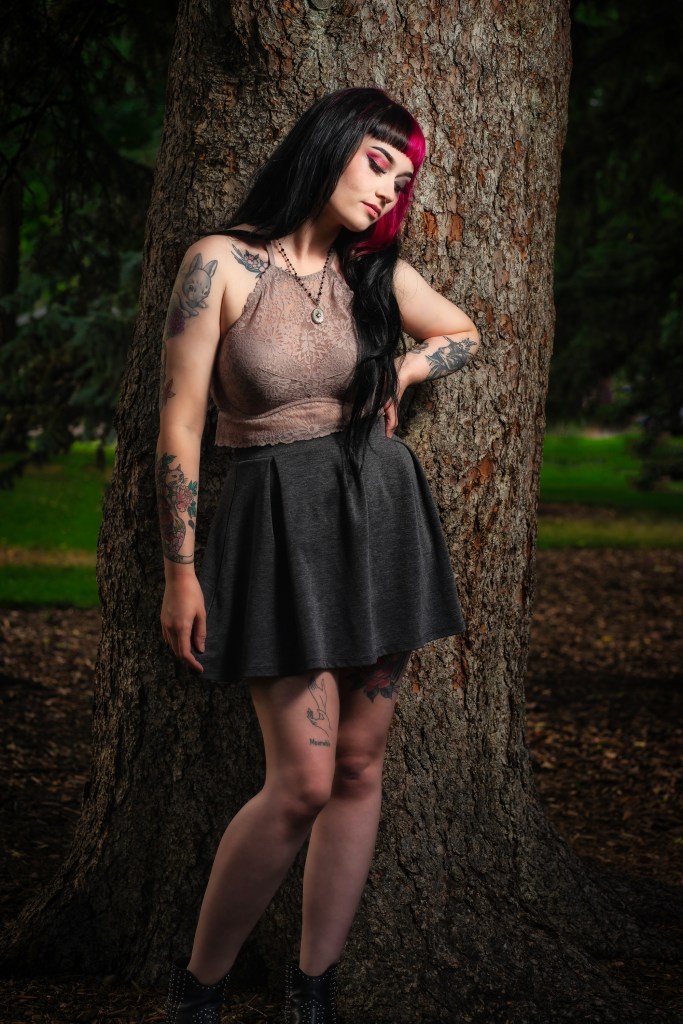
Woman with long dark hair and visible tattoos leaning against a large tree in a park, eyes closed, wearing a sleeveless top and skirt.
Anne-Elise Chapman stands against a tree in City Park, Fort Collins, Colorado.

This portrait exemplifies the photographer’s nuanced approach to environmental portraiture, where natural settings are transformed into outdoor studios through strategic lighting and compositional choices. Photographed in City Park, Fort Collins, the image presents the subject leaning against the textured bark of a mature tree, her contemplative pose and distinctive styling creating a study in contrasts between the organic and the contemporary, the natural and the cultivated.

The technical foundation reveals a methodical approach to outdoor flash photography. Working with a Sony A7ii and the respected 85mm f/1.8 lens—a classic portrait focal length that provides flattering perspective and subject isolation—the photographer employed a Godox V1s flash modified with a shoot-through umbrella. This diffusion choice proves critical to the image’s success. The softened light wraps around the subject’s features and form, preventing the harsh shadows that plague poorly executed outdoor flash work while maintaining directionality that provides dimension and depth. The lighting appears to originate from camera left, creating subtle modeling across the face and body that complements rather than competes with the ambient forest light.

The compositional structure demonstrates careful consideration of both subject and environment. The tree trunk functions as more than backdrop; it becomes an active element in the visual narrative, its rough, organic texture providing counterpoint to the smooth skin and fabric surfaces. The subject’s positioning—slightly offset from center, body angled, one hand resting naturally against the bark—creates a relaxed asymmetry that invites extended viewing. The visible tattoos become graphic elements within the composition, their dark forms echoing the patterns in the tree bark and adding layers of personal narrative to the environmental context.

Color relationships within the frame merit attention. The earthy tones of the subject’s outfit—muted rose and deep charcoal—harmonize with the brown and gray palette of the bark while maintaining sufficient contrast to ensure separation. The vivid magenta accent in the hair provides a calculated color note that draws the eye upward to the face, where the complementary makeup palette reinforces this focal point. The defocused green background, rendered as soft bokeh by the 85mm lens at apparent wide aperture, provides color balance without competing for attention.

Within Chapter 4’s exploration of portrait methodologies, this photograph demonstrates the photographer’s ability to translate studio lighting principles into outdoor contexts. The controlled light quality typically associated with indoor work here interacts with natural ambient illumination, creating a hybrid aesthetic that benefits from both approaches. The umbrella modification prevents the artificial quality that often characterizes outdoor flash photography, instead producing a luminosity that feels organic to the wooded setting while maintaining the precise control necessary for professional portraiture.

The post-processing in Luminar 4 enhances the image’s tonal sophistication without sacrificing naturalism. Skin tones remain truthful, the detail in both highlights and shadows suggests careful attention to dynamic range, and the overall color grading supports the slightly cinematic quality of the final image. There’s a refinement present that indicates maturity in the photographer’s workflow—the recognition that technical excellence serves artistic vision rather than existing as an end unto itself.

This portrait represents a convergence of skills developed across multiple photographic disciplines: the lighting control of studio work, the adaptability required for location shooting, and the interpersonal dynamics essential to capturing authentic moments within directed sessions.

Downtown Denver Dance in the Streets with Nina Harrington

Nina Harrington’s dance pose in downtown Denver exemplifies a sophisticated blend of environmental portraiture and spontaneous movement. The photographer skillfully uses off-camera flash and a low angle to enhance the scene, revealing dynamic interplay between light, architecture, and the dancer’s grace. This image highlights the artist’s technical evolution in outdoor portrait work.

Dancer balancing on one foot along a yellow centerline in a city street, arms extended, with buildings lining both sides.
Nina Harrington performs a dance pose in the middle of a downtown Denver street.

In this striking urban portrait, the photographer demonstrates a sophisticated command of environmental portraiture, transforming a mundane city thoroughfare into a stage for dynamic human expression. The image captures dancer Nina Harrington suspended mid-leap above yellow road markings in downtown Denver, her body forming an elegant arc against the crisp Colorado sky. The composition exemplifies the photographer’s evolving approach to outdoor portrait work, where controlled lighting meets spontaneous movement in public spaces.

The technical execution reveals deliberate choices that elevate this beyond documentary street photography. Shot at midday—traditionally challenging lighting conditions—the photographer employed a Godox AD100 pro strobe without modification to combat the harsh overhead sun. This off-camera flash technique creates a subtle but crucial fill that prevents the subject from becoming a silhouette while maintaining the natural warmth of the ambient light. The decision to forgo light modifiers preserves the hard-edged quality of the urban environment, allowing the concrete, asphalt, and brick architecture to retain their textural integrity.

Compositionally, the low vantage point proves essential to the image’s impact. By positioning the camera near street level, the photographer achieves multiple objectives: the dancer’s figure dominates the frame against the sky, creating separation from the complex urban backdrop; the road’s yellow double lines converge dramatically toward the vanishing point, providing powerful leading lines that anchor the viewer’s eye; and the surrounding buildings—including the distinctive Paramount sign—frame the action without overwhelming it. This perspective transforms the ordinary into the theatrical.

The choice of the Nikkor 24-120mm f/4 lens suggests a working distance that allowed the subject freedom of movement while maintaining compositional control. The focal length appears moderate within that range, neither compressing the perspective dramatically nor exaggerating the spatial relationships. This middle-ground approach serves the narrative well, presenting the scene as the viewer might experience it while standing in that same intersection.

Within Chapter 4’s exploration of portraits created in studios, outdoor environments, and workshop settings, this photograph represents the photographer’s confidence in synthesizing multiple disciplines. The image incorporates studio lighting principles applied to an uncontrolled environment, the collaborative relationship between photographer and subject typical of workshop environments, and the opportunistic awareness required for successful street photography. The dancer’s athletic grace becomes a vehicle for exploring light, geometry, and decisive moment—themes that recur throughout his portraiture work.

The post-processing in Luminar AI enhances rather than transforms the captured scene. The color palette—dominated by blues, warm earth tones, and the vibrant yellow road markings—feels authentic to the high-altitude western light. There’s a clarity and dimensional quality to the image that suggests thoughtful tonal adjustments without the oversaturation or artificial drama that often plague urban photography.

What distinguishes this work within the photographer’s broader journey is the seamless integration of technical skill and artistic vision. The image requires split-second timing, precise exposure calculation, spatial awareness, and the ability to direct movement—all while working in a public street with its inherent unpredictability. That such complexity appears effortless in the final result speaks to the photographer’s maturation in outdoor portrait work, where preparation meets spontaneity in equal measure.

LilithW 16th Street Mall Denver

The photograph featuring model LilithW on Denver’s 16th Street Mall showcases an innovative blend of urban architecture and contemporary fashion. Through careful lighting, geometric framing, and thoughtful styling, the image transforms a functional stairwell into a dramatic portrait setting, emphasizing the photographer’s skill in capturing emotional depth within architectural spaces.

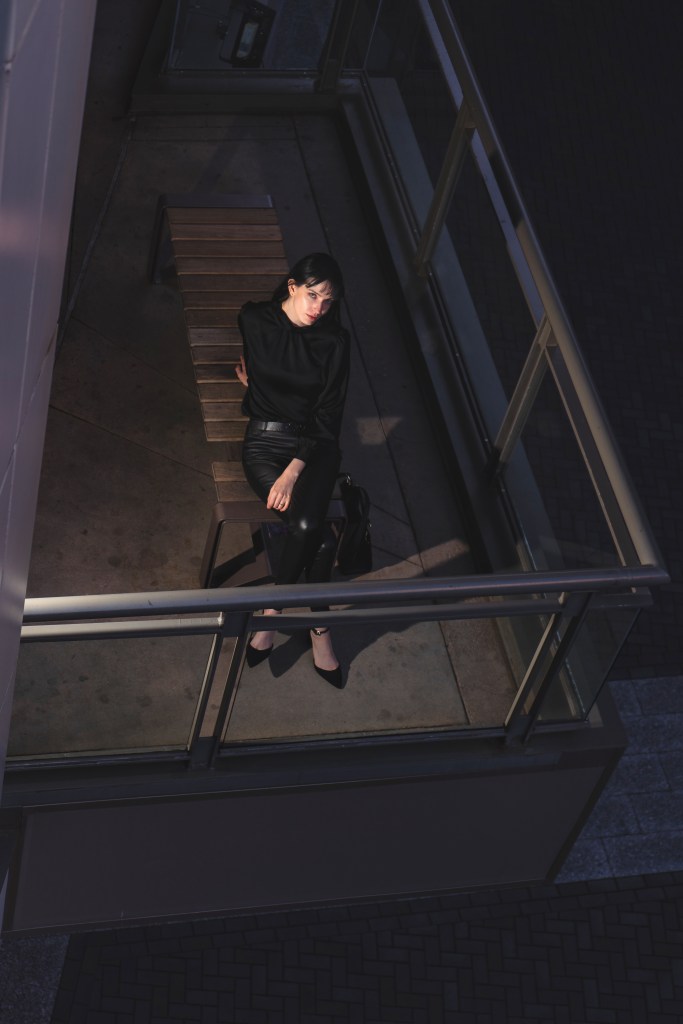
Woman dressed in black sits on a bench on an elevated walkway, viewed from above in an urban setting.
LilithW sits on a balcony along the 16th Street Mall in Denver, Colorado.

The photographer transforms an urban stairwell into a study of geometry, shadow, and contemporary fashion portraiture in this striking image from Denver’s 16th Street Mall. Shot with model LilithW, the photograph demonstrates a sophisticated understanding of architectural space as portraiture framework—a conceptual approach that positions this work as a significant entry within Chapter 4 of his Top 100 Journey project.

The compositional strategy reveals deliberate technical choices. Photographed from below, looking upward through the stairwell’s descending levels, the image creates a vertiginous sense of depth through repeating geometric forms. The metal railings create strong diagonal and horizontal lines that frame the subject, while the stairway’s perspective draws the eye upward toward LilithW’s figure. This bird’s-eye vantage point—or rather, its inverse—transforms a functional architectural space into a dramatic stage, demonstrating how environmental awareness can elevate location portraiture beyond mere documentation.

The lighting execution shows particular sophistication given the equipment employed. Using a single Godox AD100 flash without modifiers, the photographer has created directional illumination that separates the subject from the ambient darkness of the stairwell. The unmodified flash produces harder shadows and more dramatic contrast than diffused light would offer, a choice that complements the industrial setting’s angular architecture. This approach to lighting reveals growing confidence in working with minimal gear to maximum effect—a hallmark of photographers who understand that vision matters more than equipment inventory.

LilithW’s styling—black turtleneck, leather pants, and ankle boots—creates a monochromatic palette that harmonizes with the urban environment while maintaining visual distinction through texture and form. Her pose, caught mid-descent with hand resting on the railing, suggests movement arrested rather than static positioning. The downward gaze and slight forward lean create psychological engagement, as though the subject exists within her own narrative rather than performing for the camera.

Within the context of Chapter 4’s focus on studio, outdoor, and workshop portraiture, this image exemplifies the photographer’s ability to treat urban environments as found studios. The controlled lighting approach mirrors studio methodology, while the architectural setting provides the visual complexity and authentic texture that outdoor locations offer. The technical specifications—Sony A7II with the 28-70mm kit lens—underscore an important curatorial observation: this body of work privileges compositional intelligence and lighting understanding over equipment prestige.

The post-processing workflow, combining Adobe Photoshop Elements and Luminar AI, has enhanced the image’s moody atmosphere without sacrificing naturalism. The color grading emphasizes cool tones that reinforce the urban setting’s industrial character, while careful shadow detail preservation maintains dimensionality throughout the frame’s darker regions.

From a curatorial perspective, this photograph represents the photographer’s evolving facility with architectural portraiture—a subgenre that requires simultaneous attention to human subject, spatial geometry, and lighting choreography. The work’s inclusion in the Top 100 Journey project acknowledges its success in synthesizing these elements into a cohesive visual statement. The stairwell becomes more than backdrop; it functions as collaborator in creating psychological depth and visual drama. This image demonstrates how thoughtful photographers can transform everyday urban infrastructure into compelling portrait environments, finding beauty and narrative possibility in overlooked transitional spaces.