Entanglement: Portrait as Performance at the Haunt Slam

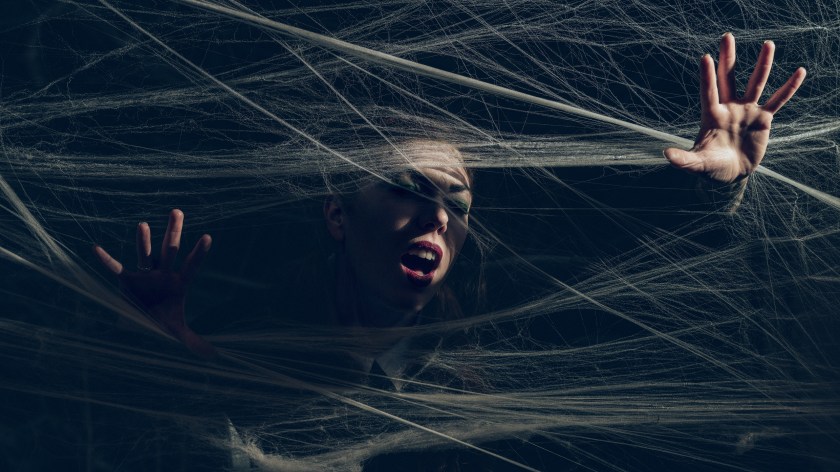
During the 2025 Portrait Slam in Denver, a striking portrait of a model named Wednesday showcases the photographer’s evolution into theatrical portraiture. The image, emphasizing themes of entrapment and performance, uses sophisticated artificial lighting to create dramatic effects. It reflects a shift towards collaborative photography, merging documentation with creative expression.

Portrait of a person pressing their hands forward through layers of stretched web-like material, with dramatic low-key lighting against a dark background.
Wednesday photographed during the 2025 Portrait Slam (Haunt Slam) at the DCO space in Denver, Colorado.

This striking portrait, captured during the 2025 Portrait Slam at Denver’s DCO space, represents a significant departure into theatrical portraiture for a photographer whose journey has increasingly embraced collaborative, event-based work. The image—featuring a model known as Wednesday—transcends conventional portraiture to become a study in entrapment, theatrical expression, and the controlled chaos of performance photography.

The composition immediately arrests the viewer with its central tension: a figure ensnared in what appears to be synthetic webbing, hands pressed outward in a gesture simultaneously defensive and reaching. The model’s expression—mouth open in what could be read as exhilaration, distress, or performative intensity—refuses easy interpretation. This ambiguity serves the work well, inviting prolonged examination rather than immediate comprehension.

Technically, the photograph demonstrates sophisticated command of artificial lighting in challenging circumstances. Shot with a Nikon Z7ii and illuminated by a Godox AD100 with grid, the lighting scheme creates dramatic chiaroscuro that sculpts the figure from the deep, nearly black background. The gridded modifier produces focused illumination that highlights the face and hands while allowing the surrounding webbing to catch light selectively, creating a three-dimensional mesh that appears to hover in space. This precision lighting transforms what could be simple event documentation into controlled studio-quality portraiture executed in a dynamic environment.

The web itself functions as both literal and metaphorical element. Its physical presence creates visual texture and geometric complexity, the crossing strands forming a secondary compositional structure that both fragments and frames the subject. Metaphorically, it invites reading as constraint, connection, or cocoon—interpretations that align with the “Haunt Slam” context while transcending mere Halloween theatrics to suggest broader themes of entanglement with technology, society, or creative process itself.

Within Chapter 6—”The Road Ahead: Recent Work & Ongoing Exploration”—this photograph signals the photographer’s continued engagement with collaborative, community-centered photography. The Portrait Slam format, hosted by Denver Models and Mike’s Camera, represents a democratization of studio portraiture, bringing together photographers, models, and creative collaborators in rapid-fire shooting sessions. That he selected this image for his Top 100 Journey suggests recognition that contemporary photographic practice increasingly exists within networks of creative exchange rather than isolated studio work.

The post-processing in Evoto maintains dramatic impact while preserving textural detail in both skin tones and the surrounding webbing. The color palette—dominated by deep teals and shadows punctuated by warm skin tones and crimson lips—creates visual coherence without sacrificing the image’s raw energy. The photographer resists over-polishing, allowing slight imperfections and authentic texture to ground the theatrical presentation in physical reality.

This work demonstrates evolution from earlier documentary and landscape work toward portraiture that embraces performance, collaboration, and conceptual staging. Yet it retains the technical rigor and compositional awareness evident throughout the Top 100 Journey. As the photographer continues exploring “the road ahead,” this image suggests that path leads toward increasingly theatrical, collaborative work that blurs boundaries between documentation and creation, between capturing moments and constructing them.

Deadpool Lucha Libre: Chromatic Drama in Miniature

The photograph of a Marvel Lucha Libre Funko Pop Deadpool figure exemplifies a blend of commercial and fine art photography. Utilizing dramatic lighting and technical precision, it transforms a mass-produced collectible into a subject of contemplation. The piece reflects the cultural hybridity of its character, bridging traditional still life with contemporary themes.

Studio photograph of a Marvel Lucha Libre Deadpool Funko Pop figure standing on a reflective black surface against a dark background.
A studio still life of a Marvel Lucha Libre Funko Pop Deadpool figure posed on black acrylic.

Within Chapter 5’s exploration of tabletop still life—from classical arrangements to experimental departures—this photograph of the Marvel Lucha Libre Funko Pop! figure demonstrates the photographer’s command of dramatic lighting and his willingness to elevate commercial objects into subjects worthy of sustained contemplation. The piece functions as both technical exercise and cultural commentary, bridging the gap between traditional product photography and fine art still life.

The composition centers on El Chimichanga De La Muerte, the Deadpool variant rendered in the distinctive aesthetic of Mexican lucha libre wrestling. Against an uncompromising black void, the figure emerges through carefully controlled illumination that recalls the chiaroscuro techniques of Dutch Golden Age painting. The photographer has employed a Godox AD100 with gridded softbox to create a focused pool of light that caresses the figure’s surfaces while allowing the background to recede entirely. This technical choice—stark, theatrical, unforgiving—transforms what might have been simple documentation into something approaching portraiture.

The red and gold color palette dominates with painterly intensity. The matte finish of the vinyl catches light selectively, creating subtle gradations across the mask’s sculptural forms. Each stitch line in the figure’s costume becomes a shadow-casting element, adding textural complexity to what is, in reality, molded plastic. The photographer’s choice of the Tamron 35mm f/2.8 lens on his Sony A7II suggests a deliberate approach to depth and perspective—close enough to capture minute details, yet distant enough to maintain the figure’s proportional integrity and comic heroism.

What elevates this work within the chapter’s trajectory is its dialogue between high and low culture. Funko Pop! figures exist as mass-produced collectibles, yet the photographer treats this specimen with the reverence typically reserved for precious antiquities or fine crafts. The shirtless, muscular torso—absurdly rendered in the Funko aesthetic with its characteristic oversized head and simplified body—becomes an exercise in form and volume under his lighting scheme. The reflection on the glossy black surface beneath adds a layer of sophistication, grounding the floating figure in space while doubling its visual presence.

The image represents a contemporary evolution in still life photography where the distinction between commercial and fine art intentionally blurs. By applying gallery-level lighting techniques to a pop culture artifact, the photographer participates in a broader artistic conversation about value, nostalgia, and the objects we choose to collect and immortalize. The lucha libre variant itself carries layers of cultural hybridity—an American comic character filtered through Mexican wrestling tradition, then reimagined as a Japanese-influenced vinyl toy.

The technical execution is nearly flawless. Exposure is carefully balanced to preserve detail in both the deepest reds and the highlighted edges of the mask. The black background shows no distracting gradients or light spill, evidence of precise modifier control and post-processing restraint. This discipline allows the figure to exist in a realm of pure focus, removed from context yet somehow more present because of that isolation.

Within the broader context of Chapter 5’s examination of still life evolution, this photograph demonstrates how experimental approaches need not abandon classical principles. The work honors centuries of still life tradition while embracing decidedly modern subject matter, creating a bridge between photographic eras.