Entanglement: Portrait as Performance at the Haunt Slam

During the 2025 Portrait Slam in Denver, a striking portrait of a model named Wednesday showcases the photographer’s evolution into theatrical portraiture. The image, emphasizing themes of entrapment and performance, uses sophisticated artificial lighting to create dramatic effects. It reflects a shift towards collaborative photography, merging documentation with creative expression.

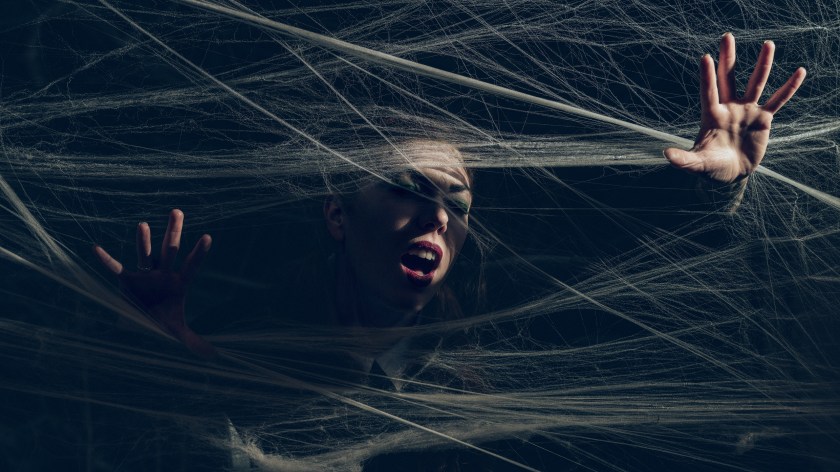
Portrait of a person pressing their hands forward through layers of stretched web-like material, with dramatic low-key lighting against a dark background.
Wednesday photographed during the 2025 Portrait Slam (Haunt Slam) at the DCO space in Denver, Colorado.

This striking portrait, captured during the 2025 Portrait Slam at Denver’s DCO space, represents a significant departure into theatrical portraiture for a photographer whose journey has increasingly embraced collaborative, event-based work. The image—featuring a model known as Wednesday—transcends conventional portraiture to become a study in entrapment, theatrical expression, and the controlled chaos of performance photography.

The composition immediately arrests the viewer with its central tension: a figure ensnared in what appears to be synthetic webbing, hands pressed outward in a gesture simultaneously defensive and reaching. The model’s expression—mouth open in what could be read as exhilaration, distress, or performative intensity—refuses easy interpretation. This ambiguity serves the work well, inviting prolonged examination rather than immediate comprehension.

Technically, the photograph demonstrates sophisticated command of artificial lighting in challenging circumstances. Shot with a Nikon Z7ii and illuminated by a Godox AD100 with grid, the lighting scheme creates dramatic chiaroscuro that sculpts the figure from the deep, nearly black background. The gridded modifier produces focused illumination that highlights the face and hands while allowing the surrounding webbing to catch light selectively, creating a three-dimensional mesh that appears to hover in space. This precision lighting transforms what could be simple event documentation into controlled studio-quality portraiture executed in a dynamic environment.

The web itself functions as both literal and metaphorical element. Its physical presence creates visual texture and geometric complexity, the crossing strands forming a secondary compositional structure that both fragments and frames the subject. Metaphorically, it invites reading as constraint, connection, or cocoon—interpretations that align with the “Haunt Slam” context while transcending mere Halloween theatrics to suggest broader themes of entanglement with technology, society, or creative process itself.

Within Chapter 6—”The Road Ahead: Recent Work & Ongoing Exploration”—this photograph signals the photographer’s continued engagement with collaborative, community-centered photography. The Portrait Slam format, hosted by Denver Models and Mike’s Camera, represents a democratization of studio portraiture, bringing together photographers, models, and creative collaborators in rapid-fire shooting sessions. That he selected this image for his Top 100 Journey suggests recognition that contemporary photographic practice increasingly exists within networks of creative exchange rather than isolated studio work.

The post-processing in Evoto maintains dramatic impact while preserving textural detail in both skin tones and the surrounding webbing. The color palette—dominated by deep teals and shadows punctuated by warm skin tones and crimson lips—creates visual coherence without sacrificing the image’s raw energy. The photographer resists over-polishing, allowing slight imperfections and authentic texture to ground the theatrical presentation in physical reality.

This work demonstrates evolution from earlier documentary and landscape work toward portraiture that embraces performance, collaboration, and conceptual staging. Yet it retains the technical rigor and compositional awareness evident throughout the Top 100 Journey. As the photographer continues exploring “the road ahead,” this image suggests that path leads toward increasingly theatrical, collaborative work that blurs boundaries between documentation and creation, between capturing moments and constructing them.
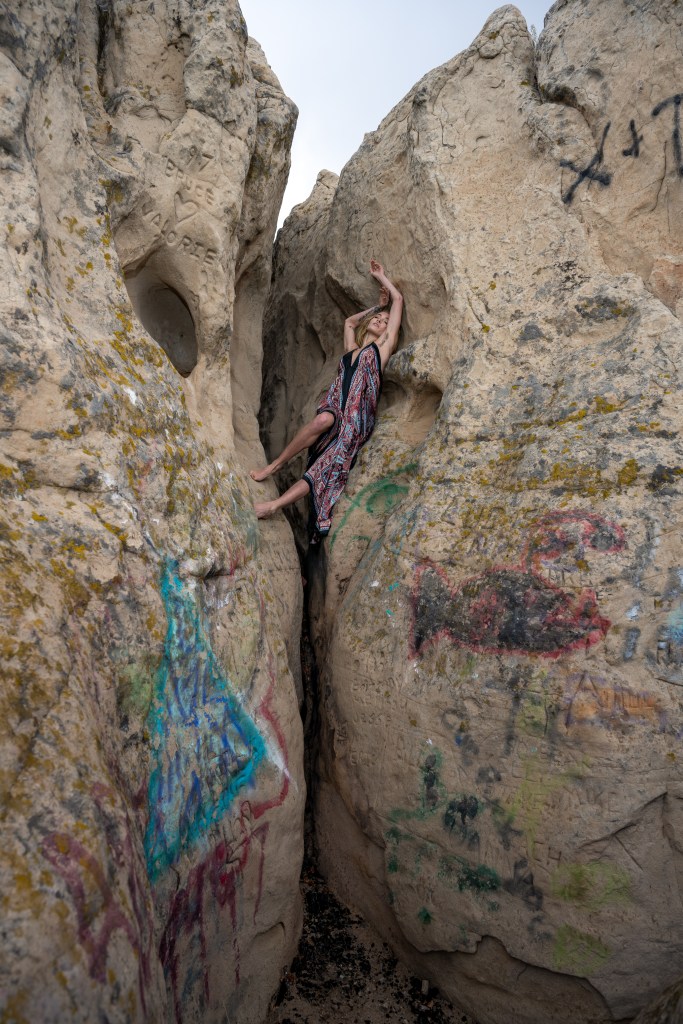
Suspended Between Earth and Sky: A Study in Geometric Embrace

The photograph of Jennie Parks in a sandstone crevice at the Colorado-Wyoming border conveys a powerful interplay between human form and rugged landscape. The composition showcases Parks as both an integral part of the environment and a symbol of human vulnerability, enriched by graffiti that connects ancient rock with contemporary existence.

Model Jennie Parks posed barefoot within a narrow sandstone rock crevice, surrounded by weathered stone walls with graffiti and lichen.
Jennie Parks positioned inside a sandstone crevice at the Natural Fort rock formation on the Colorado–Wyoming border.

In this striking composition from Chapter 6 of the photographer’s Top 100 Journey, the human figure becomes a graceful counterpoint to the harsh geometry of desert stone. Shot at the natural fort rock formation straddling the Colorado-Wyoming border, the image captures model Jennie Parks wedged within a narrow crevasse, her body forming a living bridge between two massive limestone walls that tower overhead.

The photographer demonstrates a sophisticated understanding of environmental portraiture here, positioning his subject not merely within the landscape but as an integral element of its architecture. Parks’s extended pose—one arm reaching upward, legs braced against opposing walls—transforms the human form into a line of tension that mirrors the vertical thrust of the surrounding stone. The patterned fabric of her dress introduces rhythmic visual complexity against the textured, graffiti-marked surfaces of the rock, creating a dialogue between organic movement and geological permanence.

Technically, the composition exploits the natural framing device of the rock formation with considerable skill. The converging walls create strong diagonal lines that draw the eye upward toward the narrow strip of overcast sky, while the low vantage point emphasizes the vertiginous scale of the formation. The photographer has worked with available light to maintain detail in both the shadowed crevasse and the brighter upper reaches, a challenging exposure balance that preserves the dimensional quality of the weathered stone surfaces.

What distinguishes this work within the context of “The Road Ahead: Recent Work & Ongoing Exploration” is its synthesis of earlier themes with new formal rigor. The image continues the photographer’s established interest in the relationship between human vulnerability and natural grandeur, yet demonstrates an evolving sophistication in how that relationship is articulated. Rather than placing the figure as a small element overwhelmed by landscape—a common approach in environmental portraiture—he positions Parks as an active participant in the space’s geometry, neither dominated by nor dominating the scene.

The inclusion of graffiti on the rock faces introduces an unexpected documentary element. These colorful marks of human passage—blue and turquoise abstractions, faded pink tags—situate the timeless geological formation within contemporary reality. Rather than diminishing the image’s aesthetic power, this urban palimpsest enriches the reading: the rock has witnessed countless human gestures, from ancient weathering to modern spray paint to this moment of choreographed grace.

As representative of ongoing exploration, the photograph reveals an artist continuing to refine his visual vocabulary while remaining open to chance encounters and improvisation. The natural fort formation itself suggests the kind of site-responsive work that characterizes mature landscape photography—locations discovered rather than constructed, where the photographer’s role becomes one of recognition and revelation rather than wholesale invention.

In the broader trajectory of the Top 100 Journey, this image marks a moment of confident synthesis. The technical command is assured, the conceptual framework clear, yet there remains an element of spontaneity in how Parks inhabits the narrow space. It is work that looks both backward to established concerns and forward to possibilities yet unrealized—precisely the balance one expects from a chapter titled “The Road Ahead.”

Downtown Denver Dance in the Streets with Nina Harrington

Nina Harrington’s dance pose in downtown Denver exemplifies a sophisticated blend of environmental portraiture and spontaneous movement. The photographer skillfully uses off-camera flash and a low angle to enhance the scene, revealing dynamic interplay between light, architecture, and the dancer’s grace. This image highlights the artist’s technical evolution in outdoor portrait work.

Dancer balancing on one foot along a yellow centerline in a city street, arms extended, with buildings lining both sides.
Nina Harrington performs a dance pose in the middle of a downtown Denver street.

In this striking urban portrait, the photographer demonstrates a sophisticated command of environmental portraiture, transforming a mundane city thoroughfare into a stage for dynamic human expression. The image captures dancer Nina Harrington suspended mid-leap above yellow road markings in downtown Denver, her body forming an elegant arc against the crisp Colorado sky. The composition exemplifies the photographer’s evolving approach to outdoor portrait work, where controlled lighting meets spontaneous movement in public spaces.

The technical execution reveals deliberate choices that elevate this beyond documentary street photography. Shot at midday—traditionally challenging lighting conditions—the photographer employed a Godox AD100 pro strobe without modification to combat the harsh overhead sun. This off-camera flash technique creates a subtle but crucial fill that prevents the subject from becoming a silhouette while maintaining the natural warmth of the ambient light. The decision to forgo light modifiers preserves the hard-edged quality of the urban environment, allowing the concrete, asphalt, and brick architecture to retain their textural integrity.

Compositionally, the low vantage point proves essential to the image’s impact. By positioning the camera near street level, the photographer achieves multiple objectives: the dancer’s figure dominates the frame against the sky, creating separation from the complex urban backdrop; the road’s yellow double lines converge dramatically toward the vanishing point, providing powerful leading lines that anchor the viewer’s eye; and the surrounding buildings—including the distinctive Paramount sign—frame the action without overwhelming it. This perspective transforms the ordinary into the theatrical.

The choice of the Nikkor 24-120mm f/4 lens suggests a working distance that allowed the subject freedom of movement while maintaining compositional control. The focal length appears moderate within that range, neither compressing the perspective dramatically nor exaggerating the spatial relationships. This middle-ground approach serves the narrative well, presenting the scene as the viewer might experience it while standing in that same intersection.

Within Chapter 4’s exploration of portraits created in studios, outdoor environments, and workshop settings, this photograph represents the photographer’s confidence in synthesizing multiple disciplines. The image incorporates studio lighting principles applied to an uncontrolled environment, the collaborative relationship between photographer and subject typical of workshop environments, and the opportunistic awareness required for successful street photography. The dancer’s athletic grace becomes a vehicle for exploring light, geometry, and decisive moment—themes that recur throughout his portraiture work.

The post-processing in Luminar AI enhances rather than transforms the captured scene. The color palette—dominated by blues, warm earth tones, and the vibrant yellow road markings—feels authentic to the high-altitude western light. There’s a clarity and dimensional quality to the image that suggests thoughtful tonal adjustments without the oversaturation or artificial drama that often plague urban photography.

What distinguishes this work within the photographer’s broader journey is the seamless integration of technical skill and artistic vision. The image requires split-second timing, precise exposure calculation, spatial awareness, and the ability to direct movement—all while working in a public street with its inherent unpredictability. That such complexity appears effortless in the final result speaks to the photographer’s maturation in outdoor portrait work, where preparation meets spontaneity in equal measure.

LilithW 16th Street Mall Denver

The photograph featuring model LilithW on Denver’s 16th Street Mall showcases an innovative blend of urban architecture and contemporary fashion. Through careful lighting, geometric framing, and thoughtful styling, the image transforms a functional stairwell into a dramatic portrait setting, emphasizing the photographer’s skill in capturing emotional depth within architectural spaces.

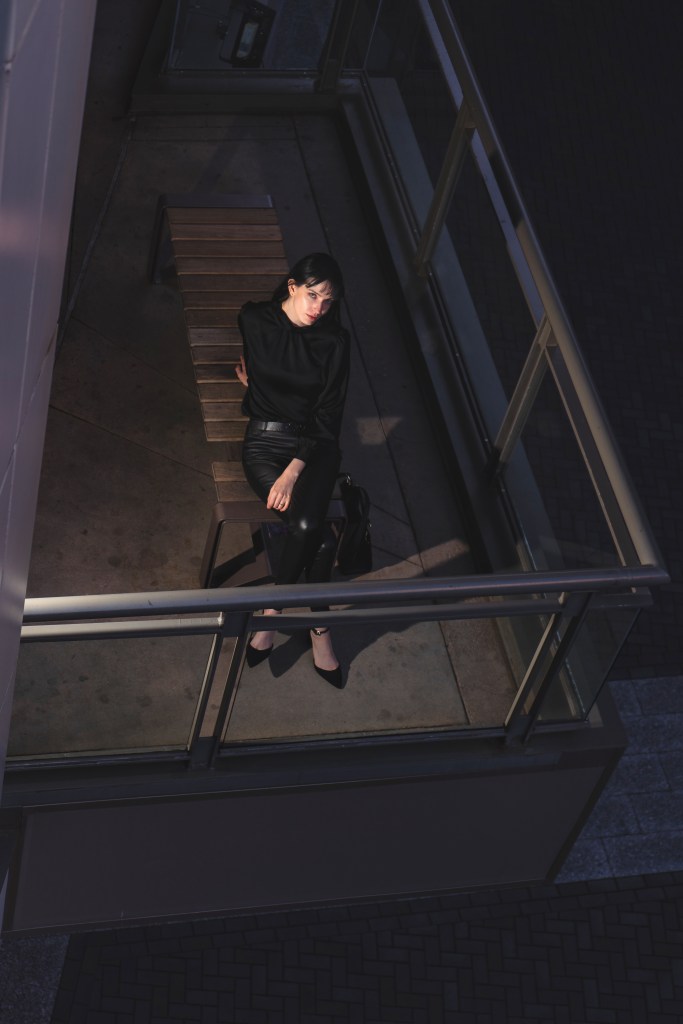
Woman dressed in black sits on a bench on an elevated walkway, viewed from above in an urban setting.
LilithW sits on a balcony along the 16th Street Mall in Denver, Colorado.

The photographer transforms an urban stairwell into a study of geometry, shadow, and contemporary fashion portraiture in this striking image from Denver’s 16th Street Mall. Shot with model LilithW, the photograph demonstrates a sophisticated understanding of architectural space as portraiture framework—a conceptual approach that positions this work as a significant entry within Chapter 4 of his Top 100 Journey project.

The compositional strategy reveals deliberate technical choices. Photographed from below, looking upward through the stairwell’s descending levels, the image creates a vertiginous sense of depth through repeating geometric forms. The metal railings create strong diagonal and horizontal lines that frame the subject, while the stairway’s perspective draws the eye upward toward LilithW’s figure. This bird’s-eye vantage point—or rather, its inverse—transforms a functional architectural space into a dramatic stage, demonstrating how environmental awareness can elevate location portraiture beyond mere documentation.

The lighting execution shows particular sophistication given the equipment employed. Using a single Godox AD100 flash without modifiers, the photographer has created directional illumination that separates the subject from the ambient darkness of the stairwell. The unmodified flash produces harder shadows and more dramatic contrast than diffused light would offer, a choice that complements the industrial setting’s angular architecture. This approach to lighting reveals growing confidence in working with minimal gear to maximum effect—a hallmark of photographers who understand that vision matters more than equipment inventory.

LilithW’s styling—black turtleneck, leather pants, and ankle boots—creates a monochromatic palette that harmonizes with the urban environment while maintaining visual distinction through texture and form. Her pose, caught mid-descent with hand resting on the railing, suggests movement arrested rather than static positioning. The downward gaze and slight forward lean create psychological engagement, as though the subject exists within her own narrative rather than performing for the camera.

Within the context of Chapter 4’s focus on studio, outdoor, and workshop portraiture, this image exemplifies the photographer’s ability to treat urban environments as found studios. The controlled lighting approach mirrors studio methodology, while the architectural setting provides the visual complexity and authentic texture that outdoor locations offer. The technical specifications—Sony A7II with the 28-70mm kit lens—underscore an important curatorial observation: this body of work privileges compositional intelligence and lighting understanding over equipment prestige.

The post-processing workflow, combining Adobe Photoshop Elements and Luminar AI, has enhanced the image’s moody atmosphere without sacrificing naturalism. The color grading emphasizes cool tones that reinforce the urban setting’s industrial character, while careful shadow detail preservation maintains dimensionality throughout the frame’s darker regions.

From a curatorial perspective, this photograph represents the photographer’s evolving facility with architectural portraiture—a subgenre that requires simultaneous attention to human subject, spatial geometry, and lighting choreography. The work’s inclusion in the Top 100 Journey project acknowledges its success in synthesizing these elements into a cohesive visual statement. The stairwell becomes more than backdrop; it functions as collaborator in creating psychological depth and visual drama. This image demonstrates how thoughtful photographers can transform everyday urban infrastructure into compelling portrait environments, finding beauty and narrative possibility in overlooked transitional spaces.

Portrait Slam 2024

Portrait Slam 2024 features Frank Graziano posed on a vintage railroad car, showcasing a blend of environmental portraiture and technical skill. The composition balances subject and setting, using light and shadow effectively. This portrait reflects the photographer’s evolution, integrating contemporary styling with Americana themes, and highlights a confident approach to on-location shooting.

Man wearing a hat stands on the side steps of a black railroad car, looking to the side.
Frank Graziano poses on a railroad car at the Colorado Railroad Museum in Golden, Colorado.

The photographer captures Frank Graziano in a moment of studied nonchalance, balanced on the step of a vintage railroad car against the industrial textures of riveted steel and weathered paint. This image, created during Portrait Slam 2024 at the Colorado Railroad Museum, exemplifies the photographer’s growing confidence in environmental portraiture—a technical and conceptual evolution clearly marked within Chapter 4 of his Top 100 Journey project.

What immediately distinguishes this portrait is its sophisticated balance between subject and setting. The railroad car’s dark, rivet-studded surface creates a powerful geometric frame, yet never overwhelms Graziano’s presence. The model’s positioning—one foot planted on the step, the other casually lifted, holding a vertical rail—demonstrates a dynamic use of diagonal lines that pulls the viewer’s eye through the composition. His cowboy hat and leather jacket evoke classic Americana, while the contemporary styling prevents the image from slipping into pastiche or nostalgia.

The photographer’s technical execution reveals careful consideration of light and shadow. The overcast sky provides even, diffused illumination that preserves detail across both the subject’s face and the textured metal surface behind him. This soft light wraps around Graziano’s features, creating subtle modeling without harsh shadows—a particularly important choice given the industrial setting’s potential to create competing visual elements. The muted color palette of charcoal grays, weathered browns, and faded blacks creates tonal harmony while allowing the warm leather tones of the hat to serve as a visual anchor.

Within the context of Chapter 4—Portraits Studio, Outdoor & Workshop Work—this image demonstrates the photographer’s ability to synthesize controlled studio techniques with the spontaneity of location work. Workshop environments often push photographers beyond their comfort zones, and this portrait suggests someone working confidently with both the challenges and opportunities of on-location shooting. The inclusion of the “KEEP OFF” text, partially visible in the frame, adds an element of subtle irony: the subject occupies precisely the forbidden space, transforming restriction into creative possibility.

The railroad setting serves as more than mere backdrop. It functions as visual metaphor—the convergence of journey, transit, and transitional spaces that resonates with the photographer’s larger Top 100 Journey project. The industrial heritage embedded in the railroad car’s weathered surface speaks to American mythology and masculine archetypes, themes Graziano’s styling deliberately engages while maintaining contemporary relevance.

From a curatorial perspective, this photograph marks a maturation in the photographer’s approach to environmental portraiture. Earlier works in his portfolio occasionally struggled with the balance between subject and location; here, both elements coexist in productive tension. The composition’s structured geometry—the vertical rails, horizontal platform, the rectangular frames within frames—creates order without rigidity, allowing Graziano’s natural pose to feel both choreographed and spontaneous.

The image’s inclusion in the Top 100 Journey project reflects its successful synthesis of technical skill, conceptual clarity, and visual impact. It demonstrates how workshop environments can push photographers toward their strongest work, combining the pressure of limited time with the inspiration of new locations and collaborative energy. The result is a portrait that honors both its subject and its setting, creating a narrative that extends beyond the single frozen moment into broader considerations of place, identity, and American visual mythology.

Architectural Authority: The Denver Public Library

The photograph of the Denver Public Library showcases the interplay of monumental architecture and urban landscape. The black and white imagery emphasizes geometric shapes and textures, transforming harsh midday light into stark contrasts. This representation transcends mere documentation, reflecting civic aspiration and how societies express values through built form within the Colorado context.

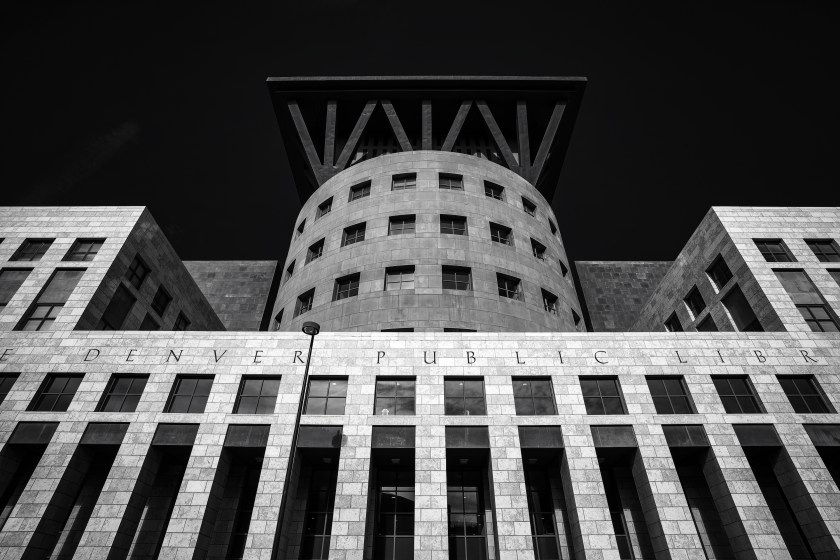
Black and white view of the Denver Public Library exterior, showing a cylindrical central structure framed by angular stone façades.
The exterior of the Denver Public Library is shown in black and white in downtown Denver, Colorado.

In this commanding study of civic architecture, the photographer demonstrates a sophisticated understanding of how monumental structures assert themselves within the urban landscape. Shot at midday when harsh overhead light typically challenges photographers, he transforms potentially difficult conditions into an asset, using deep contrast to emphasize the building’s geometric severity and sculptural mass.

The composition centers on the Denver Public Library’s distinctive cylindrical tower, which rises from the frame like a monolithic drum. The extreme upward angle, facilitated by his Samyang 18mm wide-angle lens, creates a dramatic sense of monumentality while the symmetrical flanking wings establish visual order. This architectural framework—circular form nested within angular geometry—speaks to postmodern design principles that dominated American civic architecture in the late twentieth century. The photographer’s decision to shoot in black and white strips away temporal markers and weather conditions, rendering the structure as a timeless study in form, shadow, and material.

What distinguishes this image within Chapter 3’s exploration of Colorado landscapes and cityscapes is its departure from natural grandeur toward human-made authority. Where mountain vistas offer sublime, untamed power, this photograph presents institutional permanence. The stone cladding, methodically rendered in graduated tones from light gray to near-black, becomes a study in texture and depth. The dramatic diagonal supports visible at the structure’s crown introduce dynamic tension, their angular thrust contrasting sharply with the tower’s curved facade.

The technical execution reveals maturity in the photographer’s approach to architectural documentation. Shot with the Sony A7ii, the image maintains clarity across multiple planes of depth despite the wide-angle distortion inherent to the 18mm focal length. The midday timing, often avoided by landscape photographers, proves deliberate here—the high sun creates stark shadows that carve out the building’s volumes and reveal the recessed windows as dark voids. This interplay between solid and void, light and shadow, transforms descriptive documentation into interpretive art.

The street lamp appearing at center-bottom provides crucial human scale, a reminder that this imposing structure exists within the pedestrian realm. Its modest presence underscores the building’s overwhelming verticality and mass. The text carved into the facade—”DENVER PUBLIC LIBR”—becomes both identifier and compositional element, the letterforms creating horizontal rhythm that grounds the tower’s upward thrust.

Within the photographer’s Top 100 Journey project, this image represents an important evolution. Chapter 3’s focus on Colorado landscapes and cityscapes broadens beyond wilderness to encompass how humans shape their environment. The library, as a democratic institution dedicated to public knowledge, carries symbolic weight that elevates the photograph beyond mere architectural record. It becomes a meditation on civic aspiration, on how societies express values through built form.

The conversion to monochrome proves essential to the image’s impact. Color would introduce distraction—blue sky, stone variations, surrounding urban context. Instead, the black and white treatment creates graphic clarity, emphasizing pattern, geometry, and tonal relationships. The nearly black sky becomes void, pushing the building forward as the sole subject demanding attention.

This photograph confirms the photographer’s ability to find compelling visual architecture within urban environments, applying the same compositional rigor and tonal sensitivity he brings to natural landscapes.

Denver Union Station Two Trains: Urban Infrastructure as Visual Poetry

The photograph of Denver Union Station marks a shift in the photographer’s journey from natural landscapes to urban architecture. It highlights the interplay of light, color, and geometry while capturing quiet moments in public spaces. The image symbolizes Denver’s evolution in sustainable transit, merging historical preservation with contemporary design.

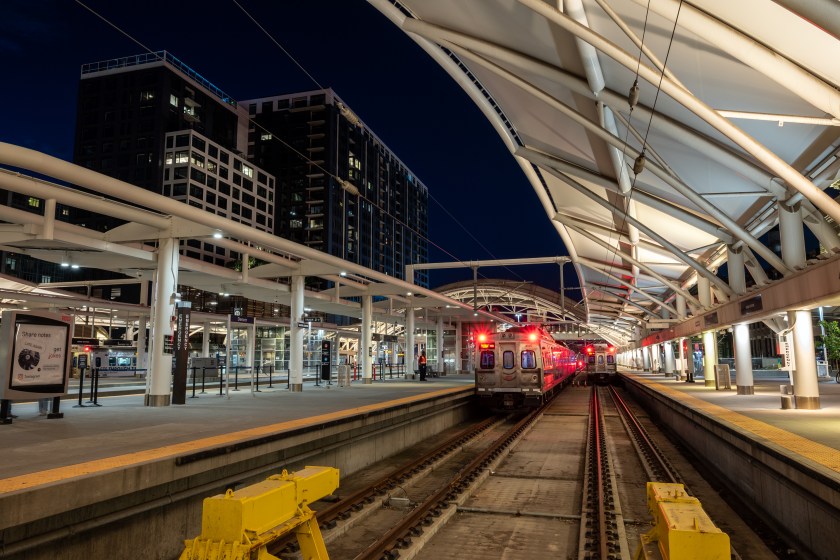
Two light rail trains sit on parallel tracks beneath the covered platforms at Denver Union Station at night.
Two RTD light rail trains are stopped on adjacent tracks at Denver Union Station in downtown Denver, Colorado.

This nocturnal study of Denver Union Station represents a compelling pivot within Chapter 3 of the photographer’s Top 100 Journey project—a shift from natural landscapes to the constructed geometries of urban infrastructure. Where previous works in this chapter have explored Colorado’s geological grandeur, this image examines the state’s architectural identity through one of its most significant transit hubs.

The composition is defined by bold linear perspective. Shot with a 14-30mm wide-angle lens, the photographer has positioned himself within the transit platform itself, allowing the parallel tracks to create strong diagonal lines that converge toward the vanishing point. This classical use of perspective transforms functional railway infrastructure into formal geometric study. The canopy overhead—a sweeping white lattice of structural supports—echoes and reinforces these diagonals, creating a rhythmic repetition that draws the eye inexorably toward the illuminated train in the distance.

Color plays a crucial role in establishing atmosphere. The deep navy blue of twilight sky provides saturated contrast against the warm artificial lighting of the station. The train’s red running lights introduce an accent of vivid color that punctuates the otherwise neutral palette of whites, grays, and concrete tones. A yellow maintenance box in the lower foreground adds an unexpected chromatic note—industrial, utilitarian, yet compositionally important as a counterweight to the red lights above.

The technical execution demonstrates careful consideration of low-light conditions. The exposure balances multiple light sources: the cool fluorescent platform lighting, the warm glow from the station building visible on the left, and the colored signals of the train itself. The photographer has managed to maintain detail throughout the frame—from the textured concrete of the platform to the lit windows of the distant residential tower—suggesting precise metering and likely the use of a tripod for stability during what was presumably a longer exposure.

What distinguishes this work is its treatment of public space during a quiet moment. The platform is nearly empty; a single figure appears as a small presence near the center, emphasizing scale and the architectural vastness of the station. This human element, though minimal, is essential—it prevents the image from becoming purely abstract geometry and reminds viewers that this is infrastructure designed for movement, for connection, for the daily transit of thousands.

Within the context of Colorado Cityscapes, this photograph documents Denver’s ongoing evolution as a metropolitan center investing in sustainable transit infrastructure. Union Station, a historic landmark renovated in recent years, represents the intersection of preservation and progress. The photographer captures this duality: the contemporary design of the platform canopy suggests forward-looking urban planning, while the fundamental elements—trains, tracks, waiting passengers—evoke the timeless ritual of rail travel.

The use of the Nikon Z5 with ultra-wide glass allows the photographer to emphasize architectural span while maintaining sharpness across the frame. The wide angle compresses multiple planes of depth into a single coherent visual statement, creating an image that functions simultaneously as documentary record and formal composition.

This photograph confirms the photographer’s ability to find visual poetry in utilitarian spaces, demonstrating that the “cityscape” portion of Chapter 3 merits equal attention to Colorado’s celebrated natural landscapes.