Long Exposure Bay Pier

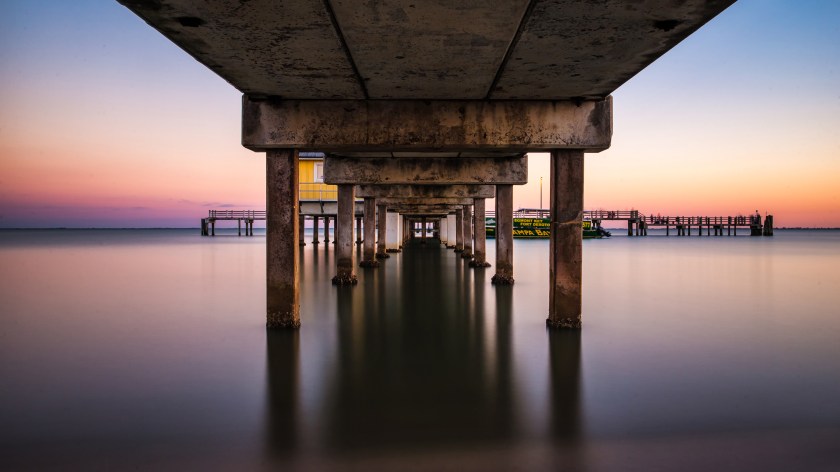
This long-exposure photograph from Fort De Soto Park captures the interplay between water and human infrastructure beneath the Bay Pier at sunset. The technical precision transforms the scene into a study of temporality, where smooth water contrasts with weathered concrete, exploring beauty in overlooked spaces. The image balances tranquility and depth, prompting contemplation.

Long exposure sunset photograph taken beneath the Bay Pier at Fort De Soto Park, showing symmetrical concrete pilings and smooth reflective water.
Long exposure sunset view beneath the Bay Pier at Fort De Soto Park.

The photographer’s technical mastery and compositional restraint converge in this striking long-exposure study from Fort De Soto Park. Captured beneath the Bay Pier at sunset, the image demonstrates a sophisticated understanding of how extended exposure transforms the ephemeral into the architectural, rendering water as smooth as polished stone and reducing the atmospheric gradient to its essential chromatic progression.

The 124-second exposure at f/16 achieves precisely what such technical specifications promise: a complete metamorphosis of the transient into the permanent. The water’s surface becomes a mirror of silk, its glassy uniformity disrupted only by the weathered pier columns that puncture the frame with rhythmic precision. These pylons, darkened by time and barnacled at their waterline, create a vanishing perspective that draws the eye inexorably toward the distant horizon where structure meets light. The photographer has positioned himself not merely under the pier but within its geometric logic, allowing the concrete deck above to function as both literal and compositional ceiling, establishing boundaries that paradoxically expand the viewer’s sense of spatial depth.

What distinguishes this work within the Florida Landscapes & Cityscapes chapter is its meditation on infrastructure as organic form. The pier’s weathered concrete surfaces—mottled with rust stains and biological growth—speak to the peninsula’s relentless humidity and salt air. Rather than presenting Florida’s more commonly depicted pristine beaches or crystalline waters, he has chosen to explore the liminal space where human construction gradually surrenders to natural forces. The corroded texture of the support beams and deck creates a counterpoint to the water’s supernatural smoothness, establishing a dialogue between industrial decay and elemental transformation.

The color palette rewards careful attention. The sky transitions from pale lavender at the zenith through bands of peach and amber toward the horizon, while the water adopts cooler tones of green and slate. This chromatic division creates temperature contrast that enhances the image’s sense of tranquility without veering into sentimentality. A yellow structure visible in the middle distance—likely a utility building or navigation marker—provides a necessary accent of saturated color, preventing the composition from becoming too subdued.

The technical execution reflects deliberate choices rather than automatic settings. The 31mm focal length on a full-frame sensor provides sufficient width to encompass the pier’s structural rhythm while maintaining proper perspective correction, avoiding the distortion that might occur at the wide end of his 18-35mm lens. The ISO 100 setting ensures maximum detail in the shadows where barnacles cling to concrete, while the extended shutter speed required neutral density filtration to prevent overexposure during the lingering twilight.

Within the photographer’s larger journey, this image represents a maturation of vision—a willingness to find beauty not in Florida’s celebrated natural wonders but in the overlooked spaces where infrastructure and environment intersect. The pier becomes a study in temporality: concrete designed to last decades, water that renews itself constantly, and light that exists only for minutes. By freezing this convergence through long exposure, he creates a document that feels both immediate and timeless, a quality that defines his most successful landscape work. The photograph succeeds because it refuses spectacle in favor of contemplation, inviting sustained viewing rather than demanding instant admiration.
Pilot Boat Pier

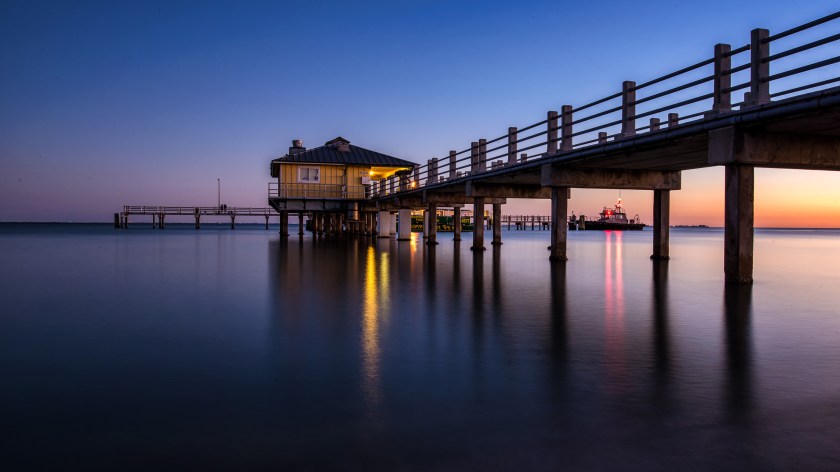
This photograph of Fort De Soto Park’s pilot boat pier captures the harmony between utilitarian structures and aesthetics. Utilizing a long exposure, the image highlights light, geometry, and the duality of human activity and nature. The pier becomes more than functional; it represents Florida’s coastal identity, deserving appreciation alongside natural landscapes.

Long exposure twilight photograph of the Bay Pier at Fort De Soto Park in Florida, with a yellow pilot‑boat building illuminated over calm water.
Long exposure twilight view of the pilot boat pier at Fort De Soto Park.

In this carefully orchestrated study of maritime infrastructure at Fort De Soto Park, the photographer demonstrates his capacity to locate poetry within utilitarian structures. The pilot boat pier—a working facility that guides commercial vessels through Tampa Bay’s shipping channels—becomes here a meditation on light, geometry, and the quiet professionalism of coastal operations. Shot during the blue hour with a twenty-five-second exposure at f/16 on a Nikon D610, the image transforms functional architecture into something approaching minimalist sculpture.

The compositional intelligence reveals itself in layers. The pier’s diagonal thrust from left to right creates dynamic movement across the frame, while the elevated structure’s horizontal rails establish rhythmic intervals that lead the eye toward the distant vessel. The photographer has positioned himself to capture the pilings in perfect vertical alignment, their reflections doubling into the glassy water below—a mirror effect achieved through the extended exposure that renders Tampa Bay into polished obsidian. At ISO 100, the twenty-five-millimeter focal length provides sufficient context to establish spatial relationships without sacrificing the intimate scale of the pier house itself.

Light operates as the image’s true subject. The warm interior glow from the pier house casts golden striations across the water, creating a luminous pathway that contrasts with the cool blue-violet gradient dominating the sky. The distant pilot boat, its navigation lights punctuating the horizon in red, provides a crucial narrative element—evidence of the pier’s ongoing purpose even as twilight suspends it in apparent timelessness. This balance between ambient and artificial light, between natural phenomena and human activity, positions the work firmly within the chapter’s exploration of Florida’s developed coastlines.

What distinguishes this image from the photographer’s other coastal studies is its emphasis on infrastructure as architecture. The pier is not merely a platform for viewing nature but an elegant construction worthy of attention in its own right. The horizontal rails, repeating with mechanical precision, create a visual counterpoint to the organic curves of the shoreline visible in the distance. The photographer acknowledges that Florida’s landscape is fundamentally collaborative—nature and human intervention existing in constant dialogue rather than opposition.

The technical execution merits particular attention. The f/16 aperture ensures depth of field sufficient to hold both foreground pilings and horizon vessel in acceptable focus, while the twenty-five-second exposure smooths the water into a reflective plane that doubles the compositional impact of every vertical element. The choice to shoot at this precise moment—when daylight has drained from the western sky but hasn’t yet surrendered to complete darkness—captures that transitional state where artificial lights begin to assert themselves without overwhelming the scene’s natural tonal range.

Within the broader context of the Florida Landscapes & Cityscapes chapter, this photograph represents the photographer’s mature understanding of the state’s coastal identity. Fort De Soto’s pilot boat pier is neither wilderness nor urban environment but something uniquely Floridian—a working maritime facility embedded within a state park, where commerce and recreation, industry and leisure, coexist without apparent conflict. By rendering it with such formal rigor and aesthetic consideration, the photographer argues for expanded recognition of these hybrid spaces as legitimate subjects for contemplation, deserving the same careful attention traditionally reserved for pristine natural vistas.

See this image on:

500px

Flickr

The Gulf Pier: A Foundation in Light and Structure

Greg Urbano’s “Landscapes in HDR” captures the Gulf Fishing Pier at Fort de Soto Park, reflecting his artistic development in photography. Utilizing a Nikon D7100, he balances composition with HDR techniques, achieving naturalistic vibrancy without over-processing. The image embodies a pivotal moment in skill mastery, exploring the connection between environment and human creation.

HDR landscape photograph of the Gulf Fishing Pier at Fort De Soto Park in Pinellas County, Florida, extending over calm water under a bright sky, taken with a Nikon D7100 at 14mm.
A 2013 HDR landscape photograph of the Gulf Fishing Pier at Fort De Soto Park in Pinellas County, Florida.

In the early stages of any photographer’s journey, there exists a pivotal moment when technical curiosity converges with artistic vision. Greg Urbano’s “Landscapes in HDR” from 2013 captures precisely this convergence—a photograph that speaks to the fundamentals of seeing while revealing the seeds of a maturing artistic voice.

The Gulf Fishing Pier at Fort de Soto Park presents itself as an exercise in classical composition, yet the image transcends mere documentation. Shot with a Nikon D7100 at 14mm, the photographer embraced the distortion inherent in ultra-wide-angle photography, using it not as a limitation but as a tool for emphasis. The pier’s concrete pathway stretches toward the horizon with geometric insistence, its weathered surface textured with salt stains and age—details that anchor the ethereal quality of the surrounding environment.

What distinguishes this work within the context of Chapter 1—Beginnings is the deliberate exploration of HDR processing, a technique that dominated landscape photography in the early 2010s. Rather than falling into the trap of over-processing that plagued much HDR work of this era, Urbano demonstrates restraint. The luminous gradations in the sky—from deep azure to wispy white—retain a naturalistic quality while revealing detail across an impressive tonal range. The turquoise waters of the Gulf of Mexico maintain their vibrancy without crossing into hypersaturation, suggesting an eye already sensitive to the boundaries between enhancement and artifice.

The technical choices reveal a photographer building his fundamental vocabulary. The aperture of ƒ/8.0 ensures critical sharpness from the foreground concrete to the distant structures, while the fast shutter speed of 1/400s freezes the subtle motion of the scene—likely the flutter of distant flags or the movement of the few figures visible along the pier. At ISO 100, the image maintains clarity in its textures, from the horizontal railings that create rhythmic lines to the architectural shelters that punctuate the composition’s middle ground.

What makes this photograph significant in understanding Urbano’s artistic evolution is not its perfection but its purposefulness. The nearly symmetrical composition, the careful attention to the leading lines, the consideration of how architectural elements frame the natural environment—these are the building blocks upon which more complex visual narratives are constructed. The weekly visits to this location mentioned in his notes speak to something essential in photographic development: the practice of returning, of seeing the same subject under different conditions, of learning through repetition.

The landscape itself offers something eternal—the meeting point of human construction and natural expanse. The pier extends confidently into the Gulf, a gesture of connection between land and water, between the photographer’s position and the infinite horizon. In capturing this scene, Urbano was not merely documenting a favorite location but engaging with fundamental questions about how we frame our relationship to place and space.

Within the broader context of “Beginnings,” this image exemplifies the necessary stage of mastering craft before transcending it. The imperfect attempts referenced in the chapter description are not failures but essential experiments. Here, we witness a photographer learning to see in high dynamic range, to compose with geometric precision, and to capture the luminous quality of coastal light—all foundational skills that would inform the more sophisticated work to come.

This is where journeys begin: in the clarity of intention, the discipline of practice, and the recognition that every master was once a student of light.