Passage Through Green: Corkscrew Swamp Sanctuary

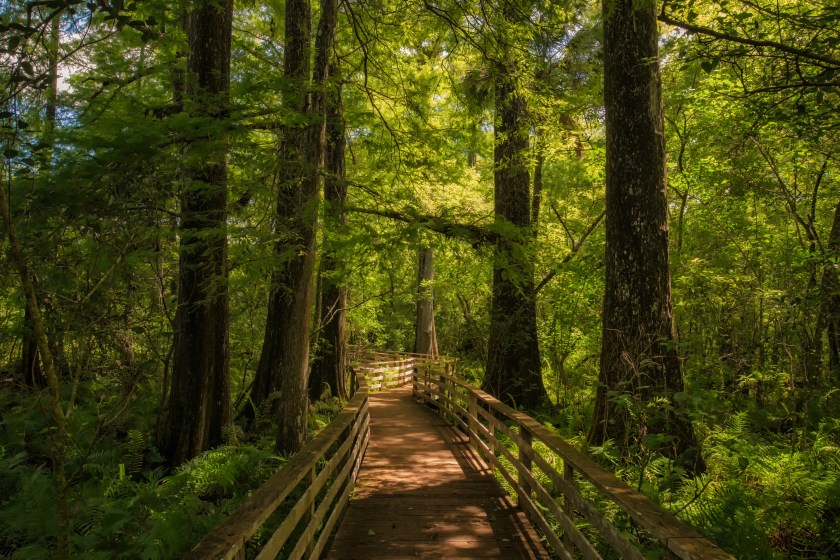
The photograph from the Corkscrew Swamp Sanctuary captures the harmonious relationship between human infrastructure and Florida’s natural environment. The cypress boardwalk invites viewers into an intricate ecosystem, showcasing careful light management and depth. By depicting the balance of accessibility and preservation, it highlights Florida’s ecological significance and the need for conservation.

Wooden boardwalk winding through tall cypress trees and dense green foliage at Corkscrew Swamp Sanctuary, with dappled sunlight on the path.
Cypress Boardwalk at Corkscrew Swamp Sanctuary (2014)

In this luminous study from the Corkscrew Swamp Sanctuary, the photographer presents Florida’s natural landscape not as wilderness observed from a distance, but as an invitation to passage—a curated encounter between human infrastructure and primeval forest. The cypress boardwalk becomes both subject and compositional device, leading the viewer into a cathedral of green light that speaks to the delicate negotiation between preservation and access.

The technical approach reveals careful consideration of the swamp’s challenging photographic conditions. Working at ISO 100 with a half-second exposure at f/16, the photographer has maximized depth of field while maintaining exceptional image quality. This combination renders crisp detail from the weathered planks of the boardwalk through to the layered canopy above, where backlit foliage creates a luminous gradient from deep shadow to radiant yellow-green. The 24mm focal length—a moderate wide-angle perspective—provides visual breadth without the distortion that might compromise the scene’s natural proportions.

What distinguishes this image is its masterful handling of light. Shooting within the swamp’s dense canopy during what appears to be late morning or early afternoon, the photographer has captured the moment when sunlight penetrates the upper canopy, creating an almost ethereal glow. The graduated tonalities—from the shadowed foreground through the mid-tones of the boardwalk to the brilliant highlights beyond—establish a sense of progression and discovery. The exposure value suggests deliberate retention of highlight detail in what could easily have become overblown areas of white, instead preserving the textural complexity of individual leaves and branches.

The boardwalk itself serves multiple compositional functions. Its strong linear perspective creates depth and movement, drawing the eye inexorably toward the illuminated center. The railings function as framing elements, containing the viewer’s gaze while suggesting the carefully managed interaction between visitors and ecosystem. The warm tones of the aged wood provide chromatic relief from the overwhelming green, grounding the image in the tangible reality of human construction within natural space.

Within Chapter 2’s exploration of Florida landscapes, this photograph represents a significant counterpoint to the architectural documentation of the Dalí Museum. Where that image examined cultural infrastructure against an urban backdrop, this work investigates environmental infrastructure—the pathways that allow observation without destruction. The photographer recognizes that Florida’s identity is inextricably linked to its threatened ecosystems, and that contemporary experience of these spaces is mediated by such interventions.

The cypress trunks, standing as dark vertical elements throughout the frame, provide rhythmic structure while emphasizing scale. Their substantial girth and textured bark speak to age and resilience, while the dense understory of ferns visible in the lower portions of the frame suggests the biodiversity these swamp systems support. The photographer has captured not merely a scenic vista but a complex ecological narrative.

This image demonstrates the photographer’s evolving understanding of Florida’s duality—a place where nature and human presence exist in constant negotiation. The boardwalk, rather than intruding upon the swamp, becomes evidence of a conservation ethic, allowing passage while preserving the delicate substrate below. In documenting this careful balance, the photographer offers a vision of Florida that transcends tourism, revealing instead a landscape worthy of sustained attention and protection.

Fallen Tree: The Foundation of Seeing

The photograph from Hillsborough River State Park, taken by Greg Urbano in 2013 with a Nikon D7100, captures a pivotal moment in his artistic development. It reflects his early understanding of composition and intentionality, showcasing the dense subtropical landscape through HDR processing. This image symbolizes the importance of beginnings and learning in photography.

HDR photograph of a forest trail in Hillsborough River State Park with a large fallen tree across the path, dense vegetation, and filtered natural light, taken with a Nikon D7100 at 10mm.
A 2013 HDR landscape photograph of a fallen tree along a forest trail in Hillsborough River State Park, Florida.

In the opening chapter of Greg Urbano’s photographic journey, this image from Hillsborough River State Park stands as a testament to the essential nature of beginnings. Shot in 2013 with a Nikon D7100, the photograph captures more than a forest scene—it documents the foundational moment when a photographer learns to truly see the landscape before him.

The composition reveals an intuitive understanding of depth and perspective. Shot at 10mm, the wide-angle lens creates an immersive quality that draws viewers directly onto the trail. The fallen log in the foreground serves as both literal and metaphorical threshold, inviting passage into the deeper woods beyond. This diagonal element cuts across the frame with authority, its weathered texture rendered in sharp detail by the f/8.0 aperture, demonstrating Urbano’s early grasp of how to balance foreground interest with background context.

The HDR processing technique employed here reflects the experimental spirit characteristic of this pre-2015 period. While HDR would later fall somewhat out of favor in fine art photography circles, its application in this image serves a clear purpose: to capture the dynamic range of a Florida forest understory, where dappled sunlight creates extreme contrasts between shadow and highlight. The palmetto fronds and oak canopy are rendered with an almost hyper-real clarity that emphasizes the dense, layered nature of this subtropical ecosystem.

What makes this photograph particularly significant within the “Beginnings” chapter is its honesty about place and limitation. Urbano’s accompanying note—that this Florida park offered his “best opportunity to capture flowing water over river rocks” before relocating to Colorado—reveals something crucial about artistic development. Great photography emerges not from waiting for perfect conditions, but from working intensively with what’s available. This trail became his classroom, this fallen log his teacher.

The technical choices demonstrate a photographer thinking through his craft. The 1/50s shutter speed suggests deliberate handholding technique, while the ISO 200 setting indicates available light conditions and a preference for image quality. These aren’t the settings of someone simply pointing and shooting; they reveal consideration and intentionality, even in these early stages.

The color palette—predominantly greens with earth-toned accents—creates a cohesive, naturalistic feel despite the HDR processing. The slight motion blur in the foliage adds an organic quality, a reminder that this is a living landscape caught in a specific moment. The trail itself winds invitingly into the frame’s depth, disappearing around a bend that promises further discovery—a fitting metaphor for the artistic journey being documented.

In the context of Urbano’s larger body of work, this image represents more than just an early attempt. It embodies the crucial truth that mastery begins with showing up, with making photographs even when the circumstances aren’t ideal, even when the technique hasn’t been perfected. The photograph’s inclusion in his top 100 collection isn’t about technical perfection but about recognizing the importance of foundation.

Every artist’s journey requires a starting point, a place where curiosity meets commitment. This fallen tree, this Florida trail, this moment of learning to see—these are the essential ingredients that would eventually lead to mountain streams in Colorado and a mature photographic vision. The imperfect attempt, it turns out, isn’t just necessary. It’s everything.