Aspen Stand, Poudre Canyon: A Study in Natural Geometry and Seasonal Light

The photograph of aspen trees along Poudre Canyon Road showcases their autumn colors, balancing structural elements with individual characteristics. It features a rhythmic vertical pattern in soft light, capturing a unique moment in Colorado’s landscape photography. This singular image asserts confidence in representing the iconic aspens effectively and artistically.

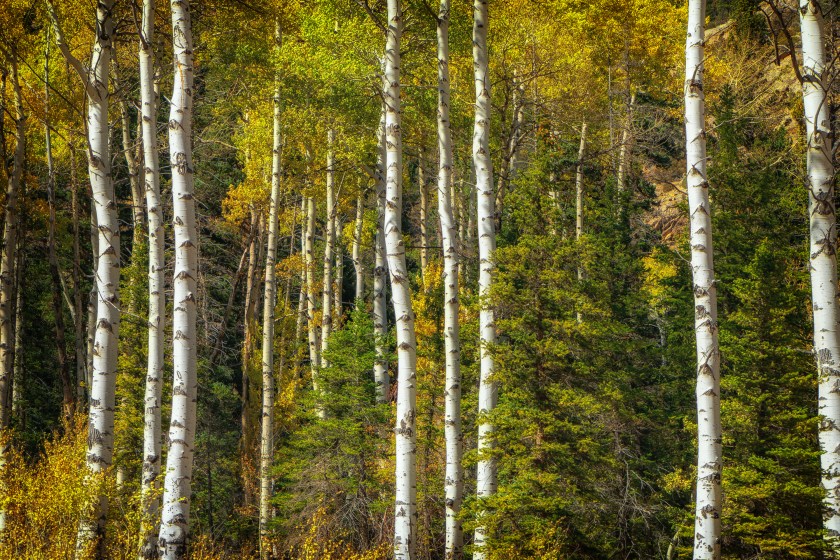
Tall white-barked aspen trees with yellow autumn leaves standing among green forest vegetation.
A stand of aspen trees displays fall foliage along Poudre Canyon Road in Colorado.

Within Chapter 3 of Greg Urbano’s Top 100 Journey—dedicated to Colorado Landscapes & Cityscapes—this photograph of aspen trees along Poudre Canyon Road represents a pivotal encounter with one of the American West’s most celebrated subjects. The image captures a dense stand of aspens in their autumn transformation, their white-barked trunks creating a rhythmic vertical pattern against a backdrop of golden and green foliage. What distinguishes this work from countless other interpretations of the same subject is the photographer’s restraint and his attention to the structural elements that give the composition its quiet authority.

The vertical emphasis dominates immediately. Dozens of aspen trunks rise through the frame, their characteristic pale bark marked by dark knots and horizontal striations that break the otherwise smooth surfaces. These natural imperfections serve as visual anchors, preventing the repetition from becoming monotonous. The photographer has positioned himself to maximize this rhythm while maintaining sufficient depth to reveal the layered complexity of the forest. Evergreens punctuate the composition in the background, their darker masses providing tonal contrast to the luminous aspens and golden understory.

The treatment of light deserves particular attention. Soft, even illumination suggests either overcast conditions or the photographer’s careful timing to avoid harsh midday sun. This choice allows the full tonal range of the foliage to register—from the brilliant yellows of peak autumn color to the deeper golds and lingering greens of leaves in transition. The post-processing, executed using DXO’s Color Efex Pro 4, enhances these chromatic relationships without pushing them into artificiality. There is saturation here, certainly, but it reads as an intensification of what was present rather than an invention.

For a photographer whose body of work encompasses diverse subjects and geographies, this image represents his only definitive statement on the iconic Colorado aspen to date—a fact he acknowledges directly in his own description. This singularity is worth considering. Rather than pursuing multiple variations or returning season after season to refine his approach, he has selected this single frame as representative. The decision suggests confidence in what was captured during that Saturday excursion from Fort Collins, and indeed, the composition supports that confidence.

The photograph functions effectively within its designated chapter, contributing to a broader portrait of Colorado’s varied landscapes. Where other images in this collection might address the state’s dramatic peaks, urban environments, or expansive vistas, this work explores the intimate scale of the mid-elevation forest. The aspens become both subject and structure, their seriality creating pattern while their individuality—visible in every unique scarring and branch configuration—asserts the organic nature of the scene.

Technically, the image demonstrates solid fundamentals: adequate depth of field to maintain sharpness across the forest layers, balanced exposure that preserves detail in both the bright foliage and darker bark, and a color palette that feels cohesive despite its range. The vertical format suits the subject matter, emphasizing the trees’ upward growth and the viewer’s sense of standing within the grove rather than observing it from outside.

This photograph documents a specific moment along Poudre Canyon Road while simultaneously engaging with a broader photographic tradition of Western landscape representation. It is work that respects its subject without overstating its case—a measured, observant addition to an ongoing artistic journey.
Into the Green Cathedral: Highlands Hammock State Park, 2011

Greg Urbano’s 2011 photograph from the Cypress Swamp Trail reflects the intersection of technical skill and artistic vision in photography. Using a Pentax K-x, he captures a weathered boardwalk amidst Florida’s lush swamp, illustrating the relationship between nature and human presence. The image balances light and texture, inviting viewers into a transformative experience.

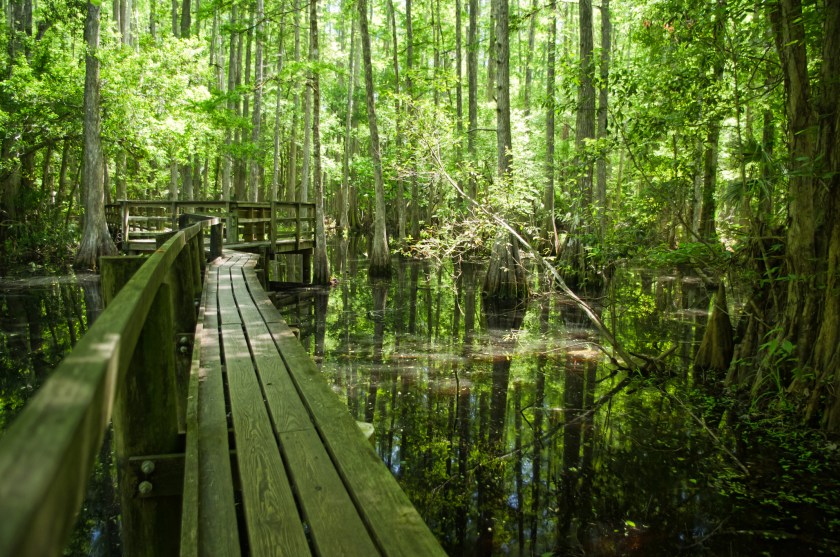
Wooden boardwalk winding through a cypress swamp with tall trees, exposed roots, and reflective dark water, photographed in 2011 with a Pentax K‑x.
A 2011 photograph of the Cypress Swamp Trail boardwalk at Highlands Hammock State Park in Florida.

In the early stages of any photographer’s journey, there exists a pivotal moment when technical capability intersects with artistic vision—when the craft begins to serve something deeper than mere documentation. Greg Urbano’s 2011 photograph from the Cypress Swamp Trail at Highlands Hammock State Park captures precisely this threshold, presenting a meditation on entrance, passage, and the liminal spaces where human intervention meets primordial nature.

The composition anchors itself on a weathered wooden boardwalk that curves through the left third of the frame, its moss-stained surface bearing witness to countless footsteps and Florida’s relentless humidity. Shot at 18mm on a Pentax K-x with the kit lens, Urbano demonstrates an understanding that wide-angle photography isn’t about capturing everything—it’s about creating context and relationship. The boardwalk serves as both literal path and visual guide, drawing the eye from the immediate foreground deep into the swamp’s verdant interior.

What distinguishes this image from typical nature photography is its masterful handling of light in a notoriously challenging environment. Shooting at f/4.0 with a 1/40s shutter speed and ISO 400, Urbano navigated the technical constraints of a modestly equipped camera to capture the dappled luminosity filtering through the canopy. The exposure balances the bright patches of sky visible through the trees with the darker water below, creating a tonal range that feels both accurate and atmospheric. The slightly elevated ISO introduces a subtle grain that, rather than detracting from the image, contributes to its organic texture.

The swamp water itself becomes a secondary canvas, reflecting the surrounding cypress trunks and creating visual echoes that blur the boundary between substance and reflection. Fallen branches break the surface tension, their pale, skeletal forms contrasting with the vibrant greens of new growth. This juxtaposition of decay and vitality speaks to the swamp’s essential nature as a place of transformation, where death continuously feeds life.

The color palette reveals a sophisticated eye for harmony—countless variations of green layer upon one another, from the luminous chartreuse of sunlit leaves to the deep olive shadows beneath the boardwalk. The aged wood introduces warmer earth tones, grounding the composition and providing respite from the overwhelming verdancy. These are the subtle decisions that separate intentional photography from happy accidents.

Within the context of a photographer’s formative work, this image represents more than technical competence. It demonstrates an emerging awareness of how to use man-made structures not as intrusions upon nature, but as framers of experience—the boardwalk doesn’t dominate the swamp; it offers a way to witness it. The slight curve of the path suggests journey and discovery, inviting viewers to imagine themselves walking deeper into this green cathedral.

Shot with entry-level equipment during a period when digital photography was becoming democratized, this photograph affirms that vision matters more than gear. The Pentax K-x and kit lens proved sufficient tools for capturing not just a place, but an atmosphere—the particular quality of light, air, and time that defines Florida’s ancient swamplands. It stands as evidence of a photographer learning to see, to compose, and to recognize moments worth preserving.

See this image on:

500px

Flickr