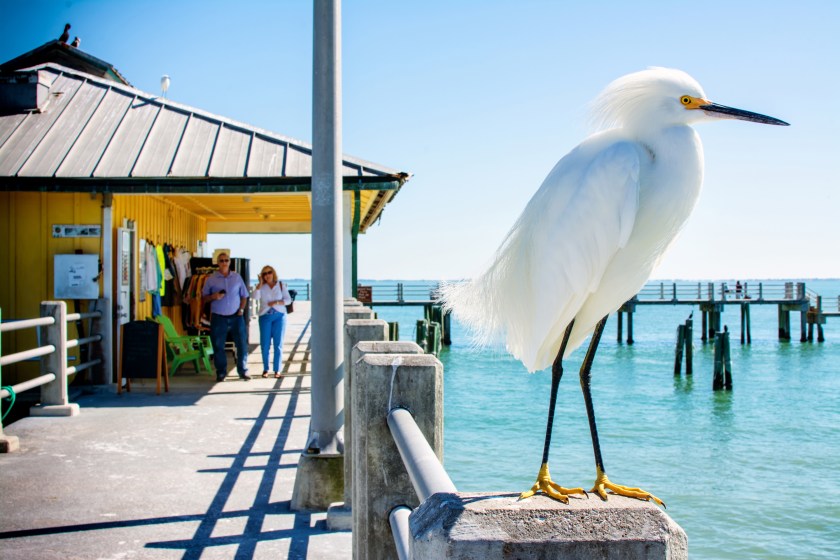
In the opening chapter of Greg Urbano’s photographic journey, “Showy Egret” stands as a masterclass in compositional awareness and environmental storytelling. Captured in 2014 at Fort De Soto’s Bay Pier in Florida, this image reveals an artist already attuned to the delicate balance between wildlife photography and human context—a sensibility that would define his evolving practice.
The photograph’s immediate strength lies in its spatial intelligence. Urbano positions the Snowy Egret in the right third of the frame, allowing the bird’s pristine plumage to command attention while the weathered pier extends into the turquoise waters beyond. This compositional choice creates a natural visual flow from foreground subject to background environment, inviting viewers to experience both the bird’s individual presence and its coastal habitat simultaneously.
Technical precision underscores the image’s effectiveness. Shot with a Nikon D7100 at f/11.0, Urbano achieves crisp depth of field that renders the egret’s delicate feathers in remarkable detail—each plume distinct against the clear Florida sky. The choice of 1/200 second shutter speed at ISO 100 captures the bird in perfect stillness, transforming a fleeting moment into something approaching portraiture. The 35mm focal length, often considered a “normal” perspective, here proves ideal for environmental wildlife work, offering intimacy without the compression or distance of telephoto lenses.
What elevates this photograph beyond straightforward nature documentation is Urbano’s willingness to embrace the human element. Two tourists emerge from a yellow-trimmed pier building in the middle distance, their presence neither accidental nor intrusive. Rather than seeking the pristine wilderness imagery common in traditional wildlife photography, Urbano acknowledges the reality of modern conservation spaces—these are shared environments where human recreation and natural habitats coexist. The egret’s confident stance on the pier post, unfazed by nearby activity, speaks to this acclimatization, suggesting a more complex narrative about wildlife adapting to anthropogenic landscapes.
The photograph’s playful title—”Showy Egret” as wordplay on “Snowy Egret”—hints at Urbano’s understanding that wildlife photography need not adopt a purely reverential tone. The egret does indeed appear showy, posed almost theatrically on its concrete perch, its breeding plumage fully displayed, yellow feet gripping the weathered surface. This anthropomorphic reading, encouraged by the title, creates accessibility without diminishing the bird’s natural beauty.
Light plays a crucial supporting role. The high, clear Florida sun creates distinct shadows across the pier’s concrete surface while illuminating the egret’s white plumage to near-luminescence. The bird’s yellow lores and feet provide punctuation points of color that echo the building’s trim, creating subtle visual rhymes within the frame.
As a foundational piece in Urbano’s “Beginnings” chapter, “Showy Egret” demonstrates technical competence married to narrative intuition. The photographer shows early understanding that compelling wildlife imagery can exist within human-modified spaces, that environmental context enriches rather than dilutes subject focus, and that humor and play have legitimate places in nature photography. These insights would prove essential as his practice developed, but here, at Fort De Soto in 2014, they exist in nascent, confident form—a young artist finding his voice through patient observation and compositional thoughtfulness.
 Greg Urbano