Passage Through Green: Corkscrew Swamp Sanctuary

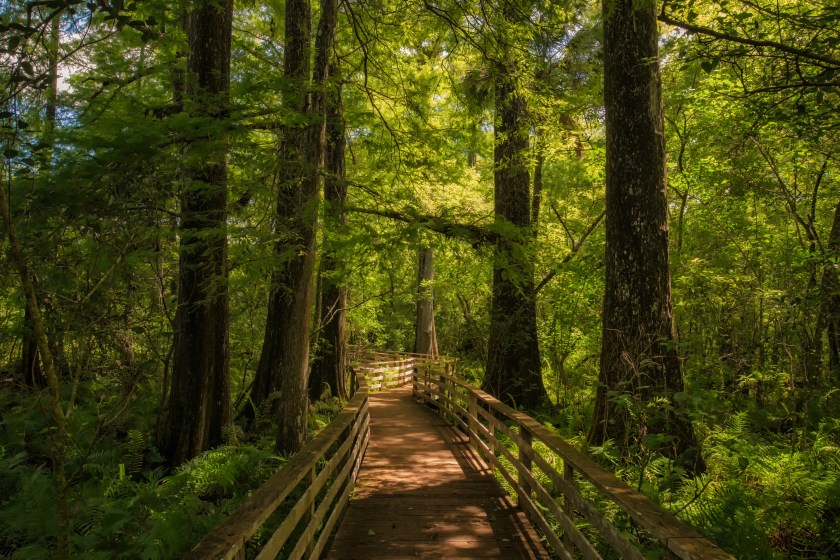
The photograph from the Corkscrew Swamp Sanctuary captures the harmonious relationship between human infrastructure and Florida’s natural environment. The cypress boardwalk invites viewers into an intricate ecosystem, showcasing careful light management and depth. By depicting the balance of accessibility and preservation, it highlights Florida’s ecological significance and the need for conservation.

Wooden boardwalk winding through tall cypress trees and dense green foliage at Corkscrew Swamp Sanctuary, with dappled sunlight on the path.
Cypress Boardwalk at Corkscrew Swamp Sanctuary (2014)

In this luminous study from the Corkscrew Swamp Sanctuary, the photographer presents Florida’s natural landscape not as wilderness observed from a distance, but as an invitation to passage—a curated encounter between human infrastructure and primeval forest. The cypress boardwalk becomes both subject and compositional device, leading the viewer into a cathedral of green light that speaks to the delicate negotiation between preservation and access.

The technical approach reveals careful consideration of the swamp’s challenging photographic conditions. Working at ISO 100 with a half-second exposure at f/16, the photographer has maximized depth of field while maintaining exceptional image quality. This combination renders crisp detail from the weathered planks of the boardwalk through to the layered canopy above, where backlit foliage creates a luminous gradient from deep shadow to radiant yellow-green. The 24mm focal length—a moderate wide-angle perspective—provides visual breadth without the distortion that might compromise the scene’s natural proportions.

What distinguishes this image is its masterful handling of light. Shooting within the swamp’s dense canopy during what appears to be late morning or early afternoon, the photographer has captured the moment when sunlight penetrates the upper canopy, creating an almost ethereal glow. The graduated tonalities—from the shadowed foreground through the mid-tones of the boardwalk to the brilliant highlights beyond—establish a sense of progression and discovery. The exposure value suggests deliberate retention of highlight detail in what could easily have become overblown areas of white, instead preserving the textural complexity of individual leaves and branches.

The boardwalk itself serves multiple compositional functions. Its strong linear perspective creates depth and movement, drawing the eye inexorably toward the illuminated center. The railings function as framing elements, containing the viewer’s gaze while suggesting the carefully managed interaction between visitors and ecosystem. The warm tones of the aged wood provide chromatic relief from the overwhelming green, grounding the image in the tangible reality of human construction within natural space.

Within Chapter 2’s exploration of Florida landscapes, this photograph represents a significant counterpoint to the architectural documentation of the Dalí Museum. Where that image examined cultural infrastructure against an urban backdrop, this work investigates environmental infrastructure—the pathways that allow observation without destruction. The photographer recognizes that Florida’s identity is inextricably linked to its threatened ecosystems, and that contemporary experience of these spaces is mediated by such interventions.

The cypress trunks, standing as dark vertical elements throughout the frame, provide rhythmic structure while emphasizing scale. Their substantial girth and textured bark speak to age and resilience, while the dense understory of ferns visible in the lower portions of the frame suggests the biodiversity these swamp systems support. The photographer has captured not merely a scenic vista but a complex ecological narrative.

This image demonstrates the photographer’s evolving understanding of Florida’s duality—a place where nature and human presence exist in constant negotiation. The boardwalk, rather than intruding upon the swamp, becomes evidence of a conservation ethic, allowing passage while preserving the delicate substrate below. In documenting this careful balance, the photographer offers a vision of Florida that transcends tourism, revealing instead a landscape worthy of sustained attention and protection.
Pilot Boat Pier

This photograph of Fort De Soto Park’s pilot boat pier captures the harmony between utilitarian structures and aesthetics. Utilizing a long exposure, the image highlights light, geometry, and the duality of human activity and nature. The pier becomes more than functional; it represents Florida’s coastal identity, deserving appreciation alongside natural landscapes.

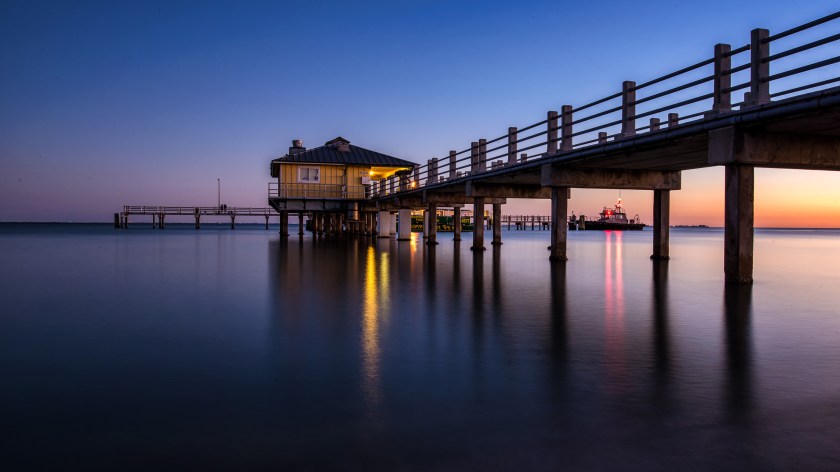
Long exposure twilight photograph of the Bay Pier at Fort De Soto Park in Florida, with a yellow pilot‑boat building illuminated over calm water.
Long exposure twilight view of the pilot boat pier at Fort De Soto Park.

In this carefully orchestrated study of maritime infrastructure at Fort De Soto Park, the photographer demonstrates his capacity to locate poetry within utilitarian structures. The pilot boat pier—a working facility that guides commercial vessels through Tampa Bay’s shipping channels—becomes here a meditation on light, geometry, and the quiet professionalism of coastal operations. Shot during the blue hour with a twenty-five-second exposure at f/16 on a Nikon D610, the image transforms functional architecture into something approaching minimalist sculpture.

The compositional intelligence reveals itself in layers. The pier’s diagonal thrust from left to right creates dynamic movement across the frame, while the elevated structure’s horizontal rails establish rhythmic intervals that lead the eye toward the distant vessel. The photographer has positioned himself to capture the pilings in perfect vertical alignment, their reflections doubling into the glassy water below—a mirror effect achieved through the extended exposure that renders Tampa Bay into polished obsidian. At ISO 100, the twenty-five-millimeter focal length provides sufficient context to establish spatial relationships without sacrificing the intimate scale of the pier house itself.

Light operates as the image’s true subject. The warm interior glow from the pier house casts golden striations across the water, creating a luminous pathway that contrasts with the cool blue-violet gradient dominating the sky. The distant pilot boat, its navigation lights punctuating the horizon in red, provides a crucial narrative element—evidence of the pier’s ongoing purpose even as twilight suspends it in apparent timelessness. This balance between ambient and artificial light, between natural phenomena and human activity, positions the work firmly within the chapter’s exploration of Florida’s developed coastlines.

What distinguishes this image from the photographer’s other coastal studies is its emphasis on infrastructure as architecture. The pier is not merely a platform for viewing nature but an elegant construction worthy of attention in its own right. The horizontal rails, repeating with mechanical precision, create a visual counterpoint to the organic curves of the shoreline visible in the distance. The photographer acknowledges that Florida’s landscape is fundamentally collaborative—nature and human intervention existing in constant dialogue rather than opposition.

The technical execution merits particular attention. The f/16 aperture ensures depth of field sufficient to hold both foreground pilings and horizon vessel in acceptable focus, while the twenty-five-second exposure smooths the water into a reflective plane that doubles the compositional impact of every vertical element. The choice to shoot at this precise moment—when daylight has drained from the western sky but hasn’t yet surrendered to complete darkness—captures that transitional state where artificial lights begin to assert themselves without overwhelming the scene’s natural tonal range.

Within the broader context of the Florida Landscapes & Cityscapes chapter, this photograph represents the photographer’s mature understanding of the state’s coastal identity. Fort De Soto’s pilot boat pier is neither wilderness nor urban environment but something uniquely Floridian—a working maritime facility embedded within a state park, where commerce and recreation, industry and leisure, coexist without apparent conflict. By rendering it with such formal rigor and aesthetic consideration, the photographer argues for expanded recognition of these hybrid spaces as legitimate subjects for contemplation, deserving the same careful attention traditionally reserved for pristine natural vistas.

See this image on:

500px

Flickr

Redington Long Pier Sunset

The photograph of Redington Long Pier at sunset highlights the interplay between Florida’s coastal architecture and natural beauty. Captured with a long exposure technique, it merges structure and color, showcasing the significance of humble elements like a bait shop sign. This image advocates for a broader definition of landscape photography, embracing authenticity over idealization.

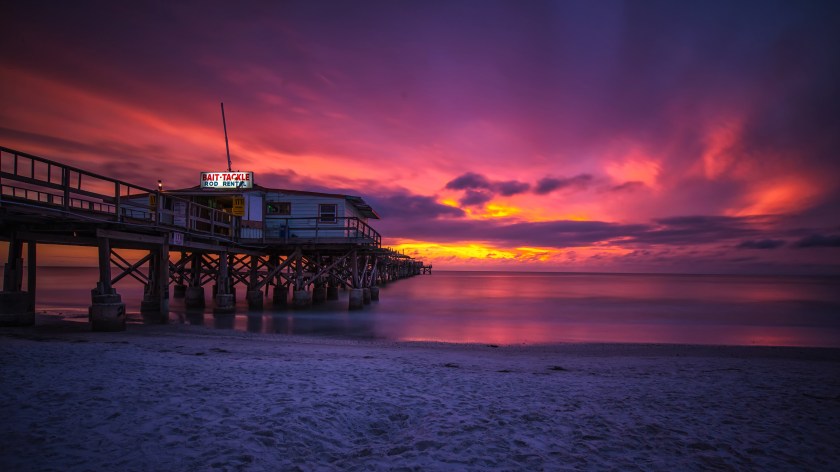
Long exposure photograph of the Redington Long Pier on Redington Beach, Florida, taken after sunset with vivid sky colors and calm reflective water.
Long exposure sunset view of the Redington Long Pier on Redington Beach.

The photographer’s approach to Florida’s coastal architecture reveals itself most compellingly in this extended exposure from Redington Beach, where a humble fishing pier becomes a study in structural grace against an incandescent sky. Captured on a Nikon D610 with an 18-35mm lens set to its widest focal length, the thirty-second exposure at f/8.0 transforms the Gulf of Mexico into liquid silk, while the pier’s weathered geometry provides essential counterpoint to the sky’s theatrical display.

What distinguishes this image within the Florida Landscapes & Cityscapes chapter is its subtle negotiation between the vernacular and the sublime. The “Bait·Tackle Rod Rental” sign—a modest beacon of commercial utility—anchors the composition with an authenticity that elevates rather than diminishes the scene’s natural grandeur. This juxtaposition speaks to the photographer’s evolving understanding of Florida’s coastal identity, where working piers and rental shacks exist not as intrusions upon beauty but as integral components of it.

The technical execution demonstrates considerable restraint. The eighteen-millimeter perspective captures the pier’s diagonal recession into the frame while maintaining clarity in the structural cross-bracing beneath the deck. The thirty-second exposure, calibrated to ISO 200, achieves that liminal smoothness in the water without sacrificing detail in the sky’s stratified clouds. The photographer has timed his capture for that brief window after sunset when the western horizon blazes with residual light while the zenith deepens toward purple—a moment lasting perhaps ten minutes when the dynamic range compresses just enough for a single exposure to hold both fire and shadow.

Color becomes the image’s primary language. The gradient from molten gold through crimson to violet speaks to the atmospheric conditions particular to Gulf Coast evenings, where humidity and marine air create these saturated transitions. The pier itself, rendered in silhouette, serves as a tonal anchor that prevents the composition from dissolving into pure chromaticism. The photographer’s choice to shoot into this gradient, rather than capturing the pier against a uniformly lit sky, reveals an understanding of how structure and color can modulate one another.

Within the broader trajectory of this chapter, the image represents a maturation of approach. Where earlier Florida work might have privileged either the natural landscape or the built environment, this photograph insists they cannot be separated. The pier extends from beach to horizon as a human gesture toward the infinite, its pilings disappearing into softened water that suggests both permanence and impermanence. The long exposure technique—a methodology that appears repeatedly throughout his landscape work—here serves not merely as technical flourish but as philosophical statement about time’s accumulation within a single frame.

The composition’s formal elegance belies its democratic subject matter. This is not a pristine wilderness or an architectural landmark, but a working-class fishing pier on a stretch of developed coastline. By rendering it with such visual authority, the photographer argues for an expanded definition of landscape photography—one that acknowledges Florida’s actual character rather than retreating to fantasies of unspoiled nature. The sunset may be spectacular, but it is the bait shop sign, glowing like a minor constellation above the water, that makes this image distinctly Floridian, distinctly true

See this image on:

Flickr

500px