The Gateway Image: Passagrille Jetty Silhouette and the Dawn of a Photographic Vision

In a 2014 photograph taken at Passagrille Beach, Greg Urbano captures a stunning sunset over the Gulf of Mexico, which inspires his beach photography. Featuring a silhouetted fisherman against an orange sky, the image combines technical skill and emotional depth, symbolizing Urbano’s artistic journey and his evolving relationship with landscape imagery.

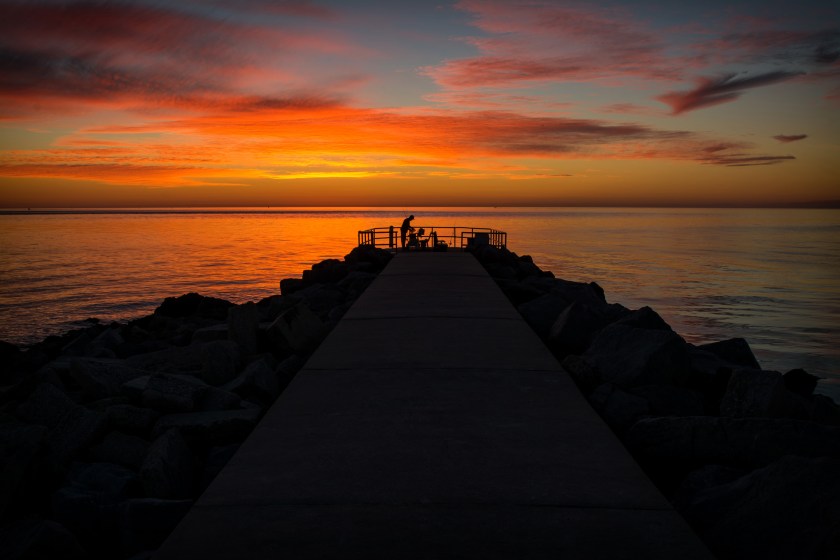
Silhouette of a lone fisherman standing on a rock jetty at Passagrille Beach during an orange Gulf of Mexico sunset, photographed with a Nikon D7100 at 24mm.
A 2014 sunset silhouette of a fisherman on the rock jetty at Passagrille Beach, Florida.

In the context of Greg Urbano’s “Beginnings” chapter, this 2014 sunset photograph from Passagrille Beach holds particular significance—not merely as a technically accomplished image, but as a foundational moment that would shape the photographer’s artistic trajectory for years to come. The image captures that precise intersection where technical competence meets emotional resonance, creating what Urbano himself identifies as his “inspiration for years of beach photography.”

The compositional structure reveals a photographer already thinking in strong geometric terms. The jetty’s dark pathway cuts through the frame with striking linearity, creating a powerful visual corridor that draws the viewer’s eye toward the observation platform at the terminus. This use of leading lines demonstrates sophisticated spatial awareness, transforming the rocky breakwater into a narrative device—a journey into the sublime moment captured in the sky above.

What distinguishes this photograph from countless other sunset images is Urbano’s commitment to silhouette as an artistic choice. Shot at ƒ/11 with a relatively slow shutter speed of 1/20 second at ISO 100, the exposure prioritizes the spectacular gradation of color in the sky while allowing the foreground elements to fall into deep shadow. The lone fisherman—barely discernible yet unmistakably present—becomes an everyman figure, a contemplative sentinel witnessing the day’s transition. This human element, reduced to pure form, prevents the image from becoming merely a spectacular sky study; instead, it grounds the natural drama in human experience.

The technical execution warrants examination. Using the Nikon D7100 with a 10-24mm lens at its maximum 24mm focal length, Urbano captures an expansive view that encompasses both the architectural elements of the jetty and the full breadth of the atmospheric display. The cropped sensor’s field of view provides enough width to establish context while maintaining focus on the central narrative. The aperture choice of ƒ/11 ensures sharpness throughout the frame, from the textured rocks in the immediate foreground to the distant horizon where sea meets sky.

The color palette—ranging from deep oranges and burning yellows to subtle purples and grays in the cloud formations—displays nature at its most theatrical. Yet Urbano’s restraint in post-processing (evident in the natural tonal transitions) allows the scene to speak with authenticity rather than hyperbole. This restraint would become a hallmark of his approach, distinguishing his work from the over-saturated aesthetic that dominates much contemporary landscape photography.

Perhaps most revealing is Urbano’s own reflection on this image as inspirational—a north star that guided subsequent explorations. One can trace forward from this moment to understand his ongoing fascination with the Gulf Coast’s theatrical sunsets, his appreciation for human elements within natural landscapes, and his sophisticated use of silhouette as a storytelling device. The photograph represents not an endpoint but a beginning, a discovery of visual vocabulary that would be refined and expanded throughout his career.

In the broader context of the “Beginnings” chapter, this Passagrille jetty image serves as both literal and metaphorical gateway—the concrete walkway leading toward beauty, the artist’s path toward photographic maturity, and the viewer’s invitation into Urbano’s evolving body of work.
Into the Green Cathedral: Highlands Hammock State Park, 2011

Greg Urbano’s 2011 photograph from the Cypress Swamp Trail reflects the intersection of technical skill and artistic vision in photography. Using a Pentax K-x, he captures a weathered boardwalk amidst Florida’s lush swamp, illustrating the relationship between nature and human presence. The image balances light and texture, inviting viewers into a transformative experience.

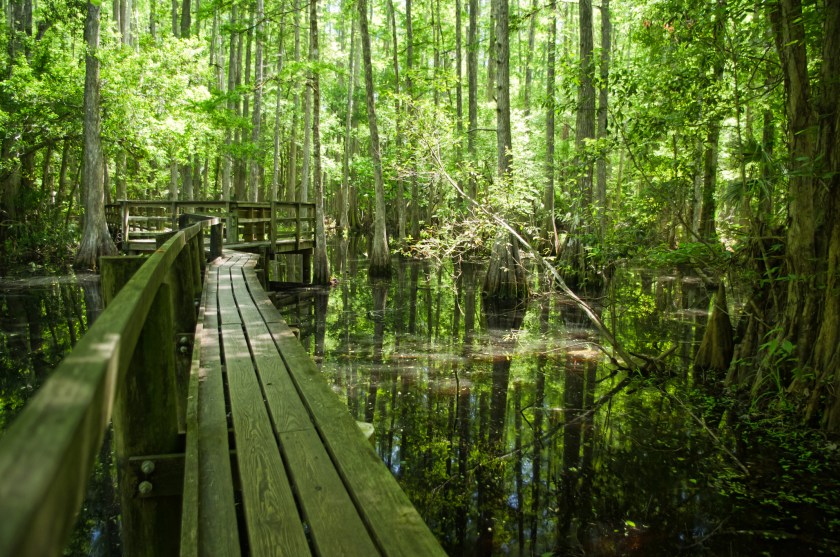
Wooden boardwalk winding through a cypress swamp with tall trees, exposed roots, and reflective dark water, photographed in 2011 with a Pentax K‑x.
A 2011 photograph of the Cypress Swamp Trail boardwalk at Highlands Hammock State Park in Florida.

In the early stages of any photographer’s journey, there exists a pivotal moment when technical capability intersects with artistic vision—when the craft begins to serve something deeper than mere documentation. Greg Urbano’s 2011 photograph from the Cypress Swamp Trail at Highlands Hammock State Park captures precisely this threshold, presenting a meditation on entrance, passage, and the liminal spaces where human intervention meets primordial nature.

The composition anchors itself on a weathered wooden boardwalk that curves through the left third of the frame, its moss-stained surface bearing witness to countless footsteps and Florida’s relentless humidity. Shot at 18mm on a Pentax K-x with the kit lens, Urbano demonstrates an understanding that wide-angle photography isn’t about capturing everything—it’s about creating context and relationship. The boardwalk serves as both literal path and visual guide, drawing the eye from the immediate foreground deep into the swamp’s verdant interior.

What distinguishes this image from typical nature photography is its masterful handling of light in a notoriously challenging environment. Shooting at f/4.0 with a 1/40s shutter speed and ISO 400, Urbano navigated the technical constraints of a modestly equipped camera to capture the dappled luminosity filtering through the canopy. The exposure balances the bright patches of sky visible through the trees with the darker water below, creating a tonal range that feels both accurate and atmospheric. The slightly elevated ISO introduces a subtle grain that, rather than detracting from the image, contributes to its organic texture.

The swamp water itself becomes a secondary canvas, reflecting the surrounding cypress trunks and creating visual echoes that blur the boundary between substance and reflection. Fallen branches break the surface tension, their pale, skeletal forms contrasting with the vibrant greens of new growth. This juxtaposition of decay and vitality speaks to the swamp’s essential nature as a place of transformation, where death continuously feeds life.

The color palette reveals a sophisticated eye for harmony—countless variations of green layer upon one another, from the luminous chartreuse of sunlit leaves to the deep olive shadows beneath the boardwalk. The aged wood introduces warmer earth tones, grounding the composition and providing respite from the overwhelming verdancy. These are the subtle decisions that separate intentional photography from happy accidents.

Within the context of a photographer’s formative work, this image represents more than technical competence. It demonstrates an emerging awareness of how to use man-made structures not as intrusions upon nature, but as framers of experience—the boardwalk doesn’t dominate the swamp; it offers a way to witness it. The slight curve of the path suggests journey and discovery, inviting viewers to imagine themselves walking deeper into this green cathedral.

Shot with entry-level equipment during a period when digital photography was becoming democratized, this photograph affirms that vision matters more than gear. The Pentax K-x and kit lens proved sufficient tools for capturing not just a place, but an atmosphere—the particular quality of light, air, and time that defines Florida’s ancient swamplands. It stands as evidence of a photographer learning to see, to compose, and to recognize moments worth preserving.

See this image on:

500px

Flickr