Fly Fisherman, Poudre River: Solitude and Seasonal Transition

The photograph of a fly fisherman in the Poudre River during autumn integrates human presence into Colorado’s natural landscape. Positioned mid-stream, the figure enhances the scene’s narrative and scale. This image balances aesthetics and documentary elements, showcasing a peaceful coexistence between nature and human activity amid vibrant seasonal colors.

A lone fly fisherman stands in a calm river beneath a small bridge, surrounded by autumn trees with yellow foliage.
A fly fisherman wades the Poudre River beneath a bridge during autumn in Colorado.

Among the works comprising Chapter 3—Colorado Landscapes & Cityscapes—this autumn scene along the Poudre River introduces a human presence that has been notably absent from much of the photographer’s natural landscape documentation. A lone fly fisherman stands mid-stream, his figure providing both scale and narrative focus within a composition dominated by seasonal color and the interplay of light on moving water. The image succeeds in balancing documentary observation with careful aesthetic consideration, capturing what appears to be a chance encounter during the photographer’s search for the last vestiges of fall color along this northern Colorado waterway.

The composition employs a classic landscape structure, divided roughly into thirds by the horizontal elements: the reflective water surface in the foreground, the bridge and human figure in the middle ground, and the autumn-touched forest rising beyond. The fisherman, positioned slightly off-center, serves as the crucial point of human scale that transforms what might otherwise be a standard seasonal landscape into something more contemplative. His solitary presence—the photographer notes he was likely the only other person at this remote turnoff—adds an element of quietude and shared appreciation for the conditions that drew both individuals to this location on a Saturday afternoon.

The treatment of water demonstrates technical proficiency with the Sony A7ii and kit lens combination. A moderate exposure time renders the river surface with subtle motion blur, smoothing ripples into gentle gradations of reflected light while maintaining enough definition to distinguish current patterns and submerged rocks. The right portion of the frame captures direct sunlight on the water, creating a bright zone of contrast against the darker, shadowed areas. This tonal range—from deep amber reflections to brilliant highlights—gives the water substantial visual weight and complexity.

Autumn color saturates the background, with golden aspens and cottonwoods forming luminous masses against the darker evergreens. The trees are captured at what the photographer sought—the final days of peak color—evident in the richness of the yellows and the beginning transitions toward bare branches. The small bridge, a modest steel and concrete structure, provides architectural grounding without overwhelming the natural elements. Its weathered construction suggests a rural access point rather than a major thoroughfare, reinforcing the sense of a discovered location rather than a destination.

What distinguishes this photograph within the broader chapter is its acknowledgment of human interaction with Colorado’s landscapes. Where other works present wilderness as untouched or urban environments as purely architectural, this image occupies a middle ground. The fisherman is neither intruder nor irrelevance; he belongs to this scene as much as the bridge or the turning leaves. His activity—fly fishing, with its requirements of patience, skill, and intimate knowledge of the water—suggests a relationship with place rather than mere passage through it.

The photographer’s decision to include this figure, captured during what he describes as a casual Saturday excursion, reveals an evolving understanding of how to represent place. Colorado’s identity encompasses not only its dramatic geology and seasonal transformations but also the quiet pursuits of those who seek out its rivers and forests during brief windows of perfect weather and fading color.
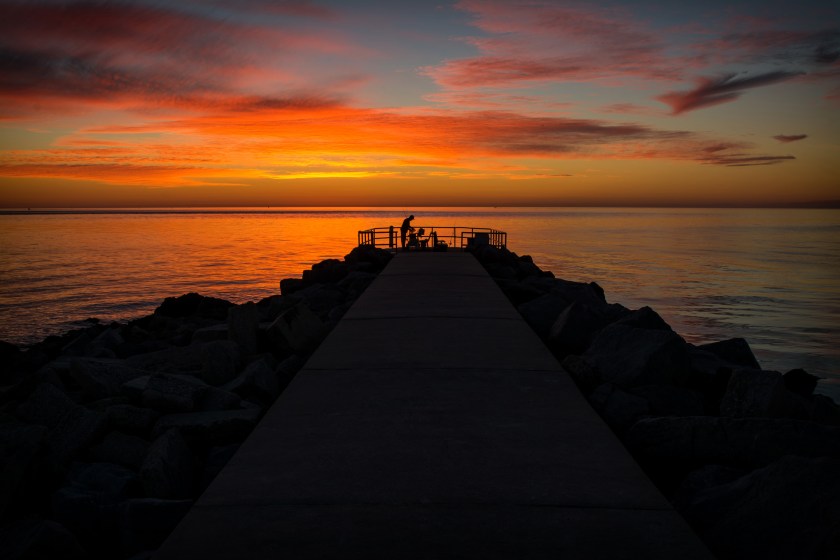
The Gateway Image: Passagrille Jetty Silhouette and the Dawn of a Photographic Vision

In a 2014 photograph taken at Passagrille Beach, Greg Urbano captures a stunning sunset over the Gulf of Mexico, which inspires his beach photography. Featuring a silhouetted fisherman against an orange sky, the image combines technical skill and emotional depth, symbolizing Urbano’s artistic journey and his evolving relationship with landscape imagery.

Silhouette of a lone fisherman standing on a rock jetty at Passagrille Beach during an orange Gulf of Mexico sunset, photographed with a Nikon D7100 at 24mm.
A 2014 sunset silhouette of a fisherman on the rock jetty at Passagrille Beach, Florida.

In the context of Greg Urbano’s “Beginnings” chapter, this 2014 sunset photograph from Passagrille Beach holds particular significance—not merely as a technically accomplished image, but as a foundational moment that would shape the photographer’s artistic trajectory for years to come. The image captures that precise intersection where technical competence meets emotional resonance, creating what Urbano himself identifies as his “inspiration for years of beach photography.”

The compositional structure reveals a photographer already thinking in strong geometric terms. The jetty’s dark pathway cuts through the frame with striking linearity, creating a powerful visual corridor that draws the viewer’s eye toward the observation platform at the terminus. This use of leading lines demonstrates sophisticated spatial awareness, transforming the rocky breakwater into a narrative device—a journey into the sublime moment captured in the sky above.

What distinguishes this photograph from countless other sunset images is Urbano’s commitment to silhouette as an artistic choice. Shot at ƒ/11 with a relatively slow shutter speed of 1/20 second at ISO 100, the exposure prioritizes the spectacular gradation of color in the sky while allowing the foreground elements to fall into deep shadow. The lone fisherman—barely discernible yet unmistakably present—becomes an everyman figure, a contemplative sentinel witnessing the day’s transition. This human element, reduced to pure form, prevents the image from becoming merely a spectacular sky study; instead, it grounds the natural drama in human experience.

The technical execution warrants examination. Using the Nikon D7100 with a 10-24mm lens at its maximum 24mm focal length, Urbano captures an expansive view that encompasses both the architectural elements of the jetty and the full breadth of the atmospheric display. The cropped sensor’s field of view provides enough width to establish context while maintaining focus on the central narrative. The aperture choice of ƒ/11 ensures sharpness throughout the frame, from the textured rocks in the immediate foreground to the distant horizon where sea meets sky.

The color palette—ranging from deep oranges and burning yellows to subtle purples and grays in the cloud formations—displays nature at its most theatrical. Yet Urbano’s restraint in post-processing (evident in the natural tonal transitions) allows the scene to speak with authenticity rather than hyperbole. This restraint would become a hallmark of his approach, distinguishing his work from the over-saturated aesthetic that dominates much contemporary landscape photography.

Perhaps most revealing is Urbano’s own reflection on this image as inspirational—a north star that guided subsequent explorations. One can trace forward from this moment to understand his ongoing fascination with the Gulf Coast’s theatrical sunsets, his appreciation for human elements within natural landscapes, and his sophisticated use of silhouette as a storytelling device. The photograph represents not an endpoint but a beginning, a discovery of visual vocabulary that would be refined and expanded throughout his career.

In the broader context of the “Beginnings” chapter, this Passagrille jetty image serves as both literal and metaphorical gateway—the concrete walkway leading toward beauty, the artist’s path toward photographic maturity, and the viewer’s invitation into Urbano’s evolving body of work.