Light Paint Egg: Precision and Wonder in Contemporary Still Life

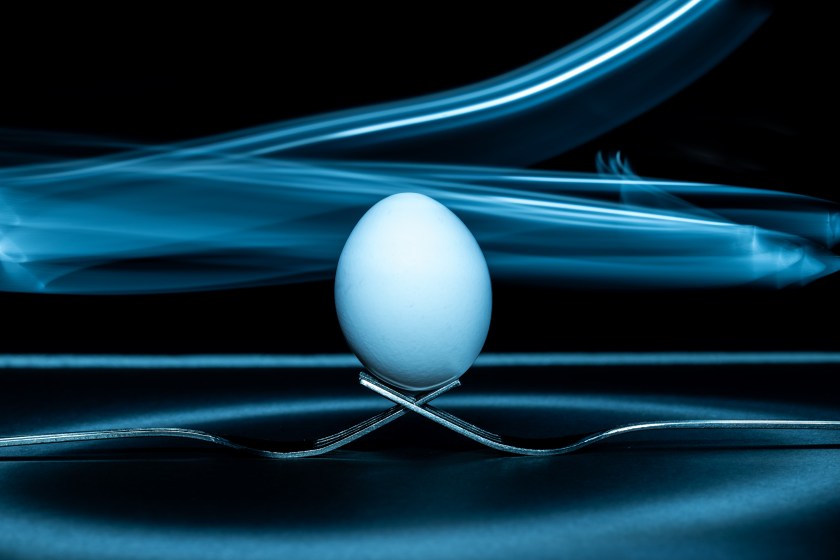
The photograph “Light Paint Egg” showcases a white egg balanced on crossed forks, illuminated through light painting techniques. This work exemplifies the artist’s blend of traditional and contemporary methods, capturing a balance between stasis and motion. It represents an innovative departure in still life, emphasizing creativity and technical mastery despite simple materials.

White egg balanced upright on crossed metal forks, photographed against a dark background with blue light trails created through light painting.
A white egg balanced on crossed forks, photographed using light painting techniques for the 52 Frames Week 11 “Egg” challenge.

In this meticulously crafted photograph, the artist demonstrates a masterful command of light painting technique, transforming an ordinary subject into an object of contemplation. The egg, positioned at the composition’s center, becomes a luminous focal point—its pale, almost ethereal surface contrasting dramatically against the deep black void that surrounds it. This is not merely documentation of an object, but rather an exploration of form, light, and the delicate balance between the tangible and the abstract.

The technical execution reveals a photographer working at the intersection of traditional still life aesthetics and contemporary experimental methods. Inspired by demonstrations from the lighting equipment company Adaptalux, he pursued this vision independently, relying on his own resourcefulness and understanding of photographic principles rather than specialized gear. This approach speaks to a fundamental confidence in craft—the knowledge that compelling imagery emerges not from equipment alone, but from vision and technical literacy working in concert.

The light trails that sweep through the frame possess an almost calligraphic quality, their cool blue tones suggesting both movement and stillness simultaneously. These luminous threads create a complex spatial environment, establishing depth and dimensionality around the egg while reinforcing its solidity and sculptural presence. The waves beneath appear to cradle the subject, while the diagonal streaks above suggest trajectory, momentum, perhaps even flight. There exists here a visual tension between stasis and motion, weight and weightlessness—themes that resonate throughout his broader body of work.

Positioned within Chapter 6 of his Top 100 Journey—”The Road Ahead: Recent Work & Ongoing Exploration”—this photograph exemplifies the artist’s willingness to embrace technical challenges and aesthetic risks. The chapter’s title suggests forward movement, continued evolution, and the photographer’s commitment to expanding his visual vocabulary. Indeed, this image represents a departure from more conventional approaches to still life, demonstrating how constraints—in this case, a weekly theme challenge—can catalyze creative innovation.

The composition adheres to classical principles while subverting expectations. The egg, that most ancient and universal of symbols, is elevated beyond its associations with fragility and potential. Here it becomes something simultaneously organic and otherworldly, as though suspended in a dimension where the laws of physics bend to artistic intention. The photographer’s choice to work with long exposure and moving light sources transforms the medium itself into a drawing tool, blurring the boundaries between photography, painting, and performance.

What distinguishes this work within his oeuvre is its synthesis of technical precision and poetic sensibility. The execution required careful planning—controlling exposure duration, choreographing light movement, managing ambient contamination—yet the final image transcends its methodology. It invites meditation on form, on the nature of photographic representation, and on how familiar objects can be estranged and renewed through careful observation and technical intervention.

As part of his ongoing exploration documented in the Top 100 Journey project, “Light Paint Egg” signals a photographer unafraid to experiment, to respond to creative prompts with rigor and imagination, and to push the boundaries of his practice. It stands as evidence that profound imagery can emerge from simple materials when vision, patience, and technical mastery converge.

Jonny Edward — Portrait

In this sixth chapter of the visual odyssey, Jonny Edward’s portrait embodies the blend of environment and identity, created in his studio, Atelier Alchimia. The image emphasizes texture and iconography, showcasing a stylistic marriage between traditional garments and modern tattoos. It marks a pivot to evocative, symbolic portraiture, exploring the philosophy of aesthetic existence.

Portrait of a person wearing a black hat and round glasses, seated indoors with tattooed arms, dressed in a vest, shirt, and tie against a textured studio backdrop.
Portrait of Jonny Edward photographed seated in his studio, wearing a hat, glasses, and layered clothing, with tattoos visible on both arms.

In the sixth chapter of this ongoing visual odyssey, the photographer explores the intersection of environment and identity, moving beyond the mere capture of a likeness to conduct a sophisticated study of texture and personal iconography. This portrait of Jonny Edward, captured within the subject’s own creative sanctuary, Atelier Alchimia, serves as a cornerstone of the “Recent Work & Ongoing Exploration” phase. It represents a pivot toward a more layered, atmospheric approach to portraiture, where the subject and the space they inhabit become indistinguishable components of a singular narrative.

The composition is a masterclass in the management of complex visual information. The subject is positioned with a calculated stillness, his gaze direct and piercing through circular frames that provide a geometric anchor for the viewer. There is a profound intentionality in the styling: the marriage of classic haberdashery—a wide-brimmed felt hat, a patterned cravat, and a structured waistcoat—against the modern, intricate cartography of extensive tattoo work. The photographer skillfully navigates these disparate elements, ensuring that the elaborate patterns of the skin and the plaid of the vest complement rather than compete with one another.

Technically, the image excels in its tonal range and tactile quality. The lighting is deliberate, casting a soft yet directional glow that carves out the contours of the subject’s face and highlights the physical relief of the ink on his forearms. There is a tangible weight to the textures presented: the coarseness of the waistcoat’s weave, the smoothness of the felt hat, and the weathered patina of the background wall. This background, reminiscent of a Renaissance fresco in its muted, distressed tones, provides a timeless quality that lifts the portrait out of a specific era and into a more permanent, artistic realm.

As a significant entry in the “Top 100 Journey,” this work illustrates the photographer’s evolving mastery of the “creative workshop” environment. By collaborating within a space designed for artistic alchemy, he has successfully distilled the essence of a fellow creator. The image functions as a dialogue between two artists—one in front of the lens and one behind it—resulting in a portrait that feels less like an observation and more like an excavation.

In the context of Chapter 6: The Road Ahead, this photograph signals a refined direction. It moves away from traditional, literal portraiture toward a more symbolic and evocative methodology. The hands, clasped in a gesture of quiet strength, draw the eye to the lower third of the frame, grounding the composition and reinforcing the sense of grounded presence. It is an exploration of the “modern alchemist,” capturing a figure who is both a product of and a contributor to the creative landscape of Colorado. This portrait does not merely record a face; it documents a philosophy of aesthetic existence, marking a high point in the photographer’s continued pursuit of visual excellence.

Reclamation and Ruin: A Study in Agricultural Melancholy

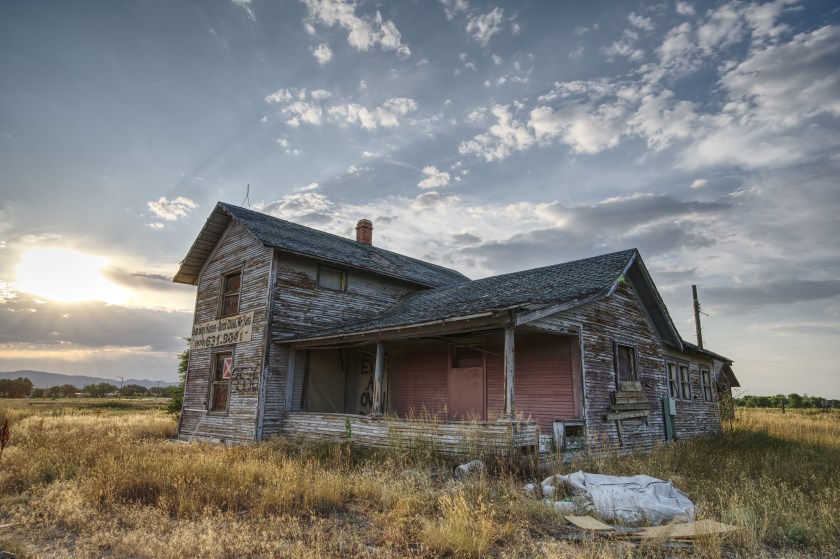
The photograph of an abandoned farmhouse near Fort Collins, Colorado, embodies themes of impermanence and decay. The image balances architectural elements with natural landscapes, showcasing technical sophistication through HDR processing. By highlighting details of deterioration amidst recent human traces, it transforms rural abandonment into a poignant meditation on time and memory.

Weathered wooden farmhouse with boarded windows and peeling paint standing in tall grass near Fort Collins, Colorado.
An abandoned wooden farmhouse sits in open prairie near Fort Collins, Colorado.

In this haunting documentation of rural abandonment, the photographer captures a weathered farmhouse on the outskirts of Fort Collins, Colorado—a structure caught in the liminal space between human history and nature’s patient reclamation. The image, selected for Chapter 6 of his Top 100 Journey, exemplifies the ongoing evolution in his practice toward subjects that speak to impermanence, transition, and the quiet dignity of forgotten places.

The compositional strategy reveals a mature understanding of architectural photography merged with landscape sensibility. The two-story structure commands the frame while remaining subordinate to the expansive Colorado sky, which fills nearly half the image with dramatic cloud formations. This deliberate balance prevents the photograph from becoming merely documentary, instead elevating it into meditation on time and decay. The golden hour lighting—captured with precision timing—rakes across the weathered clapboard siding, accentuating every crack, peel, and shadow in the wood grain. This textural emphasis transforms deterioration into visual poetry.

His decision to employ HDR processing demonstrates technical sophistication in service of artistic vision rather than mere spectacle. The extended dynamic range allows simultaneous preservation of detail in the sun-bleached siding and the darker recesses of boarded windows and doorways. The processing maintains naturalistic color while enhancing the amber warmth of dying light against cool blue-grey clouds, creating chromatic tension that mirrors the thematic conflict between persistence and decay.

The overgrown prairie grass in the foreground serves multiple functions within the composition. Practically, it provides textural contrast to the geometric severity of the architecture; symbolically, it represents nature’s inexorable advance. The discarded white fabric or tarp in the lower right corner introduces a note of recent human presence, suggesting that abandonment is an ongoing process rather than a completed historical fact. This detail prevents the image from slipping into nostalgic romanticism.

What distinguishes this work within the context of Chapter 6—titled “The Road Ahead: Recent Work & Ongoing Exploration”—is its synthesis of earlier themes with evolving concerns. The photographer has long demonstrated interest in human traces within landscape, but here the investigation deepens. Rather than simply documenting what remains, he engages with the process of vanishing itself. The boarded windows become blind eyes; the peeling paint functions as aging skin; the sagging roofline suggests exhaustion. The structure possesses almost anthropomorphic vulnerability.

The photograph’s origins as a response to the 52frames weekly challenge reveals another dimension of his practice—the ability to transform assignment-based work into personally meaningful investigation. Many photographers struggle to maintain artistic integrity within the constraints of themed prompts, yet he has consistently used such frameworks as catalysts rather than limitations.

The telephone number still visible on the building’s facade—a commercial ghost—adds poignant specificity. It grounds the abstracted themes of abandonment and time in particular lives, particular businesses, particular failures or departures. This detail resists the tendency toward generic commentary on “the death of rural America” and instead insists on the singular reality of this particular farmhouse, this particular field, this particular evening light.

In positioning this image within his ongoing journey, the photographer signals continued commitment to finding profound resonance in overlooked subjects. The road ahead, it seems, leads deliberately toward what others pass by—not from contrarian impulse, but from genuine recognition that beauty and meaning persist even in, perhaps especially in, the discarded and decaying.

Tomatos

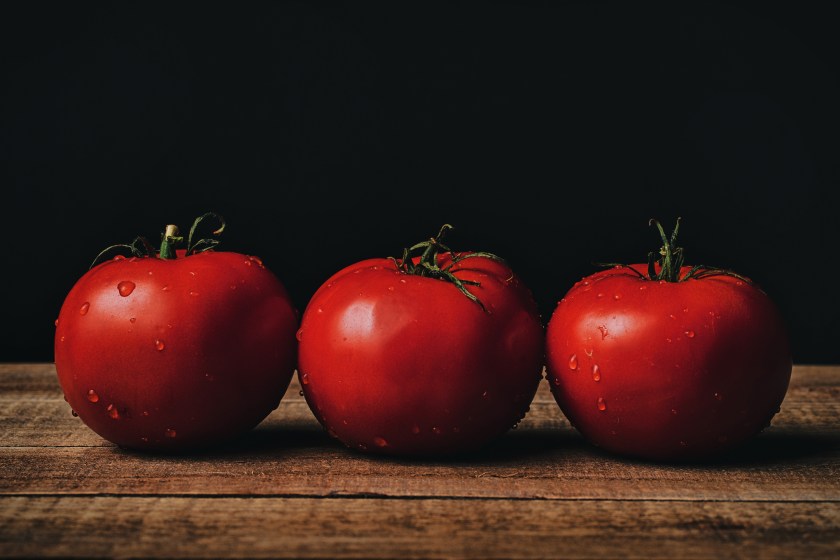
This photographic composition showcases three tomatoes on a textured wooden surface against a dark background, illustrating the themes of light and form in still life art. Using controlled lighting to create a dramatic chiaroscuro effect, the photographer emphasizes the tomatoes’ beauty, merging classical traditions with contemporary techniques.

Tabletop still life of three ripe tomatoes with water droplets on a wooden surface against a dark background.
A tabletop still life of three tomatoes arranged on a wooden surface and lit against a dark background.

In this deceptively simple composition, the photographer demonstrates how the most humble subjects—three tomatoes from a supermarket produce section—can become vehicles for exploring light, form, and the enduring traditions of still life photography. The work sits comfortably within the classical end of Chapter 5’s spectrum, channeling centuries of artistic precedent while employing decidedly contemporary tools and techniques.

The arrangement recalls Dutch Golden Age vanitas paintings, where ordinary kitchen staples were elevated to subjects of profound contemplation. Here, three ripe tomatoes rest upon a weathered wooden surface, their placement casual yet deliberate. The varying positions of their stems—pointing in different directions like botanical compasses—introduce subtle asymmetry that prevents the composition from becoming static. Water droplets cling to the glossy red skin, suggesting recent washing and adding points of light that animate the surface.

His lighting strategy proves crucial to the image’s success. Working with a single Godox V1s flash modified by a softbox and grid, he achieves remarkable control over illumination. The grid attachment narrows the light spread, creating focused illumination that emphasizes the tomatoes while allowing the background to fall into deep, theatrical darkness. This chiaroscuro effect—the dramatic interplay of light and shadow—lends gravitas to subjects that might otherwise seem merely documentary.

The wooden surface provides essential contextual grounding. Its rough texture and visible grain contrast beautifully with the smooth, taut skin of the tomatoes, creating a dialogue between refined organic form and rustic materiality. The warm tones of the aged wood complement the rich reds of the fruit, establishing a harmonious yet varied color palette that feels both earthy and sophisticated.

His post-processing approach through Skylum Luminar 4, utilizing a color LUT (Look-Up Table), demonstrates an efficient workflow that enhances rather than overwhelms the captured image. The color grading deepens the reds toward burgundy in the shadows while maintaining natural highlights, creating dimensionality that draws the eye around each form. This restrained digital intervention respects the photographic integrity of the scene while amplifying its visual impact.

Within the broader trajectory of his still life work, this image represents a return to fundamentals—a meditation on how controlled lighting and thoughtful composition can transform the everyday into the examined. Where other works in this chapter might push toward experimental territories, this photograph anchors itself in proven traditions, demonstrating that innovation need not always mean departure from established visual language.

The Sony A7ii captures these elements with clarity and subtle tonal gradation, rendering the tomatoes with sufficient detail to appreciate their imperfect spherical forms, the slight variations in color saturation, and the delicate green stems that signal recent harvest. These details matter; they prevent the image from becoming abstract or overly stylized, maintaining its connection to the tangible world.

Ultimately, this work succeeds through its quiet confidence. The photographer understands that compelling still life photography requires neither exotic subjects nor complex staging—only patient observation, technical competence, and an appreciation for how light reveals the inherent beauty in forms we too often overlook. These grocery store tomatoes, frozen in this particular moment of light and shadow, become worthy of sustained attention.

Powerade Sports Drink

The photographer’s still life study of three Powerade bottles transcends typical commercial product photography through technical mastery and thoughtful lighting. Using a classic triangular arrangement against a dark background, he elevates mundane objects into gallery-worthy art, emphasizing color and light. This work reflects his evolving confidence and duality in art and commerce.

Studio still life of three Powerade sports drink bottles in red, orange, and blue on a reflective black surface.
A studio still life of three Powerade sports drink bottles arranged on a reflective surface against a dark background.

The photographer’s exploration of commercial product photography takes an unexpectedly sophisticated turn in this meticulously composed study of three Powerade bottles. Working within the constraints of a domestic setting—his living room transformed into an improvised studio—he demonstrates how technical mastery and thoughtful lighting can elevate mundane consumer objects into subjects worthy of gallery consideration.

The composition employs a classical triangular arrangement, with the three bottles positioned against a stark black background that eliminates all contextual distraction. This deliberate void forces the viewer’s attention entirely onto the subjects themselves: the vivid red and orange bottles flanking a brilliant blue variant. The color palette recalls the saturated hues of contemporary advertising photography, yet the treatment here transcends mere product documentation. Each bottle catches and refracts light differently, creating internal luminosity that transforms the beverages into glowing, jewel-like objects.

His technical approach reveals significant evolution in his still life practice. Utilizing a Sony A7ii with a kit lens, softbox, and flash, he crafts lighting that achieves both commercial polish and artistic dimensionality. The softbox provides diffused illumination that wraps around the bottles’ curved surfaces, while strategic flash placement creates the distinctive highlights and reflections visible across each container. The condensation beading on the plastic surfaces adds textural authenticity, suggesting these are not pristine studio props but objects intercepted in their natural state—cold, recently removed from refrigeration, existing in that liminal moment between commercial packaging and consumption.

The post-processing workflow—Adobe Camera Raw within Photoshop 2018, enhanced with Nik/DXO Viveza—amplifies the inherent drama of the scene. The blacks deepen to an almost velvety darkness, while the colors intensify without crossing into oversaturation. This balance proves crucial: the image maintains photographic credibility while achieving the heightened reality that characterizes effective still life work.

Within the broader context of Chapter 5’s exploration from classic to experimental tabletop photography, this image occupies an interesting middle ground. It adheres to established commercial photography conventions—the product-forward composition, the dramatic lighting, the emphasis on color and form—yet subverts them through its gallery presentation context. Removed from their intended commercial environment and reframed as objects of aesthetic contemplation, these sports drinks become something more: symbols of contemporary consumer culture, studies in color theory and light behavior, or perhaps meditations on how photography itself mediates our relationship with everyday objects.

The work also demonstrates his growing confidence in minimal staging. Rather than elaborate props or complex narratives, he allows the bottles themselves to carry the visual weight of the image. The slight rotation of each container, the variation in liquid levels, the casual yet deliberate spacing—these subtle decisions reveal an artist increasingly comfortable trusting in restraint.

This photograph ultimately succeeds because it occupies dual territories: it could function effectively as commercial product photography while simultaneously inviting the slower, more contemplative viewing that gallery work demands. This duality, this ability to straddle commercial and fine art sensibilities, marks a significant development in his still life practice and suggests promising directions for future experimentation.

St. Vrain Waterfall: A Study in Motion and Permanence

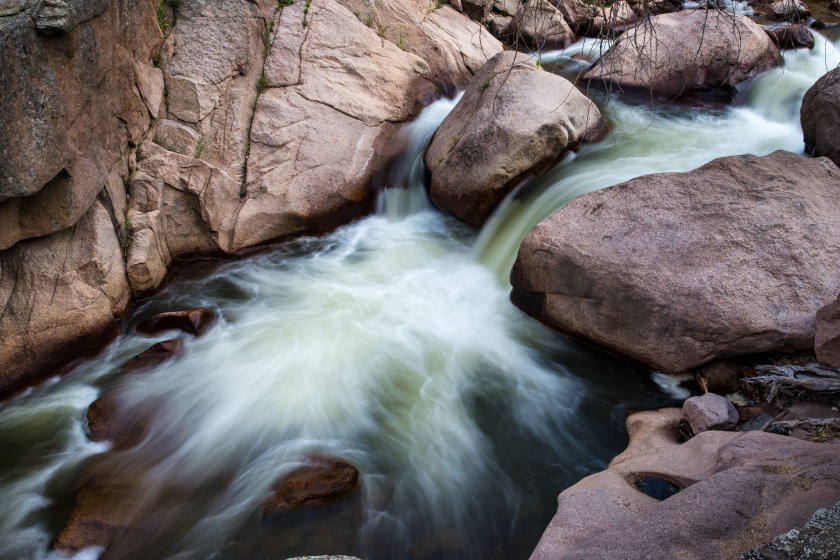
The photograph of a small waterfall along St. Vrain Creek embodies the tension between geological permanence and water’s fleeting essence. Using long exposure, it transforms the scene into a contemplative study of motion and stillness. The intimate scale highlights the beauty of overlooked subjects, emphasizing the profound within Colorado’s landscapes.

Long exposure view of a small waterfall flowing through smooth granite boulders along St. Vrain Creek.
A small waterfall flows between granite rocks along St. Vrain Creek in northern Colorado.

Within the third chapter of Greg Urbano’s Top 100 Journey—devoted to Colorado Landscapes & Cityscapes—this long exposure photograph of the St. Vrain presents a meditation on the fundamental tension between geological permanence and hydrological flux. The image captures a modest cascade in Northern Colorado, yet its technical execution elevates what might be considered a commonplace subject into something altogether more contemplative.

The photographer’s decision to employ long exposure proves essential to the work’s success. Water, rendered as gossamer curtains of white and pale green, flows through the frame with an almost supernatural quality. This technique transforms the kinetic energy of rushing water into something visually paradoxical: movement frozen into silken stillness. The effect creates a temporal ambiguity that refuses to commit to either instant or duration, existing instead in a liminal space between photographic modes.

Compositionally, the work demonstrates a sophisticated understanding of how natural forms interact within the frame. Pink-hued granite boulders, weathered and moss-touched, provide structural anchors throughout the image. These stones—products of millennia—stand in stark contrast to the ephemeral blur of water that has shaped them. The photographer positions these elements with careful attention to visual weight and balance, allowing the eye to trace pathways through the composition that mirror the water’s own journey through the rocky terrain.

The color palette reveals itself as deliberately restrained. Warm earth tones of pink and tan granite dominate, punctuated by touches of green moss and the cool, milky whites of the flowing water. This chromatic restraint prevents the image from becoming overly dramatic, instead maintaining the documentary authenticity that characterizes much of this chapter’s work. The photographer resists the temptation to over-saturate or manipulate, trusting the natural beauty of the Colorado landscape to speak for itself.

What distinguishes this photograph within the broader context of the Colorado Landscapes & Cityscapes chapter is its intimate scale. Rather than pursuing the grand vistas often associated with Rocky Mountain photography, the work turns its attention to a more modest subject—a small waterfall that countless hikers might pass without particular notice. This choice reflects a maturing sensibility within the photographer’s practice, one that finds profundity in the overlooked rather than the obvious.

The technical execution warrants recognition as well. Managing long exposure in daylight conditions requires careful control of light through neutral density filtration and precise shutter speed calculation. The photographer has balanced these elements skillfully, maintaining detail in both the highlighted water and shadowed crevices of stone. Branches visible at the top of the frame remain relatively sharp, suggesting a shutter speed calibrated to render water motion without sacrificing all structural definition in the surrounding environment.

Within the arc of the Top 100 Journey project, this image represents an important moment of focus. The work demonstrates that landscape photography need not rely on sweeping panoramas or dramatic weather to achieve visual and emotional resonance. Instead, it proposes that careful attention to the quotidian—to the small waterfalls tucked into Northern Colorado’s piedmont—can yield images of equal contemplative depth. The St. Vrain Waterfall stands as evidence of a photographer learning to see not just the spectacular, but the quietly profound.

Long Exposure Dillon Reservoir: A Study in Temporal Meditation

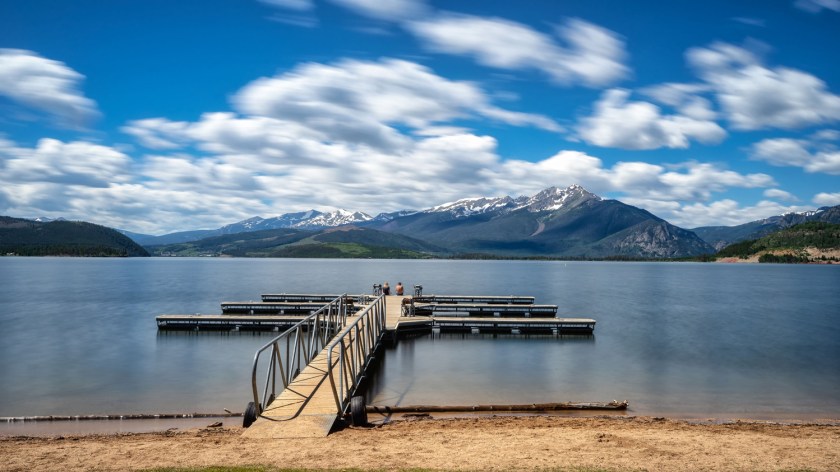
The photograph from Dillon Reservoir near Silverthorne, Colorado, features a dock leading into tranquil waters, showcasing the photographer’s technical skill and evolving artistic vision. Utilizing long exposure, the image captures a balance of nature and human infrastructure, encouraging contemplation on time, landscape, and accessibility, while inviting viewers to engage further with their surroundings.

Long exposure view of a dock extending into Dillon Reservoir with mountains and blurred clouds in the background.
A dock extends into Dillon Reservoir near Silverthorne, Colorado, with mountains rising beyond the water.

In this carefully composed study from Dillon Reservoir, the photographer employs extended exposure to transform a commonplace mountain scene into something approaching the transcendent. The image stands as a compelling entry within Chapter 3 of his Top 100 Journey, demonstrating a technical maturity and conceptual clarity that marks his evolving engagement with Colorado’s diverse landscapes.

The composition centers on a weathered dock extending into the reservoir’s calm waters, its wooden walkway and metal railings leading the viewer’s eye toward distant figures positioned at the structure’s terminus. By utilizing a 10-stop neutral density filter with his Sony A7II, the photographer has rendered the water as a glassy, almost ethereal surface—its texture smoothed into gradations of subtle color that suggest movement while paradoxically conveying absolute stillness. This temporal compression transforms fleeting moments into something more permanent, inviting contemplation of how we perceive and record the passage of time.

The technical execution reveals a photographer comfortable with his equipment’s capabilities and limitations. Working with the camera’s kit lens, he has extracted remarkable clarity across the frame, from the sandy foreground through the architectural elements of the dock to the snow-capped peaks beyond. The slight motion blur in the clouds—streaked horizontally across an impeccable blue sky—provides visual rhythm and suggests the duration of the exposure without overwhelming the image’s serene character.

What distinguishes this photograph within the Colorado landscapes chapter is its successful marriage of the state’s iconic mountain scenery with human infrastructure. Rather than presenting wilderness in isolation, the image acknowledges recreational use and accessibility, grounding the sublime natural setting in contemporary experience. The dock becomes a metaphor for our relationship with landscape—a point of interface, an invitation to venture further, a structure that both facilitates and frames our encounter with nature.

Compositionally, the photographer demonstrates sophisticated understanding of visual weight and balance. The curved railing in the immediate foreground creates dynamic entry into the frame, while the horizontal platforms and vertical posts establish geometric order against the organic forms of mountains and clouds. The small human figures at the dock’s end provide crucial scale, reminding viewers of the landscape’s monumentality while suggesting contemplative communion with place.

The color palette rewards close examination. Warm sandy tones in the foreground transition to the cool grays and blues of water and sky, punctuated by the brilliant whites of snow and cloud. This chromatic progression creates depth while maintaining overall tonal harmony. The long exposure has also produced subtle color shifts in the water, where reflected sky and submerged earth combine into something neither purely blue nor brown but somewhere beautifully between.

Within the broader context of his Top 100 Journey, this image represents a photographer increasingly confident in his technical command and artistic vision. The decision to work near Silverthorne—accessible from Interstate 70 rather than requiring backcountry expedition—suggests a mature understanding that compelling photographs need not emerge solely from remote locations. Instead, seeing becomes the essential act, recognizing potential in familiar places and applying technique to reveal what casual observation might miss.

This photograph ultimately asks viewers to pause, to consider how we move through landscape and how landscape moves through time. It is work that respects both craft and subject, offering neither mere technical display nor sentimental postcard but something more considered: a meditation on place, presence, and the strange alchemy of photography itself.