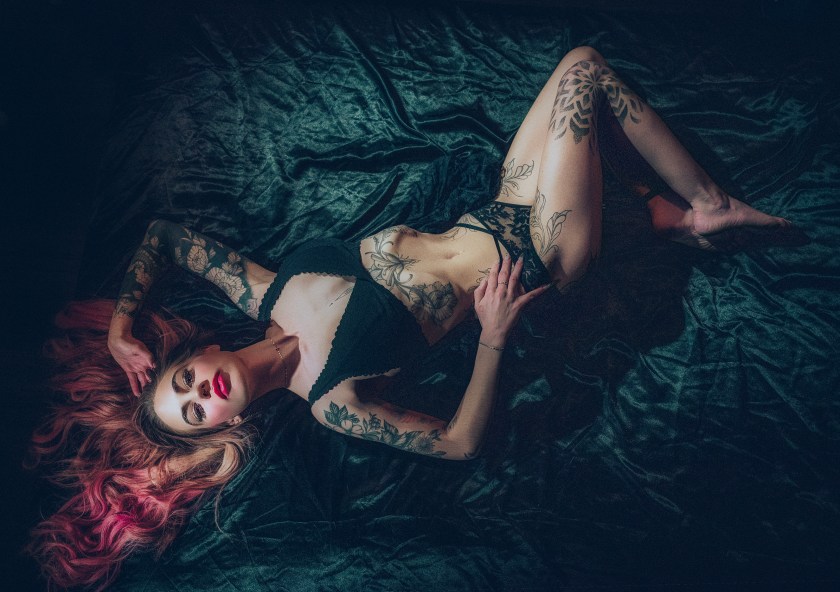
Within Chapter 6’s exploration of recent directions, this portrait represents a deliberate engagement with historical photographic language reimagined through contemporary aesthetics. Created during a workshop at RAW Studios in Denver focused on recreating film noir and 1940s Hollywood glamour, the photographer demonstrates how classical techniques can be subverted and reclaimed through modern sensibilities. The result is an image that exists in productive tension between eras, neither purely nostalgic nor entirely contemporary.
The composition draws immediate lineage to mid-century boudoir photography, yet the execution reveals crucial departures from those conventions. The model—Betty, known professionally as Strawberry Ravecake—reclines against luxurious teal-green velvet that recalls old Hollywood opulence. Her positioning, with head tilted back and limbs arranged in studied repose, references the languorous poses characteristic of 1940s pin-up and glamour photography. However, the extensive floral tattoo work covering her arms, legs, and torso fundamentally transforms the visual narrative. Where golden-age Hollywood demanded unmarked skin as a canvas for projected fantasy, here the body arrives already inscribed with personal history and deliberate aesthetic choices.
The lighting strategy merits particular attention. Deep shadows dominate the frame, with careful modeling that emphasizes dimensional form while maintaining areas of near-total darkness. This chiaroscuro approach—essential to film noir’s visual vocabulary—creates dramatic contrast between illuminated flesh and surrounding void. The photographer employs what appears to be a single key light positioned to camera right, allowing natural falloff to shape the subject rather than filling shadows with secondary sources. This restraint honors noir’s painterly treatment of darkness as an active compositional element rather than merely the absence of light.
Color becomes a strategic departure from strict period authenticity. While classic noir worked exclusively in black and white, the photographer retains the jewel tones of the velvet backdrop and the subject’s vibrant red-to-blonde ombré hair. The black lingerie and bold red lipstick provide chromatic punctuation, creating focal points that guide the viewer’s eye through the composition. This selective use of color acknowledges that contemporary audiences read images differently than their 1940s counterparts; pure monochrome might feel like affectation rather than interpretation.
The workshop context—Portfolio Building for Aspiring Photographers and Models—frames this image as both artistic output and pedagogical artifact. Workshop environments typically emphasize technical mastery and stylistic imitation, yet this photograph transcends mere exercise. The collaborative nature of such sessions, with multiple participants working alongside professional instruction, requires the photographer to synthesize learning in real-time while maintaining artistic vision. That this image earned placement in his Top 100 Journey suggests successful integration of classical technique with personal aesthetic development.
Within Chapter 6’s framework of ongoing exploration, the photograph demonstrates expanded engagement with historical photographic genres. The work reveals an artist comfortable moving between documentary observation, macro intimacy, and now studio-based portraiture. By choosing to engage with noir’s visual language through contemporary bodies and sensibilities, he participates in an ongoing cultural conversation about representation, desire, and the constructed nature of glamour across generations. The velvet wrinkles, the tattoo artistry, and the calculated pose coalesce into an image that respects its influences while asserting its moment.
 Greg Urbano