Suspended Between Earth and Sky: A Study in Geometric Embrace

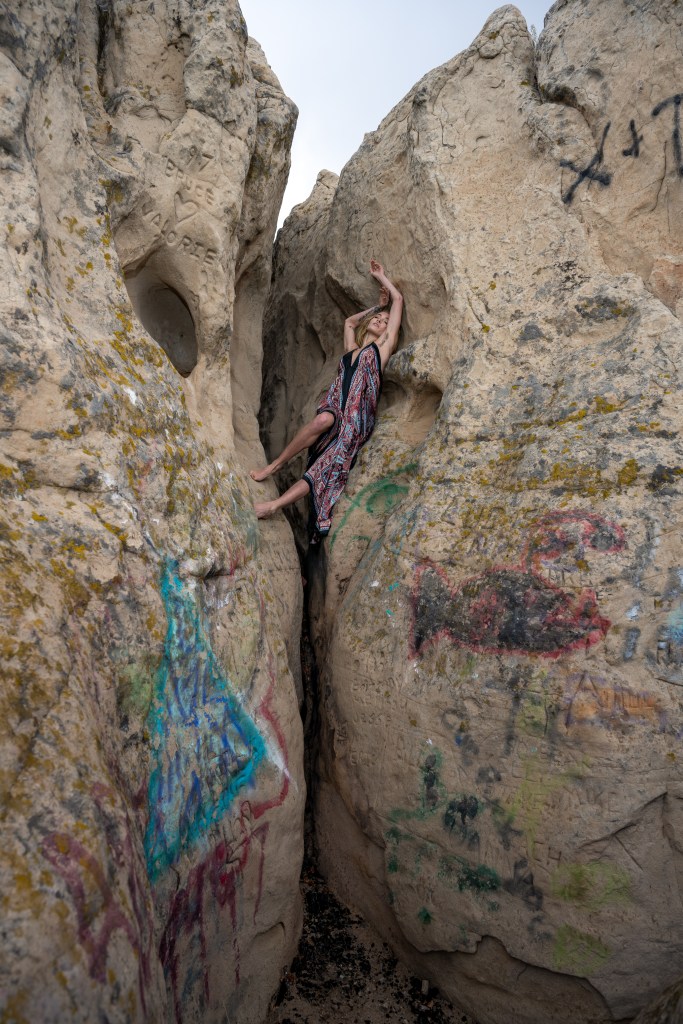
The photograph of Jennie Parks in a sandstone crevice at the Colorado-Wyoming border conveys a powerful interplay between human form and rugged landscape. The composition showcases Parks as both an integral part of the environment and a symbol of human vulnerability, enriched by graffiti that connects ancient rock with contemporary existence.

Model Jennie Parks posed barefoot within a narrow sandstone rock crevice, surrounded by weathered stone walls with graffiti and lichen.
Jennie Parks positioned inside a sandstone crevice at the Natural Fort rock formation on the Colorado–Wyoming border.

In this striking composition from Chapter 6 of the photographer’s Top 100 Journey, the human figure becomes a graceful counterpoint to the harsh geometry of desert stone. Shot at the natural fort rock formation straddling the Colorado-Wyoming border, the image captures model Jennie Parks wedged within a narrow crevasse, her body forming a living bridge between two massive limestone walls that tower overhead.

The photographer demonstrates a sophisticated understanding of environmental portraiture here, positioning his subject not merely within the landscape but as an integral element of its architecture. Parks’s extended pose—one arm reaching upward, legs braced against opposing walls—transforms the human form into a line of tension that mirrors the vertical thrust of the surrounding stone. The patterned fabric of her dress introduces rhythmic visual complexity against the textured, graffiti-marked surfaces of the rock, creating a dialogue between organic movement and geological permanence.

Technically, the composition exploits the natural framing device of the rock formation with considerable skill. The converging walls create strong diagonal lines that draw the eye upward toward the narrow strip of overcast sky, while the low vantage point emphasizes the vertiginous scale of the formation. The photographer has worked with available light to maintain detail in both the shadowed crevasse and the brighter upper reaches, a challenging exposure balance that preserves the dimensional quality of the weathered stone surfaces.

What distinguishes this work within the context of “The Road Ahead: Recent Work & Ongoing Exploration” is its synthesis of earlier themes with new formal rigor. The image continues the photographer’s established interest in the relationship between human vulnerability and natural grandeur, yet demonstrates an evolving sophistication in how that relationship is articulated. Rather than placing the figure as a small element overwhelmed by landscape—a common approach in environmental portraiture—he positions Parks as an active participant in the space’s geometry, neither dominated by nor dominating the scene.

The inclusion of graffiti on the rock faces introduces an unexpected documentary element. These colorful marks of human passage—blue and turquoise abstractions, faded pink tags—situate the timeless geological formation within contemporary reality. Rather than diminishing the image’s aesthetic power, this urban palimpsest enriches the reading: the rock has witnessed countless human gestures, from ancient weathering to modern spray paint to this moment of choreographed grace.

As representative of ongoing exploration, the photograph reveals an artist continuing to refine his visual vocabulary while remaining open to chance encounters and improvisation. The natural fort formation itself suggests the kind of site-responsive work that characterizes mature landscape photography—locations discovered rather than constructed, where the photographer’s role becomes one of recognition and revelation rather than wholesale invention.

In the broader trajectory of the Top 100 Journey, this image marks a moment of confident synthesis. The technical command is assured, the conceptual framework clear, yet there remains an element of spontaneity in how Parks inhabits the narrow space. It is work that looks both backward to established concerns and forward to possibilities yet unrealized—precisely the balance one expects from a chapter titled “The Road Ahead.”
Maia del Mazo: Intimate Focus in Environmental Context

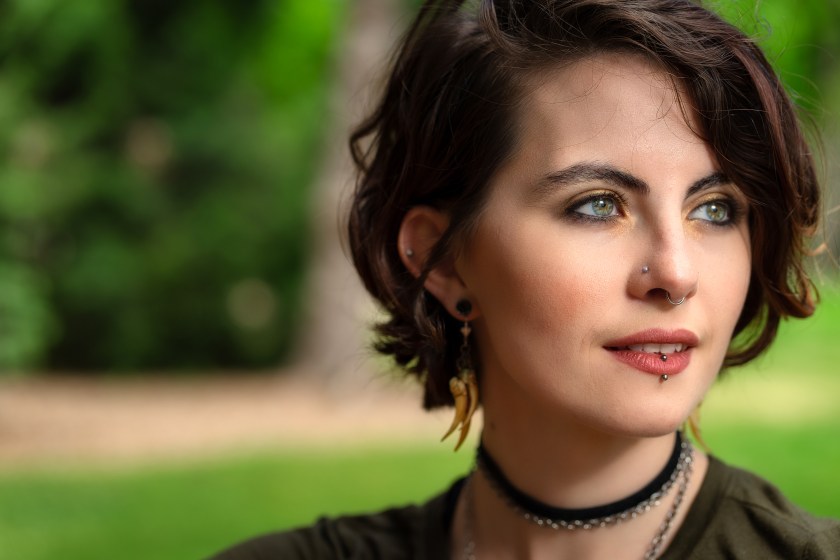
Maia del Mazo’s portrait, taken in City Park, Fort Collins, showcases a sophisticated blend of technical skill and authentic presence in outdoor environmental portraiture. The controlled lighting, tight framing, and engaging gaze create intimacy, emphasizing psychological connection. This work reflects the photographer’s evolving style, merging formal excellence with genuine subject interaction.

Woman with short dark hair and facial piercings looks off-camera in a park, with green foliage softly blurred behind her.
Maia del Mazo is photographed in City Park, Fort Collins, Colorado.

This portrait of Maia del Mazo demonstrates the photographer’s evolving approach to environmental portraiture, where technical control and authentic subject presence converge within naturalistic settings. Created in City Park, Fort Collins, the image exemplifies how careful light management can produce studio-quality results while preserving the atmospheric qualities inherent to outdoor locations.

The composition employs a tight framing strategy that prioritizes facial features and direct eye contact over environmental context. While the verdant park setting remains visible through soft bokeh, it functions primarily as chromatic backdrop—its luminous greens providing color temperature contrast against the subject’s warm skin tones and earth-toned clothing. This compositional choice reflects a portrait philosophy centered on psychological connection rather than contextual documentation, using location as supporting element rather than co-protagonist.

The lighting execution reveals refined outdoor flash technique. Employing a single strobe with shoot-through umbrella, the photographer has created illumination that appears both directional and enveloping. The soft light wraps around facial contours with dimensional subtlety, evident in the delicate shadow transitions beneath the cheekbones and jawline. This quality suggests careful modifier positioning—likely placed to camera left, creating gentle modeling while maintaining even exposure across the subject’s face. The approach successfully mimics the flattering characteristics of window light or late-day sun while providing consistent exposure control impossible with ambient illumination alone.

The subject’s direct gaze creates immediate engagement, her slight smile and relaxed demeanor suggesting collaborative rapport rather than performative posing. The styling elements—including visible piercings, layered chokers, and olive-toned garment—construct contemporary identity markers that the photographer neither emphasizes nor downplays, allowing personal expression to coexist naturally with formal portrait structure. This balance between individual authenticity and aesthetic cohesion marks a mature approach to contemporary portraiture.

Technical choices throughout support the image’s intimate character. The Sony 85mm f/1.8 lens, deployed at wide aperture on the Sony A7II, produces the shallow depth of field that isolates the subject while maintaining sharpness across critical focal planes. The resulting background compression creates spatial ambiguity—the viewer understands outdoor context without distraction from precise environmental detail. Post-processing in Luminar 4 has enhanced color separation, particularly emphasizing the complementary relationship between cool background tones and warm subject illumination.

Within Chapter 4’s examination of portrait methodologies, this photograph represents outdoor work informed by studio sensibility. The technical execution—single light source, controlled depth of field, precise subject positioning—demonstrates principles typically associated with interior photography adapted to location constraints. This synthesis suggests workshop-influenced learning, where traditional lighting fundamentals are studied and subsequently applied across varied environments.

The image also reflects broader developments in his portrait practice. Compared to more environmental portraits that incorporate gesture and setting, this work focuses attention inward, using technical precision to facilitate psychological presence. The direct gaze and tight framing create intimacy despite the public park location, demonstrating how formal control can serve rather than diminish authentic connection.

As part of his Top 100 Journey documentation, this portrait affirms the photographer’s technical versatility while revealing his growing interest in portraiture that balances formal excellence with genuine subject engagement. It represents work where technical mastery becomes invisible infrastructure—present in every aspect of execution yet never overshadowing the essential human element at the photograph’s center.