Milky Way Interrupted: The Anthropocene Inscribed in Starlight

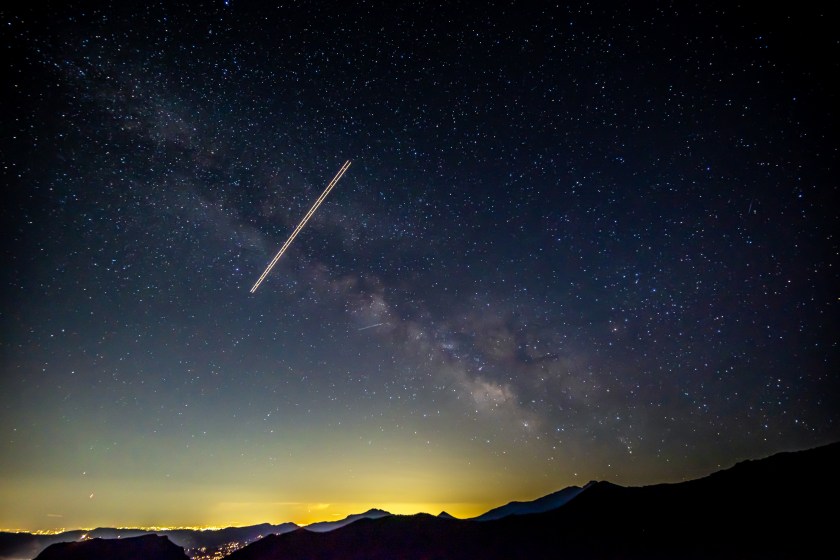
“Milky Way Interrupted,” a photograph by Greg Urbano, captures a unique blend of three realities—the Milky Way, Colorado mountains, and an aircraft’s light trail. This interplay creates tension between the timeless cosmos and modern human impact, emphasizing how even remote landscapes reflect our influence. The image invites varied interpretations while acknowledging evolving wilderness photography’s complexities.

The Milky Way stretches across a star-filled night sky above silhouetted mountain ridges, with a bright aircraft light trail crossing the stars.
The Milky Way appears above the mountains of Rocky Mountain National Park as an aircraft passes through the night sky near Rainbow Curve.

Among the selections comprising Chapter 3 of Greg Urbano’s Top 100 Journey, “Milky Way Interrupted” stands as perhaps the most conceptually layered work—a photograph that captures not one subject but three distinct temporal and spatial realities coexisting within a single frame. Captured from Rainbow Curve in Rocky Mountain National Park, the image presents the galactic core of the Milky Way, the ancient mountain silhouettes of Colorado’s high country, and a striking diagonal light trail that bisects the celestial display with unmistakable human presence.

The composition’s power lies precisely in this interruption. The aircraft’s light trail—rendered as a warm, golden-orange streak through long exposure—cuts diagonally across the frame, creating a dynamic tension between the timeless and the contemporary. While astrophotography typically seeks to eliminate such intrusions, this photographer has embraced the collision, transforming what might be considered a technical flaw into the photograph’s conceptual strength. The work becomes a document of our current moment, when even the most remote wilderness viewing points cannot escape the signatures of human movement across the planet.

Technical execution reveals careful consideration of the challenges inherent to night sky photography. Shot with a Nikon Z5, the image demonstrates the full-frame sensor’s capability to resolve stellar detail while managing the noise characteristics of extended ISO settings. The photographer has successfully balanced multiple exposure considerations: maintaining star sharpness through appropriate shutter speed selection, capturing the subtle gradations of airglow near the horizon, and rendering the mountainous foreground as legible silhouettes rather than featureless black masses.

The color palette deserves particular attention. The frame transitions from deep indigo and blue-black in the upper reaches, through the dusty rose and purple tones of the galactic core, down to the unexpected warmth of light pollution painting the horizon in amber and gold. This terrestrial glow—emanating from Front Range cities invisible beyond the mountains—creates an almost painterly quality along the lower third of the composition. The photograph thus captures three light sources simultaneously: starlight millions of years old, the reflected sunlight from a pressurized aluminum tube at 35,000 feet, and the collective illumination of human civilization diffused through atmosphere and distance.

Within the context of the Colorado Landscapes & Cityscapes chapter, this work occupies a unique position. It represents the photographer’s willingness to document Colorado not as pristine wilderness separate from human influence, but as a landscape inevitably marked by contemporary life. The image acknowledges that wilderness photography in the 21st century must contend with satellite constellations, flight paths, and light pollution—that the “natural” landscape exists now only in relationship to human infrastructure.

The title’s simple declaration—”Interrupted”—functions with appropriate restraint. It states fact without judgment, allowing viewers to bring their own interpretations to the juxtaposition. Some may read the aircraft trail as intrusion, others as a reminder of our species’ brief moment against cosmic timescales. The photographer wisely resists imposing a singular reading, instead presenting the visual evidence and trusting the inherent complexity of the image to generate meaning. This restraint marks a mature approach to landscape photography’s evolving role in documenting our changing relationship with the natural world.

St. Vrain Waterfall: A Study in Motion and Permanence

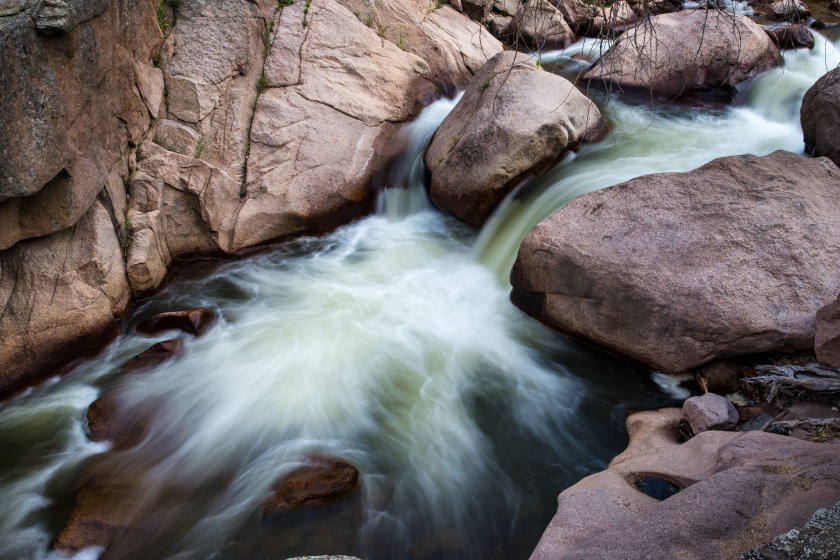
The photograph of a small waterfall along St. Vrain Creek embodies the tension between geological permanence and water’s fleeting essence. Using long exposure, it transforms the scene into a contemplative study of motion and stillness. The intimate scale highlights the beauty of overlooked subjects, emphasizing the profound within Colorado’s landscapes.

Long exposure view of a small waterfall flowing through smooth granite boulders along St. Vrain Creek.
A small waterfall flows between granite rocks along St. Vrain Creek in northern Colorado.

Within the third chapter of Greg Urbano’s Top 100 Journey—devoted to Colorado Landscapes & Cityscapes—this long exposure photograph of the St. Vrain presents a meditation on the fundamental tension between geological permanence and hydrological flux. The image captures a modest cascade in Northern Colorado, yet its technical execution elevates what might be considered a commonplace subject into something altogether more contemplative.

The photographer’s decision to employ long exposure proves essential to the work’s success. Water, rendered as gossamer curtains of white and pale green, flows through the frame with an almost supernatural quality. This technique transforms the kinetic energy of rushing water into something visually paradoxical: movement frozen into silken stillness. The effect creates a temporal ambiguity that refuses to commit to either instant or duration, existing instead in a liminal space between photographic modes.

Compositionally, the work demonstrates a sophisticated understanding of how natural forms interact within the frame. Pink-hued granite boulders, weathered and moss-touched, provide structural anchors throughout the image. These stones—products of millennia—stand in stark contrast to the ephemeral blur of water that has shaped them. The photographer positions these elements with careful attention to visual weight and balance, allowing the eye to trace pathways through the composition that mirror the water’s own journey through the rocky terrain.

The color palette reveals itself as deliberately restrained. Warm earth tones of pink and tan granite dominate, punctuated by touches of green moss and the cool, milky whites of the flowing water. This chromatic restraint prevents the image from becoming overly dramatic, instead maintaining the documentary authenticity that characterizes much of this chapter’s work. The photographer resists the temptation to over-saturate or manipulate, trusting the natural beauty of the Colorado landscape to speak for itself.

What distinguishes this photograph within the broader context of the Colorado Landscapes & Cityscapes chapter is its intimate scale. Rather than pursuing the grand vistas often associated with Rocky Mountain photography, the work turns its attention to a more modest subject—a small waterfall that countless hikers might pass without particular notice. This choice reflects a maturing sensibility within the photographer’s practice, one that finds profundity in the overlooked rather than the obvious.

The technical execution warrants recognition as well. Managing long exposure in daylight conditions requires careful control of light through neutral density filtration and precise shutter speed calculation. The photographer has balanced these elements skillfully, maintaining detail in both the highlighted water and shadowed crevices of stone. Branches visible at the top of the frame remain relatively sharp, suggesting a shutter speed calibrated to render water motion without sacrificing all structural definition in the surrounding environment.

Within the arc of the Top 100 Journey project, this image represents an important moment of focus. The work demonstrates that landscape photography need not rely on sweeping panoramas or dramatic weather to achieve visual and emotional resonance. Instead, it proposes that careful attention to the quotidian—to the small waterfalls tucked into Northern Colorado’s piedmont—can yield images of equal contemplative depth. The St. Vrain Waterfall stands as evidence of a photographer learning to see not just the spectacular, but the quietly profound.

Boulder Falls Long Exposure

The photograph of Boulder Falls captures the intricate interplay of water and rock in Colorado’s canyon, showcasing the photographer’s mastery of long exposure techniques. Using a Nikon D610, the image balances smooth water motion with structural clarity. This work signifies a matured artistic voice within the broader context of his evolving landscape photography.

Long-exposure view of Boulder Falls flowing over rocks into a shallow pool within a rocky canyon.
Long-exposure photograph of Boulder Falls cascading through a rocky canyon in Colorado.

The photographer’s mastery of long exposure technique reaches full maturity in this commanding portrait of Boulder Falls, where water, stone, and light converge in a composition of remarkable spatial depth and textural complexity. Captured with a Nikon D610 and an 18-35mm f/3.5-4.5 lens at its widest setting of 18mm, the image employs a half-second exposure at ƒ/4.0 and ISO 100 to render cascading water as ethereal veils against the canyon’s ancient geological architecture.

The composition operates on multiple planes, drawing the eye through a carefully orchestrated visual journey. In the immediate foreground, stream-smoothed boulders—some dry and tan, others wet and rust-colored—create a rocky platform that grounds the viewer’s perspective. Water flows around and between these stones in delicate ribbons, their motion captured as soft blur that contrasts with the sharp detail of stationary rock. The middle ground presents the falls itself, a luminous white cascade plunging through a dramatic cleft in the granite amphitheater. Finally, the background reveals towering rock walls in warm earth tones, their fractured surfaces speaking to millennia of geological upheaval, crowned by evergreen forest and a brilliant blue sky.

What distinguishes this work from countless waterfall photographs is the photographer’s sophisticated understanding of how long exposure serves composition rather than merely creating predictable aesthetic effects. The half-second shutter speed proves precisely calibrated—long enough to smooth the water into silken forms while short enough to preserve structural definition in the cascade. The falls maintain sculptural presence rather than dissolving into amorphous white masses. Similarly, the foreground stream retains enough texture and gradation to read as water in motion rather than abstract blur.

The technical choices reveal deliberate control over the medium. The wide 18mm focal length encompasses the entire scene’s grandeur while maintaining exceptional corner-to-corner sharpness, crucial when working with such complex spatial relationships. The ƒ/4.0 aperture balances depth of field considerations—keeping both foreground rocks and distant walls acceptably sharp—with the light reduction necessary for the extended exposure. At ISO 100, the image maintains optimal clarity across its tonal range, from the brightest highlights in the falling water to the shadowed crevices in the surrounding stone.

The inclusion of this photograph in Chapter 3—Colorado Landscapes & Cityscapes—marks a significant development in the photographer’s journey. Where earlier chapters saw him exploring beyond Florida’s boundaries, this chapter formalizes Colorado as a central subject within his practice. The image embodies what might be termed “high country aesthetics”: the interplay of water and granite, the vertical drama of canyon topography, the crystalline light of elevated altitude. These elements recur throughout Rocky Mountain landscape photography, yet the photographer brings fresh eyes to familiar territory through precise craft and compositional intelligence.

Within the broader context of the Top 100 Journey project, “Boulder Falls Long Exposure” represents an artist who has moved beyond technical experimentation toward mature artistic voice. The photograph demonstrates that mastery emerges not from discovering novel techniques but from wielding established ones with intention, subtlety, and unwavering attention to the specific demands of place and moment.

Black Forest

The photograph “Black Forest,” taken along Colorado Highway 14 in the Roosevelt National Forest, captures the aftermath of wildfire with striking clarity. The image, presented in monochrome, highlights resilience amidst destruction, showcasing charred pine trees against snow. Through meticulous technical execution, the artist transforms environmental tragedy into profound visual poetry.

all, fire-scarred pine trees rise from a snow-covered forest under an overcast winter sky.
Fire-scarred pine trees stand in deep snow along Colorado Highway 14 in the Roosevelt National Forest.

Stark verticality defines this haunting monochrome study captured along Colorado Highway 14 in the Roosevelt National Forest, where the photographer confronts the aftermath of wildfire with unflinching clarity. Titled “Black Forest,” the image transforms environmental tragedy into a meditation on resilience, absence, and the stark beauty found in landscapes marked by upheaval. Shot with a Sony Alpha a7 II equipped with a Samyang AF 18mm f/2.8 lens, the technical specifications—ƒ/11.0, 1/200s, ISO 100—reveal a photographer working with precision to render both foreground detail and atmospheric depth.

The composition presents a forest reduced to skeletal architecture. Charred pines, stripped of foliage by fire, rise as dark sentinels against pristine snow cover and a brooding sky. The wide-angle perspective at 18mm creates exaggerated depth, pulling the viewer into this expanse of vertical repetition. Trees march rhythmically across the frame, their bare trunks creating a natural grid that speaks simultaneously to destruction and order. The interplay between the blackened wood and white snow generates maximum tonal contrast—a decision reinforced by the photographer’s choice to render the scene in black and white during post-processing.

This monochromatic treatment proves essential to the image’s power. By eliminating color, the photographer strips away potential distraction, forcing attention to form, texture, and the dramatic chiaroscuro that defines the scene. The absence of color becomes metaphorically resonant, echoing the absence of living foliage. Shadows stretch across the snow-covered ground, cast by winter sun through the denuded canopy, creating secondary patterns that add visual complexity to the stark tableau.

The technical execution demonstrates sophisticated understanding of landscape photography fundamentals. The aperture choice of ƒ/11.0 provides substantial depth of field, ensuring sharpness from the foreground trees through to the distant background, while the relatively fast shutter speed of 1/200s freezes any potential wind movement in the upper branches. At ISO 100, the image maintains optimal clarity and tonal gradation—critical considerations when working in monochrome, where subtle gradations between black and white carry significant expressive weight.

The image’s inclusion within Chapter 2—Florida Landscapes & Cityscapes—continues the geographical expansion evident in this photographer’s evolving project. Again working far from Florida’s borders, he engages with Rocky Mountain topography and ecological narrative. This persistent geographic departure suggests an artist whose vision transcends regional documentation, seeking instead to explore universal themes of landscape transformation, human impact, and natural regeneration across diverse environments.

What distinguishes this work from mere documentation of fire damage is its formal rigor and unexpected aesthetic grace. The photographer finds pattern and rhythm in catastrophe, transforming a scarred forest into something approaching abstract composition. The trees function as both individual subjects and collective form—a forest that remains a forest even in its diminished state.

Within the broader context of the Top 100 Journey project, “Black Forest” represents an artist willing to engage with difficult environmental subjects while maintaining commitment to visual poetry. The photograph neither exploits tragedy nor sanitizes it, instead offering honest witness rendered through thoughtful craft—a balance that marks mature artistic vision.

Big Thompson Long Exposure

The photograph of the Big Thompson River showcases a masterful interplay of permanence and fluidity through long exposure techniques. Captured in Colorado, the image emphasizes detail in granite boulders alongside soft, flowing water. It reflects the photographer’s evolving artistic journey, expanding thematic boundaries while presenting a cohesive and naturalistic landscape composition.

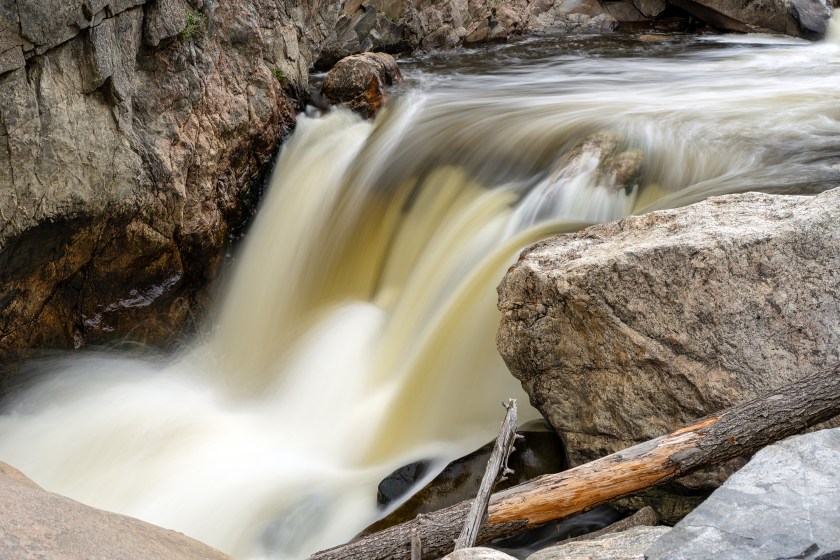
Long exposure view of fast-moving water flowing over a rocky drop on the Big Thompson River between granite boulders.
Water flows over a small rocky drop along the Big Thompson River, photographed with a long exposure.

The photographer’s technical mastery converges with natural drama in this commanding study of the Big Thompson River, captured in Colorado’s rugged high country. Shot with a Sony Alpha a7 II paired with the Sony FE 28-70mm f/3.5-5.6 OSS lens at 62mm, the image employs long exposure technique enhanced by neutral density filtration to transform rushing water into ethereal ribbons of motion. At ƒ/9.0 and ISO 50, the exposure settings reveal a deliberate approach to capturing both sharpness in the surrounding geology and the silken blur of flowing water.

What immediately arrests the viewer is the dramatic interplay between permanence and fluidity. Massive granite boulders—textured, ancient, immovable—frame a cascade that appears simultaneously powerful and gossamer-soft. The long exposure technique transforms the torrent into bands of cream and amber, creating visual movement that guides the eye through the composition in sweeping arcs. The golden tint in the water suggests the presence of sediment or tannins, lending warmth to what might otherwise read as a cool mountain scene.

The compositional architecture demonstrates sophisticated understanding of visual weight and balance. A substantial boulder occupies the right foreground, its weathered surface rendered in exquisite detail, while a piece of driftwood creates a diagonal element that adds depth and natural geometry. The left side reveals stratified rock walls, their vertical presence providing counterpoint to the horizontal flow. This triangulation of elements—stone, water, wood—creates a cohesive environmental portrait rather than merely documenting a waterfall.

The inclusion of this image within Chapter 2—Florida Landscapes & Cityscapes—presents an intriguing curatorial question. Clearly captured in Colorado’s Rocky Mountain ecosystem rather than Florida, the photograph signals an expansion in the photographer’s geographical scope and thematic boundaries. This apparent departure from the chapter’s titular focus suggests an evolving artistic journey, one where the photographer moves beyond regional constraints to explore universal themes of landscape and natural process. Perhaps the chapter title reflects the photographer’s home base or primary focus, while individual works demonstrate his widening field of exploration.

The technical execution reveals growing confidence with long exposure photography as a expressive tool. The neutral density filter allows for extended exposure times in daylight conditions, creating that characteristic motion blur while maintaining proper exposure across the frame’s dynamic range. The choice of ƒ/9.0 ensures adequate depth of field to keep both foreground rocks and background elements acceptably sharp, a critical consideration in landscape work where context matters as much as subject.

What elevates this beyond technical exercise is the photographer’s eye for natural composition. The cascade’s S-curve creates inherent grace, while the careful positioning relative to the boulder forms suggests patient observation and deliberate framing. The subdued color palette—grays, tans, muted greens—speaks to naturalistic rendering rather than heightened saturation, allowing texture and form to dominate over chromatic spectacle.

Within the broader trajectory of the Top 100 Journey project, this image represents an artist testing boundaries and methodologies. It demonstrates that landscape photography, when executed with technical precision and compositional awareness, can reveal the sublime within the observable—the eternal dance between stone and water, stillness and motion, captured in a single decisive exposure.

City Pier on Anna Maria Island: A Study in Patience and Atmospheric Drama

The long exposure photograph of the City Pier on Anna Maria Island captures the unique interplay of land, water, and sky under dramatic storm clouds. Through technical mastery, the image transforms fleeting moments into timelessness, blending sharp details of the pier with ethereal human figures and smooth water, reflecting deep engagement with Florida’s coastal landscapes.

Long exposure photograph of the City Pier on Anna Maria Island, showing a wooden pier leading to a waterfront building under dark storm clouds.
Long exposure view of the City Pier on Anna Maria Island beneath dramatic storm clouds.

Within the photographer’s carefully curated Top 100 Journey, this long exposure study of the City Pier on Anna Maria Island stands as a masterful example of how technical discipline can amplify emotional resonance. Positioned within Chapter 2—Florida Landscapes & Cityscapes—the image demonstrates a sophisticated understanding of the Gulf Coast’s unique visual character, where land, water, and sky exist in constant, subtle negotiation.

The composition reveals itself through classical simplicity: a weathered wooden pier extends from foreground to middle distance, leading the viewer’s eye toward a modest building crowned with an American flag. Yet what elevates this photograph beyond documentary record is the photographer’s deliberate manipulation of time itself. Shot with a fifteen-second exposure at f/18, the image transforms fleeting atmospheric conditions into something more permanent and contemplative. The threatening cloud formations above, rather than appearing frozen in mid-motion, achieve a painterly quality—their movement compressed and softened into bands of gray and white that suggest both weight and ethereality.

This temporal expansion creates a fascinating duality throughout the frame. While the pier’s wooden planks remain sharp and detailed, bearing the textural evidence of salt air and countless footfalls, the human figures near the building dissolve into ghostly presences, their individual identities surrendered to the longer rhythm of place. The water, too, undergoes transformation; what would typically appear as distinct waves and surface texture becomes a smooth, almost metallic gradient stretching from jade green to soft gray, merging seamlessly with the horizon.

The technical execution here deserves careful consideration. Working with a Nikon D610 and an 18-35mm lens set to 35mm, the photographer has achieved remarkable sharpness across the entire frame. The f/18 aperture ensures deep depth of field while the ISO 100 setting maintains clean tonal gradations essential for the image’s subtle atmospheric rendering. These choices reflect not mere technical competence but aesthetic intention—a desire to capture both concrete detail and ephemeral mood simultaneously.

Within the broader context of Chapter 2, this photograph exemplifies the photographer’s evolving relationship with Florida’s coastal environments. Where lesser practitioners might seek the obvious drama of golden hour or storm-tossed seas, he finds complexity in overcast conditions and the patient observation they demand. The image refuses easy categorization: it is neither purely documentary nor overtly romantic, but occupies a thoughtful middle ground where observation and interpretation merge.

The architectural elements—particularly the modest pier building with its peaked roof and practical design—anchor the composition in specificity while the long exposure technique universalizes the experience. This is simultaneously a portrait of a particular place and a meditation on impermanence, on how human structures persist while human presence itself becomes fluid and uncertain.

As part of a long-term project, this photograph suggests an artist committed to deep engagement rather than superficial tourism. The willingness to wait for proper atmospheric conditions, to set up the necessary equipment for extended exposures, and to see beyond the immediate toward something more contemplative marks this as serious photographic inquiry. Within his Top 100 Journey, it stands as evidence that Florida’s landscapes, often dismissed as visually unchallenging, reward patient observation with unexpected subtlety and depth.

Passage Through Green: Corkscrew Swamp Sanctuary

The photograph from the Corkscrew Swamp Sanctuary captures the harmonious relationship between human infrastructure and Florida’s natural environment. The cypress boardwalk invites viewers into an intricate ecosystem, showcasing careful light management and depth. By depicting the balance of accessibility and preservation, it highlights Florida’s ecological significance and the need for conservation.

Wooden boardwalk winding through tall cypress trees and dense green foliage at Corkscrew Swamp Sanctuary, with dappled sunlight on the path.
Cypress Boardwalk at Corkscrew Swamp Sanctuary (2014)

In this luminous study from the Corkscrew Swamp Sanctuary, the photographer presents Florida’s natural landscape not as wilderness observed from a distance, but as an invitation to passage—a curated encounter between human infrastructure and primeval forest. The cypress boardwalk becomes both subject and compositional device, leading the viewer into a cathedral of green light that speaks to the delicate negotiation between preservation and access.

The technical approach reveals careful consideration of the swamp’s challenging photographic conditions. Working at ISO 100 with a half-second exposure at f/16, the photographer has maximized depth of field while maintaining exceptional image quality. This combination renders crisp detail from the weathered planks of the boardwalk through to the layered canopy above, where backlit foliage creates a luminous gradient from deep shadow to radiant yellow-green. The 24mm focal length—a moderate wide-angle perspective—provides visual breadth without the distortion that might compromise the scene’s natural proportions.

What distinguishes this image is its masterful handling of light. Shooting within the swamp’s dense canopy during what appears to be late morning or early afternoon, the photographer has captured the moment when sunlight penetrates the upper canopy, creating an almost ethereal glow. The graduated tonalities—from the shadowed foreground through the mid-tones of the boardwalk to the brilliant highlights beyond—establish a sense of progression and discovery. The exposure value suggests deliberate retention of highlight detail in what could easily have become overblown areas of white, instead preserving the textural complexity of individual leaves and branches.

The boardwalk itself serves multiple compositional functions. Its strong linear perspective creates depth and movement, drawing the eye inexorably toward the illuminated center. The railings function as framing elements, containing the viewer’s gaze while suggesting the carefully managed interaction between visitors and ecosystem. The warm tones of the aged wood provide chromatic relief from the overwhelming green, grounding the image in the tangible reality of human construction within natural space.

Within Chapter 2’s exploration of Florida landscapes, this photograph represents a significant counterpoint to the architectural documentation of the Dalí Museum. Where that image examined cultural infrastructure against an urban backdrop, this work investigates environmental infrastructure—the pathways that allow observation without destruction. The photographer recognizes that Florida’s identity is inextricably linked to its threatened ecosystems, and that contemporary experience of these spaces is mediated by such interventions.

The cypress trunks, standing as dark vertical elements throughout the frame, provide rhythmic structure while emphasizing scale. Their substantial girth and textured bark speak to age and resilience, while the dense understory of ferns visible in the lower portions of the frame suggests the biodiversity these swamp systems support. The photographer has captured not merely a scenic vista but a complex ecological narrative.

This image demonstrates the photographer’s evolving understanding of Florida’s duality—a place where nature and human presence exist in constant negotiation. The boardwalk, rather than intruding upon the swamp, becomes evidence of a conservation ethic, allowing passage while preserving the delicate substrate below. In documenting this careful balance, the photographer offers a vision of Florida that transcends tourism, revealing instead a landscape worthy of sustained attention and protection.