The Zipper: Temporal Geometry in Motion

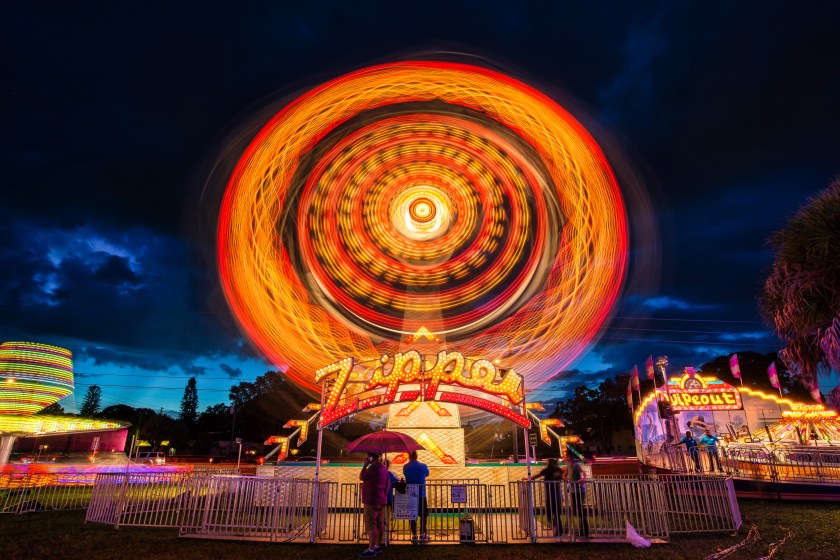
Greg Urbano’s photograph of the Zipper ride at a Florida carnival uniquely transforms the concept of landscape photography. By capturing swirling light trails during twilight, it emphasizes the intersection of cultural and physical landscapes. The image reveals the dynamic nature of our experiences, illustrating how ephemeral entertainment shapes collective identity in Florida.

Long exposure photograph of the Zipper carnival ride at night, creating circular light trails in vivid colors with people standing below.
Long exposure night view of the Zipper ride creating swirling light trails at a carnival.

Within Chapter 2 of Greg Urbano’s Top 100 Journey, this carnival ride photograph stands as a compelling exploration of how Florida’s cultural landscape extends beyond its natural and architectural features into the realm of ephemeral entertainment. The image captures the Zipper in full rotation during twilight hours, transforming a traveling carnival attraction into a blazing mandala of light and motion that challenges traditional notions of what constitutes a “landscape.”

The photographer’s technical execution is precise and purposeful. Working with a Nikon D610 at 18mm, he has employed a six-second exposure at f/22 and ISO 100 to record not the ride itself, but rather the luminous trace of its movement through space. This approach fundamentally alters the subject’s visual character—what would typically appear as a stationary mechanical structure becomes instead a dynamic sculptural form composed entirely of light trails. The concentric circles of orange, red, and yellow fire outward from a brilliant white core, creating a hypnotic pattern that suggests both solar imagery and abstract expressionist painting.

The compositional framework demonstrates sophisticated spatial awareness. The ride occupies the central position, its circular motion perfectly framed against a deepening blue sky where storm clouds gather at the horizon. Silhouetted figures stand before the ticket booth in the immediate foreground, their stillness providing human scale and anchoring the viewer’s perspective. These stationary forms create a deliberate counterpoint to the violent spinning above them, emphasizing through contrast the temporal nature of the photographer’s chosen exposure duration.

Environmental context enriches the reading of this work. The characteristic Florida palm trees visible at right, the flat terrain, and the quality of the twilight atmosphere all ground the image firmly within the state’s visual vocabulary. Additional carnival rides glow at the periphery—including what appears to be a carousel and swing ride—establishing this as a comprehensive documentation of Florida’s traveling fair culture, a seasonal tradition that punctuates small-town life across the state.

What makes this photograph particularly significant within the Landscapes & Cityscapes chapter is its conceptual expansion of both terms. The photographer argues implicitly that Florida’s landscape includes not only its physical geography but also its temporal and cultural topography—the fairs, festivals, and itinerant amusements that transform ordinary municipal parks into spaces of collective experience. This is landscape photography that acknowledges human activity not as intrusion but as essential component.

The technical choices support this interpretation. The narrow aperture has rendered the background rides and architectural elements with acceptable sharpness while creating prominent starbursts on individual light points—a decorative effect that paradoxically enhances rather than diminishes the image’s documentary authenticity. The relatively brief six-second exposure has captured sufficient motion to abstract the Zipper into pure pattern while maintaining enough detail in the stationary elements to preserve spatial legibility.

In positioning this work alongside more conventional Florida landscapes within his broader project, the photographer demonstrates an inclusive vision of place-making. Here, the spectacular is found not in natural grandeur or architectural monumentality, but in the democratic pleasure of a county fair at dusk—a quintessentially American scene rendered with technical sophistication and genuine respect for its subject matter.

The Gulf Pier: A Foundation in Light and Structure

Greg Urbano’s “Landscapes in HDR” captures the Gulf Fishing Pier at Fort de Soto Park, reflecting his artistic development in photography. Utilizing a Nikon D7100, he balances composition with HDR techniques, achieving naturalistic vibrancy without over-processing. The image embodies a pivotal moment in skill mastery, exploring the connection between environment and human creation.

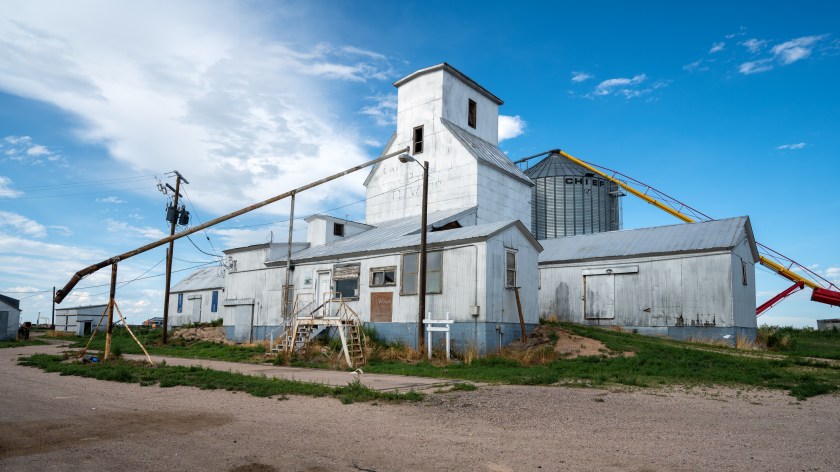
HDR landscape photograph of the Gulf Fishing Pier at Fort De Soto Park in Pinellas County, Florida, extending over calm water under a bright sky, taken with a Nikon D7100 at 14mm.
A 2013 HDR landscape photograph of the Gulf Fishing Pier at Fort De Soto Park in Pinellas County, Florida.

In the early stages of any photographer’s journey, there exists a pivotal moment when technical curiosity converges with artistic vision. Greg Urbano’s “Landscapes in HDR” from 2013 captures precisely this convergence—a photograph that speaks to the fundamentals of seeing while revealing the seeds of a maturing artistic voice.

The Gulf Fishing Pier at Fort de Soto Park presents itself as an exercise in classical composition, yet the image transcends mere documentation. Shot with a Nikon D7100 at 14mm, the photographer embraced the distortion inherent in ultra-wide-angle photography, using it not as a limitation but as a tool for emphasis. The pier’s concrete pathway stretches toward the horizon with geometric insistence, its weathered surface textured with salt stains and age—details that anchor the ethereal quality of the surrounding environment.

What distinguishes this work within the context of Chapter 1—Beginnings is the deliberate exploration of HDR processing, a technique that dominated landscape photography in the early 2010s. Rather than falling into the trap of over-processing that plagued much HDR work of this era, Urbano demonstrates restraint. The luminous gradations in the sky—from deep azure to wispy white—retain a naturalistic quality while revealing detail across an impressive tonal range. The turquoise waters of the Gulf of Mexico maintain their vibrancy without crossing into hypersaturation, suggesting an eye already sensitive to the boundaries between enhancement and artifice.

The technical choices reveal a photographer building his fundamental vocabulary. The aperture of ƒ/8.0 ensures critical sharpness from the foreground concrete to the distant structures, while the fast shutter speed of 1/400s freezes the subtle motion of the scene—likely the flutter of distant flags or the movement of the few figures visible along the pier. At ISO 100, the image maintains clarity in its textures, from the horizontal railings that create rhythmic lines to the architectural shelters that punctuate the composition’s middle ground.

What makes this photograph significant in understanding Urbano’s artistic evolution is not its perfection but its purposefulness. The nearly symmetrical composition, the careful attention to the leading lines, the consideration of how architectural elements frame the natural environment—these are the building blocks upon which more complex visual narratives are constructed. The weekly visits to this location mentioned in his notes speak to something essential in photographic development: the practice of returning, of seeing the same subject under different conditions, of learning through repetition.

The landscape itself offers something eternal—the meeting point of human construction and natural expanse. The pier extends confidently into the Gulf, a gesture of connection between land and water, between the photographer’s position and the infinite horizon. In capturing this scene, Urbano was not merely documenting a favorite location but engaging with fundamental questions about how we frame our relationship to place and space.

Within the broader context of “Beginnings,” this image exemplifies the necessary stage of mastering craft before transcending it. The imperfect attempts referenced in the chapter description are not failures but essential experiments. Here, we witness a photographer learning to see in high dynamic range, to compose with geometric precision, and to capture the luminous quality of coastal light—all foundational skills that would inform the more sophisticated work to come.

This is where journeys begin: in the clarity of intention, the discipline of practice, and the recognition that every master was once a student of light.