Pier 60 Pink Sunset

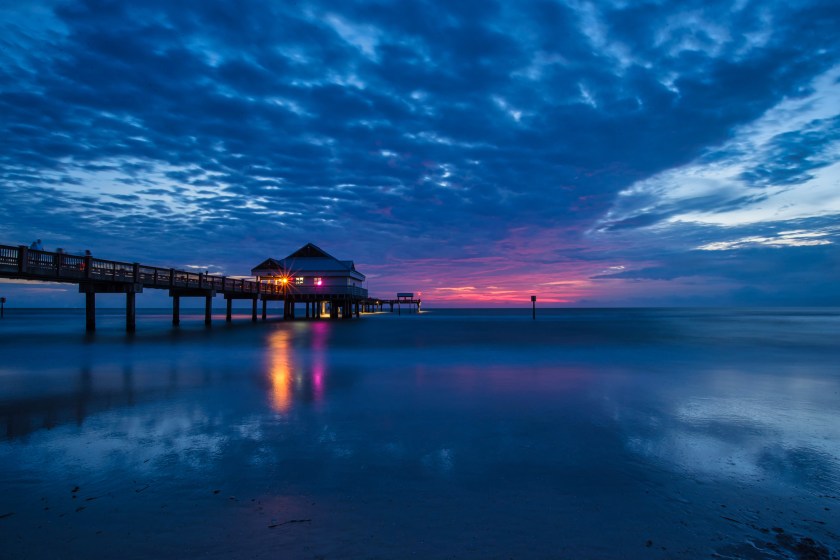
In this contemplative study from Chapter 2 of the Top 100 Journey, the photographer demonstrates a sophisticated command of long-exposure technique to capture the liminal hour where day surrenders to night along Florida’s Gulf Coast. Shot at Clearwater Beach, this sixty-second exposure transforms the volatile surf into a glassy, ethereal plane that mirrors the atmospheric drama unfolding above, while Pier 60 extends into the frame with geometric precision against a sky rendered in deep indigos and persistent pink tones.

Long exposure photograph of Pier 60 on Clearwater Beach at sunset, with pink and purple sky tones reflecting on calm water.
Long exposure pink sunset at Pier 60 on Clearwater Beach.

In this contemplative study from Chapter 2 of the Top 100 Journey, the photographer demonstrates a sophisticated command of long-exposure technique to capture the liminal hour where day surrenders to night along Florida’s Gulf Coast. Shot at Clearwater Beach, this sixty-second exposure transforms the volatile surf into a glassy, ethereal plane that mirrors the atmospheric drama unfolding above.

The composition centers on Pier 60, an iconic structure that extends into the frame with geometric precision. The photographer has positioned himself to capture the pier in its full dimensionality—the wooden pilings create a rhythmic vertical pattern that draws the eye toward the pavilion structure, where warm sodium lights pierce the deepening blue hour. These artificial punctuations of yellow and magenta provide crucial counterpoints to the natural color palette, preventing the image from dissolving entirely into monochromatic twilight. The long exposure has softened the lights into glowing orbs, their reflections stretching across the wet sand in elongated streaks that echo the horizontal thrust of the pier itself.

The technical execution reveals deliberate choices throughout. At f/22, the photographer has prioritized depth of field and the creation of diffraction spikes around the light sources, adding a subtle stellar quality to the illumination. The ISO 100 setting ensures maximum image quality, while the 18mm focal length—shot on a full-frame Nikon D610 with an 18-35mm lens—provides expansive coverage that encompasses both the architectural subject and the vast atmospheric canvas surrounding it. This wider perspective situates the human-made structure within the broader natural context, a recurring tension in his Florida landscapes.

The sky commands nearly two-thirds of the frame, and rightfully so. The textured cloud formations—rendered in deep indigos and cobalt blues—create a dramatic ceiling that seems to press down upon the horizon line where pink and peach tones persist from the recently set sun. This color gradient, from warm horizon to cool zenith, demonstrates the photographer’s understanding of transitional light and his patience in waiting for the precise moment when competing color temperatures achieve balance.

The wet foreground sand serves multiple compositional functions. Its reflective quality doubles the visual information, creating subtle mirror images of the pier lights, while the barely perceptible texture of the beach—preserved despite the long exposure—grounds the image in physical reality. This detail prevents the photograph from becoming overly abstract, maintaining the delicate equilibrium between documentary observation and interpretive vision.

Within the broader context of Chapter 2—Florida Landscapes & Cityscapes—this image exemplifies the photographer’s evolving relationship with his adopted coastal environment. Where earlier works might emphasize the region’s vibrant daylight character, this photograph engages with Florida’s more contemplative aspects: the quiet moments of transition, the interplay between natural beauty and recreational infrastructure, the way tourism and wilderness coexist along these developed shorelines.

The photograph ultimately succeeds as both technical achievement and aesthetic statement. It captures a specific place at a specific moment while transcending those particulars to evoke the universal experience of standing at the edge of vast water as darkness approaches—a meditation on transience rendered permanent through the camera’s patient eye.

Redington Long Pier Sunset

The photograph of Redington Long Pier at sunset highlights the interplay between Florida’s coastal architecture and natural beauty. Captured with a long exposure technique, it merges structure and color, showcasing the significance of humble elements like a bait shop sign. This image advocates for a broader definition of landscape photography, embracing authenticity over idealization.

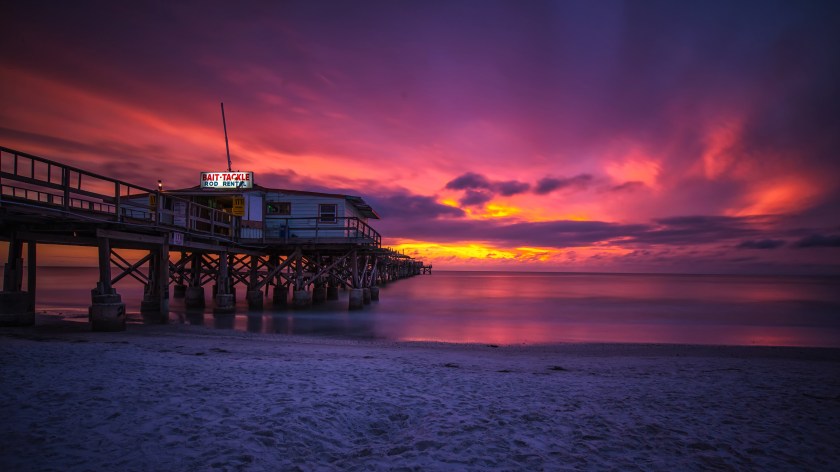
Long exposure photograph of the Redington Long Pier on Redington Beach, Florida, taken after sunset with vivid sky colors and calm reflective water.
Long exposure sunset view of the Redington Long Pier on Redington Beach.

The photographer’s approach to Florida’s coastal architecture reveals itself most compellingly in this extended exposure from Redington Beach, where a humble fishing pier becomes a study in structural grace against an incandescent sky. Captured on a Nikon D610 with an 18-35mm lens set to its widest focal length, the thirty-second exposure at f/8.0 transforms the Gulf of Mexico into liquid silk, while the pier’s weathered geometry provides essential counterpoint to the sky’s theatrical display.

What distinguishes this image within the Florida Landscapes & Cityscapes chapter is its subtle negotiation between the vernacular and the sublime. The “Bait·Tackle Rod Rental” sign—a modest beacon of commercial utility—anchors the composition with an authenticity that elevates rather than diminishes the scene’s natural grandeur. This juxtaposition speaks to the photographer’s evolving understanding of Florida’s coastal identity, where working piers and rental shacks exist not as intrusions upon beauty but as integral components of it.

The technical execution demonstrates considerable restraint. The eighteen-millimeter perspective captures the pier’s diagonal recession into the frame while maintaining clarity in the structural cross-bracing beneath the deck. The thirty-second exposure, calibrated to ISO 200, achieves that liminal smoothness in the water without sacrificing detail in the sky’s stratified clouds. The photographer has timed his capture for that brief window after sunset when the western horizon blazes with residual light while the zenith deepens toward purple—a moment lasting perhaps ten minutes when the dynamic range compresses just enough for a single exposure to hold both fire and shadow.

Color becomes the image’s primary language. The gradient from molten gold through crimson to violet speaks to the atmospheric conditions particular to Gulf Coast evenings, where humidity and marine air create these saturated transitions. The pier itself, rendered in silhouette, serves as a tonal anchor that prevents the composition from dissolving into pure chromaticism. The photographer’s choice to shoot into this gradient, rather than capturing the pier against a uniformly lit sky, reveals an understanding of how structure and color can modulate one another.

Within the broader trajectory of this chapter, the image represents a maturation of approach. Where earlier Florida work might have privileged either the natural landscape or the built environment, this photograph insists they cannot be separated. The pier extends from beach to horizon as a human gesture toward the infinite, its pilings disappearing into softened water that suggests both permanence and impermanence. The long exposure technique—a methodology that appears repeatedly throughout his landscape work—here serves not merely as technical flourish but as philosophical statement about time’s accumulation within a single frame.

The composition’s formal elegance belies its democratic subject matter. This is not a pristine wilderness or an architectural landmark, but a working-class fishing pier on a stretch of developed coastline. By rendering it with such visual authority, the photographer argues for an expanded definition of landscape photography—one that acknowledges Florida’s actual character rather than retreating to fantasies of unspoiled nature. The sunset may be spectacular, but it is the bait shop sign, glowing like a minor constellation above the water, that makes this image distinctly Floridian, distinctly true

See this image on:

Flickr

500px

Electric Sublime: Atmospheric Drama Over Tampa Bay

The image of a lightning strike over Tampa Bay, captured from Vinoy Park, showcases the photographer’s skill in storm photography. Using a Nikon D610, the thirty-second exposure reveals a dramatic interplay of colors and natural forces. This work highlights Florida’s weather patterns, merging urban and natural landscapes in a powerful visual narrative.

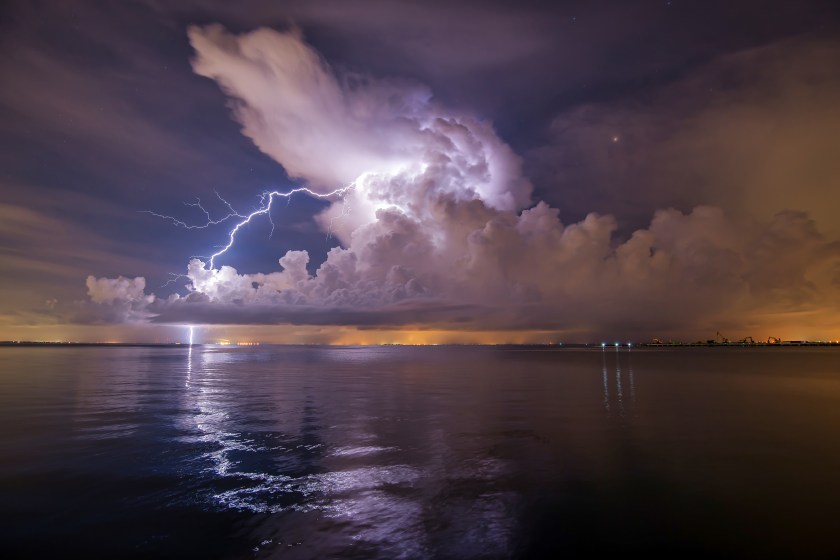
Long exposure photograph of lightning illuminating clouds over Tampa Bay, viewed from Vinoy Park in St. Petersburg, Florida.
Long exposure lightning strike over Tampa Bay from Vinoy Park.

Among the most technically demanding and visually arresting images in Chapter 2 of the photographer’s Top 100 Journey, this capture of a lightning strike over Tampa Bay represents a masterful convergence of patience, preparation, and meteorological fortune. Photographed from Vinoy Park in St. Petersburg, the image transforms a transient weather event into a sustained meditation on nature’s raw power and the atmospheric spectacle that defines Florida’s subtropical climate.

The composition presents a study in horizontal stratification—water, distant shoreline, and sky arranged in classical landscape proportions, yet animated by the extraordinary electrical discharge that commands the frame’s center. A single lightning bolt descends vertically through towering cumulonimbus clouds, creating a luminous column that connects the charged atmosphere to the bay’s surface. The strike illuminates the cloud structure from within, revealing billowing formations in shades of pearl, lavender, and steel blue against a gradient sky that transitions from deep indigo to warm amber.

Technical execution reflects the specialized demands of storm photography. Working with a Nikon D610 at the wide end of an 18-35mm lens, the photographer selected an 18mm focal length to encompass both the expansive cloud system and the reflective water below. The thirty-second exposure at f/5.6 and ISO 400 represents a calculated approach to lightning capture—a long enough duration to increase the probability of recording a strike within the frame, yet controlled enough to prevent overexposure of ambient light sources visible along the distant horizon. This extended shutter speed also smooths the bay’s surface into a mirror-like plane, its subtle texture suggesting gentle motion while maintaining enough definition to anchor the composition.

The color palette distinguishes this work within the chapter’s broader collection. Where the architectural study of Signature Place employed monochrome austerity, this image embraces the full chromatic range of atmospheric phenomena. The storm cell’s cool blues and purples contrast with the warm ochre glow infiltrating from the right edge of the frame—likely light pollution from Tampa’s urban corridor or residual sunset illumination scattered through distant clouds. This interplay of cool and warm tones creates visual tension that enhances the image’s dramatic impact without resorting to artificial enhancement.

Within Chapter 2’s exploration of Florida Landscapes & Cityscapes, this photograph occupies essential territory. Florida’s identity remains inextricably linked to its volatile weather patterns—the daily thunderstorm cycles of summer, the atmospheric electricity that makes the state the lightning capital of North America. By documenting this phenomenon, the photographer engages with environmental storytelling that moves beyond picturesque representation toward a more complete portrait of place.

The work also demonstrates sophisticated understanding of the sublime in contemporary landscape photography. The tradition of depicting nature’s awesome power—from nineteenth-century Romantic painters to mid-century photographers like Ansel Adams capturing Sierra storms—finds fresh expression here. The lightning strike serves as both subject and metaphor: a literal discharge of atmospheric energy and a symbolic representation of nature’s capacity to humble human observers.

Viewed alongside the chapter’s urban architectural studies, this image provides necessary balance. Together, these photographs suggest a photographer equally attentive to built and natural environments, capable of finding visual poetry in glass towers and electrical storms alike. Such range indicates a mature artistic vision—one that recognizes Florida’s complexity as both a site of intensive human development and a landscape still subject to forces beyond human control.

Venice Fishing Pier Sunset: Mastering the Fundamentals of Light

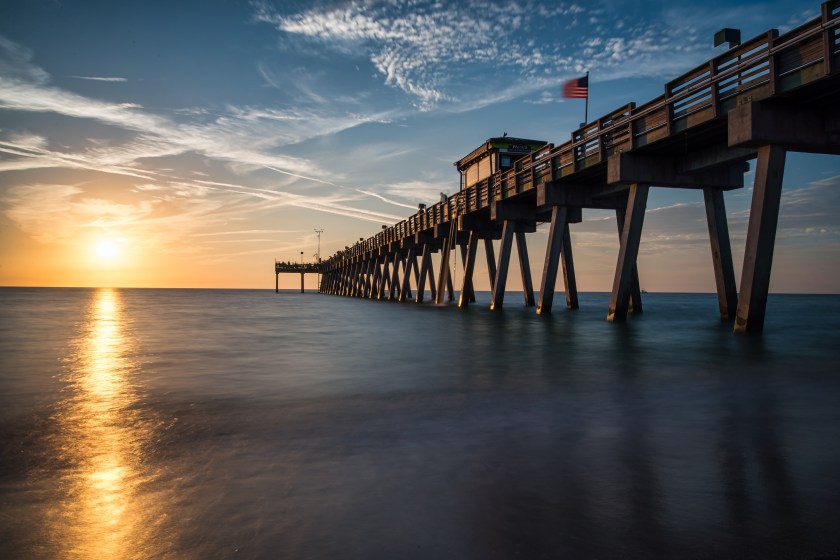
Greg Urbano’s sunset photograph of the Venice Fishing Pier exemplifies the intersection of technical skill and artistic sensibility in landscape photography. Through meticulous use of exposure and composition, Urbano captures a moment where structured permanence meets the fluidity of nature, showcasing balanced tones and dynamic movement in a serene coastal scene.

Sunset photograph of the Venice Fishing Pier in Florida, showing the pier extending into the Gulf of Mexico with golden reflections on calm water.
Sunset over the Gulf of Mexico with the Venice Fishing Pier in the background, captured in a long exposure.

Within Greg Urbano’s “Beginnings” chapter, this sunset photograph of the Venice Fishing Pier represents a photographer coming to terms with landscape photography’s essential discipline: the patient orchestration of light, water, and architecture. Shot along Florida’s Gulf Coast, the image demonstrates technical competence married to an emerging aesthetic sensibility—a combination that marks the transition from enthusiast to serious practitioner.

The technical execution reveals deliberate choices that elevate this beyond a simple sunset snapshot. Using a Nikon D610 with an 18-35mm lens set to 28mm, Urbano selected an aperture of f/18 to maximize depth of field, ensuring sharpness from the foreground water to the distant pier structure. The 13-second exposure at ISO 100 transforms the Gulf of Mexico into a silken plane, smoothing the texture of incoming waves into an ethereal blue gradient. This long exposure technique—fundamental to seascape photography—requires both technical knowledge and patience, waiting for the precise moment when light, tide, and atmospheric conditions align.

The composition demonstrates sophisticated spatial awareness. The pier’s diagonal thrust from lower right to upper left creates dynamic movement through the frame, leading the viewer’s eye from the silky foreground water toward the structure’s vanishing point. The rhythmic repetition of pier supports establishes a visual cadence, their angular geometry contrasting beautifully with the organic flow of water and clouds. An American flag atop the pier adds a vertical accent and a touch of patriotic iconography without overwhelming the scene’s natural beauty.

What distinguishes this photograph is Urbano’s treatment of light. The setting sun hovers just above the horizon line, its golden warmth reflected in a shimmering path across the water’s surface. The exposure balances multiple tonal zones expertly: the brilliant sun doesn’t blow out to featureless white, the shadowed pier structure retains detail, and the water holds both luminous highlights and cool, deep blues. This tonal control suggests a photographer who understands exposure compensation and potentially uses graduated neutral density filters or careful post-processing to manage the scene’s extreme dynamic range.

The sky deserves particular attention. Wispy cirrus clouds stretch across the frame in delicate streaks, their feathered patterns creating texture and visual interest in what might otherwise be empty blue space. The interplay between warm sunset tones near the horizon and cooler blues above establishes atmospheric depth, giving the image a sense of vast space and coastal openness.

As a “Beginnings” chapter work, this photograph represents mastery of landscape photography fundamentals. The long exposure technique, the careful attention to composition and leading lines, the patient waiting for optimal light—these are the building blocks upon which more experimental work can later be constructed. There’s confidence here, a photographer who has moved beyond technical uncertainty into intentional image-making.

The Venice Pier becomes more than a documentary subject; it transforms into a meditation on structure and impermanence. The solid, engineered permanence of the pier contrasts with the fluid, ever-changing water—a tension made visible through photographic technique. Urbano captures not just a place, but a moment of perfect equilibrium between human construction and natural forces, all bathed in the transient golden light that photographers chase endlessly along coastlines worldwide.

The Gateway Image: Passagrille Jetty Silhouette and the Dawn of a Photographic Vision

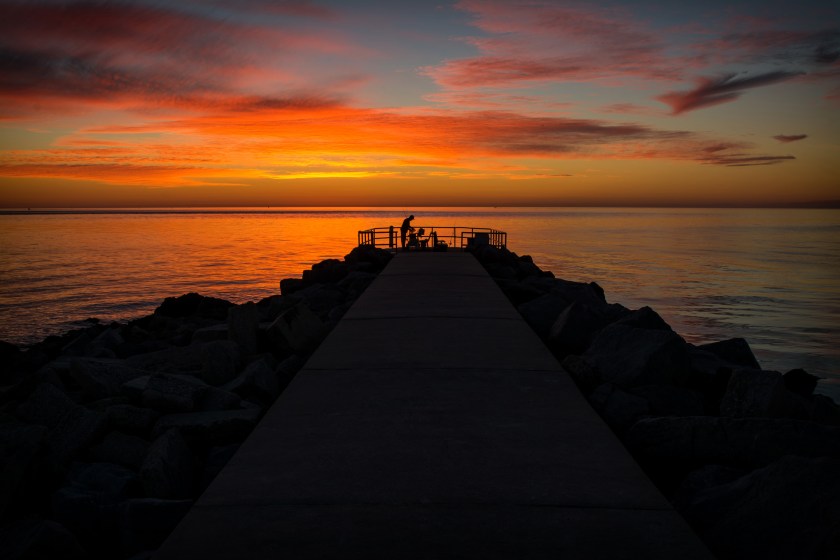
In a 2014 photograph taken at Passagrille Beach, Greg Urbano captures a stunning sunset over the Gulf of Mexico, which inspires his beach photography. Featuring a silhouetted fisherman against an orange sky, the image combines technical skill and emotional depth, symbolizing Urbano’s artistic journey and his evolving relationship with landscape imagery.

Silhouette of a lone fisherman standing on a rock jetty at Passagrille Beach during an orange Gulf of Mexico sunset, photographed with a Nikon D7100 at 24mm.
A 2014 sunset silhouette of a fisherman on the rock jetty at Passagrille Beach, Florida.

In the context of Greg Urbano’s “Beginnings” chapter, this 2014 sunset photograph from Passagrille Beach holds particular significance—not merely as a technically accomplished image, but as a foundational moment that would shape the photographer’s artistic trajectory for years to come. The image captures that precise intersection where technical competence meets emotional resonance, creating what Urbano himself identifies as his “inspiration for years of beach photography.”

The compositional structure reveals a photographer already thinking in strong geometric terms. The jetty’s dark pathway cuts through the frame with striking linearity, creating a powerful visual corridor that draws the viewer’s eye toward the observation platform at the terminus. This use of leading lines demonstrates sophisticated spatial awareness, transforming the rocky breakwater into a narrative device—a journey into the sublime moment captured in the sky above.

What distinguishes this photograph from countless other sunset images is Urbano’s commitment to silhouette as an artistic choice. Shot at ƒ/11 with a relatively slow shutter speed of 1/20 second at ISO 100, the exposure prioritizes the spectacular gradation of color in the sky while allowing the foreground elements to fall into deep shadow. The lone fisherman—barely discernible yet unmistakably present—becomes an everyman figure, a contemplative sentinel witnessing the day’s transition. This human element, reduced to pure form, prevents the image from becoming merely a spectacular sky study; instead, it grounds the natural drama in human experience.

The technical execution warrants examination. Using the Nikon D7100 with a 10-24mm lens at its maximum 24mm focal length, Urbano captures an expansive view that encompasses both the architectural elements of the jetty and the full breadth of the atmospheric display. The cropped sensor’s field of view provides enough width to establish context while maintaining focus on the central narrative. The aperture choice of ƒ/11 ensures sharpness throughout the frame, from the textured rocks in the immediate foreground to the distant horizon where sea meets sky.

The color palette—ranging from deep oranges and burning yellows to subtle purples and grays in the cloud formations—displays nature at its most theatrical. Yet Urbano’s restraint in post-processing (evident in the natural tonal transitions) allows the scene to speak with authenticity rather than hyperbole. This restraint would become a hallmark of his approach, distinguishing his work from the over-saturated aesthetic that dominates much contemporary landscape photography.

Perhaps most revealing is Urbano’s own reflection on this image as inspirational—a north star that guided subsequent explorations. One can trace forward from this moment to understand his ongoing fascination with the Gulf Coast’s theatrical sunsets, his appreciation for human elements within natural landscapes, and his sophisticated use of silhouette as a storytelling device. The photograph represents not an endpoint but a beginning, a discovery of visual vocabulary that would be refined and expanded throughout his career.

In the broader context of the “Beginnings” chapter, this Passagrille jetty image serves as both literal and metaphorical gateway—the concrete walkway leading toward beauty, the artist’s path toward photographic maturity, and the viewer’s invitation into Urbano’s evolving body of work.