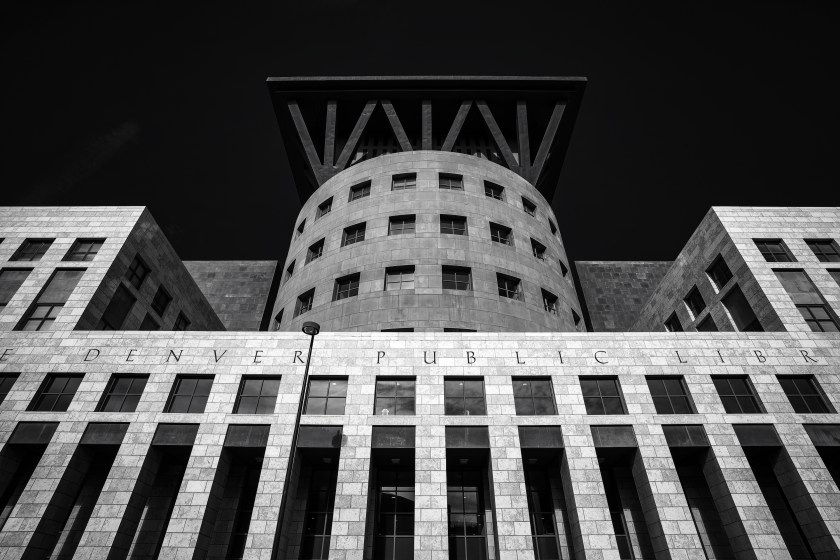
In this commanding study of civic architecture, the photographer demonstrates a sophisticated understanding of how monumental structures assert themselves within the urban landscape. Shot at midday when harsh overhead light typically challenges photographers, he transforms potentially difficult conditions into an asset, using deep contrast to emphasize the building’s geometric severity and sculptural mass.
The composition centers on the Denver Public Library’s distinctive cylindrical tower, which rises from the frame like a monolithic drum. The extreme upward angle, facilitated by his Samyang 18mm wide-angle lens, creates a dramatic sense of monumentality while the symmetrical flanking wings establish visual order. This architectural framework—circular form nested within angular geometry—speaks to postmodern design principles that dominated American civic architecture in the late twentieth century. The photographer’s decision to shoot in black and white strips away temporal markers and weather conditions, rendering the structure as a timeless study in form, shadow, and material.
What distinguishes this image within Chapter 3’s exploration of Colorado landscapes and cityscapes is its departure from natural grandeur toward human-made authority. Where mountain vistas offer sublime, untamed power, this photograph presents institutional permanence. The stone cladding, methodically rendered in graduated tones from light gray to near-black, becomes a study in texture and depth. The dramatic diagonal supports visible at the structure’s crown introduce dynamic tension, their angular thrust contrasting sharply with the tower’s curved facade.
The technical execution reveals maturity in the photographer’s approach to architectural documentation. Shot with the Sony A7ii, the image maintains clarity across multiple planes of depth despite the wide-angle distortion inherent to the 18mm focal length. The midday timing, often avoided by landscape photographers, proves deliberate here—the high sun creates stark shadows that carve out the building’s volumes and reveal the recessed windows as dark voids. This interplay between solid and void, light and shadow, transforms descriptive documentation into interpretive art.
The street lamp appearing at center-bottom provides crucial human scale, a reminder that this imposing structure exists within the pedestrian realm. Its modest presence underscores the building’s overwhelming verticality and mass. The text carved into the facade—”DENVER PUBLIC LIBR”—becomes both identifier and compositional element, the letterforms creating horizontal rhythm that grounds the tower’s upward thrust.
Within the photographer’s Top 100 Journey project, this image represents an important evolution. Chapter 3’s focus on Colorado landscapes and cityscapes broadens beyond wilderness to encompass how humans shape their environment. The library, as a democratic institution dedicated to public knowledge, carries symbolic weight that elevates the photograph beyond mere architectural record. It becomes a meditation on civic aspiration, on how societies express values through built form.
The conversion to monochrome proves essential to the image’s impact. Color would introduce distraction—blue sky, stone variations, surrounding urban context. Instead, the black and white treatment creates graphic clarity, emphasizing pattern, geometry, and tonal relationships. The nearly black sky becomes void, pushing the building forward as the sole subject demanding attention.
This photograph confirms the photographer’s ability to find compelling visual architecture within urban environments, applying the same compositional rigor and tonal sensitivity he brings to natural landscapes.
 Greg Urbano