Night at the Marina: A Study in Urban Reflection

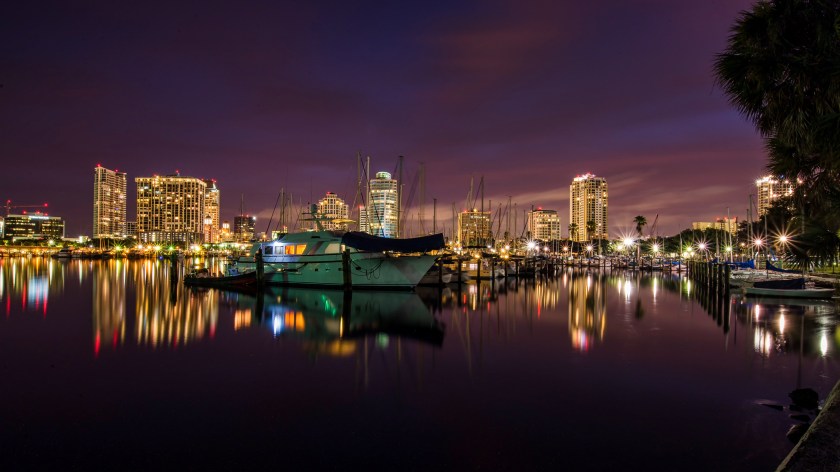
The photograph from Greg Urbano’s Top 100 Journey captures St. Petersburg’s Municipal Marina at night, showcasing a dialogue of architecture, water, and light. Through a long exposure, the image blends city and reflection, revealing duality in urban nature. Urbano’s technical choices highlight Florida’s beauty within its metropolitan context.

Nighttime long exposure photograph of the St. Petersburg, Florida skyline viewed from the Municipal Marina, with boats and colorful reflections on calm water.
Long exposure nighttime view of the St. Petersburg skyline from the Municipal Marina.

In this striking nocturnal composition from Chapter 2 of Greg Urbano’s Top 100 Journey, the photographer transforms St. Petersburg’s Municipal Marina into a stage where architecture, water, and light perform an intricate dialogue. Shot with a Nikon D610 at the wide end of an 18-35mm lens, the image demonstrates his evolving command of the Florida landscape—this time rendered not through the state’s iconic natural vistas, but through the geometry and luminescence of its urban waterfront.

The technical approach reveals deliberate choices that serve the image’s contemplative mood. A 150-second exposure at f/20 has allowed the photographer to capture not merely a moment but an accumulation of light and stillness. The water becomes a flawless mirror, its surface so calm that the distinction between city and reflection dissolves into symmetry. This extended duration smooths away any transient ripples, creating an almost surreal doubling effect where the marina’s vessels and the downtown skyline exist in perfect vertical equilibrium.

The color palette is equally considered. The twilight sky transitions from deep violet to warm amber along the horizon, providing a graduated backdrop that never competes with the main subject. The buildings’ golden illumination—ranging from honey tones to brilliant white—creates rhythmic vertical accents across the frame, while the marina lights introduce unexpected splashes of emerald and ruby that punctuate the composition with chromatic variety. These colored reflections stretch and shimmer in the foreground water, adding texture to what might otherwise be an overly static scene.

Compositionally, the photographer has positioned himself to maximize the reflection’s impact while maintaining architectural legibility. The yacht in the immediate foreground serves as an anchor point, its substantial form providing scale and depth to the scene. The vessel’s subtle green illumination connects it visually to the reflected lights while distinguishing it from the darker water surrounding it. Behind, the forest of masts creates a delicate counterpoint to the solid mass of the high-rises, introducing organic irregularity into an otherwise geometric composition.

What distinguishes this work within the Florida Landscapes & Cityscapes chapter is its meditation on duality—the way human development interacts with the natural world, specifically water’s capacity to both accept and transform urban light. The photographer has found in St. Petersburg’s marina a location where Florida’s maritime character persists even within its metropolitan context. The palm fronds visible at the frame’s edge remind viewers of the subtropical environment, preventing the scene from becoming generically urban.

The technical execution supports this conceptual balance. The ISO 160 setting has preserved clean shadows and prevented noise in the darker areas, while the narrow aperture has rendered sharpness from the foreground yacht to the distant towers. The starburst effects visible on some light sources—a result of the f/20 aperture—add a subtle decorative element without overwhelming the image’s naturalistic foundation.

Within his broader body of work exploring Florida’s diverse landscapes, this photograph represents an important expansion of scope. Here, the photographer demonstrates that the state’s visual poetry exists not only in its Everglades, beaches, and wetlands, but also in the moments when its cities pause and reflect—literally and figuratively—upon themselves. The result is an image that honors both the constructed and the elemental, capturing a Florida that is simultaneously modern and timeless.
Night at the Dali: Architecture as Teacher

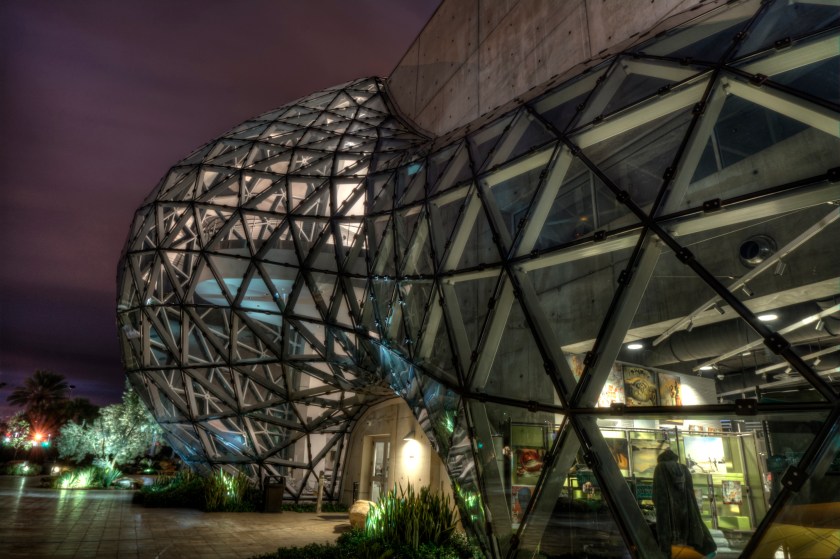
In 2013, Greg Urbano’s photography evolved, particularly with architecture and HDR techniques. His night photograph of the Dalí Museum in St. Petersburg showcases his technical growth and artistic maturity. Through careful exposure settings and HDR processing, he captures dramatic contrasts, reflecting his continuous exploration and adaptability in night photography.

HDR nighttime photograph of the Dali Museum in St. Petersburg, Florida, showing its illuminated geodesic glass facade and surrounding landscaping, taken with a Nikon D7100 at 14mm.
A 2013 HDR nighttime photograph of the Dali Museum’s geodesic glass structure in St. Petersburg, Florida.

In this 2013 photograph of St. Petersburg’s Dalí Museum, Greg Urbano captures far more than an architectural landmark—he documents a photographer in the act of discovery, using his camera to decode the visual language of light, structure, and time. The image stands as a testament to what the Chapter 1 — Beginnings theme celebrates: the transformative power of experimentation and the artistic maturity that emerges from technical curiosity.

The composition immediately announces ambition. Shot with a 14mm ultra-wide lens, the perspective tilts upward to embrace the museum’s extraordinary geodesic glass bubble, that surrealist flourish erupting from an otherwise rectilinear concrete structure. The ultra-wide focal length creates dramatic spatial distortion—the glass sphere appears to swell toward the viewer while the building’s mass recedes at impossible angles. This is deliberate visual exaggeration, the photographer using optical characteristics as expressive tools rather than merely recording what stands before him.

Urbano’s fifteen-second exposure at ƒ/11 reveals careful consideration of night photography’s particular demands. The narrow aperture ensures front-to-back sharpness across the complex geometric planes, while the extended shutter speed gathers sufficient light to render both the illuminated interior spaces and the textured concrete exterior. At ISO 250, he maintained image quality while managing the sensor’s heat buildup during long exposures—a technical balancing act that night photography ruthlessly exposes when miscalculated.

The HDR processing, which Urbano identifies as a focus of his 2013 work, serves the subject’s inherent drama without overwhelming it. High Dynamic Range imaging compresses the vast tonal range between the glowing glass panels and the deep purple-gray twilight sky into a single viewable image. Here, the technique preserves detail in both the brightest interior lights and the shadowed architectural framework—the black steel triangles that form the geodesic pattern remain visible and textured rather than silhouetted into flat darkness.

What distinguishes this image within the Beginnings chapter is its transparency about process. The HDR treatment shows characteristic traces of learning—slight luminous halos around high-contrast edges, enhanced local contrast that gives surfaces an almost tactile presence, color saturation pushed just beyond naturalism. These are not flaws but evidence of active experimentation, a photographer testing the boundaries of technique to understand where effectiveness ends and excess begins.

The photograph’s context enriches its meaning considerably. This museum stood a brief walk from the photographer’s residence, close enough for repeated visits, for returning under different conditions, for the kind of sustained engagement that transforms casual documentation into genuine study. This proximity allowed Urbano to approach the subject with evolving sophistication, each attempt building on lessons from the previous one.

The wet pavement in the foreground adds an unexpected grace note—evidence of recent rain creating reflective surfaces that double the architectural lighting, adding visual complexity without cluttering the composition. Whether intentional or opportunistic, this detail demonstrates the photographer’s developing awareness of how environmental conditions can enhance rather than merely complicate a scene.

Viewed within the arc of artistic development, this photograph captures a crucial transition point: technical capability catching up with visual ambition, the gap between conception and execution narrowing with each frame. It is the work of a photographer actively becoming, embracing complexity as the necessary path toward mastery.