Architectural Authority: The Denver Public Library

The photograph of the Denver Public Library showcases the interplay of monumental architecture and urban landscape. The black and white imagery emphasizes geometric shapes and textures, transforming harsh midday light into stark contrasts. This representation transcends mere documentation, reflecting civic aspiration and how societies express values through built form within the Colorado context.

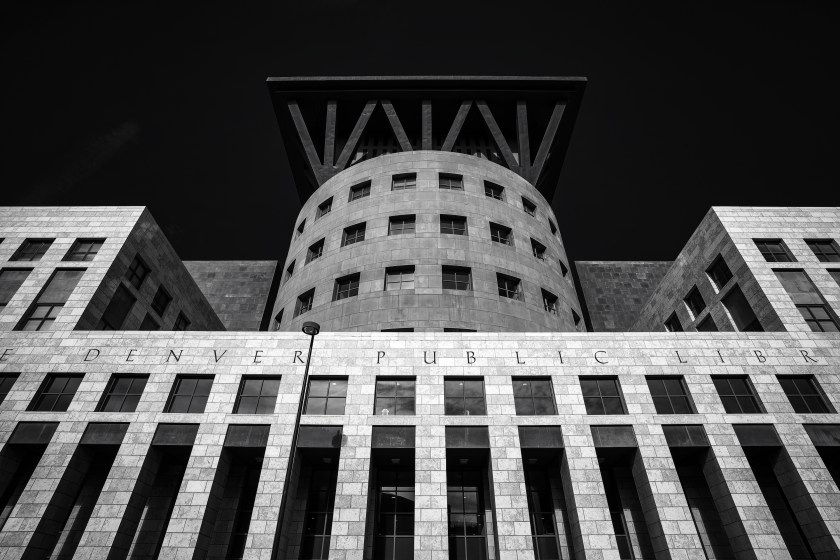
Black and white view of the Denver Public Library exterior, showing a cylindrical central structure framed by angular stone façades.
The exterior of the Denver Public Library is shown in black and white in downtown Denver, Colorado.

In this commanding study of civic architecture, the photographer demonstrates a sophisticated understanding of how monumental structures assert themselves within the urban landscape. Shot at midday when harsh overhead light typically challenges photographers, he transforms potentially difficult conditions into an asset, using deep contrast to emphasize the building’s geometric severity and sculptural mass.

The composition centers on the Denver Public Library’s distinctive cylindrical tower, which rises from the frame like a monolithic drum. The extreme upward angle, facilitated by his Samyang 18mm wide-angle lens, creates a dramatic sense of monumentality while the symmetrical flanking wings establish visual order. This architectural framework—circular form nested within angular geometry—speaks to postmodern design principles that dominated American civic architecture in the late twentieth century. The photographer’s decision to shoot in black and white strips away temporal markers and weather conditions, rendering the structure as a timeless study in form, shadow, and material.

What distinguishes this image within Chapter 3’s exploration of Colorado landscapes and cityscapes is its departure from natural grandeur toward human-made authority. Where mountain vistas offer sublime, untamed power, this photograph presents institutional permanence. The stone cladding, methodically rendered in graduated tones from light gray to near-black, becomes a study in texture and depth. The dramatic diagonal supports visible at the structure’s crown introduce dynamic tension, their angular thrust contrasting sharply with the tower’s curved facade.

The technical execution reveals maturity in the photographer’s approach to architectural documentation. Shot with the Sony A7ii, the image maintains clarity across multiple planes of depth despite the wide-angle distortion inherent to the 18mm focal length. The midday timing, often avoided by landscape photographers, proves deliberate here—the high sun creates stark shadows that carve out the building’s volumes and reveal the recessed windows as dark voids. This interplay between solid and void, light and shadow, transforms descriptive documentation into interpretive art.

The street lamp appearing at center-bottom provides crucial human scale, a reminder that this imposing structure exists within the pedestrian realm. Its modest presence underscores the building’s overwhelming verticality and mass. The text carved into the facade—”DENVER PUBLIC LIBR”—becomes both identifier and compositional element, the letterforms creating horizontal rhythm that grounds the tower’s upward thrust.

Within the photographer’s Top 100 Journey project, this image represents an important evolution. Chapter 3’s focus on Colorado landscapes and cityscapes broadens beyond wilderness to encompass how humans shape their environment. The library, as a democratic institution dedicated to public knowledge, carries symbolic weight that elevates the photograph beyond mere architectural record. It becomes a meditation on civic aspiration, on how societies express values through built form.

The conversion to monochrome proves essential to the image’s impact. Color would introduce distraction—blue sky, stone variations, surrounding urban context. Instead, the black and white treatment creates graphic clarity, emphasizing pattern, geometry, and tonal relationships. The nearly black sky becomes void, pushing the building forward as the sole subject demanding attention.

This photograph confirms the photographer’s ability to find compelling visual architecture within urban environments, applying the same compositional rigor and tonal sensitivity he brings to natural landscapes.

City Pier on Anna Maria Island: A Study in Patience and Atmospheric Drama

The long exposure photograph of the City Pier on Anna Maria Island captures the unique interplay of land, water, and sky under dramatic storm clouds. Through technical mastery, the image transforms fleeting moments into timelessness, blending sharp details of the pier with ethereal human figures and smooth water, reflecting deep engagement with Florida’s coastal landscapes.

Long exposure photograph of the City Pier on Anna Maria Island, showing a wooden pier leading to a waterfront building under dark storm clouds.
Long exposure view of the City Pier on Anna Maria Island beneath dramatic storm clouds.

Within the photographer’s carefully curated Top 100 Journey, this long exposure study of the City Pier on Anna Maria Island stands as a masterful example of how technical discipline can amplify emotional resonance. Positioned within Chapter 2—Florida Landscapes & Cityscapes—the image demonstrates a sophisticated understanding of the Gulf Coast’s unique visual character, where land, water, and sky exist in constant, subtle negotiation.

The composition reveals itself through classical simplicity: a weathered wooden pier extends from foreground to middle distance, leading the viewer’s eye toward a modest building crowned with an American flag. Yet what elevates this photograph beyond documentary record is the photographer’s deliberate manipulation of time itself. Shot with a fifteen-second exposure at f/18, the image transforms fleeting atmospheric conditions into something more permanent and contemplative. The threatening cloud formations above, rather than appearing frozen in mid-motion, achieve a painterly quality—their movement compressed and softened into bands of gray and white that suggest both weight and ethereality.

This temporal expansion creates a fascinating duality throughout the frame. While the pier’s wooden planks remain sharp and detailed, bearing the textural evidence of salt air and countless footfalls, the human figures near the building dissolve into ghostly presences, their individual identities surrendered to the longer rhythm of place. The water, too, undergoes transformation; what would typically appear as distinct waves and surface texture becomes a smooth, almost metallic gradient stretching from jade green to soft gray, merging seamlessly with the horizon.

The technical execution here deserves careful consideration. Working with a Nikon D610 and an 18-35mm lens set to 35mm, the photographer has achieved remarkable sharpness across the entire frame. The f/18 aperture ensures deep depth of field while the ISO 100 setting maintains clean tonal gradations essential for the image’s subtle atmospheric rendering. These choices reflect not mere technical competence but aesthetic intention—a desire to capture both concrete detail and ephemeral mood simultaneously.

Within the broader context of Chapter 2, this photograph exemplifies the photographer’s evolving relationship with Florida’s coastal environments. Where lesser practitioners might seek the obvious drama of golden hour or storm-tossed seas, he finds complexity in overcast conditions and the patient observation they demand. The image refuses easy categorization: it is neither purely documentary nor overtly romantic, but occupies a thoughtful middle ground where observation and interpretation merge.

The architectural elements—particularly the modest pier building with its peaked roof and practical design—anchor the composition in specificity while the long exposure technique universalizes the experience. This is simultaneously a portrait of a particular place and a meditation on impermanence, on how human structures persist while human presence itself becomes fluid and uncertain.

As part of a long-term project, this photograph suggests an artist committed to deep engagement rather than superficial tourism. The willingness to wait for proper atmospheric conditions, to set up the necessary equipment for extended exposures, and to see beyond the immediate toward something more contemplative marks this as serious photographic inquiry. Within his Top 100 Journey, it stands as evidence that Florida’s landscapes, often dismissed as visually unchallenging, reward patient observation with unexpected subtlety and depth.

The Zipper: Temporal Geometry in Motion

Greg Urbano’s photograph of the Zipper ride at a Florida carnival uniquely transforms the concept of landscape photography. By capturing swirling light trails during twilight, it emphasizes the intersection of cultural and physical landscapes. The image reveals the dynamic nature of our experiences, illustrating how ephemeral entertainment shapes collective identity in Florida.

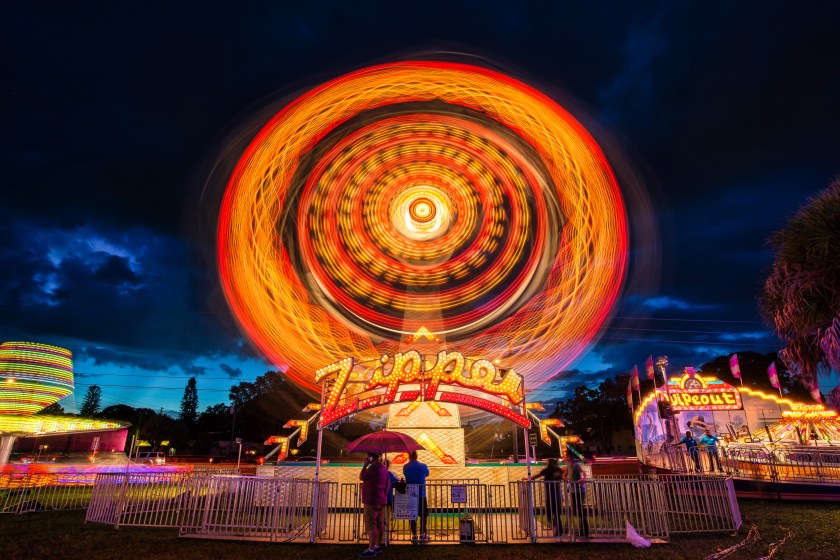
Long exposure photograph of the Zipper carnival ride at night, creating circular light trails in vivid colors with people standing below.
Long exposure night view of the Zipper ride creating swirling light trails at a carnival.

Within Chapter 2 of Greg Urbano’s Top 100 Journey, this carnival ride photograph stands as a compelling exploration of how Florida’s cultural landscape extends beyond its natural and architectural features into the realm of ephemeral entertainment. The image captures the Zipper in full rotation during twilight hours, transforming a traveling carnival attraction into a blazing mandala of light and motion that challenges traditional notions of what constitutes a “landscape.”

The photographer’s technical execution is precise and purposeful. Working with a Nikon D610 at 18mm, he has employed a six-second exposure at f/22 and ISO 100 to record not the ride itself, but rather the luminous trace of its movement through space. This approach fundamentally alters the subject’s visual character—what would typically appear as a stationary mechanical structure becomes instead a dynamic sculptural form composed entirely of light trails. The concentric circles of orange, red, and yellow fire outward from a brilliant white core, creating a hypnotic pattern that suggests both solar imagery and abstract expressionist painting.

The compositional framework demonstrates sophisticated spatial awareness. The ride occupies the central position, its circular motion perfectly framed against a deepening blue sky where storm clouds gather at the horizon. Silhouetted figures stand before the ticket booth in the immediate foreground, their stillness providing human scale and anchoring the viewer’s perspective. These stationary forms create a deliberate counterpoint to the violent spinning above them, emphasizing through contrast the temporal nature of the photographer’s chosen exposure duration.

Environmental context enriches the reading of this work. The characteristic Florida palm trees visible at right, the flat terrain, and the quality of the twilight atmosphere all ground the image firmly within the state’s visual vocabulary. Additional carnival rides glow at the periphery—including what appears to be a carousel and swing ride—establishing this as a comprehensive documentation of Florida’s traveling fair culture, a seasonal tradition that punctuates small-town life across the state.

What makes this photograph particularly significant within the Landscapes & Cityscapes chapter is its conceptual expansion of both terms. The photographer argues implicitly that Florida’s landscape includes not only its physical geography but also its temporal and cultural topography—the fairs, festivals, and itinerant amusements that transform ordinary municipal parks into spaces of collective experience. This is landscape photography that acknowledges human activity not as intrusion but as essential component.

The technical choices support this interpretation. The narrow aperture has rendered the background rides and architectural elements with acceptable sharpness while creating prominent starbursts on individual light points—a decorative effect that paradoxically enhances rather than diminishes the image’s documentary authenticity. The relatively brief six-second exposure has captured sufficient motion to abstract the Zipper into pure pattern while maintaining enough detail in the stationary elements to preserve spatial legibility.

In positioning this work alongside more conventional Florida landscapes within his broader project, the photographer demonstrates an inclusive vision of place-making. Here, the spectacular is found not in natural grandeur or architectural monumentality, but in the democratic pleasure of a county fair at dusk—a quintessentially American scene rendered with technical sophistication and genuine respect for its subject matter.

Burning Sands: A Meditation on Ephemeral Beginnings

The 2014 photograph from Greg Urbano’s “Burning Sands” captures a sand sculpture at Treasure Island, Florida, portraying the transient nature of creation. It juxtaposes themes of existence and decay through an overcast atmosphere, intricate details, and a solitary figure, emphasizing the cycle of beginnings and endings inherent in art and life.

Detailed sand sculpture on a beach under an overcast sky at the Sanding Ovations event in Treasure Island, Florida, photographed with a Nikon D7100 at 11.5mm.
A 2014 photograph of a sand sculpture at the Sanding Ovations event on Treasure Island Beach, Florida.

In the opening chapter of Greg Urbano’s photographic journey, “Burning Sands” stands as a profound meditation on the transient nature of creation itself. Captured in 2014 at the Sanding Ovations event in Treasure Island, Florida, this image transcends its origins as documentary photography to become something altogether more contemplative—a visual poem about the delicate threshold between existence and dissolution.

The photograph presents an intricate sand sculpture rendered in monochromatic tones, its draped forms suggesting both shelter and sorrow. A solitary figure crouches within an arched doorway, while skeletal remains sprawl at the sculpture’s base, creating a narrative that feels simultaneously ancient and immediate. What elevates this work beyond mere documentation is the atmospheric haze that envelops the scene—that distinctive quality the photographer describes as having a “Burning Man vibe.” The overcast morning has transformed the beach into an otherworldly playa, where the sun becomes a pale disk suspended in a beige firmament.

Urbano’s technical approach demonstrates a sophisticated understanding of environmental photography. Shot with a Nikon D7100 at 11.5mm, the ultra-wide angle encompasses not only the foreground sculpture but also the secondary forms receding into the atmospheric distance, creating layers of depth that pull the viewer’s eye through the composition. The aperture of f/6.3 maintains critical sharpness across the sculptural details while allowing the background to soften naturally into the haze. At 1/1600s, the shutter freezes what is essentially a meditation on impermanence—an irony not lost on the careful observer.

The positioning of this work within Chapter 1—Beginnings feels particularly apt. Sand sculptures exist in perhaps the most precarious state of any art form: they are born from the beach and inevitably return to it, whether through wind, tide, or the simple passage of time. There is something profoundly instructive about beginning a photographic journey with such ephemeral subject matter. It suggests an artist already attuned to photography’s essential purpose: to preserve the fleeting, to honor what cannot last.

The sculpture’s symbolic vocabulary—the draped archway, the protective figure, the bones suggesting mortality—reads as universal rather than specific. These are archetypal forms that resonate across cultures and epochs. Yet the photographer’s framing transforms these symbols into something fresh. The ropes cordoning the installation, visible in the foreground, serve as a subtle reminder of the boundary between art and observer, between preservation and inevitable decay.

What makes “Burning Sands” particularly compelling within Urbano’s broader body of work is its early demonstration of his eye for the liminal—those in-between spaces where conditions create unexpected beauty. The hazy atmosphere wasn’t planned or controlled; it was observed, recognized, and captured. This sensitivity to environmental gift-giving would become a hallmark of his photographic practice.

In the context of beginnings, this image offers a paradox: it documents creation while simultaneously evoking dissolution. The pale sun, the encompassing haze, the skeletal remains—all suggest endings as much as beginnings. Perhaps that’s the deeper wisdom captured here: that every beginning contains within it the seed of its own conclusion, and the artist’s task is simply to bear witness to both with equal reverence.

Lady in a Hat: A Study in Perspective and Presence

In 2013, Greg Urbano’s photograph “Lady in a Hat” encapsulated his experimental spirit in photography. Taken at a Veterans benefit car show in Florida, it features a classic car and a woman in a hat, illustrating the dynamic between subject and observer. This image showcases the evolution of Urbano’s artistry and HDR techniques, emphasizing compositional storytelling.

HDR photograph from a 2013 car show featuring a woman wearing a hat standing near classic vehicles, taken with a Nikon D5100 at 10mm.
A 2013 HDR photograph from a Veterans benefit car show at Bay Pines VA in Pinellas County, Florida.
Shot with a Nikon D5100.

In the early years of Greg Urbano’s photographic journey, there existed a willingness to experiment boldly with emerging digital techniques—a quality that would become foundational to his artistic identity. “Lady in a Hat,” captured in 2013 at a Veterans benefit car show in Bay Pines, Florida, exemplifies this experimental spirit while revealing an intuitive understanding of compositional storytelling that would define his later work.

The photograph presents a gleaming black classic car, its hood raised to display immaculate chrome and engineering, positioned at a dramatic low angle that transforms the vehicle into something monumental. But what elevates this image beyond typical automotive photography is the deliberate inclusion of a figure in the background—a woman in a distinctive hat, observing the scene. This compositional choice transforms what could have been a straightforward documentation of mechanical beauty into a meditation on observation itself, on the relationship between spectator and spectacle.

Urbano shot this image with a Nikon D5100 at 10mm, an ultra-wide focal length that creates pronounced perspective distortion. The technical settings—f/10 at 1/320s, ISO 160—suggest bright midday conditions, yet the photographer’s use of HDR processing pushes the tonal range far beyond what the camera captured in a single exposure. This was 2013, when HDR photography was experiencing widespread popularity in automotive and architectural work, and Urbano was actively exploring its possibilities. The processing intensifies the reflections on the car’s black paint, brings out texture in the engine bay, and maintains detail in both the bright Florida sky and the shadowed undercarriage.

What makes this image significant within the context of Chapter 1—Beginnings is not its technical perfection, but rather what it reveals about the photographer’s developing eye. The ultra-wide perspective could easily overwhelm the frame, yet Urbano maintains balance through careful positioning. The car dominates the foreground, grounded by fallen leaves and grass texture, while the human element remains present but unobtrusive in the middle distance. This suggests an emerging awareness of layered storytelling, of creating images that reward sustained viewing.

The title itself demonstrates artistic intentionality. “Lady in a Hat” redirects our attention from the obvious subject—the pristine classic car—to the peripheral human presence, suggesting that the photographer understood even then that compelling photographs often exist in the tension between primary and secondary subjects, between what commands attention and what quietly observes.

This photograph also documents a specific moment in Urbano’s technical education. HDR processing, with its characteristic emphasis on local contrast and detail recovery, taught photographers of this era to see scenes in terms of tonal relationships rather than single exposures. This training in visualizing extended dynamic range would later inform his approach to lighting and exposure, even when shooting single frames.

Within the broader narrative of the Top 100 Journey project, “Lady in a Hat” represents the necessary phase of bold experimentation that precedes refinement. It captures a photographer unafraid to push processing techniques to their limits, to shoot from unconventional angles, and to include elements that complicate rather than simplify the frame. These imperfect attempts, as Urbano himself acknowledges, formed the foundation for everything that followed—a reminder that artistic growth requires the courage to create before one fully understands how.

Coney Island Grill, 2011

Greg Urbano’s 2011 photograph of Coney Island Grill in St. Petersburg, Florida, captures the intersection of nostalgia and contemporary life. Through careful composition and lighting, Urbano highlights the diner as a communal space. The image preserves a sense of belonging while acknowledging economic pressures facing such establishments, transforming it into a documentary elegy.

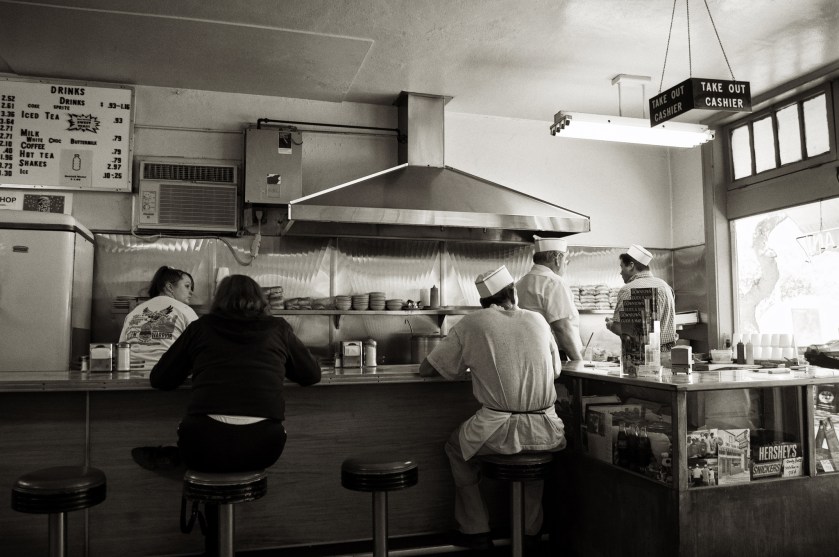
Black and white interior photograph of Coney Island Grill diner in St. Petersburg, Florida, showing customers at counter with chrome stools, cooks in white uniforms behind the counter, vintage menu board, and classic diner lighting and fixtures.
The timeless charm of Coney Island Grill in downtown St. Petersburg, Florida, 2011. This black and white photograph captures the authentic American diner experience with counter service, vintage stools, and white-uniformed cooks serving up classic hot dogs and nostalgia in this beloved St. Pete institution.

In the monochromatic stillness of this 2011 photograph, Greg Urbano captures the Coney Island Grill in downtown St. Petersburg, Florida, not as a restaurant, but as a theater of American nostalgia. The image presents a classic counter-service establishment frozen in a moment that feels simultaneously contemporary and timeless, a quality that speaks to the enduring nature of these communal spaces in American culture.

The composition demonstrates Urbano’s understanding of documentary photography’s essential paradox: how to frame the ordinary in ways that reveal its extraordinary nature. Shot with a Pentax K-x at 18mm, the wide-angle perspective encompasses the full breadth of the counter scene while maintaining intimate proximity to the subjects. The technical choices—f/5.6 at 1/40s, ISO 400—suggest available light work, resulting in the soft, natural illumination that bathes the scene in an almost ethereal quality despite the grittiness of the setting.

What commands attention is the photographer’s positioning. Urbano places the viewer among the patrons, seated at the counter alongside two customers whose backs form the photograph’s foreground. This deliberate framing creates layers of engagement: we observe not just the space, but the act of inhabiting it. The diner on the left, in a dark jacket, and the chef in white with his distinctive paper hat become characters in a narrative about place and belonging.

The tonal range of the black and white rendering amplifies the scene’s nostalgic register. Notice how the overhead hood reflects light downward onto the work surface, creating a stage-like illumination for the kitchen staff. The ribbed metal backdrop, the orderly rows of plates, the utilitarian equipment—all these elements speak to efficiency and tradition. Yet Urbano avoids romanticizing the space. The air conditioning unit, the fluorescent fixtures, the practical signage directing customers to the “TAKE OUT CASHIER”—these details ground the image in working-class reality.

The drinks menu board, visible in the upper left corner, provides cultural specificity. Iced tea, milk, hot chocolate, shakes—this is comfort food territory, unpretentious and familiar. The pricing, the handwritten additions, the weathered appearance of the signage all contribute to the sense that this establishment has served its community for years, possibly decades.

Within the context of Urbano’s Top 100 Journey, this photograph functions as documentary evidence of endangered spaces. Classic diners and grills face mounting economic pressures, often displaced by chains or upscale development. By photographing the Coney Island Grill with such careful attention to atmosphere and human presence, Urbano creates both record and elegy. The image honors the social function of these establishments—as gathering places, as democratic spaces where counter seats make everyone equal, where the transaction between server and served maintains its human dimension.

The geometry of the composition reinforces this democratic spirit. The long horizontal line of the counter, repeated in the overhead hood and service shelf, creates stability and continuity. The figures, distributed across the frame, suggest community without crowding. Even in stillness, the photograph conveys the rhythm of daily life, the quiet choreography of ordering, preparing, and serving food.

This is photography that understands place as palimpsest—layers of time, use, and memory inscribed in a single frame.

See this image on:

500px

Flickr

Alioto’s on Fisherman’s Wharf: A Study in Nocturnal Americana

Greg Urbano’s 2010 black and white photograph of Alioto’s restaurant in San Francisco is a significant early work, capturing the intersection of technical skill and artistic vision. It explores familiar scenes through a developing photographic perspective, revealing how ordinary moments can become extraordinary. The image emphasizes light, structure, and context, marking a pivotal discovery in Urbano’s artistic journey.

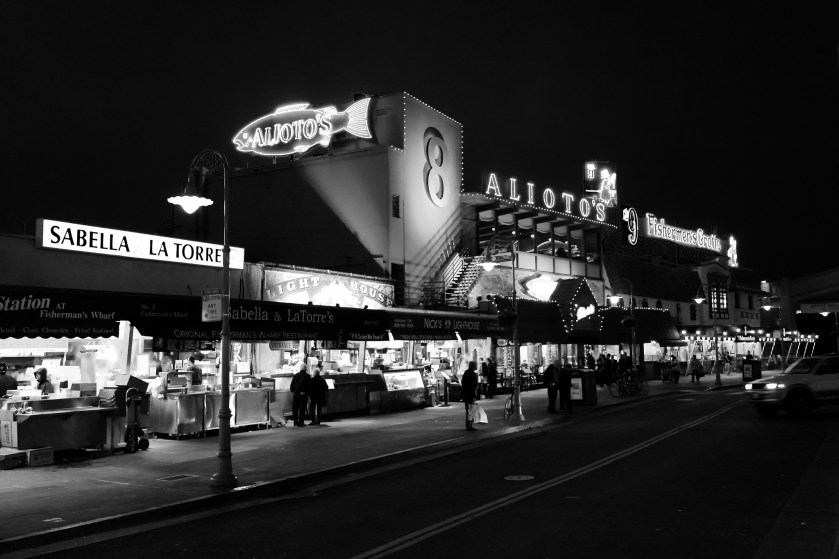
Black and white night photograph of Alioto's #8 restaurant with illuminated neon signs and marquee lights on Fisherman's Wharf in San Francisco. Food vendor stalls including Sabella LaTorre line the boardwalk in the foreground, with pedestrians visible under vintage street lamps.
Alioto’s Restaurant at Fisherman’s Wharf, San Francisco – Night Photography 2010. Iconic neon signs and vintage architecture illuminate this historic seafood destination on San Francisco’s waterfront. Black and white travel photography capturing the timeless charm of Fisherman’s Wharf restaurants and food stalls.

Alioto’s on Fisherman’s Wharf: A Study in Nocturnal Americana

Greg Urbano’s 2010 photograph of Alioto’s restaurant on Fisherman’s Wharf stands as a pivotal work from Chapter One of his Top 100 Journey—a collection dedicated to early beginnings and the formative images that taught him how to see. This photograph represents more than just a vacation snapshot; it captures the moment when technical skill and artistic vision began to converge.

This image works on multiple levels simultaneously. On the surface, it presents a straightforward night photograph of a famous San Francisco landmark. But closer examination reveals a developing understanding of tonal relationships and compositional balance. The black and white treatment isn’t merely aesthetic—it’s revelatory. By stripping away color, the photographer forces viewers to see the architecture of light itself. The neon signs become sculptural elements, the illuminated storefronts transform into glowing boxes of human activity, and the darkness above presses down with an almost palpable weight.

What makes this photograph particularly significant as an early work is its democratic vision. He doesn’t attempt to elevate Alioto’s to fine art by isolating it or abstracting it beyond recognition. Instead, he presents the entire commercial ecosystem: the neighboring Sabella LaTorre sign, the smaller vendor stalls with their utilitarian lighting, the people moving through the frame as gentle blurs. This is tourism and commerce as theater, captured without cynicism or sentimentality—a mature perspective for someone still discovering their photographic voice.

The technical execution demonstrates the learning curve inherent in Chapter One. Shot with a Samsung NX100—not a professional camera by any measure—this image proves that vision was developing faster than equipment acquisition. The exposure is carefully controlled, holding detail in both the bright signage and the darker architectural elements. The vantage point shows deliberate thought: low enough to emphasize the vertical drama of the building, yet far enough back to include context. That giant illuminated fish and the number “8” become almost sculptural forms against the night sky.

As an early capture, this photograph reveals an artist already grasping something fundamental: great photographs often lie not in exotic locations but in how we see the familiar. Fisherman’s Wharf has been photographed millions of times, yet this image feels both specific and universal. It could only be this place, yet it speaks to every similar waterfront tourist district in America. This understanding—that the ordinary can become extraordinary through careful observation—marks a crucial lesson in any photographer’s development.

The inclusion of this work in the Top 100 Journey reflects its role as a foundational piece. It’s not about perfection; it’s about the spark of discovery. The photograph represents a moment when the camera revealed something the artist was only beginning to articulate—an ability to see light as structure, to recognize the poetry in commercial spaces, to trust in straightforward documentation over manipulation.

The photograph has aged beautifully, which speaks to the instincts already present in these early days. In an era of digital saturation and Instagram filters, there’s something refreshing about this honest image. It doesn’t try too hard. It simply observes, with emerging intelligence and care.

When displayed as part of Chapter One: Beginnings, this image invites viewers to consider the photographer’s journey. It rewards examination not just for its formal qualities—the geometry, the light, the tonal range—but for what it represents: a lesson learned, a moment of clarity, a step toward understanding how to translate vision into image. This is where the journey truly began.

See larger sizes of the image on these sites:

Flickr

500px