Stuckey’s Skeleton: Monuments to Velocity and Obsolescence

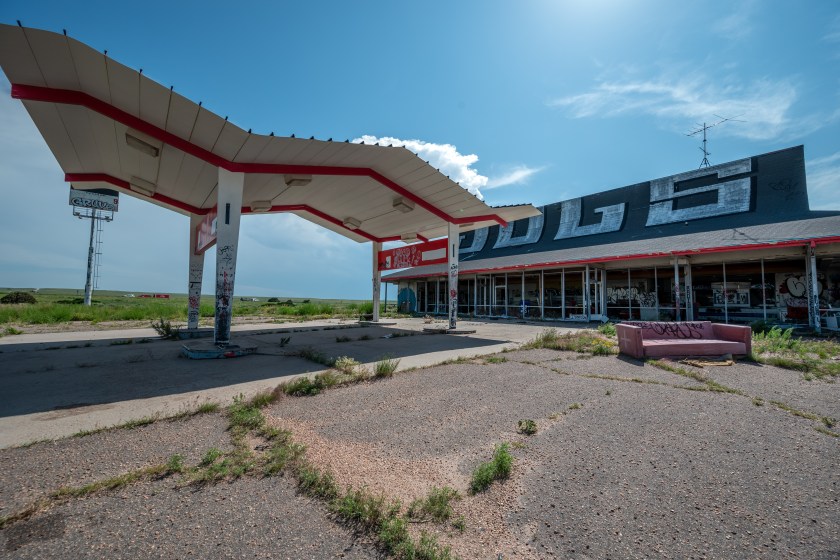
The photo of an abandoned Stuckey’s along I-76 in Colorado captures the decline of mid-century roadside travel due to economic shifts and infrastructure changes. With documentary clarity, it emphasizes architectural decay and cultural history, inviting viewers to reflect on both nostalgia and contemporary relevance while preserving a forgotten era of American mobility.

Abandoned roadside building with a former gas canopy and boarded storefront, covered in graffiti and surrounded by cracked pavement and weeds under a blue sky.
The abandoned remains of a former Stuckey’s at the Sedgwick exit along I-76 in northeastern Colorado.

In this documentation of a former Stuckey’s roadside station along Interstate 76 near Sedgwick, Colorado, the photographer captures a distinctly American form of ruin—one born not of catastrophe but of bypass, economic shift, and the relentless evolution of travel infrastructure. The image, positioned within Chapter 6 of his Top 100 Journey, reflects a thematic concern with both literal and metaphorical roads ahead, while simultaneously acknowledging what has been left behind.

The composition employs a wide-angle perspective that emphasizes the structure’s geometric severity against an expansive Colorado sky. The canopy’s angular red-and-white striping draws the eye leftward, while the weathered building facade—bearing faded lettering and graffiti-marked columns—anchors the right side of the frame. Between these elements lies cracked asphalt overtaken by scrub grass, a visual testimony to years of abandonment. The photographer positions himself at a slight distance, allowing the full scope of dereliction to register without sensationalizing the decay.

What distinguishes this work from mere urban exploration photography is its restraint. Rather than fetishizing abandonment or deploying dramatic processing techniques, the photographer presents the scene with documentary clarity. The natural light—diffused through wispy clouds—provides even illumination that reveals texture in the deteriorating surfaces without casting the scene into melodrama. A discarded pink couch in the lower right corner serves as an unexpected punctuation mark, a surreal domestic intrusion into commercial space that hints at the site’s reappropriation by transient visitors.

The Stuckey’s chain represents a specific era of American mobility—mid-century road travel when interstate commerce moved at human speeds and roadside stops functioned as destinations rather than mere interruptions. The photographer’s selection of this subject speaks to an interest in cultural archaeology, in preserving evidence of infrastructures that once defined travel experience but now exist as skeletal reminders of obsolete commercial models.

Within the context of Chapter 6’s “ongoing exploration,” this photograph demonstrates an expansion of the photographer’s subject matter beyond controlled studio environments and collaborative performances. Here, he engages with the built environment as found object, approaching landscape and architecture with the same compositional rigor previously applied to portraiture and experimental lighting. The decision to include this image alongside more technically innovative work suggests an artistic practice concerned with breadth as much as depth—a willingness to move between modes of image-making as the subject demands.

The personal dimension—referenced in the accompanying text through memories of hot dogs and pecan log rolls—remains deliberately absent from the photograph itself. This restraint allows the image to function on multiple levels: as architectural document, as cultural commentary, as landscape study. The photographer trusts the visual evidence to carry meaning without editorial intervention, letting viewers project their own relationships to such spaces.

As part of the Top 100 selection, this photograph confirms that the journey ahead need not always involve technical innovation or conceptual complexity. Sometimes it requires simply bearing witness to what time and economics have rendered irrelevant, preserving in two dimensions what three-dimensional space will not sustain much longer. The road ahead, this image suggests, is also paved with remnants of roads already traveled.
Northern Hotel Lobby: Architecture as Stage in the Contemporary Photographic Journey

The photograph of the Northern Hotel lobby, taken during Scott Kelby’s Worldwide Photowalk, captures the interplay of light, architecture, and human presence. Elevating the viewer’s experience, it harmonizes historical preservation with contemporary exploration, highlighting the importance of collaborative practice in photography and the evolving narrative of space and community.

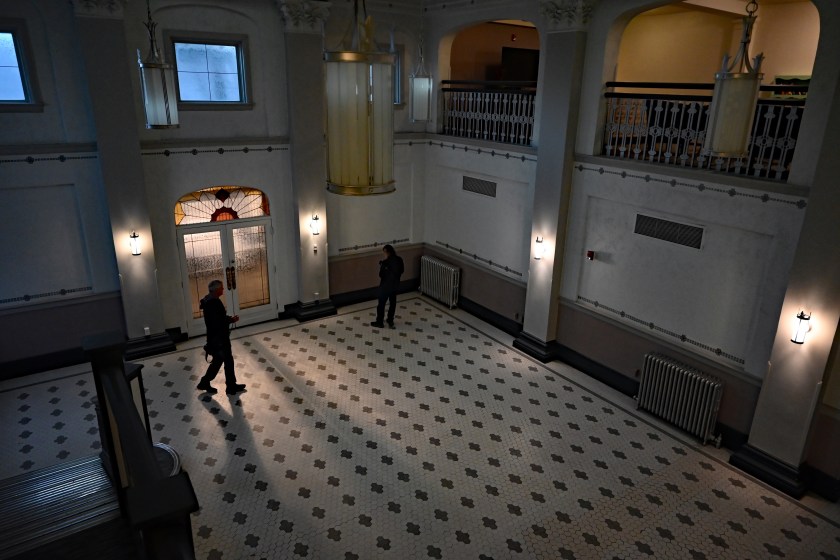
View of the Northern Hotel lobby from an upper staircase, showing patterned tile flooring, hanging lights, and two people walking across the open space below.
The Northern Hotel lobby in Fort Collins, photographed from the top of the staircase during Scott Kelby’s Worldwide Photowalk.

In this commanding architectural study, the photographer positions his lens at the apex of a staircase, transforming the Northern Hotel’s lobby into a theater of light, geometry, and human scale. Captured during Scott Kelby’s Worldwide Photowalk in Fort Collins, the image represents a significant entry in Chapter 6 of his Top 100 Journey—a section devoted to recent work and ongoing exploration. Here, the photographer’s evolving visual language finds purchase in the interplay between preserved historical space and contemporary documentary practice.

The composition demonstrates a mature understanding of spatial dynamics. Shot from an elevated vantage point, the frame encompasses the lobby’s full vertical reach, from the patterned terrazzo floor below to the arched balconies above. Two fellow photographers occupy the lower portion of the frame, their dark silhouettes providing crucial scale against the expanse of white walls and geometric flooring. This human element prevents the space from becoming merely an exercise in architectural documentation; instead, it anchors the viewer’s experience in a moment of shared discovery.

The photographer’s technical execution reveals deliberate choices regarding exposure and white balance. The warm incandescent glow from wall sconces contrasts with cooler ambient light filtering through windows, creating a subtle temperature gradient that enhances the lobby’s dimensionality. Pendant lights suspended from the ceiling echo this interplay, their cylindrical forms acting as vertical punctuation marks in the composition. The decorative tile borders running horizontally along the walls establish rhythm, while the radiators beneath provide industrial counterpoint to the space’s ornamental flourishes.

What distinguishes this work within the context of Chapter 6 is its relationship to process and community. Unlike the more introspective or solitary work that might characterize earlier chapters, this photograph emerges from collaborative exploration—a photowalk that brings practitioners together in shared discovery. The photographer’s decision to include his companions becomes a subtle commentary on the social dimensions of photographic practice, acknowledging that contemporary image-making often unfolds in dialogue with others.

The Northern Hotel itself, with its restored early twentieth-century details, offers fertile ground for examining how historical architecture persists in contemporary life. The stained glass transom above the entrance door, the ornamental ironwork of the balcony railings, and the carefully preserved floor pattern all speak to preservation efforts that transform commercial spaces into cultural touchstones. The photographer approaches this material not with nostalgia but with documentary clarity, allowing the space’s formal qualities to assert themselves.

In the broader trajectory of his Top 100 Journey, this image signals an openness to environmental portraiture and architectural narrative. The “ongoing exploration” referenced in Chapter 6 manifests here as a willingness to work within structured events and communal frameworks while maintaining individual vision. The photograph neither dominates its subject with excessive intervention nor withdraws into passive recording; rather, it strikes a balance between observation and interpretation.

The Northern Hotel lobby becomes, under his lens, both subject and metaphor—a preserved space that hosts contemporary seekers, a historical vessel filled with present-tense activity. This duality resonates throughout the photographer’s recent work, suggesting that the road ahead involves continued negotiation between tradition and innovation, solitude and community, documentation and artistic expression.

Reclamation and Ruin: A Study in Agricultural Melancholy

The photograph of an abandoned farmhouse near Fort Collins, Colorado, embodies themes of impermanence and decay. The image balances architectural elements with natural landscapes, showcasing technical sophistication through HDR processing. By highlighting details of deterioration amidst recent human traces, it transforms rural abandonment into a poignant meditation on time and memory.

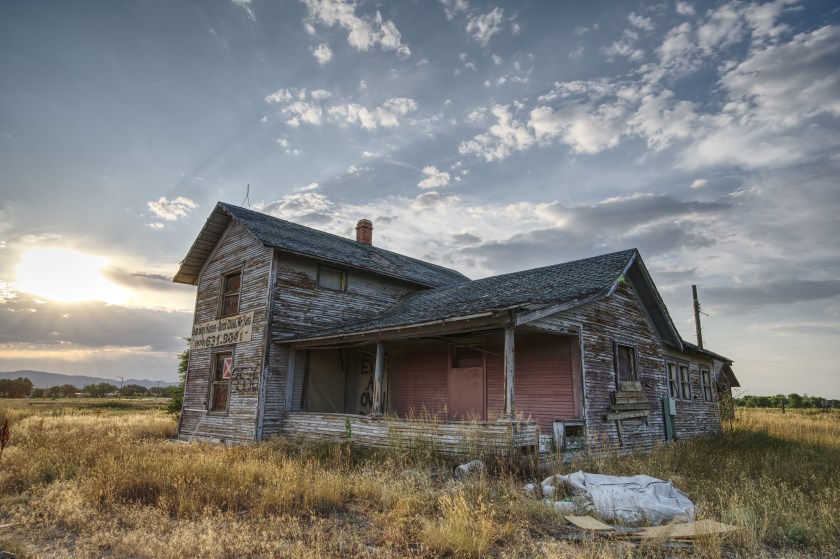
Weathered wooden farmhouse with boarded windows and peeling paint standing in tall grass near Fort Collins, Colorado.
An abandoned wooden farmhouse sits in open prairie near Fort Collins, Colorado.

In this haunting documentation of rural abandonment, the photographer captures a weathered farmhouse on the outskirts of Fort Collins, Colorado—a structure caught in the liminal space between human history and nature’s patient reclamation. The image, selected for Chapter 6 of his Top 100 Journey, exemplifies the ongoing evolution in his practice toward subjects that speak to impermanence, transition, and the quiet dignity of forgotten places.

The compositional strategy reveals a mature understanding of architectural photography merged with landscape sensibility. The two-story structure commands the frame while remaining subordinate to the expansive Colorado sky, which fills nearly half the image with dramatic cloud formations. This deliberate balance prevents the photograph from becoming merely documentary, instead elevating it into meditation on time and decay. The golden hour lighting—captured with precision timing—rakes across the weathered clapboard siding, accentuating every crack, peel, and shadow in the wood grain. This textural emphasis transforms deterioration into visual poetry.

His decision to employ HDR processing demonstrates technical sophistication in service of artistic vision rather than mere spectacle. The extended dynamic range allows simultaneous preservation of detail in the sun-bleached siding and the darker recesses of boarded windows and doorways. The processing maintains naturalistic color while enhancing the amber warmth of dying light against cool blue-grey clouds, creating chromatic tension that mirrors the thematic conflict between persistence and decay.

The overgrown prairie grass in the foreground serves multiple functions within the composition. Practically, it provides textural contrast to the geometric severity of the architecture; symbolically, it represents nature’s inexorable advance. The discarded white fabric or tarp in the lower right corner introduces a note of recent human presence, suggesting that abandonment is an ongoing process rather than a completed historical fact. This detail prevents the image from slipping into nostalgic romanticism.

What distinguishes this work within the context of Chapter 6—titled “The Road Ahead: Recent Work & Ongoing Exploration”—is its synthesis of earlier themes with evolving concerns. The photographer has long demonstrated interest in human traces within landscape, but here the investigation deepens. Rather than simply documenting what remains, he engages with the process of vanishing itself. The boarded windows become blind eyes; the peeling paint functions as aging skin; the sagging roofline suggests exhaustion. The structure possesses almost anthropomorphic vulnerability.

The photograph’s origins as a response to the 52frames weekly challenge reveals another dimension of his practice—the ability to transform assignment-based work into personally meaningful investigation. Many photographers struggle to maintain artistic integrity within the constraints of themed prompts, yet he has consistently used such frameworks as catalysts rather than limitations.

The telephone number still visible on the building’s facade—a commercial ghost—adds poignant specificity. It grounds the abstracted themes of abandonment and time in particular lives, particular businesses, particular failures or departures. This detail resists the tendency toward generic commentary on “the death of rural America” and instead insists on the singular reality of this particular farmhouse, this particular field, this particular evening light.

In positioning this image within his ongoing journey, the photographer signals continued commitment to finding profound resonance in overlooked subjects. The road ahead, it seems, leads deliberately toward what others pass by—not from contrarian impulse, but from genuine recognition that beauty and meaning persist even in, perhaps especially in, the discarded and decaying.

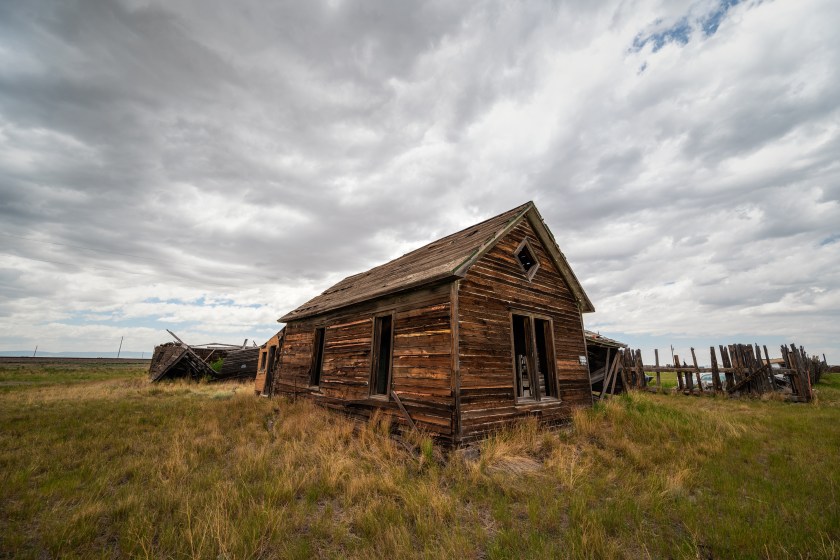
Corner House, Bosler Wyoming 2025: Architecture at the Edge of Erasure

In Chapter 6 of Greg Urbano’s Top 100 Journey, a photograph captures a deteriorating house in the ghost town of Bosler, Wyoming. The image illustrates the photographer’s exploration of abandonment, focusing on atmospheric conditions and the surrounding landscape. This work highlights the themes of decay, isolation, and the complexity of preservation amid a vanishing settlement.

Weathered wooden house with broken windows standing alone in grassland under an overcast sky in Bosler, Wyoming.
A deteriorating wooden house stands at a corner in the ghost town of Bosler, Wyoming.

In this recently captured photograph from Chapter 6 of Greg Urbano’s Top 100 Journey, the photographer documents a collapsing structure in Bosler, Wyoming—one of the few remaining witnesses to a town that has largely disappeared from both map and memory. The image exemplifies the photographer’s continued investigation into the material traces of Western settlement, while revealing new subtleties in his approach to documenting abandonment and temporal passage.

The composition centers on a weathered wooden dwelling, its steep-pitched roofline still asserting architectural intention despite advanced structural compromise. The building’s corner placement within the frame—echoing its designation as a “corner house”—creates a dynamic diagonal energy, the structure appearing to lean into the wind-swept grassland that now reclaims the site. Dark window openings punctuate the horizontal wood siding, which has weathered to rich amber and umber tones, each plank articulated by the diffused overcast light.

What distinguishes this work within the photographer’s recent output is his expanded attention to atmospheric conditions. The turbulent cloudscape dominates nearly two-thirds of the frame, its churning gray masses punctuated by occasional breaks of blue—a meteorological drama that mirrors the building’s own precarious state between persistence and collapse. This sky is not mere backdrop but active participant, suggesting the elemental forces that have contributed to the structure’s deterioration and will eventually complete its dissolution.

The surrounding landscape provides crucial narrative context. Collapsed outbuildings and fence remnants scatter across the middle ground, fragmentary evidence of what was once a more substantial settlement. Golden prairie grasses advance toward the dwelling’s foundation, their subtle movement implied even within the photograph’s frozen moment. The extreme horizontality of the High Plains extends to a barely perceptible horizon line, emphasizing the profound isolation of this site just north of Laramie, accessible from Highway 80 yet psychologically distant from contemporary traffic patterns.

From a technical standpoint, the photographer employs what appears to be a moderate wide-angle perspective, capturing sufficient environmental context while maintaining the building’s structural integrity within the frame. The exposure handles the challenging luminosity range of overcast conditions with nuance, preserving detail in both shadowed door openings and highlighted cloud formations. This balanced approach serves the documentary imperative while allowing for aesthetic contemplation.

Within Chapter 6’s thematic framework of “The Road Ahead,” this photograph functions as meditation on endings and continuations. Bosler exists now primarily as absence—a ghost town in the most literal sense—yet the photographer’s attention validates its remaining physical evidence as worthy of sustained consideration. His choice to include this work in his curated Top 100 Journey suggests an artist grappling with questions of what deserves preservation, at least photographically, when material preservation is no longer possible.

The work also demonstrates evolution in the photographer’s relationship to his subject matter. Where earlier chapters might have emphasized formal qualities or nostalgic resonance, this image presents abandonment as process rather than state—a building actively returning to landscape, caught mid-transition. The corner house stands as both monument and warning, its dignified decay offering no easy emotional resolution. This measured, clear-eyed approach marks the maturation of an artist comfortable with ambiguity, finding profundity in the unheroic persistence of structures at civilization’s receding edge.

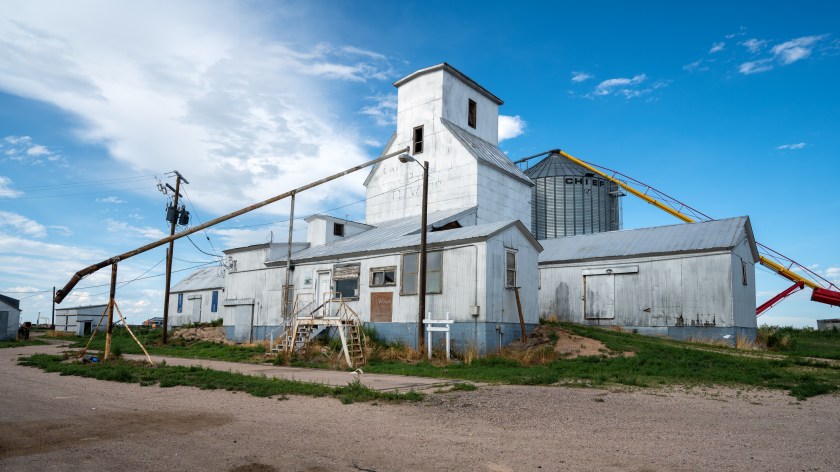
Briggsdale Scale and Silos: Monuments of Rural Persistence

The photograph of the Briggsdale Scale and Silos in eastern Colorado captures the beauty of agricultural remnants under a vast prairie sky. The artist portrays abandonment as transformation rather than decay, highlighting layered complexities and themes of economic change. This work reflects both personal exploration and broader cultural narratives in rural America.

Rural grain elevator complex with white scale house buildings and metal silos under a blue sky in eastern Colorado.
The Briggsdale scale and silos stand along a roadside in rural eastern Colorado.

In this commanding photograph from Chapter 6 of Greg Urbano’s Top 100 Journey, the photographer turns his lens toward the structural remnants of agricultural infrastructure in eastern Colorado. The Briggsdale Scale and Silos stand as weathered sentinels against an expansive prairie sky, their utilitarian forms elevated to subjects of aesthetic contemplation through careful compositional framing and an acute sensitivity to light.

The image presents a study in contrasts—temporal, textural, and tonal. The white-painted grain elevator rises prominently in the frame’s left third, its verticality punctuated by narrow window openings that read as dark voids against the painted surface. Adjacent structures spread horizontally across the composition, their corrugated metal siding bearing the patina of decades exposed to the elements. A modern Chief grain bin introduces a cylindrical geometry, while the skeletal remains of what appears to be an auger system arc across the upper right quadrant, its yellow and red paint providing the only vivid chromatic notes in an otherwise muted palette.

What distinguishes this work within the photographer’s ongoing exploration is its treatment of abandonment not as decay but as transformation. The structures retain their monumental presence even as nature begins its slow reclamation—weeds push through concrete, grass encroaches on gravel pathways, and rust blooms across metal surfaces. The dramatic cloud formation sweeping across the cobalt sky suggests movement and change, while the buildings themselves remain rooted, immovable despite their gradual obsolescence.

The photographer’s technical execution reveals a sophisticated understanding of documentary traditions. Shot in brilliant midday light that might challenge less experienced practitioners, he harnesses the harsh illumination to articulate every surface detail—the vertical seams of the elevator, the weathering patterns on wood siding, the dimensional quality of the corrugated metal. The deep blue sky provides crucial tonal separation, preventing the white structures from dissolving into atmospheric haze while simultaneously emphasizing the vastness of the landscape context.

Within Chapter 6’s framework of “The Road Ahead,” this photograph functions as both retrospective and prospective statement. It acknowledges the photographer’s established interest in vernacular architecture and rural landscapes while suggesting new territories of investigation. The composition’s layered complexity—multiple structures occupying different spatial planes, the interplay of geometric forms, the dialogue between human-made and natural elements—indicates an artist pushing beyond straightforward documentation toward more nuanced visual poetry.

The work also engages broader themes of economic transition and cultural memory embedded in the American rural landscape. These agricultural structures, once vital nodes in the grain production and distribution network, now stand largely dormant, their continued presence a testament to both past prosperity and present uncertainty. The photographer neither romanticizes nor condemns this state of affairs; instead, he presents the scene with clear-eyed attention, allowing viewers to project their own narratives onto these architectural forms.

As part of his long-term Top 100 Journey project, this image demonstrates the photographer’s commitment to sustained engagement with place and subject matter. His repeated travels through eastern Colorado have yielded not mere repetition but deepening insight, as evidenced by this photograph’s confident handling of complex visual elements. It represents the work of an artist whose ongoing exploration continues to reveal new dimensions within familiar territory, finding monumentality in structures others might overlook and poetry in the persistent presence of the seemingly obsolete.

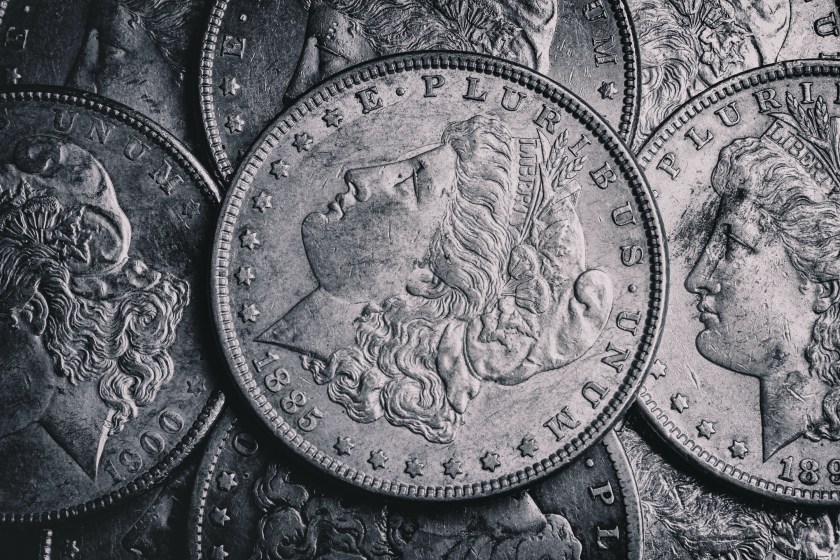
Morgan Silver Dollars: Texture, Time, and Monochromatic Study

The photographed still life of overlapping late nineteenth-century Morgan silver dollars showcases a detailed exploration of numismatic design through macro photography. The monochromatic treatment emphasizes surface textures and historical nuances while controlled lighting enhances the sculptural qualities. This work merges traditional still life methodologies with contemporary techniques, documenting valuable artifacts within a modern context.

Close-up photograph of overlapping Morgan silver dollar coins showing worn engraved profiles and inscriptions.
A close-up still life of overlapping Morgan silver dollar coins from the late nineteenth century.

This monochromatic study of late nineteenth-century Morgan Silver Dollars represents the photographer’s deliberate expansion into controlled still life work, demonstrating how historical objects can serve as compelling subjects for formal exploration. The composition arranges multiple coins in overlapping layers, creating a topographical landscape of circular forms that invites close examination of surface detail, wear patterns, and the inherent sculptural qualities of numismatic design.

The technical approach centers on macro photography, executed with a Meike 85mm f/2.8 lens paired with his Sony A7ii system. This focal length and aperture combination allows for selective focus that emphasizes the central Morgan Dollar while surrounding coins recede into varying degrees of sharpness. The viewer’s eye naturally gravitates to the prominently featured coin displaying Liberty’s profile, her flowing hair rendered in remarkable relief detail. The inscription “E PLURIBUS UNUM” curves along the upper edge, each letter capturing light differently based on the coin’s worn topography—evidence of decades in circulation.

His conversion to black and white through Nik Silver Efex Pro proves particularly astute for this subject matter. The monochromatic treatment unifies the silver surfaces while accentuating tonal variations that reveal the coins’ individual histories. Scratches, patina, and areas of polish loss become visual information rather than mere damage. The grayscale palette also reinforces the historical nature of these artifacts, creating an aesthetic continuity between the coins’ era of origin and the contemporary photograph documenting them.

The lighting strategy deserves attention for its subtlety. Diffuse illumination reveals the bas-relief portraits and decorative elements without creating harsh specular highlights that might obscure detail or introduce unwanted contrast. Shadows between stacked coins provide dimensional information, suggesting weight and materiality. The photographer has avoided the common pitfall of overworking metallic surfaces, instead allowing the silver to speak through its natural reflective properties and acquired character.

Within Chapter 5’s framework examining still life photography from classic to experimental approaches, this work anchors itself firmly in traditional methodology. The arrangement recalls centuries of vanitas imagery where objects of commerce and temporal value serve as subjects for formal study. Yet the execution benefits from modern digital capture capabilities—the macro lens resolving minute surface textures that would challenge film-based systems, and post-processing software offering precise tonal control.

The choice to work with borrowed objects introduces an interesting collaborative element to his expanding still life practice. These coins carry not only their original historical context but also the contemporary narrative of a colleague’s collection—objects held, preserved, and valued by someone within his immediate circle. This transforms the exercise from pure technical study into a form of visual preservation, documenting specific artifacts at a particular moment in their continuing existence.

As an entry point into product and still life photography practiced within the domestic studio environment, this image succeeds in demonstrating foundational skills: controlled lighting, thoughtful composition, appropriate lens selection, and sensitive post-processing. The Morgan Dollars provide subject matter rich enough to reward close attention while remaining accessible—a practical choice for developing technical proficiency that yields aesthetically resolved results worthy of inclusion in his curated collection.

Maia del Mazo Urban : A Study in Contemporary Youth Portraiture

Maia del Mazo’s portrait, captured in Old Town Fort Collins, exemplifies the intersection of contemporary youth culture and environmental portraiture. Utilizing natural light and artificial enhancement, the photographer balances technical precision with spontaneity. The subject’s confident pose and styling reflect a subcultural moment, fostering an authentic connection with the viewer.

Woman wearing red shorts and knee-high socks crouches on a concrete surface in an urban setting with bright sky behind her.
Maia del Mazo poses in an urban location in Old Town Fort Collins, Colorado.

Within Chapter 4 of the photographer’s Top 100 Journey—dedicated to studio, outdoor, and workshop portraiture—this image of Maia del Mazo emerges as a compelling examination of contemporary youth culture and environmental portraiture. Shot in Old Town Fort Collins, Colorado, the photograph demonstrates the artist’s evolving command of natural light augmented by carefully controlled artificial illumination, a technical approach that has become increasingly refined throughout this chapter of his documentary project.

The composition presents the subject in a confident, grounded squat position against a minimalist architectural backdrop. Her styling—vintage band aesthetic meeting modern streetwear, complete with floral combat boots, striped knee socks, and layered chokers—speaks to a specific subcultural moment. The photographer has positioned her centrally within the frame, allowing the clean lines of the urban architecture to recede into soft focus, creating negative space that amplifies the subject’s presence rather than competing with it.

Technically, the image represents a sophisticated balance between available daylight and artificial enhancement. Shot with a Sony A7ii paired with an 85mm f/1.8 lens, the photographer employed a handheld Godox V1s flash without modification—a bold choice that suggests confidence in reading ambient conditions. The direct flash technique produces a subtle fill that lifts shadows without flattening the image’s dimensionality, while the 85mm focal length compresses the background just enough to isolate the figure without creating unnatural bokeh. The slight wind-swept quality of the subject’s hair adds dynamism to what might otherwise read as a static pose.

What distinguishes this work within the chapter’s broader context is its departure from traditional studio control. While maintaining the technical precision associated with formal portraiture, the photographer embraces environmental elements—concrete surfaces, architectural geometry, natural wind movement—that introduce spontaneity into the frame. This hybrid approach reflects an evolution in his practice, moving beyond purely controlled studio environments toward a more flexible methodology that captures authentic personality within structured compositions.

The post-processing in Luminar 4 demonstrates restraint appropriate to the subject matter. Color grading emphasizes warm tones in the subject’s skin and the amber cast of her sunglasses while maintaining the cooler neutrals of the concrete and sky. The processing enhances rather than transforms, supporting the documentary quality inherent in the photographer’s approach to his Top 100 Journey project.

The subject’s body language—relaxed yet assertive, casual yet deliberate—suggests a collaborative relationship between photographer and sitter. This comfort level allows for genuine expression rather than performative posing, a quality that distinguishes effective contemporary portraiture from mere documentation. The direct, knowing gaze above the rose-tinted frames establishes connection with the viewer while maintaining a degree of cool remove characteristic of youth subculture.

As part of the photographer’s long-term Top 100 Journey, this image contributes to an ongoing investigation into portraiture’s capacity to capture both individual personality and broader cultural moments. It represents the workshop and outdoor component of Chapter 4’s mission, demonstrating how environmental factors and technical adaptability can produce work that honors both formal photographic traditions and contemporary visual language. The result is a portrait that feels simultaneously timeless in its compositional confidence and distinctly anchored in its cultural moment.