Lights Camera Action: Urban Pulse and Architectural Legacy

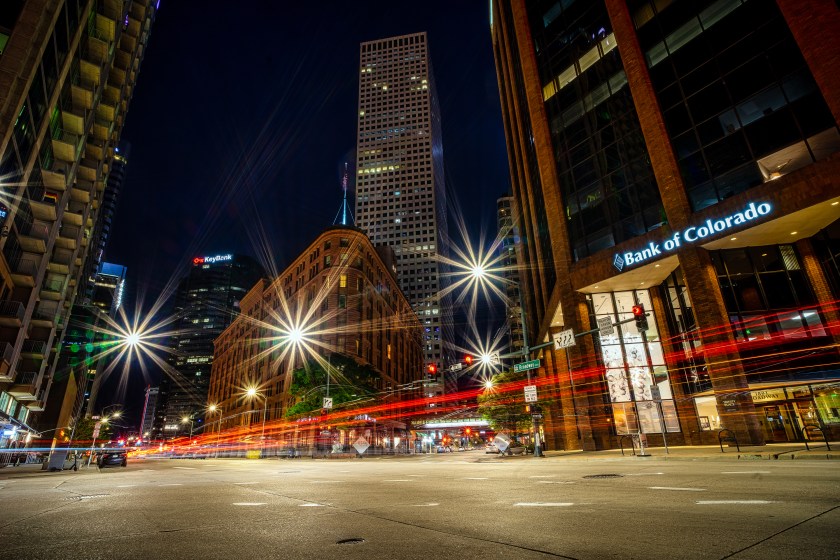
The photograph captures the Broadway and Tremont intersection in downtown Denver, highlighting the contrast between historic architecture and modern life through long exposure techniques. It features the Brown Palace Hotel amidst urban vitality, emphasizing Denver’s artistic complexity. The image challenges traditional views on Colorado’s landscape, advocating for cityscapes’ recognition in photographic surveys.

Long exposure light trails streak through a downtown Denver intersection at night, with tall buildings and streetlights surrounding the scene.
Long exposure traffic moves through the Broadway and Tremont intersection in downtown Denver, Colorado, with city buildings illuminated at night.

In this dynamic nocturnal study of downtown Denver, the photographer captures the essential duality of contemporary urban experience—the historic permanence of architecture set against the ephemeral flow of modern life. Positioned at the intersection of Broadway and Tremont, the image exemplifies his expanding vision within Chapter 3 of the Top 100 Journey, demonstrating how cityscapes demand entirely different technical and conceptual approaches than the natural landscapes that dominate much of his Colorado work.

The composition centers on the iconic triangular form of the Brown Palace Hotel, its distinctive Italianate Renaissance architecture rendered in warm amber tones against the deep blue of evening sky. This historic structure, framed between modern high-rises including the recognizable Republic Plaza tower, serves as both literal and metaphorical anchor—a touchstone of Denver’s Victorian-era prosperity surrounded by evidence of contemporary economic vitality. The photographer’s selection of this particular vantage point acknowledges the city’s layered temporal identity, where preservation and progress coexist in productive tension.

Working with an 18mm Samyang wide-angle lens mounted to his Sony A7II, he employs long exposure to transform vehicular traffic into ribbons of light—brilliant red taillights streaking horizontally across the frame’s lower third. These light trails provide kinetic energy and directional movement, leading the eye through the urban canyon while simultaneously suggesting the ceaseless motion of city life. Street lamps contribute their own starburst effects, punctuating the composition with points of crystalline brilliance that add theatrical dimension to the scene.

The technical execution reveals sophisticated understanding of night photography’s particular challenges. The exposure balances multiple light sources—artificial street lighting, illuminated building interiors, vehicle headlights, and residual ambient sky—without sacrificing detail in highlights or shadows. Corporate signage for KeyBank and Bank of Colorado glows with intentional clarity, grounding the image in specific place while contributing to the overall color harmony. The photographer’s post-processing in Luminar 4 has enhanced these chromatic relationships without pushing them into garishness, maintaining naturalistic tonality despite the inherently artificial lighting conditions.

What distinguishes this photograph within the broader chapter is its successful integration of Colorado’s urban identity alongside the state’s more frequently celebrated natural splendor. While mountain vistas and wilderness landscapes tend to dominate photographic representations of Colorado, this image argues persuasively for Denver’s visual complexity and photographic merit. The cityscape becomes landscape—vertical rather than horizontal, constructed rather than geological, but equally worthy of sustained aesthetic attention.

The wide-angle perspective introduces subtle geometric distortion that emphasizes the vertiginous quality of urban space, the way buildings frame and compress sky into channels of deep blue-black. Empty pavement in the immediate foreground provides breathing room, allowing viewers to enter the scene before being swept into the light-streaked energy of the intersection itself. This compositional breathing space demonstrates restraint and confidence, resisting the temptation to fill every pixel with information.

Within his evolving practice, this photograph represents important formal development. The controlled chaos of long-exposure urban photography requires different skills than landscape work—timing traffic flow, managing mixed lighting, balancing architectural detail against motion blur. His success here suggests a photographer expanding his technical vocabulary while maintaining consistent artistic sensibility. The image asks viewers to reconsider what constitutes Colorado landscape, proposing that cityscapes deserve equal consideration in any comprehensive photographic survey of the state’s visual identity.
Contemporary Urban Narrative: The Scooter as Cultural Marker in Denver’s Historic District

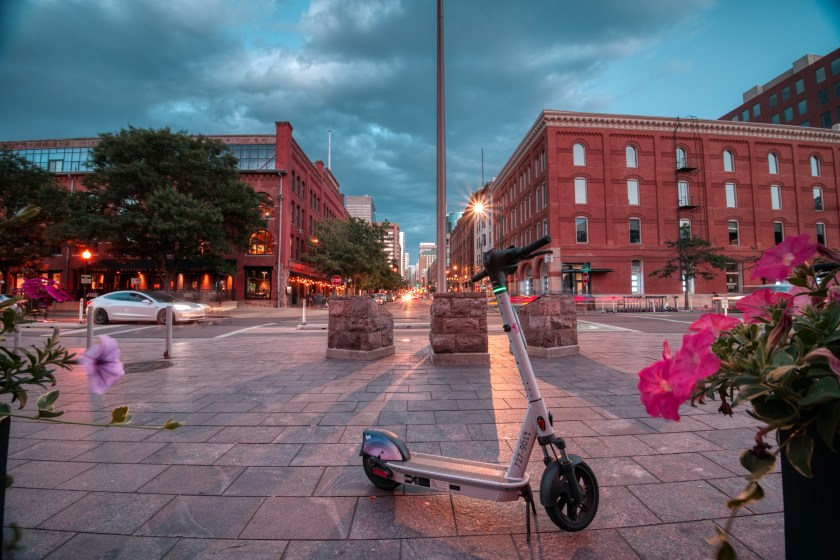
The photograph captures Denver’s Union Station, highlighting urban mobility through an electric scooter, symbolizing the modern sharing economy. Blending historic architecture and contemporary transit, it embodies Denver’s revitalization. The technical execution showcases skill in low-light conditions, emphasizing the cityscape’s complexity as part of Colorado’s evolving identity.

An electric scooter stands on a plaza at Denver Union Station, framed by brick buildings and evening traffic under a cloudy sky.
An electric scooter sits in the foreground near Denver Union Station as evening light and traffic move through downtown Denver.

In this street-level composition from Denver’s Union Station district, the photographer constructs a narrative about contemporary urban mobility that extends beyond mere documentation. The electric scooter, positioned prominently in the foreground, functions as both subject and symbol—a deliberate choice that anchors this image firmly in its specific cultural moment while engaging with the broader themes of his Colorado cityscapes chapter.

Shot with the Nikon Z5 and Nikkor 14-30mm wide-angle lens during the transitional blue hour, the image demonstrates technical command over challenging mixed-lighting conditions. His HDR processing through Aurora software balances the warm sodium vapor glow of street lamps with the cooler tones of approaching dusk, creating a color palette that feels authentic to the urban evening experience. The dramatic cloud formations overhead add atmospheric weight without overwhelming the architectural elements below.

The composition’s strength lies in its layered storytelling. The scooter occupies the immediate foreground, a symbol of the sharing economy and evolving transportation patterns that have reshaped American cities in recent years. Behind it, motion-blurred pedestrians and vehicle light trails suggest continuous movement—the perpetual flow of urban life. The red brick Victorian-era buildings flanking the street provide historical context, their solid permanence contrasting with the ephemeral nature of the modern transit device and the transient human figures.

This juxtaposition between historic preservation and contemporary innovation becomes the photograph’s central thesis. Denver’s Union Station neighborhood represents a successful urban revitalization, where nineteenth-century industrial architecture has been adapted for twenty-first-century use. The photographer captures this temporal complexity not through obvious before-and-after documentation, but through subtle visual relationships: old brick against new pavement, traditional street furniture against app-based transportation, architectural permanence against digital-age impermanence.

The wide-angle perspective creates dynamic leading lines through the paved plaza, drawing the viewer’s eye from the scooter through the middle ground and toward the vanishing point where downtown high-rises punctuate the skyline. Pink flowers frame the right edge, their organic forms softening the geometric rigor of the built environment while adding unexpected color that complements the warm building tones.

Within the context of Chapter 3’s exploration of Colorado landscapes and cityscapes, this image represents an important counterpoint to mountain vistas and natural panoramas. It acknowledges that Colorado’s contemporary identity includes rapidly growing urban centers navigating questions of density, mobility, and livability. The photographer treats the cityscape with the same observational care one might afford wilderness photography, suggesting that urban environments deserve equally thoughtful documentation.

The technical execution reflects growing proficiency with the Z5 system in low-light scenarios. The exposure balances bright highlights from street lamps and vehicle headlights while retaining shadow detail in the building facades and foreground elements. This dynamic range management, enhanced through HDR processing, avoids the artificial appearance that often compromises such techniques.

Ultimately, this photograph functions as cultural documentation—a moment preserved when electric scooters had become ubiquitous urban fixtures, when historic districts balanced preservation with progress, and when cities like Denver negotiated their identity between Western heritage and metropolitan aspiration. The photographer’s choice to include this image in his curated Top 100 Journey acknowledges that landscape photography can encompass the human-altered terrain of city streets, where the stories being told are equally complex and worthy of attention.