Downtown Denver Dance in the Streets with Nina Harrington

Nina Harrington’s dance pose in downtown Denver exemplifies a sophisticated blend of environmental portraiture and spontaneous movement. The photographer skillfully uses off-camera flash and a low angle to enhance the scene, revealing dynamic interplay between light, architecture, and the dancer’s grace. This image highlights the artist’s technical evolution in outdoor portrait work.

Dancer balancing on one foot along a yellow centerline in a city street, arms extended, with buildings lining both sides.
Nina Harrington performs a dance pose in the middle of a downtown Denver street.

In this striking urban portrait, the photographer demonstrates a sophisticated command of environmental portraiture, transforming a mundane city thoroughfare into a stage for dynamic human expression. The image captures dancer Nina Harrington suspended mid-leap above yellow road markings in downtown Denver, her body forming an elegant arc against the crisp Colorado sky. The composition exemplifies the photographer’s evolving approach to outdoor portrait work, where controlled lighting meets spontaneous movement in public spaces.

The technical execution reveals deliberate choices that elevate this beyond documentary street photography. Shot at midday—traditionally challenging lighting conditions—the photographer employed a Godox AD100 pro strobe without modification to combat the harsh overhead sun. This off-camera flash technique creates a subtle but crucial fill that prevents the subject from becoming a silhouette while maintaining the natural warmth of the ambient light. The decision to forgo light modifiers preserves the hard-edged quality of the urban environment, allowing the concrete, asphalt, and brick architecture to retain their textural integrity.

Compositionally, the low vantage point proves essential to the image’s impact. By positioning the camera near street level, the photographer achieves multiple objectives: the dancer’s figure dominates the frame against the sky, creating separation from the complex urban backdrop; the road’s yellow double lines converge dramatically toward the vanishing point, providing powerful leading lines that anchor the viewer’s eye; and the surrounding buildings—including the distinctive Paramount sign—frame the action without overwhelming it. This perspective transforms the ordinary into the theatrical.

The choice of the Nikkor 24-120mm f/4 lens suggests a working distance that allowed the subject freedom of movement while maintaining compositional control. The focal length appears moderate within that range, neither compressing the perspective dramatically nor exaggerating the spatial relationships. This middle-ground approach serves the narrative well, presenting the scene as the viewer might experience it while standing in that same intersection.

Within Chapter 4’s exploration of portraits created in studios, outdoor environments, and workshop settings, this photograph represents the photographer’s confidence in synthesizing multiple disciplines. The image incorporates studio lighting principles applied to an uncontrolled environment, the collaborative relationship between photographer and subject typical of workshop environments, and the opportunistic awareness required for successful street photography. The dancer’s athletic grace becomes a vehicle for exploring light, geometry, and decisive moment—themes that recur throughout his portraiture work.

The post-processing in Luminar AI enhances rather than transforms the captured scene. The color palette—dominated by blues, warm earth tones, and the vibrant yellow road markings—feels authentic to the high-altitude western light. There’s a clarity and dimensional quality to the image that suggests thoughtful tonal adjustments without the oversaturation or artificial drama that often plague urban photography.

What distinguishes this work within the photographer’s broader journey is the seamless integration of technical skill and artistic vision. The image requires split-second timing, precise exposure calculation, spatial awareness, and the ability to direct movement—all while working in a public street with its inherent unpredictability. That such complexity appears effortless in the final result speaks to the photographer’s maturation in outdoor portrait work, where preparation meets spontaneity in equal measure.
Convention Center Station: Urban Infrastructure as Light Study

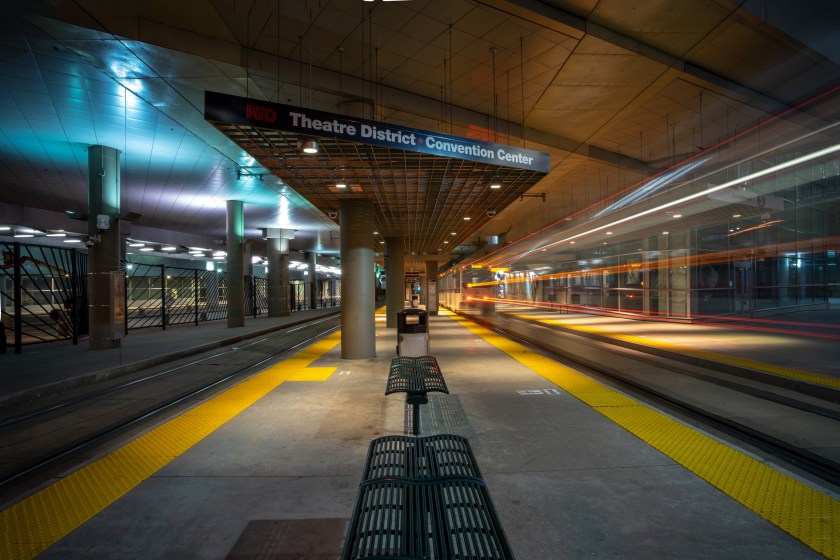
The photograph at Denver’s Convention Center RTD station captures an arriving light rail train through long exposure, emphasizing urban environments over natural landscapes. The technical choices create depth and contrast between warm light trails and cooler architectural tones. This piece illustrates Colorado’s identity, showcasing urban transit as significant as its natural vistas.

Text: Long exposure view of the RTD light rail platform at the Convention Center with blurred train lights in downtown Denver.
A long exposure captures an arriving RTD light rail train at the Convention Center station in downtown Denver, Colorado.

In the urban component of Chapter 3—Colorado Landscapes & Cityscapes—this long exposure photograph of Denver’s Convention Center RTD station marks a deliberate shift from natural subjects to the constructed environments that define contemporary Colorado life. The image captures a light rail train arriving at the platform, its motion rendered as luminous streaks of amber and red that cut through the architectural geometry of the underground station. This is urban photography that privileges process and temporal collapse over the decisive moment, transforming public transit infrastructure into an exercise in controlled abstraction.

The photographer’s technical approach is fundamental to the image’s success. Using a Sony A7ii paired with a Samyang 18mm wide-angle lens, he has embraced the distortions and expansiveness that such focal lengths provide. The wide angle compresses the station’s perspective while simultaneously stretching its architectural lines, creating a sense of depth that pulls the viewer’s eye from the central platform toward both vanishing points. The long exposure—likely several seconds given the degree of light trail elongation—allows the moving train to register as pure energy rather than solid form, a ghost of motion suspended within the static framework of concrete, steel, and tile.

Color plays a crucial structural role. The safety-yellow platform edges create strong horizontal bands that anchor the composition and provide visual weight at the bottom of the frame. These bright strips contrast sharply with the cooler tones dominating the upper portions—cyan-tinted fluorescent lighting that bathes the ceiling panels and creates atmospheric zones of cool illumination. The train’s light trails introduce warm amber tones that bridge these temperature extremes, serving as the compositional focal point despite their ethereal nature. The signage identifying the Theatre District/Convention Center stop glows in the upper third, grounding the image in specific geographic and civic context.

What distinguishes this work within the broader chapter is its commitment to representing Colorado’s urban character with the same attention previously devoted to its natural landscapes. Denver’s RTD system, as critical infrastructure connecting the metropolitan region, deserves documentation as much as any mountain vista or aspen grove. The photographer recognizes this and approaches the subject with seriousness of purpose. The empty platform—devoid of waiting passengers—allows the architecture and light to speak without human interruption, though the absence of people also raises questions about time of day, accessibility, and the photographer’s relationship to urban space during off-peak hours.

The symmetry is notable but not absolute. The central platform creates a strong vertical axis, reinforced by support columns and the overhead ceiling structure. Yet the composition retains enough asymmetry—particularly in the light trails and architectural details—to avoid static formalism. The textured platform surface, captured with clarity despite the low light conditions, provides tactile detail that prevents the image from becoming purely graphic.

Within a collection that spans Colorado’s diverse visual territories, this photograph asserts that the state’s identity includes its cities and their infrastructure. It is work that finds aesthetic potential in transit stations, that sees light trails as valid subjects alongside geological formations, and that expands the definition of landscape to include the spaces humans build for movement and connection.