Deadpool Lucha Libre: Chromatic Drama in Miniature

The photograph of a Marvel Lucha Libre Funko Pop Deadpool figure exemplifies a blend of commercial and fine art photography. Utilizing dramatic lighting and technical precision, it transforms a mass-produced collectible into a subject of contemplation. The piece reflects the cultural hybridity of its character, bridging traditional still life with contemporary themes.

Studio photograph of a Marvel Lucha Libre Deadpool Funko Pop figure standing on a reflective black surface against a dark background.
A studio still life of a Marvel Lucha Libre Funko Pop Deadpool figure posed on black acrylic.

Within Chapter 5’s exploration of tabletop still life—from classical arrangements to experimental departures—this photograph of the Marvel Lucha Libre Funko Pop! figure demonstrates the photographer’s command of dramatic lighting and his willingness to elevate commercial objects into subjects worthy of sustained contemplation. The piece functions as both technical exercise and cultural commentary, bridging the gap between traditional product photography and fine art still life.

The composition centers on El Chimichanga De La Muerte, the Deadpool variant rendered in the distinctive aesthetic of Mexican lucha libre wrestling. Against an uncompromising black void, the figure emerges through carefully controlled illumination that recalls the chiaroscuro techniques of Dutch Golden Age painting. The photographer has employed a Godox AD100 with gridded softbox to create a focused pool of light that caresses the figure’s surfaces while allowing the background to recede entirely. This technical choice—stark, theatrical, unforgiving—transforms what might have been simple documentation into something approaching portraiture.

The red and gold color palette dominates with painterly intensity. The matte finish of the vinyl catches light selectively, creating subtle gradations across the mask’s sculptural forms. Each stitch line in the figure’s costume becomes a shadow-casting element, adding textural complexity to what is, in reality, molded plastic. The photographer’s choice of the Tamron 35mm f/2.8 lens on his Sony A7II suggests a deliberate approach to depth and perspective—close enough to capture minute details, yet distant enough to maintain the figure’s proportional integrity and comic heroism.

What elevates this work within the chapter’s trajectory is its dialogue between high and low culture. Funko Pop! figures exist as mass-produced collectibles, yet the photographer treats this specimen with the reverence typically reserved for precious antiquities or fine crafts. The shirtless, muscular torso—absurdly rendered in the Funko aesthetic with its characteristic oversized head and simplified body—becomes an exercise in form and volume under his lighting scheme. The reflection on the glossy black surface beneath adds a layer of sophistication, grounding the floating figure in space while doubling its visual presence.

The image represents a contemporary evolution in still life photography where the distinction between commercial and fine art intentionally blurs. By applying gallery-level lighting techniques to a pop culture artifact, the photographer participates in a broader artistic conversation about value, nostalgia, and the objects we choose to collect and immortalize. The lucha libre variant itself carries layers of cultural hybridity—an American comic character filtered through Mexican wrestling tradition, then reimagined as a Japanese-influenced vinyl toy.

The technical execution is nearly flawless. Exposure is carefully balanced to preserve detail in both the deepest reds and the highlighted edges of the mask. The black background shows no distracting gradients or light spill, evidence of precise modifier control and post-processing restraint. This discipline allows the figure to exist in a realm of pure focus, removed from context yet somehow more present because of that isolation.

Within the broader context of Chapter 5’s examination of still life evolution, this photograph demonstrates how experimental approaches need not abandon classical principles. The work honors centuries of still life tradition while embracing decidedly modern subject matter, creating a bridge between photographic eras.

Morgan Silver Dollars: Texture, Time, and Monochromatic Study

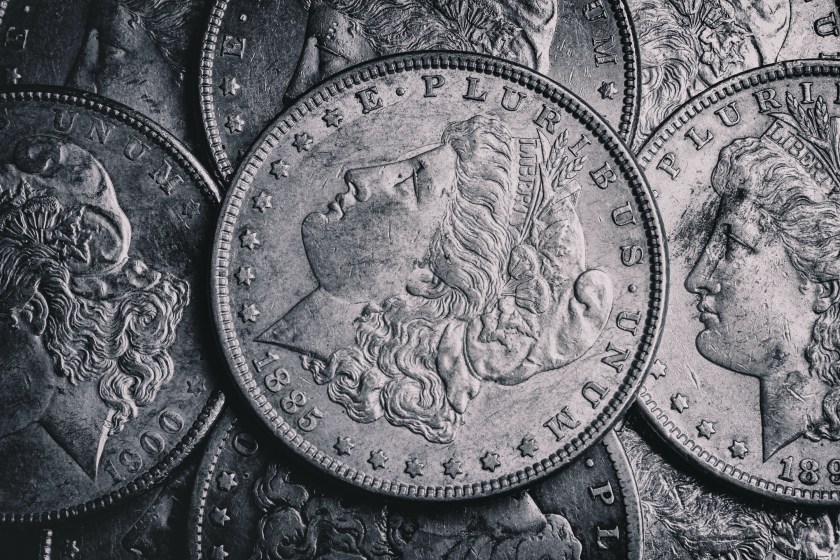
The photographed still life of overlapping late nineteenth-century Morgan silver dollars showcases a detailed exploration of numismatic design through macro photography. The monochromatic treatment emphasizes surface textures and historical nuances while controlled lighting enhances the sculptural qualities. This work merges traditional still life methodologies with contemporary techniques, documenting valuable artifacts within a modern context.

Close-up photograph of overlapping Morgan silver dollar coins showing worn engraved profiles and inscriptions.
A close-up still life of overlapping Morgan silver dollar coins from the late nineteenth century.

This monochromatic study of late nineteenth-century Morgan Silver Dollars represents the photographer’s deliberate expansion into controlled still life work, demonstrating how historical objects can serve as compelling subjects for formal exploration. The composition arranges multiple coins in overlapping layers, creating a topographical landscape of circular forms that invites close examination of surface detail, wear patterns, and the inherent sculptural qualities of numismatic design.

The technical approach centers on macro photography, executed with a Meike 85mm f/2.8 lens paired with his Sony A7ii system. This focal length and aperture combination allows for selective focus that emphasizes the central Morgan Dollar while surrounding coins recede into varying degrees of sharpness. The viewer’s eye naturally gravitates to the prominently featured coin displaying Liberty’s profile, her flowing hair rendered in remarkable relief detail. The inscription “E PLURIBUS UNUM” curves along the upper edge, each letter capturing light differently based on the coin’s worn topography—evidence of decades in circulation.

His conversion to black and white through Nik Silver Efex Pro proves particularly astute for this subject matter. The monochromatic treatment unifies the silver surfaces while accentuating tonal variations that reveal the coins’ individual histories. Scratches, patina, and areas of polish loss become visual information rather than mere damage. The grayscale palette also reinforces the historical nature of these artifacts, creating an aesthetic continuity between the coins’ era of origin and the contemporary photograph documenting them.

The lighting strategy deserves attention for its subtlety. Diffuse illumination reveals the bas-relief portraits and decorative elements without creating harsh specular highlights that might obscure detail or introduce unwanted contrast. Shadows between stacked coins provide dimensional information, suggesting weight and materiality. The photographer has avoided the common pitfall of overworking metallic surfaces, instead allowing the silver to speak through its natural reflective properties and acquired character.

Within Chapter 5’s framework examining still life photography from classic to experimental approaches, this work anchors itself firmly in traditional methodology. The arrangement recalls centuries of vanitas imagery where objects of commerce and temporal value serve as subjects for formal study. Yet the execution benefits from modern digital capture capabilities—the macro lens resolving minute surface textures that would challenge film-based systems, and post-processing software offering precise tonal control.

The choice to work with borrowed objects introduces an interesting collaborative element to his expanding still life practice. These coins carry not only their original historical context but also the contemporary narrative of a colleague’s collection—objects held, preserved, and valued by someone within his immediate circle. This transforms the exercise from pure technical study into a form of visual preservation, documenting specific artifacts at a particular moment in their continuing existence.

As an entry point into product and still life photography practiced within the domestic studio environment, this image succeeds in demonstrating foundational skills: controlled lighting, thoughtful composition, appropriate lens selection, and sensitive post-processing. The Morgan Dollars provide subject matter rich enough to reward close attention while remaining accessible—a practical choice for developing technical proficiency that yields aesthetically resolved results worthy of inclusion in his curated collection.

Big Daddy: Layered Depth in Contemporary Tabletop Composition

A focus-stacked image of a Funko Pop BioShock Big Daddy figure highlights the photographer’s skill in elevating a mass-market collectible to art. By mastering focus stacking and lighting techniques, he achieves hyperreal detail and visual analysis, suggesting aesthetic value exists beyond an object’s origins. This work bridges traditional and modern photography, emphasizing form and texture.

Studio photograph of a Funko Pop Big Daddy figure from BioShock, lit against a black background.
A focus-stacked studio image of a Funko Pop Games BioShock Big Daddy figure on black acrylic against a black backdrop.

In this striking tabletop study, the photographer transforms a mass-market collectible into a subject worthy of contemplated observation. The Funko Pop! Games Bioshock 65 figure—depicting the iconic Big Daddy character—emerges from absolute darkness with a presence that transcends its commercial origins. This work exemplifies the photographer’s evolving command of still life technique, demonstrating how contemporary imaging technology can elevate genre photography into something more architecturally precise and visually arresting.

The technical execution reveals a sophisticated understanding of focus stacking methodology. By compositing multiple exposures captured at incrementally adjusted focal planes, he has achieved a depth of field impossible through traditional single-exposure photography. Every riveted seam of the copper-toned diving helmet, each glowing porthole window, and the textured surfaces of the green atmospheric diving suit maintain perfect clarity throughout the frame. This exhaustive sharpness creates an almost hyperreal quality, allowing viewers to examine the figure with a scrutiny typically reserved for museum artifacts rather than vinyl toys.

His lighting strategy demonstrates restraint and intentionality. The stripbox and softbox configuration creates dimensional modeling that accentuates the sculptural qualities of the form. The warm metallic tones of the helmet and boots catch highlights that suggest weight and substance, while the darker green suit recedes appropriately into shadow. The signature yellow portholes glow with an internal luminosity, creating focal points that guide the eye through the composition. Against the black acrylic surface and backdrop, the figure exists in a void that emphasizes form over context—a classic gallery presentation strategy that isolates the subject for pure visual analysis.

Within the framework of Chapter 5’s exploration of tabletop photography from classic to experimental, this image occupies an interesting transitional space. The setup itself—studio lighting, controlled environment, careful composition—adheres to traditional still life conventions established over centuries of studio practice. Yet the technical execution, particularly the focus stacking process completed in Affinity Photo, represents distinctly contemporary capabilities. The photographer bridges historical methodology with digital innovation, creating work that honors tradition while exploiting modern tools.

The choice of subject matter also merits consideration. By photographing a figure from video game culture with the same technical rigor one might apply to antique objects or fine art pieces, he democratizes the still life genre. This approach suggests that aesthetic value exists independent of an object’s pedigree or market position. The Big Daddy, rendered with such meticulous attention, becomes a study in form, light, and texture—qualities inherent to all successful still life work regardless of subject provenance.

The reflection visible on the glossy black surface beneath the figure adds a subtle but important element of depth. This mirroring effect grounds the subject in space while maintaining the minimalist aesthetic. The overall composition reads as both technically accomplished and conceptually considered—a balance not always achieved in enthusiast tabletop work.

As part of his Top 100 Journey, this photograph represents his technical proficiency in a controlled environment, showcasing abilities that extend beyond spontaneous capture into the realm of constructed, considered image-making where patience and precision yield images of remarkable clarity and presence.

Anne-Elise

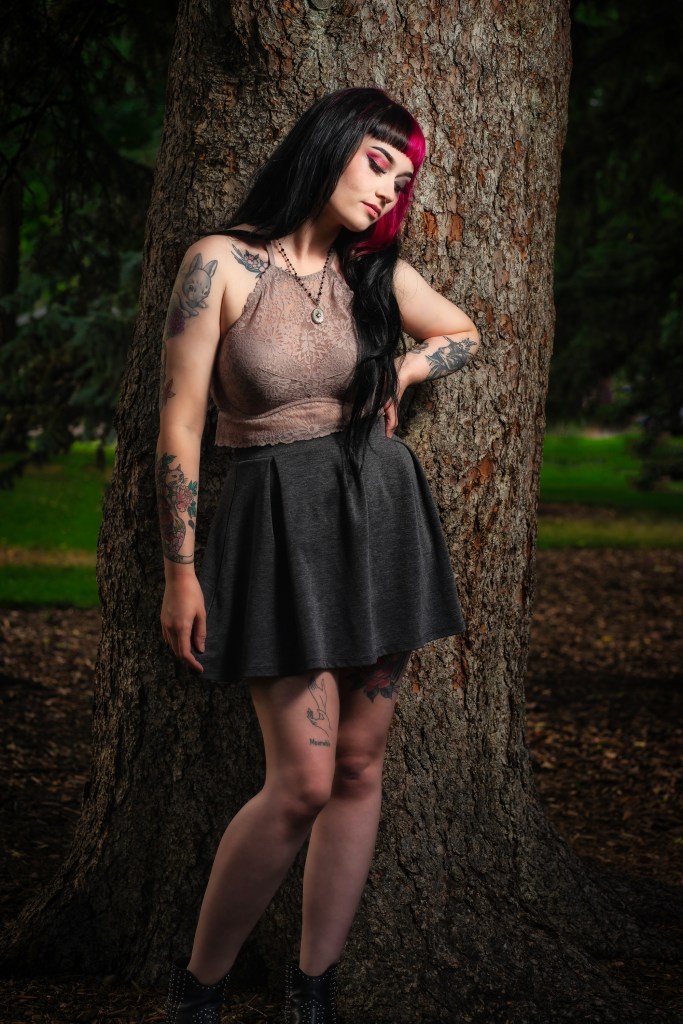
The portrait of Anne-Elise Chapman in City Park, Fort Collins, highlights the photographer’s skill in blending environmental portraiture with studio techniques. Utilizing careful lighting and composition, the image captures contrasts between natural and contemporary elements. The strategic use of color and texture enriches the narrative, showcasing technical excellence and artistic vision.

Woman with long dark hair and visible tattoos leaning against a large tree in a park, eyes closed, wearing a sleeveless top and skirt.
Anne-Elise Chapman stands against a tree in City Park, Fort Collins, Colorado.

This portrait exemplifies the photographer’s nuanced approach to environmental portraiture, where natural settings are transformed into outdoor studios through strategic lighting and compositional choices. Photographed in City Park, Fort Collins, the image presents the subject leaning against the textured bark of a mature tree, her contemplative pose and distinctive styling creating a study in contrasts between the organic and the contemporary, the natural and the cultivated.

The technical foundation reveals a methodical approach to outdoor flash photography. Working with a Sony A7ii and the respected 85mm f/1.8 lens—a classic portrait focal length that provides flattering perspective and subject isolation—the photographer employed a Godox V1s flash modified with a shoot-through umbrella. This diffusion choice proves critical to the image’s success. The softened light wraps around the subject’s features and form, preventing the harsh shadows that plague poorly executed outdoor flash work while maintaining directionality that provides dimension and depth. The lighting appears to originate from camera left, creating subtle modeling across the face and body that complements rather than competes with the ambient forest light.

The compositional structure demonstrates careful consideration of both subject and environment. The tree trunk functions as more than backdrop; it becomes an active element in the visual narrative, its rough, organic texture providing counterpoint to the smooth skin and fabric surfaces. The subject’s positioning—slightly offset from center, body angled, one hand resting naturally against the bark—creates a relaxed asymmetry that invites extended viewing. The visible tattoos become graphic elements within the composition, their dark forms echoing the patterns in the tree bark and adding layers of personal narrative to the environmental context.

Color relationships within the frame merit attention. The earthy tones of the subject’s outfit—muted rose and deep charcoal—harmonize with the brown and gray palette of the bark while maintaining sufficient contrast to ensure separation. The vivid magenta accent in the hair provides a calculated color note that draws the eye upward to the face, where the complementary makeup palette reinforces this focal point. The defocused green background, rendered as soft bokeh by the 85mm lens at apparent wide aperture, provides color balance without competing for attention.

Within Chapter 4’s exploration of portrait methodologies, this photograph demonstrates the photographer’s ability to translate studio lighting principles into outdoor contexts. The controlled light quality typically associated with indoor work here interacts with natural ambient illumination, creating a hybrid aesthetic that benefits from both approaches. The umbrella modification prevents the artificial quality that often characterizes outdoor flash photography, instead producing a luminosity that feels organic to the wooded setting while maintaining the precise control necessary for professional portraiture.

The post-processing in Luminar 4 enhances the image’s tonal sophistication without sacrificing naturalism. Skin tones remain truthful, the detail in both highlights and shadows suggests careful attention to dynamic range, and the overall color grading supports the slightly cinematic quality of the final image. There’s a refinement present that indicates maturity in the photographer’s workflow—the recognition that technical excellence serves artistic vision rather than existing as an end unto itself.

This portrait represents a convergence of skills developed across multiple photographic disciplines: the lighting control of studio work, the adaptability required for location shooting, and the interpersonal dynamics essential to capturing authentic moments within directed sessions.

Kelly

PKelly R. Bienfang’s studio portrait captures the essence of minimalist photography, focusing on the subject against a clean white backdrop. Utilizing controlled lighting and strategic posing, the image showcases the photographer’s skill and adaptability. It highlights the evolving rapport between photographer and subject, emphasizing the importance of genuine collaboration in achieving impactful portraits.

Woman with long light brown hair posing against a white background, one arm raised to her head, wearing a sleeveless top.
PKelly R. Bienfang poses during a studio portrait session in Fort Collins, Colorado.

This portrait from Chapter 4 of Greg Urbano’s Top 100 Journey exemplifies the photographer’s refined approach to studio portraiture, demonstrating how minimalist environments and controlled lighting can distill a subject’s presence to its essential elements. Captured at Old Town Yoga in downtown Fort Collins, Colorado, the image reveals the photographer’s ability to transform functional spaces into effective portrait studios, a skill central to the chapter’s exploration of diverse shooting contexts.

The composition centers on the subject, Kelly, photographed against a pure white backdrop that eliminates all contextual information, focusing attention entirely on her form, expression, and movement. Her pose—arm raised to gather flowing hair, head tilted, gaze directed toward the camera—suggests a moment caught between deliberate positioning and natural gesture. The wind-swept quality of her hair introduces dynamic motion into an otherwise static studio setup, creating visual energy that prevents the portrait from settling into conventional headshot territory.

The photographer’s technical execution demonstrates consistent mastery of the equipment established throughout this chapter. Working with the Sony A7ii and 85mm f/1.8 lens, supplemented by a Godox V1s flash modified through a shoot-through umbrella, he has created illumination that reads as both bright and dimensioned. The lighting wraps evenly across the subject’s features while maintaining sufficient shadow information to model her facial structure and the curves of her shoulders and arms. The high-key approach—white background, luminous skin tones—requires precise exposure control to prevent blown highlights while retaining textural detail in hair and fabric.

Color becomes a critical compositional element in this reduced visual field. The deep burgundy of Kelly’s garment provides the primary chromatic accent against the neutral backdrop and warm skin tones, creating a complementary relationship that anchors the eye. The photographer has allowed the subject’s honey-blonde hair to cascade freely, its varied tones adding subtle complexity to the upper portion of the frame. Post-processing in Luminar 4 has yielded clean, commercial-quality results—polished without appearing artificial, enhanced without sacrificing the authentic quality of skin and texture.

Within the broader context of Chapter 4, this photograph represents the studio portrait in its most distilled form. While other works in this series incorporate environmental elements or natural light scenarios, this image strips away such variables to focus purely on subject, light, and photographer’s vision. The setting at Old Town Yoga—likely chosen for its available space and clean backgrounds rather than thematic connection—underscores the photographer’s adaptability, his capacity to identify and utilize whatever resources a location offers.

The portrait also reflects evolving confidence in direction and collaboration. The pose suggests active guidance rather than passive documentation, indicating the photographer’s growing comfort in shaping rather than merely recording moments. Kelly’s ease before the camera—the natural grace of her gesture, the direct engagement of her gaze—speaks to successful rapport between photographer and subject, that intangible but essential element of portrait work that transcends technical proficiency.

This image stands as evidence of the photographer’s progression toward professional fluency in controlled portrait environments, demonstrating that compelling imagery emerges not from elaborate setups but from clear vision executed with precision.

Joy

Joy’s portraiture, captured during a studio session in Denver, exemplifies contemporary photography that harmonizes technical prowess with intimate atmosphere. Using controlled lighting and thoughtful composition, the image showcases Joy’s comfort and presence. It reflects the photographer’s growth in creating authentic portrayals within collaborative workshop settings, emphasizing spontaneity amidst structure.

Woman lies on her stomach on a bed with pillows, looking toward the camera in a softly lit indoor space.
Joy reclines on a bed during a studio session at Headquarters in Denver, Colorado.

Within Chapter 4 of Greg Urbano’s Top 100 Journey—a section dedicated to studio, outdoor, and workshop portraiture—this photograph stands as a compelling study in contemporary portraiture that balances technical precision with an atmosphere of relaxed intimacy. Captured during the Sunday Night Meets sessions at the Headquarters in Denver, Colorado, the image demonstrates the photographer’s evolving command of controlled lighting environments and his ability to translate spontaneity into refined compositional structure.

The subject, identified simply as Joy, reclines across a bed adorned with an array of textured pillows in warm earth tones—burnt orange, cream, and cognac leather—that create a sophisticated color palette against crisp white linens. Her pose suggests ease and self-possession, legs bent upward, body stretched diagonally across the frame in a manner that fills the space without appearing contrived. The composition guides the viewer’s eye from her contemplative expression through the length of her form, utilizing the diagonal as a classical device to create visual momentum within an otherwise still domestic scene.

Technically, the photographer employed a Sony A7ii paired with an 85mm f/1.8 lens, supplemented by a Godox V1s flash fired through a shoot-through umbrella. This setup reveals a deliberate approach to managing the challenge of interior lighting. The umbrella modifier produces soft, directional illumination that wraps around the subject’s features and limbs, creating gentle gradations of shadow that model form without harsh contrast. The 85mm focal length, a portrait standard, maintains proper perspective while allowing sufficient working distance in what appears to be a modest interior space. The choice to augment available window light with flash demonstrates an understanding that control, rather than pure naturalism, often serves the portrait best.

The environmental context—a workshop setting where photographers gather to practice and experiment—adds significance to the technical choices evident here. Such collaborative sessions demand efficiency and adaptability, requiring the photographer to balance artistic vision with the practical constraints of shared time and space. That this image emerged from such circumstances speaks to his ability to synthesize technical preparation with responsive observation, recognizing and capturing moments of genuine presence even within structured shooting scenarios.

Post-processing in Skylum’s Luminar 4 has yielded a polished yet authentic aesthetic. The skin tones register warmly against the cooler neutrals of the background, while the overall color grading maintains consistency with the chapter’s broader visual language. The photographer has avoided the temptation toward heavy manipulation, instead allowing the fundamental strength of the capture—lighting, composition, and subject rapport—to carry the image.

Within the trajectory of Chapter 4, this photograph represents the photographer’s progression from purely technical competency toward a more holistic understanding of portraiture as collaborative performance. The subject’s comfort before the camera, the thoughtfully curated environment, and the measured application of artificial light combine to create an image that feels both intentional and uncontrived. It exemplifies the workshop paradigm at its most productive: controlled conditions that paradoxically enable spontaneity, resulting in portraiture that documents not just appearance, but a quality of presence that transcends the specifics of its making.

Mike Groth: Classical Studio Portraiture and the Language of Formality

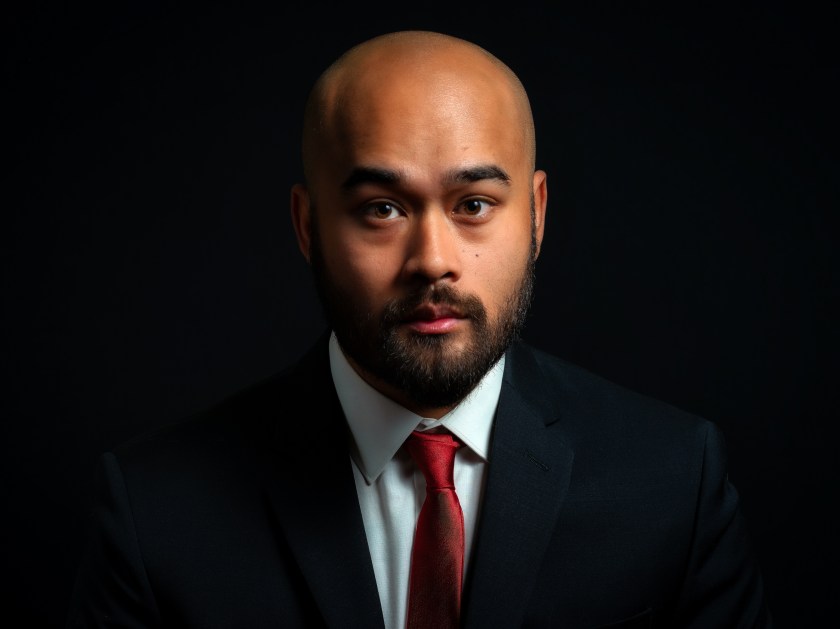
Mike Groth’s studio portrait, featured in Chapter 4 of the Top 100 Journey, exemplifies traditional portraiture through controlled lighting and composition. Shot at Old Town Yoga Studio, the image focuses on character and presence, utilizing a classic backdrop and professional techniques. Its formal simplicity highlights the subject’s confidence, making it versatile across various contexts.

Bald man with a beard wearing a suit and red tie looks directly at the camera against a black background.
Mike Groth is photographed in a studio portrait at Old Town Yoga Studio in Fort Collins, Colorado.

Within Chapter 4 of the photographer’s Top 100 Journey, this portrait of Mike Groth represents a return to the foundational principles of studio portraiture—controlled lighting, deliberate composition, and the timeless formality of traditional headshot aesthetics. Shot at the Old Town Yoga Studio in Fort Collins, Colorado, the image demonstrates the photographer’s facility with classic studio techniques while exploring the psychological dimensions of formal masculine presentation.

The technical execution adheres to established conventions of corporate and editorial portraiture. Utilizing a Sony A7ii with an 85mm f/1.8 lens, the photographer has positioned his subject against a pure black backdrop, eliminating all environmental context to focus entirely on character and presence. A Godox V1s flash paired with a shoot-through umbrella provides the primary illumination—a traditional modifier choice that produces soft, diffused light with gentle shadow gradation across the subject’s features. This approach creates dimensional modeling without the harsh contrast of direct flash, revealing the contours of the face while maintaining a polished, professional quality.

The composition centers the subject in a classical three-quarter view, shoulders angled slightly to create visual interest while the face turns toward the camera. This positioning—neither fully frontal nor profile—has been a cornerstone of portraiture since the Renaissance, offering both dimensionality and direct engagement. The subject’s formal attire—dark suit, white shirt, burgundy tie—reinforces the traditional corporate aesthetic, while his neutral expression and direct gaze suggest confidence tempered with approachability.

What distinguishes this work within the photographer’s broader practice is its embrace of restraint. Where other images in Chapter 4 explore environmental integration and spontaneous moments, this portrait strips away context to examine how lighting, posture, and expression alone can convey character. The black void backdrop functions not merely as a neutral background but as an active element, creating psychological weight and directing all attention to the subtle details: the catch lights in the eyes, the texture of facial hair, the precise fall of shadow along the jawline.

The post-processing in Luminar 4 maintains the studio’s carefully controlled atmosphere. Skin tones are rendered with natural warmth while preserving texture and detail. The lighting reveals itself as directional yet forgiving, highlighting the subject’s facial structure without creating unflattering shadows. This balance between revelation and flattery characterizes effective professional portraiture—honest without being harsh, polished without appearing artificial.

Within the context of Chapter 4’s mission to document studio, outdoor, and workshop methodologies, this image anchors the studio component with particular authority. It demonstrates that contemporary portrait photography need not abandon classical techniques in pursuit of innovation. The photographer’s choice to work within established conventions reflects an understanding that certain approaches endure precisely because they succeed in their essential task: revealing the subject’s presence and character with clarity and dignity.

The formal simplicity of this portrait allows it to function across multiple contexts—editorial, corporate, archival. This versatility speaks to the photographer’s understanding of portraiture not merely as artistic expression but as functional communication. As part of the Top 100 Journey, the image represents a technical benchmark, showcasing the fundamental competencies upon which more experimental work can build. It is portraiture in its most distilled form: light, subject, and the photographer’s ability to orchestrate their interaction with precision and purpose.