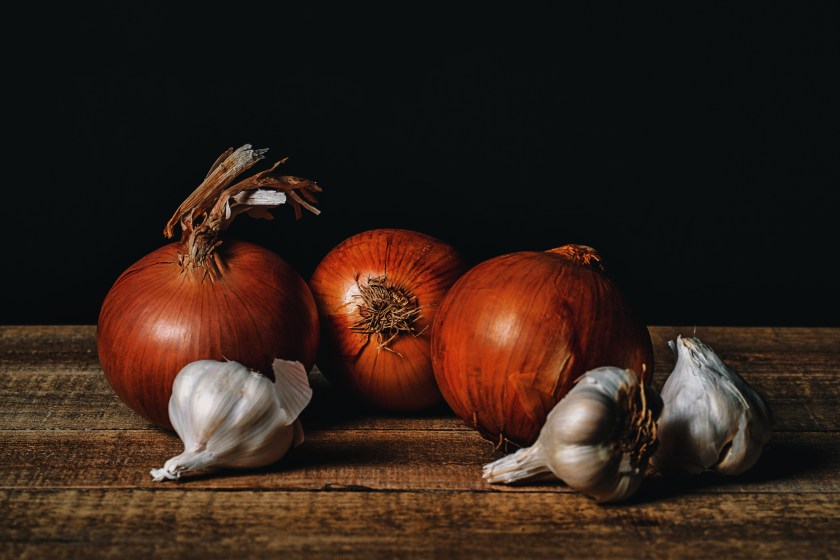
Onions and Garlic: A Study in Chiaroscuro and Culinary Stillness

The photograph captures a still life of onions and garlic on a wooden surface, showcasing classical principles through contemporary techniques. The controlled lighting and asymmetrical balance create depth, while post-processing enhances tonal richness. This artwork engages with historical traditions, revealing how ordinary subjects can convey significant meaning through careful observation and technical precision.

Tabletop still life of whole onions and garlic bulbs arranged on a wooden surface against a dark background.
A tabletop still life of onions and garlic arranged on a wooden surface and lit against a dark background.

In this deliberate composition, the photographer demonstrates a mastery of classical still life principles while working within the constraints of contemporary digital tools. The image presents three bronze-skinned onions accompanied by two heads of garlic, arranged on weathered wood against an impenetrable black void—a setup that immediately recalls the Dutch and Spanish still life traditions of the 17th century, where humble kitchen subjects were elevated to objects of contemplation.

The technical execution reveals a sophisticated understanding of light modulation. Working with a single modified light source—a Godox V1s paired with a softbox and grid—the photographer has created a tightly controlled illumination that wraps around the subjects’ curved surfaces while maintaining crisp shadow definition. The grid attachment proves essential here, preventing light spill into the background and preserving the dramatic contrast that gives the image its gravitas. This economy of means, using just one light to achieve such dimensional modeling, speaks to both practical skill and aesthetic intentionality.

What distinguishes this work within Chapter 5’s progression from classic to experimental tabletop photography is its conscious dialogue with art historical precedent. The photographer acknowledges drawing inspiration from a tutorial source, yet the resulting image transcends mere technical exercise. The onions’ papery skins catch light with a luminosity that suggests both fragility and age, their dried stalks creating gestural elements that break the otherwise spherical regularity. The garlic bulbs, positioned in the lower quadrant, provide tonal counterpoint—their pearl-white surfaces reflecting light with greater intensity than the warmer onions above.

The compositional arrangement follows classical principles of asymmetrical balance. The three onions occupy distinct spatial planes, their positioning creating depth through overlapping forms and subtle scale variation. The leftmost onion’s dramatic upward-reaching stem introduces vertical energy, while the garlic anchors the composition’s base. This triangular organization guides the viewer’s eye through the frame in a measured, contemplative rhythm appropriate to the subject matter.

Post-processing choices, implemented through color grading in Luminar 4, enhance the image’s tonal richness without sacrificing naturalism. The warm amber-to-sienna palette suggests candlelight or late afternoon sun, though the lighting setup confirms neither. This ambiguity of light source contributes to the image’s timeless quality—it could as easily have been captured in a 17th-century Dutch kitchen as in a contemporary studio.

The weathered wooden surface provides crucial textural contrast to the subjects’ organic forms. Its rough grain and worn patina introduce narrative suggestions of use and time, transforming a simple backdrop into an active compositional element. The wood’s horizontal planking creates subtle linear structure beneath the curved biological forms above.

Within the broader context of this chapter’s exploration, this photograph occupies the “classic” end of the spectrum—demonstrating that traditional approaches retain their power when executed with technical precision and compositional intelligence. The work proves that experimentation need not always mean formal rupture; sometimes it involves mining established vocabularies with fresh attention. Here, the photographer engages in a centuries-old conversation about how light reveals form, how arrangement creates meaning, and how the ordinary, when carefully observed, achieves a quiet monumentality that rewards sustained viewing.

City Pier on Anna Maria Island: A Study in Patience and Atmospheric Drama

The long exposure photograph of the City Pier on Anna Maria Island captures the unique interplay of land, water, and sky under dramatic storm clouds. Through technical mastery, the image transforms fleeting moments into timelessness, blending sharp details of the pier with ethereal human figures and smooth water, reflecting deep engagement with Florida’s coastal landscapes.

Long exposure photograph of the City Pier on Anna Maria Island, showing a wooden pier leading to a waterfront building under dark storm clouds.
Long exposure view of the City Pier on Anna Maria Island beneath dramatic storm clouds.

Within the photographer’s carefully curated Top 100 Journey, this long exposure study of the City Pier on Anna Maria Island stands as a masterful example of how technical discipline can amplify emotional resonance. Positioned within Chapter 2—Florida Landscapes & Cityscapes—the image demonstrates a sophisticated understanding of the Gulf Coast’s unique visual character, where land, water, and sky exist in constant, subtle negotiation.

The composition reveals itself through classical simplicity: a weathered wooden pier extends from foreground to middle distance, leading the viewer’s eye toward a modest building crowned with an American flag. Yet what elevates this photograph beyond documentary record is the photographer’s deliberate manipulation of time itself. Shot with a fifteen-second exposure at f/18, the image transforms fleeting atmospheric conditions into something more permanent and contemplative. The threatening cloud formations above, rather than appearing frozen in mid-motion, achieve a painterly quality—their movement compressed and softened into bands of gray and white that suggest both weight and ethereality.

This temporal expansion creates a fascinating duality throughout the frame. While the pier’s wooden planks remain sharp and detailed, bearing the textural evidence of salt air and countless footfalls, the human figures near the building dissolve into ghostly presences, their individual identities surrendered to the longer rhythm of place. The water, too, undergoes transformation; what would typically appear as distinct waves and surface texture becomes a smooth, almost metallic gradient stretching from jade green to soft gray, merging seamlessly with the horizon.

The technical execution here deserves careful consideration. Working with a Nikon D610 and an 18-35mm lens set to 35mm, the photographer has achieved remarkable sharpness across the entire frame. The f/18 aperture ensures deep depth of field while the ISO 100 setting maintains clean tonal gradations essential for the image’s subtle atmospheric rendering. These choices reflect not mere technical competence but aesthetic intention—a desire to capture both concrete detail and ephemeral mood simultaneously.

Within the broader context of Chapter 2, this photograph exemplifies the photographer’s evolving relationship with Florida’s coastal environments. Where lesser practitioners might seek the obvious drama of golden hour or storm-tossed seas, he finds complexity in overcast conditions and the patient observation they demand. The image refuses easy categorization: it is neither purely documentary nor overtly romantic, but occupies a thoughtful middle ground where observation and interpretation merge.

The architectural elements—particularly the modest pier building with its peaked roof and practical design—anchor the composition in specificity while the long exposure technique universalizes the experience. This is simultaneously a portrait of a particular place and a meditation on impermanence, on how human structures persist while human presence itself becomes fluid and uncertain.

As part of a long-term project, this photograph suggests an artist committed to deep engagement rather than superficial tourism. The willingness to wait for proper atmospheric conditions, to set up the necessary equipment for extended exposures, and to see beyond the immediate toward something more contemplative marks this as serious photographic inquiry. Within his Top 100 Journey, it stands as evidence that Florida’s landscapes, often dismissed as visually unchallenging, reward patient observation with unexpected subtlety and depth.